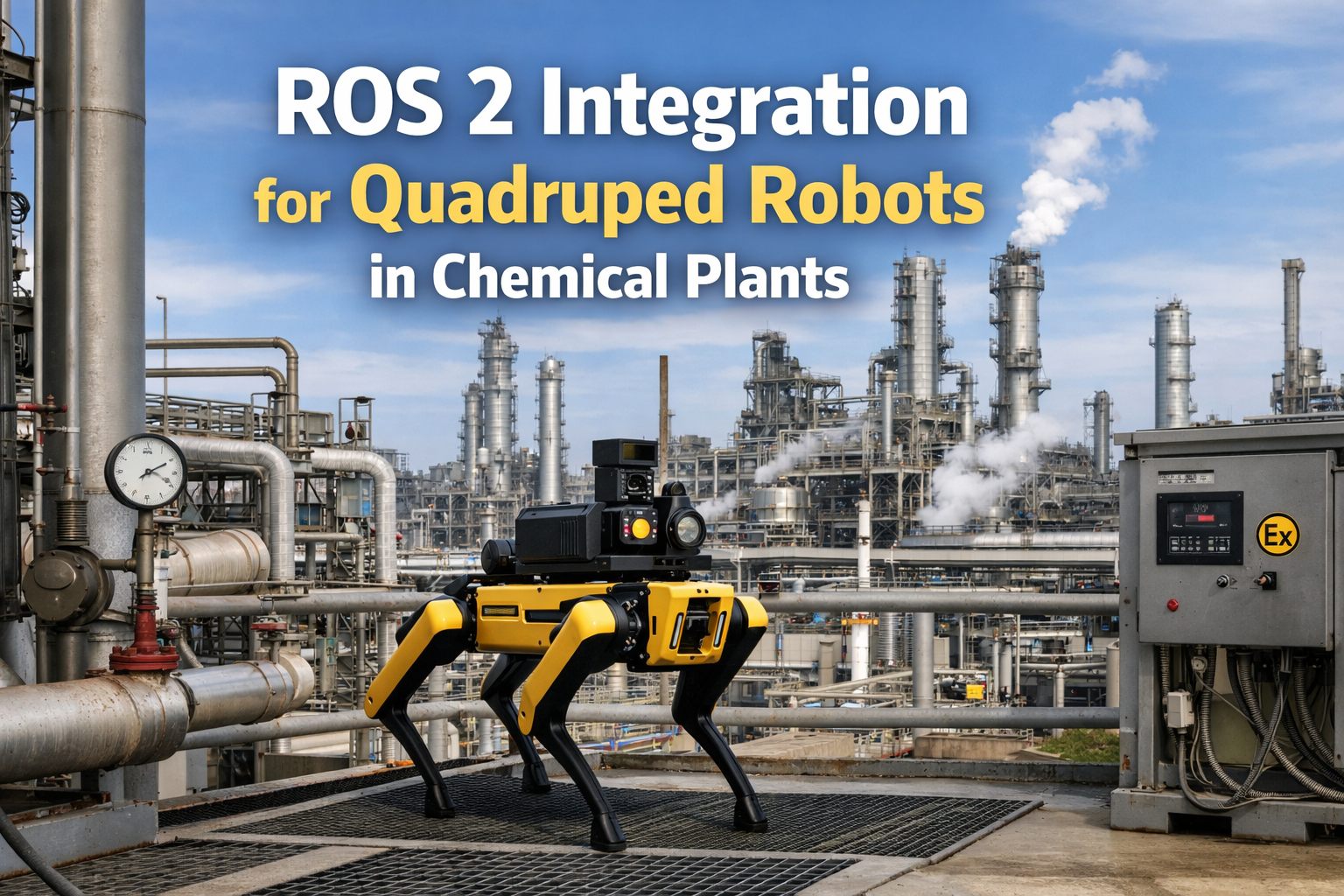
Your chemical plant runs 8,760 hours a year. Your inspection team covers maybe 2% of that — walking the same routes, checking the same gauges, missing the same blind spots. Meanwhile, one undetected flange leak or bearing failure triggers an unplanned shutdown costing $260,000 to $2 million per incident. In 2026, over 41% of large industrial enterprises are already piloting quadruped robots for routine inspections. The question is no longer whether robot inspection works — it is whether you can afford to keep doing it the old way.
$20 Billion
Per Year
Lost to unplanned downtime in chemical manufacturing alone
— Aberdeen Group / IIoT World Industry Report
41%
of large industrial plants now piloting quadruped robots for inspection
$200K+
annual savings per robot from early failure detection
12 mo
average ROI payback on inspection robot deployments
Why Chemical Plants Need Quadruped Robots — Not Just Any Robot
Chemical facilities are uniquely hostile environments. Corrosive vapors, explosive atmospheres, multi-level pipe racks, grated walkways, and confined spaces make them impossible for wheeled robots and dangerous for daily human rounds. Quadruped robots solve problems no other platform can:
✗ 2-4 hours per round, 1-2 rounds per shift
✗ Human fatigue limits detection accuracy after 45 minutes
✗ Cannot enter IDLH zones without full SCBA gear and buddy system
✗ No consistent thermal or acoustic baseline data
✗ Paper-based records prone to errors and delays
✓ 24/7 autonomous patrols with automated recharging
✓ Thermal, acoustic, gas, and visual sensors — superhuman detection
✓ ATEX/IECEx Zone 1 certified models for explosive atmospheres
✓ Consistent baselines enable trend analysis and anomaly detection
✓ Findings auto-upload to CMMS with photos and location data
Already considering a robot pilot? Talk to our deployment specialists to integrate robotic inspection data directly into your maintenance workflows.
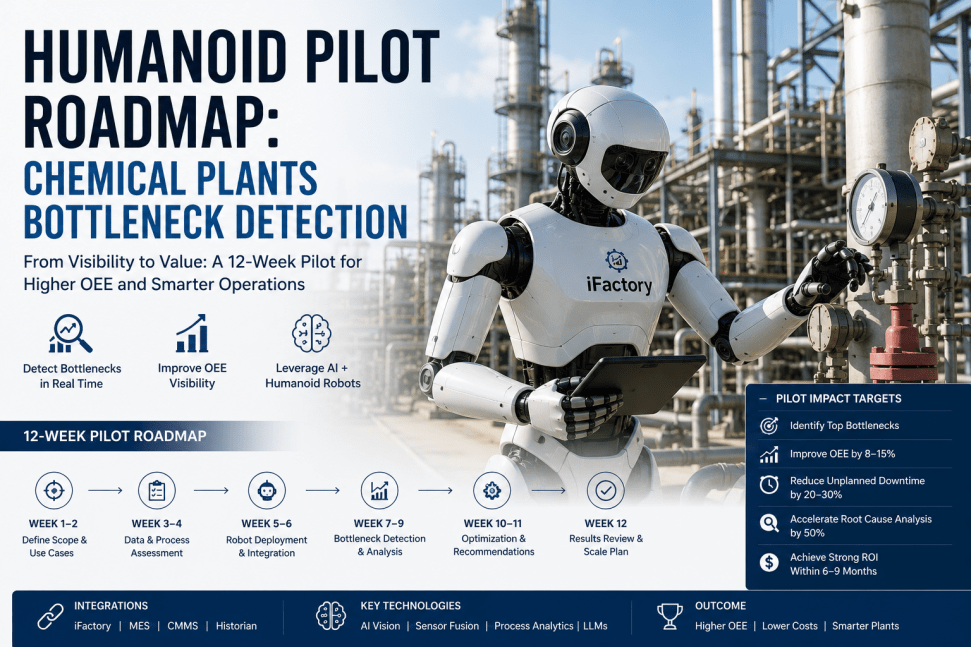
The 4-Phase Pilot Deployment Framework
Successful chemical plant robot pilots follow a structured rollout. Skipping phases is why 30% of pilots fail to scale. Here is the framework used by BASF, Shell, and Equinor to go from proof-of-concept to plant-wide deployment:
Assessment & Scoping
Map high-value inspection routes and hazardous zones
Identify 3-5 critical assets with history of unplanned failures
Define pilot KPIs: anomalies detected, inspection coverage, MTBF impact
Assess ATEX/IECEx zone requirements and robot certification needs
Key Deliverable:
Pilot scope document with ROI baseline metrics
Controlled Deployment
Deploy robot on single patrol route with manual oversight
Calibrate sensor thresholds against known-good equipment
Integrate data pipeline with CMMS for auto work order creation
Train 2-3 operators on robot handling and mission configuration
Key Deliverable:
First anomaly detection with validated CMMS work order
Validation & Optimization
Expand to 3-5 patrol routes covering priority equipment
Compare robot-detected anomalies against manual inspection findings
Measure reduction in unplanned downtime incidents
Document ROI data: prevented failures, labor reallocation, safety metrics
Key Deliverable:
ROI validation report with scale-up recommendation
Scale & Integrate
Deploy additional robots or expand route coverage plant-wide
Integrate with digital twin and predictive maintenance models
Automate reporting dashboards for plant leadership
Establish continuous improvement loop: route optimization, sensor upgrades
Key Deliverable:
Plant-wide autonomous inspection program
Track Every Phase From One Dashboard
iFactory's Pilot Performance Dashboard tracks anomalies detected, inspection coverage, work orders generated, and ROI metrics in real time — giving you the data to prove value and justify scale-up.
CAPEX vs. OPEX: The Real Investment Breakdown
The biggest objection to robot pilots is upfront cost. Here is the transparent financial picture — and why the numbers overwhelmingly favor deployment:
Quadruped robot (Ex-certified)
$75,000 – $150,000
Sensor payload (thermal + acoustic + gas)
$25,000 – $57,000
Autonomous docking station
$8,000 – $15,000
Site mapping & route programming
$10,000 – $20,000
CMMS integration & data pipeline
$5,000 – $15,000
Total CAPEX
$123,000 – $257,000
Software license & AI analytics
$18,000 – $36,000
Maintenance & calibration
$8,000 – $15,000
CMMS platform (iFactory)
$3,600 – $9,600
Operator training (refresher)
$2,000 – $5,000
Battery & component replacements
$3,000 – $6,000
Total Annual OPEX
$34,600 – $71,600
Robot-as-a-Service (RaaS) Option
Prefer OPEX-only? Many vendors now offer RaaS models starting at $4,000-$8,000/month — converting the entire investment to a predictable operating expense with no CAPEX approval delays, included maintenance, and the flexibility to scale or exit.
ROI Calculator: What One Prevented Failure Saves You
Cost of One Unplanned Shutdown
Lost production (avg $100K/hour × 8 hrs)
$800,000
Emergency repair & parts
$150,000
Environmental cleanup & compliance
$50,000
Regulatory fines (EPA/OSHA)
$25,000+
Single Incident Total
$1,025,000+
VS
Cost of Preventing That Failure
Robot patrol detects thermal anomaly
$0
CMMS auto-generates work order
$0
Scheduled repair during planned outage
$12,000
Parts ordered at standard pricing
$8,000
Planned Repair Total
$20,000
Net Savings Per Prevented Incident
$1,000,000+
One single prevented shutdown pays for the entire pilot — robot, sensors, integration, and first year of operations
Want to run these numbers for your specific facility? Book a free ROI analysis with our chemical plant specialists.
What the Robot Actually Detects — And What Humans Miss
Chemical plant quadruped robots carry multi-sensor payloads that capture data across four dimensions simultaneously. Here is what a single autonomous patrol delivers:
Infrared cameras detect temperature anomalies in bearings, motors, electrical connections, pipe insulation, and steam traps — identifying failures 2-6 weeks before they cause shutdowns.
Hot bearings
Insulation gaps
Electrical faults
Steam trap failures
Ultrasonic sensors detect high-frequency sounds from compressed air leaks, valve seat erosion, and bearing wear — problems invisible to human ears that cost chemical plants thousands per day in wasted energy.
Air leaks
Valve erosion
Pump cavitation
Bearing defects
Onboard gas sensors continuously monitor for VOCs, H₂S, ammonia, chlorine, and combustible gases — providing real-time leak detection that protects both workers and compliance standing.
VOC leaks
H₂S detection
Ammonia plumes
LEL monitoring
High-resolution cameras with AI recognition read analog gauges, detect corrosion, identify missing bolts, check valve positions, and flag safety hazards — with repeatable accuracy no human inspector can match.
Gauge readings
Corrosion spots
Valve positions
Safety violations
Turn Robot Findings Into Instant Work Orders
When the robot detects a thermal anomaly or gas leak, iFactory automatically creates a prioritized work order with photos, GPS location, severity rating, and recommended actions — no manual data entry required.
Pilot KPIs: What to Measure and When
Inspection Points Per Day
50-100 (manual)
500-800 (robot)
CMMS inspection log count
Anomalies Detected Monthly
5-10 (human rounds)
25-60 (multi-sensor)
iFactory anomaly dashboard
Unplanned Downtime Events
2-4 per quarter
0-1 per quarter
Production system records
Mean Time Between Failures
Facility baseline
+30-50% improvement
CMMS asset reliability reports
Human Exposure Hours in Hazardous Zones
120-200 hrs/month
20-40 hrs/month
Safety management system
Work Order Response Time
4-24 hours (manual)
<1 hour (auto-generated)
CMMS work order timestamps
Who's Already Doing This: Industry Leaders
BASF
Testing ANYmal quadruped robots at chemical plants, gathering visual, thermal, and acoustic data of equipment across production units.
Shell
Deployed Spot and ANYmal robots across refineries and chemical facilities for autonomous gauge reading, leak detection, and safety patrols.
Equinor
Using explosion-proof quadruped robots for offshore and chemical operations, reducing human entry into hazardous zones by over 60%.
BP
Spot robots autonomously read gauges, monitor corrosion, and measure methane on rigs and chemical processing operations in the Gulf of Mexico.
"Industrial inspection robots like Spot are one of the most cost-effective options for scaling predictive maintenance — reducing both barriers to entry and ongoing costs. A typical inspection mission can include hundreds of inspection points. Customers are achieving ROI in just over a year, and sometimes significantly faster."
— Boston Dynamics, Calculating the Financial Benefits of Robotics Investments
Frequently Asked Questions
How much does a quadruped robot pilot cost for a chemical plant?
A complete pilot including an explosion-proof quadruped robot, sensor payload, docking station, site mapping, and CMMS integration typically runs $123,000 to $257,000 in CAPEX with $35,000-$72,000 in annual OPEX. Robot-as-a-Service models are also available starting at $4,000-$8,000 per month, converting the entire investment to operating expense. One prevented unplanned shutdown — which averages over $1 million in chemical manufacturing — pays for the entire pilot.
Can quadruped robots operate in explosive atmospheres?
Yes. The ANYbotics ANYmal X is the first commercially available quadruped robot with ATEX/IECEx Zone 1 certification, meaning it can operate in areas where explosive gas mixtures are present during normal operations. BASF, Shell, and Equinor have all deployed these robots in active petrochemical environments. Standard models like Boston Dynamics Spot are rated for general industrial use but require non-explosive zone designation.
How does robot inspection data integrate with our existing CMMS?
Modern quadruped platforms upload inspection findings via API directly to CMMS platforms like iFactory. When the robot detects an anomaly — a thermal hot spot, gas leak, or abnormal gauge reading — it automatically creates a work order with diagnostic photos, GPS coordinates, severity classification, and recommended actions. This eliminates manual data entry and ensures every finding gets tracked through to resolution.
What is the typical ROI timeline for a chemical plant robot pilot?
Most deployments achieve ROI within 12 months. Given that a single unplanned shutdown in chemical manufacturing costs $260,000 to $2 million, even one prevented incident justifies the entire pilot investment. Ongoing savings from reduced human hazard exposure, increased inspection coverage, and earlier anomaly detection compound over time — with mature deployments saving $200,000+ annually per robot.
How long does it take to deploy a quadruped robot pilot?
Using the 4-phase framework, a chemical plant can go from assessment to validated pilot results in approximately 20 weeks. Phase 1 (assessment and scoping) takes 4 weeks, Phase 2 (controlled deployment) takes 6 weeks, Phase 3 (validation and optimization) takes 10 weeks, and Phase 4 (scale-up) begins around week 21. Operator training typically requires 1-2 days for the robot platform plus additional training on CMMS integration workflows.
Your Plant Is Already Generating Data. Start Capturing It.
iFactory connects quadruped robot inspection platforms to your maintenance workflows — turning thermal anomalies, gas detections, and visual findings into prioritized work orders with zero manual effort. Start your pilot with the CMMS that was built for autonomous inspection.