A Tier 1 stamping supplier in Michigan ignored a recurring spindle vibration alert for eleven days in early 2024 — not from negligence, but because there was no system to escalate it from the operator who noticed it to the maintenance planner who could act on it. The press failed during a peak production run, shutting the line for 22 hours and costing an estimated $1.8 million in lost throughput, expedited freight, and emergency labor. The anomaly was visible in the data. Nobody saw it in time. By 2030, that scenario becomes structurally impossible in automotive plants running humanoid robots and embodied AI. The machines themselves will walk the floor, detect the anomaly, log it in the CMMS, and trigger a corrective work order — autonomously, every shift, without waiting for a human to notice. The window to build that infrastructure is right now, in 2026.
Humanoid Robots and Embodied AI Are Rewriting Automotive Manufacturing by 2030
From autonomous equipment inspection to real-time anomaly detection on the assembly line, embodied AI gives U.S. automotive plants the continuous intelligence layer that human teams alone cannot sustain. iFactory delivers the AI vision, digital twin, predictive maintenance, and CMMS infrastructure your plant needs before humanoid robots arrive on the floor.
Today's Automotive Floor vs. the 2030 Embodied AI Factory
The gap between a plant that reacts to failures and one that prevents them is not a hardware gap — it is a data infrastructure gap. Here is what changes when embodied AI and humanoid robots are integrated into your production environment.
Without Embodied AI / iFactory
- Technician notices vibration on a press during a walk-around — logged on paper, forgotten by next shift.
- Equipment inspections happen weekly or bi-weekly — anomalies develop between visits.
- CMMS work orders created manually, hours after the anomaly is observed.
- No visibility into equipment health in lights-out zones or hazardous areas.
- Digital twin is a static CAD model — not a live operational mirror of the floor.
With Humanoid Robots & iFactory
- Humanoid robot performs autonomous inspection every shift, including lights-out periods.
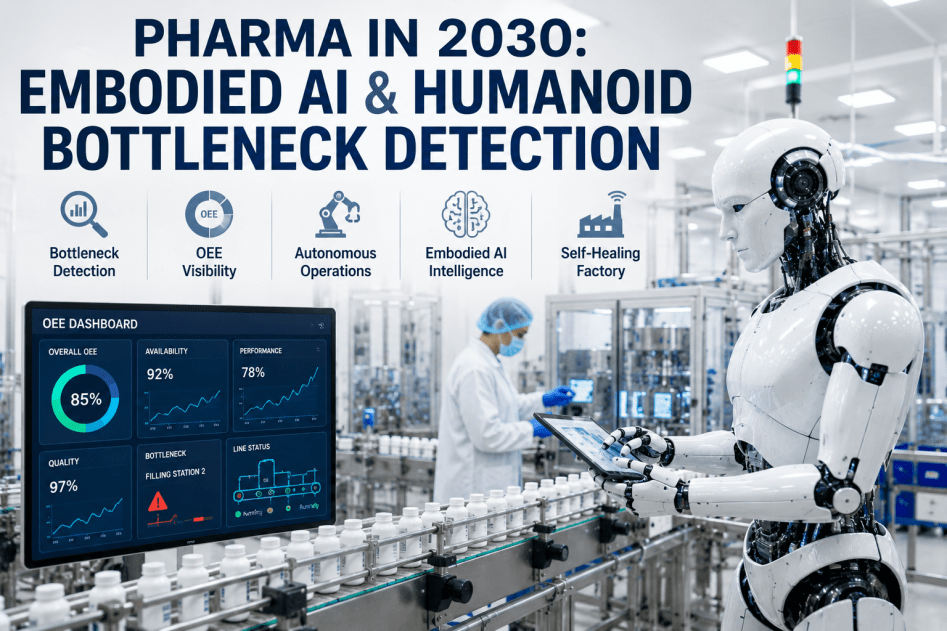
- AI detects acoustic, thermal, and vibration anomalies in real time across all assets.
- CMMS work order generated automatically with asset ID, severity, and recommended action.
- Full floor coverage — including confined zones, high-heat areas, and elevated platforms.
- Digital twin updated continuously with live spatial and operational data from the robot fleet.
Why Automotive Manufacturing Is the Proving Ground for Humanoid Robots
The automotive assembly environment is uniquely suited to humanoid robot deployment. Lines are structured, tasks are repeatable, ergonomic injury costs are high, and the financial stakes of unplanned downtime are among the largest in all of manufacturing. These are the numbers that are forcing the conversation.
Cost of One Hour of Unplanned Downtime — Final Assembly
Lost throughput, expedited freight, overtime labor, and customer penalty clauses combine to make every unplanned stoppage a six-figure event.
U.S. Automotive Plants Without Real-Time Equipment Health Monitoring
The majority of U.S. automotive facilities still rely on scheduled walk-arounds and reactive maintenance for the bulk of their asset base.
Assembly Tasks Addressable by Humanoid Robots — Current Capability
Parts retrieval, visual inspection, torque verification, tray transport, and ergonomic assist tasks are within current humanoid robot capability envelopes.
Expected Production-Scale Humanoid Robot Deployment in Automotive
Industry analysts and OEM roadmaps converge on 2027–2030 for broad production-scale deployment across assembly, inspection, and maintenance roles.
Higher Integration Cost for Plants That Wait to Build AI Infrastructure
Plants without AI vision, digital twin, and CMMS infrastructure in place before humanoid robots arrive will face significantly higher onboarding costs and longer ramp times.
Four Capabilities Embodied AI Unlocks on the Automotive Floor
Traditional industrial robots are fixed, single-purpose, and blind to anything outside their programmed task. Embodied AI — AI systems with physical presence, sensory awareness, and contextual decision-making — delivers capabilities that fixed automation simply cannot.
Autonomous Roving Inspection
Humanoid robots walk programmed routes across the assembly line, using computer vision to detect oil leaks, worn tooling, misaligned components, and thermal anomalies — including during lights-out periods.
Equipment Health Anomaly Detection
Onboard acoustic, thermal, and vibration sensors flag bearing overheat, spindle harmonics, and hydraulic deviations — logging findings directly into the CMMS without human intermediary.
Adaptive Assembly Assistance
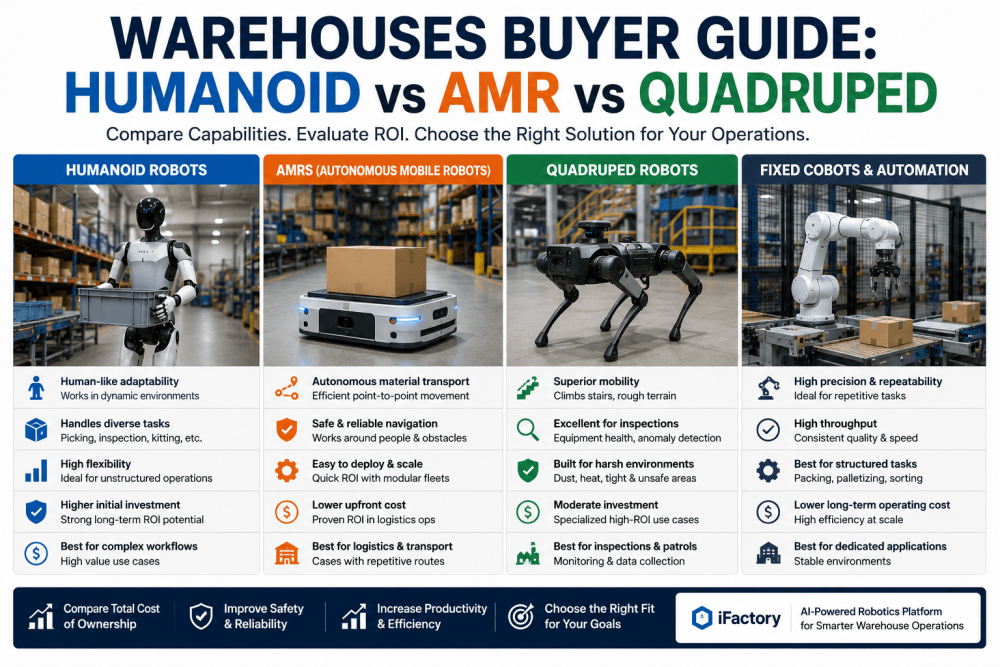
Unlike fixed cobots, humanoid robots adapt to line speed, model mix, and operator position — and can be redeployed to a different station in minutes via software, not engineering hours.
Digital Twin Synchronization
Every observation — a torque reading, a visual anomaly, a part location — feeds a live digital twin, giving plant engineers a continuously updated virtual model for optimization and failure analysis.
Traditional Automation vs. Embodied AI: What Changes on Your Plant Floor
The shift from fixed industrial automation to humanoid and embodied AI redefines what is operationally possible in equipment monitoring, inspection frequency, and adaptive response. This table maps the difference for automotive operations and maintenance leaders.
| Capability Area | Traditional Fixed Automation | Embodied AI / Humanoid Robots |
|---|---|---|
| Equipment Inspection Frequency | Scheduled walk-arounds — weekly or bi-weekly | Continuous — every shift including lights-out |
| Anomaly Detection Coverage | Fixed sensors at pre-wired points only | Roving multi-sensor across all assets — no wiring required |
| Response to New Equipment | Requires new sensor installation and wiring project | Robot re-routes to new asset — no infrastructure change |
| Unstructured Zone Coverage | No coverage outside fixed sensor range | Full floor including aisles, storage, and utility areas |
| CMMS / MES Data Entry | Manual entry by technician after inspection | Automatic logging with timestamp, asset ID, and severity |
| Redeployment Flexibility | Fixed installation — relocation requires engineering | Reassigned to new station or task via software in minutes |
| Ergonomic Risk Exposure | Human inspectors in high-heat, confined, and noisy zones | Robot handles ergonomically hazardous inspection tasks |
| Digital Twin Data Quality | Sparse — only where sensors are installed | Dense — whole-floor spatial and operational data stream |
The infrastructure your plant needs to benefit from humanoid robots — AI vision, digital twin, CMMS, and equipment health data pipelines — takes 18–36 months to build and calibrate. The competitive window is 2025–2027. Book a Demo to see how iFactory is already running as the foundation layer for embodied AI integration in automotive environments today.
iFactory: The Platform That Bridges Today's Automotive Floor and 2030's Embodied Factory
Humanoid robots do not operate in a vacuum. They require a digital infrastructure layer — AI vision processing, equipment health data pipelines, digital twin synchronization, and integrated work order management — that most automotive plants do not yet have. iFactory delivers that infrastructure today, on production-proven AI vision, predictive maintenance, and CMMS capabilities already running on automotive plant floors.
AI Vision Camera — Continuous Visual Inspection, Active Today
iFactory's AI Vision Camera performs real-time visual inspection across assembly lines, weld stations, and equipment bays — detecting surface defects, assembly errors, and equipment anomalies at machine speed. It builds the labeled visual dataset that validates humanoid robot perception systems when they arrive on your floor.
Predictive Maintenance with Equipment Health Anomaly Detection
iFactory's predictive maintenance module connects to PLCs, vibration monitors, and thermal cameras across your critical automotive assets — stamping presses, welding robots, CMMs, and conveyors. Anomaly detection flags deviations before failures occur, feeding CMMS work orders automatically with priority and recommended action.
Digital Twin AI — Live Virtual Mirror of Your Production Line
iFactory's Digital Twin AI creates and maintains a real-time virtual model of your plant, synchronized with sensor data, production counts, and equipment health readings. When humanoid robots begin feeding spatial observation data, the twin absorbs it without architectural change — because it was designed for it from the start.
Robotics AI Integration Framework
iFactory's Robotics AI module provides the integration layer connecting autonomous systems — including future humanoid robots — to your CMMS, MES, and ERP. Observation data from robotic inspections flows directly into work order management and parts inventory without manual re-entry.
CMMS with Autonomous Work Order Triggering
When an AI vision camera, predictive sensor, or humanoid robot detects an equipment anomaly, iFactory's CMMS automatically generates a work order — assigned, prioritized, and linked to the asset's full maintenance history. No human intermediary. No delay.
On-Premise NVIDIA-Powered Deployment
iFactory runs on an on-premise NVIDIA appliance inside your plant network — zero cloud dependency, zero data egress. All equipment health data, visual inspection records, and production intelligence stay inside your facility, satisfying OEM data security requirements and enabling the low-latency processing humanoid robot control demands.
Everything Your Plant Needs to Be Humanoid Robot-Ready by 2027
iFactory delivers a fully integrated AI infrastructure platform — not a set of disconnected tools. Every component is pre-integrated and ready to run on your plant network within 6 to 12 weeks.
AI Vision Inspection Active on Day 30
Cameras deployed at high-value inspection points within the first month. Anomaly detection begins generating alerts before the quarter is over.
On-Premise NVIDIA Appliance
Zero cloud dependency. Zero data egress. All equipment health and production data stays inside your plant network — always.
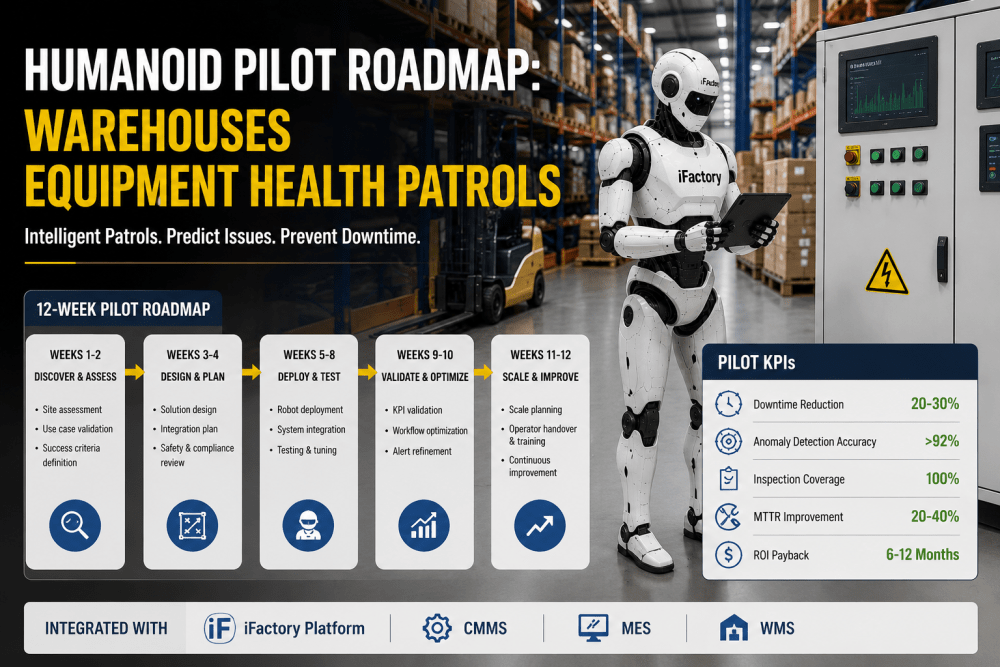
6–12 Week Pilot to Live Operations
We connect to your existing PLCs, SCADA, and data sources. You get a working, measurable pilot in one quarter, not one year.
24x7 Managed Service & Uptime Monitoring
iFactory monitors the platform, applies updates, and ensures system availability. Your team focuses on production, not IT infrastructure.
Humanoid Robot Readiness Architecture
Every component — digital twin, AI vision, CMMS — is built to absorb humanoid robot data feeds when the hardware matures. No rearchitecting required.
SAP, MES & CMMS Integration
iFactory connects to your existing systems via OPC UA, REST APIs, and database connectors. Anomaly-triggered work orders flow into your existing workflows automatically.
What Automotive Operations Leaders Are Saying About the 2030 Transition
The plants that will win in 2030 are not necessarily the ones that buy the most humanoid robots. They are the ones that already have the data infrastructure to make those robots useful on day one. AI vision, predictive maintenance, and a live digital twin are not preparation for humanoid robots — they are the robots' central nervous system. Without them, you have a very expensive walking actuator that cannot talk to your production systems. The infrastructure window closes in 2027. Plants that miss it will spend the next five years catching up.
The 2030 Embodied AI Factory Is Being Built Today — With or Without You
Humanoid robots and embodied AI are not a distant science experiment for automotive manufacturers. Tesla, BMW, Ford, and their Tier 1 supplier networks are deploying early-stage units right now and building toward production-scale integration by 2027–2030. The OEMs and suppliers that win in that environment will not be the ones that reacted fastest when the hardware matured — they will be the ones that built the AI vision, digital twin, and equipment health monitoring infrastructure years in advance.
iFactory is the platform that bridges the gap. It delivers production-proven AI vision, predictive maintenance, and CMMS capabilities today — on an on-premise NVIDIA appliance, inside your plant network — while architecting your environment for seamless humanoid robot integration when the hardware arrives. The 6–12 week pilot is the lowest-risk, highest-leverage investment your automotive plant can make in 2026. Book a Demo and leave with a plant-specific roadmap for embodied AI readiness.
What Automotive Manufacturing Professionals Ask About Humanoid Robots and Embodied AI
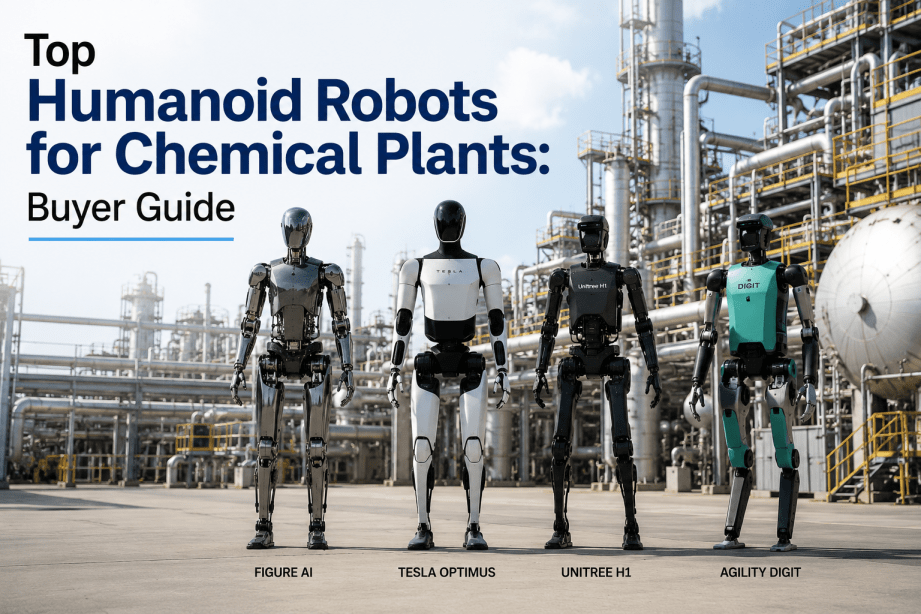
The honest answer is: partially ready now, broadly ready by 2027–2030. As of mid-2026, platforms including Tesla Optimus Gen 2, Figure 02, and Agility Robotics Digit are performing structured tasks — parts retrieval, visual inspection, tray transport — in controlled automotive and logistics environments. They are not yet operating autonomously on a high-speed final assembly line at scale. The realistic production-scale window for most automotive tasks is 2027–2030. However, the infrastructure your plant needs to benefit from them — AI vision, digital twin, CMMS, and sensor data pipelines — takes 18–36 months to build and calibrate. The right time to start is now, not when the robots are already at your loading dock.
Yes. iFactory's predictive maintenance module performs equipment health anomaly detection today using PLC sensor data, vibration monitors, acoustic sensors, and thermal imaging cameras. The AI engine establishes a baseline for each asset and flags deviations — abnormal bearing temperatures, unusual spindle harmonics, hydraulic pressure drops — that indicate developing failures before they cause downtime. When a humanoid robot is added to your environment, it extends this capability to assets that are not sensor-wired, by physically inspecting them with onboard sensors and logging findings directly into iFactory's CMMS. The platform absorbs robot-generated observations without any architectural change because the data schema was built for it.
The ROI does not depend on humanoid robots at all — it is fully justified by the immediate value of AI vision inspection, predictive maintenance, and digital twin operations. A typical iFactory deployment in an automotive environment recovers its investment within 9–14 months through reductions in unplanned downtime, quality escape costs, and maintenance labor. The humanoid robot readiness is a compounding secondary benefit. Plants that deploy iFactory in 2026 will have 2–3 years of clean asset health data, trained anomaly detection models, and a live digital twin when humanoid robots reach production scale — making robot integration a software configuration exercise, not a multi-year infrastructure rebuild.
iFactory's Digital Twin AI creates a real-time virtual model of your plant, synchronized with sensor data, production counts, and equipment health readings. When a humanoid robot is deployed, it becomes another data source feeding that twin — every visual observation, acoustic reading, and spatial position the robot logs is absorbed into the live model. This gives plant engineers a continuously updated picture of floor status without requiring them to physically inspect the line. More importantly, the digital twin gives the humanoid robot's AI system a pre-existing understanding of the plant layout, equipment locations, and historical anomaly patterns — which dramatically accelerates its ability to perform useful inspection work from its first day of deployment.
iFactory is explicitly designed for the full automotive supply chain — not just large OEMs. The platform scales from a single plant with 50 assets to a multi-facility operation with thousands. Tier 2 and Tier 3 suppliers typically see the fastest ROI because their maintenance and inspection processes are less mature — meaning the gap between current operations and AI-augmented operations is larger, and the gains are faster to realize. The 6–12 week pilot structure fits the capital planning cycles and IT resource constraints of mid-size suppliers. A Book a Demo session with iFactory's automotive team will produce a plant-specific ROI model based on your asset count, current downtime rates, and inspection labor costs.
Your 2030 Competitive Position Is Determined by What You Deploy in 2026
Plants that build AI vision, digital twin, and CMMS infrastructure now will absorb humanoid robots as a software upgrade. Plants that wait will face integration costs 3–5x higher and a data gap that takes years to close. iFactory is live in automotive environments today. The pilot takes 6–12 weeks.
.png)