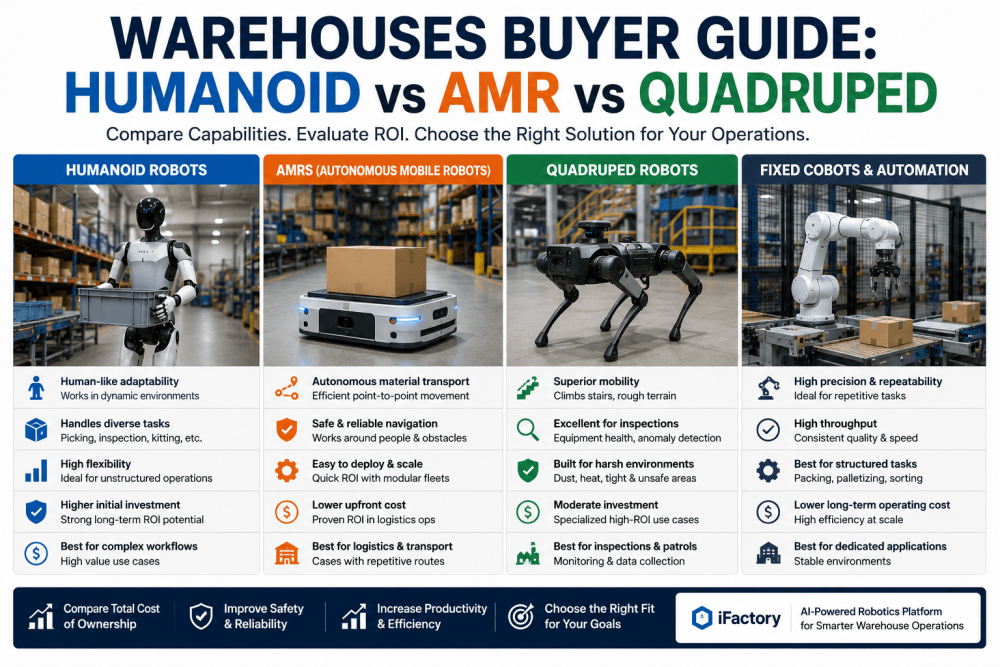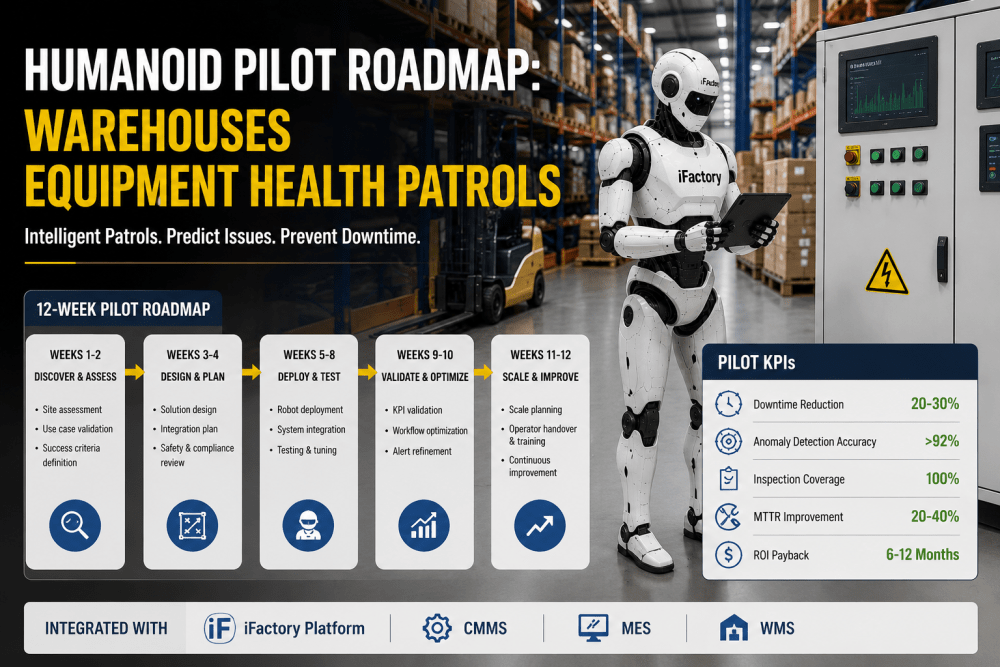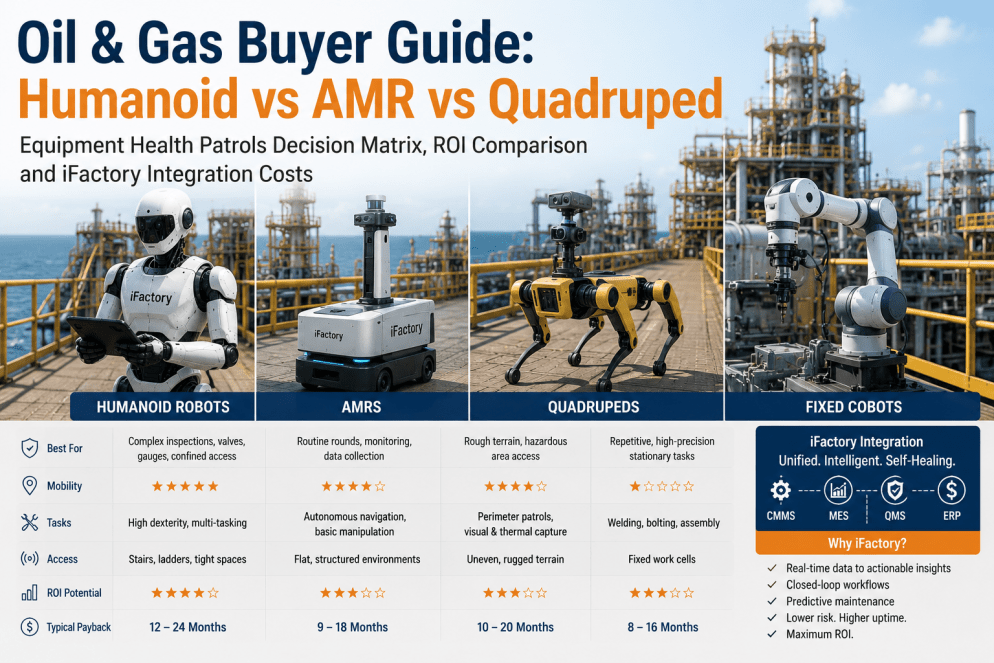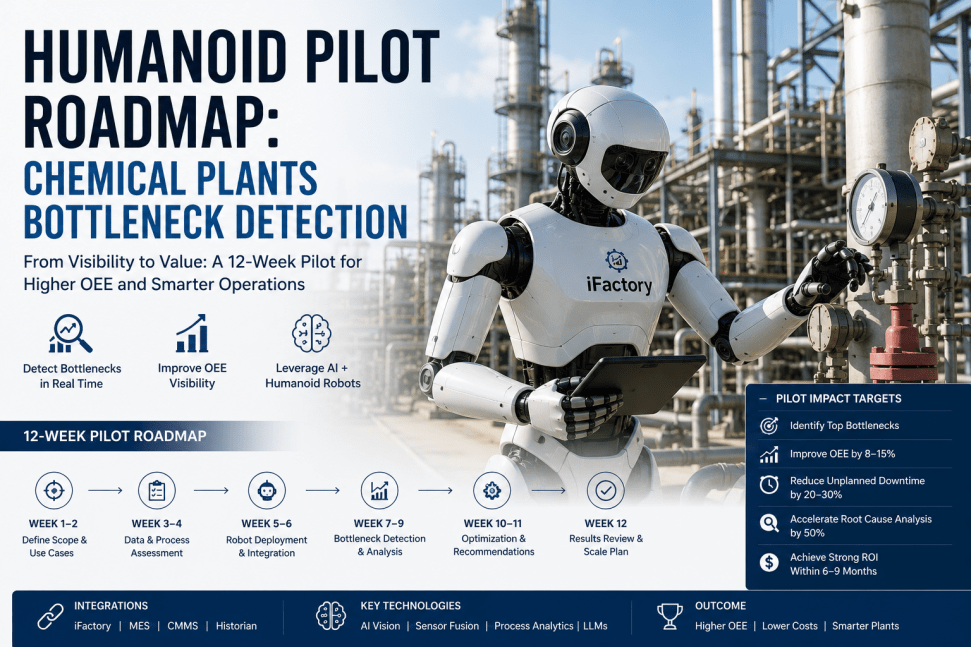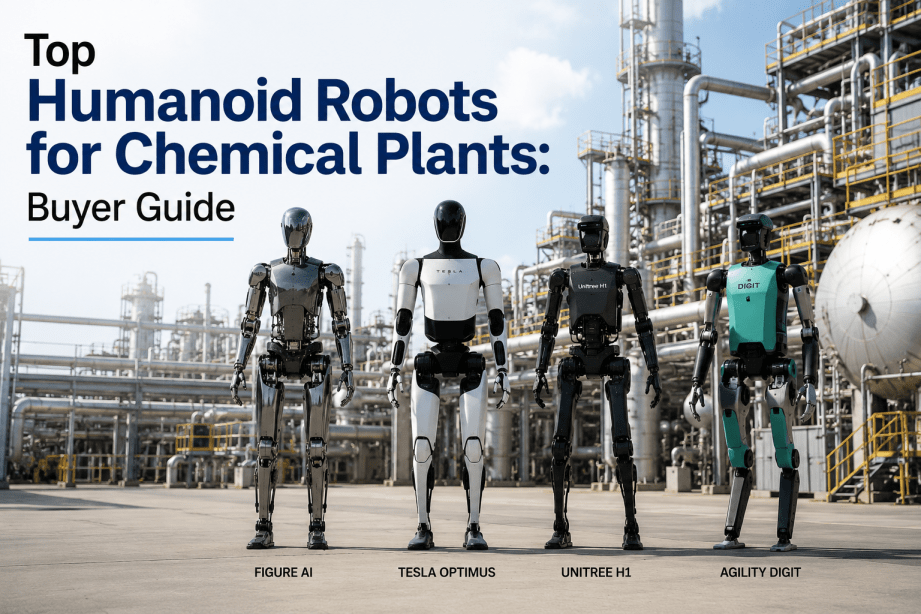
Chemical plants operate under extreme conditions where equipment health monitoring and anomaly detection directly impact safety, uptime, and regulatory compliance. Humanoid robots — from Figure AI and Tesla Optimus to Unitree H1 and Agility Digit — are entering industrial environments to perform autonomous inspections, equipment health monitoring, and anomaly detection tasks that were previously manual, intermittent, or too dangerous for human workers. This buyer guide provides chemical plant managers, maintenance leaders, and digital transformation executives with a structured comparison of the leading humanoid robot platforms, evaluating their equipment health monitoring capabilities, anomaly detection accuracy, deployment costs, safety certifications, and integration readiness with existing CMMS and MES infrastructure. iFactory's AI Vision, Digital Twin, and Robotics integration platform connects humanoid robot sensor data directly to your existing maintenance and quality systems — enabling autonomous patrols, real-time anomaly alerts, and predictive maintenance workflows without requiring changes to your process control infrastructure. Book a Demo to discuss how humanoid robotics integration applies to your chemical plant operations.
01 / The Humanoid Robot Landscape for Chemical Plants
Four humanoid robot platforms have emerged as leading candidates for industrial deployment in chemical processing environments. Each platform brings distinct design philosophies, payload capacities, AI capabilities, and integration architectures. Understanding the differences between these platforms is the first step in selecting the right system for your chemical plant's equipment health monitoring and anomaly detection requirements. Book a Demo to review platform-specific deployment scenarios for your chemical plant.
Platform Comparison: Leading Humanoid Robots for Chemical Plant Deployment
| Parameter | Figure AI | Tesla Optimus | Unitree H1 | Agility Digit |
|---|---|---|---|---|
| Form Factor | Full-body bipedal, 6-DOF arms | Full-body bipedal, human-scale | Lightweight bipedal, 180 cm | Reverse-joint bipedal, modular |
| Payload Capacity | 45 kg per arm | 20 kg per arm (est.) | 15 kg total (est.) | 25 kg total |
| Battery Life | 4-6 hours (est.) | 6-8 hours (est.) | 3-4 hours | 6-8 hours |
| AI / ML Capability | Onboard inference, custom models | FSD neural network, scalable AI | Basic onboard processing | Cloud + edge AI architecture |
| Visual Inspection | RGB-D cameras, object detection | Multi-camera array, 360-degree | Optional RGB-D payload | Modular sensor suite |
| Thermal Monitoring | Integrated thermal camera option | Thermal sensor capable | Payload-dependent | Configurable thermal payload |
| CMMS / MES Integration | API-based integration | Tesla ecosystem integration | Limited native integration | Built-in CMMS connectors |
| Safety Certification | In progress (industrial) | In progress (industrial) | Basic safety compliance | ISO 13482 compliant |
| Best Use Case | Full inspection + manipulation | Multi-unit patrol fleets | Confined space inspections | Continuous patrol + monitoring |
| Estimated Cost Range | $60-80K (est.) | $20-30K (target) | $25-40K (est.) | $40-60K (est.) |
02 / Equipment Health and Anomaly Detection Capabilities
The primary value of humanoid robots in chemical plants lies in their ability to perform continuous, autonomous equipment health monitoring and detect anomalies — vibration changes, temperature deviations, acoustic patterns, visual defects — before they escalate into unplanned downtime or safety incidents. Each platform approaches this capability differently based on its sensor architecture, onboard AI processing, and integration with plant systems. Book a Demo to see how iFactory's platform centralizes anomaly detection data from any humanoid robot into a unified equipment health dashboard.
Humanoid robots perform visual inspection using integrated RGB and RGB-D cameras that capture high-resolution images of equipment surfaces, gauge readings, seal integrity, and structural conditions. Onboard AI models classify visible anomalies — corrosion, cracking, leakage, misalignment, degradation — and compare findings against baseline images from previous patrol cycles. Figure AI's manipulation capability enables the robot to open inspection panels, adjust camera angles, and physically interact with equipment during inspection. Tesla Optimus leverages its multi-camera array for 360-degree equipment scanning during patrols, capturing visual data from every angle in a single pass. Unitree H1's lightweight design allows it to access elevated platforms and confined spaces where fixed cameras cannot reach. Agility Digit's modular payload system supports specialized visual inspection cameras — including high-zoom optics for remote gauge reading and ultraviolet imaging for refrigerant and fluid leak detection. iFactory's platform aggregates all visual inspection data from any humanoid platform, applies AI-based anomaly classification, and creates equipment health records that feed directly into your CMMS work order generation system.
Thermal monitoring is one of the most valuable capabilities for chemical plant equipment health, as temperature deviations are early indicators of bearing wear, insulation degradation, electrical faults, and process abnormalities. Humanoid robots equipped with thermal cameras can perform full-equipment thermal scans during each patrol cycle, capturing surface temperature distributions across pumps, motors, heat exchangers, piping, and electrical panels. Acoustic monitoring adds another detection layer — ultrasonic sensors capture high-frequency emissions from leaking valves, cavitating pumps, and arcing electrical components that are inaudible to human operators. The combination of thermal and acoustic data enables the robot to detect multiple failure modes during a single patrol pass. Agility Digit's modular architecture supports interchangeable thermal and acoustic payloads optimized for specific equipment types. Figure AI's onboard processing can run real-time thermal trend analysis, comparing current readings against historical baselines and flagging deviations that exceed configurable thresholds. iFactory's Digital Twin platform maps thermal and acoustic data points to specific equipment assets in your plant, creating a time-series health record that enables predictive maintenance scheduling based on actual equipment condition rather than calendar intervals.
The value of humanoid robot inspection data depends entirely on how effectively it integrates with your existing plant systems. Raw inspection images, thermal readings, and acoustic recordings are useful only when correlated with equipment identifiers, work order histories, and process data within your CMMS and MES platforms. Figure AI provides API-based data output that can be routed to third-party systems through custom connectors. Agility Digit includes pre-built integration modules for major CMMS platforms, enabling direct work order creation from inspection findings. Tesla Optimus's integration path runs through the Tesla ecosystem, requiring adaptation for non-Tesla plant systems. Unitree H1 offers limited native integration capabilities, relying on third-party middleware for plant system connectivity. iFactory's Robotics integration platform provides a unified data layer that connects any humanoid robot platform to your existing CMMS, MES, quality management, and asset hierarchy systems. Inspection data from any robot is automatically mapped to the correct equipment tag in your asset register, anomaly classifications trigger work order generation with supporting evidence, and equipment health trends are displayed on a unified dashboard that combines data from robotic patrols, fixed sensors, and operator rounds.
03 / Deployment, Safety and ROI Analysis
Deploying humanoid robots in chemical plant environments requires structured planning across site assessment, platform selection, integration architecture, safety validation, and ROI measurement. Chemical plants present unique challenges — hazardous area classifications, corrosive atmospheres, extreme temperatures, and strict regulatory oversight — that influence platform selection and deployment approach. Book a Demo to discuss a deployment roadmap tailored to your chemical plant's equipment health monitoring requirements and infrastructure.
Expert Review — A Chemical Plant Reliability Engineer's Perspective on Humanoid Robots
Conclusion — Humanoid Robots Are Ready for Chemical Plant Equipment Health Monitoring
Chemical plant managers and reliability leaders evaluating humanoid robots for equipment health monitoring and anomaly detection have four mature platforms to choose from — Figure AI, Tesla Optimus, Unitree H1, and Agility Digit — each with distinct strengths in payload capacity, AI capability, mobility, and integration readiness. The selection decision should be driven by your specific inspection requirements, plant layout, existing system architecture, and deployment timeline rather than platform specifications alone. The business case for humanoid robot deployment in chemical plants is supported by documented 60%+ reductions in manual inspection labor, 85%+ anomaly detection accuracy, and 12-18 month ROI timelines across early-adopter deployments. iFactory's AI Vision, Digital Twin, and Robotics integration platform provides the critical integration layer that connects any humanoid robot's inspection data to your CMMS, MES, and quality systems — enabling autonomous equipment health monitoring, predictive maintenance alerts, and real-time anomaly detection dashboards without requiring changes to your process control infrastructure. Book a Demo to schedule a humanoid robotics assessment for your chemical plant and determine which platform best fits your equipment health monitoring requirements.