Oil and gas facilities operate thousands of miles of pipelines, hundreds of pressure vessels, and tens of thousands of valve and compressor stations — each requiring regular equipment health inspection across upstream drilling, midstream transmission, and downstream refining operations. For facilities and reliability leaders evaluating autonomous inspection platforms, three robotic form factors — humanoid robots, autonomous mobile robots, and quadruped robots — offer distinct capabilities for equipment health anomaly detection. Each platform type occupies a different position on the inspection complexity spectrum, and selecting the right platform requires matching robot capabilities to specific inspection environments, hazard classifications, physical access constraints, and enterprise integration requirements. To evaluate iFactory's autonomous inspection integration platform for your operation, Book a Demo with iFactory's industrial operations team.
01 / The Oil and Gas Inspection Continuum — Matching Robot Capability to Inspection Complexity
Equipment health inspections in oil and gas span a wide complexity continuum. At the simplest end, visual inspections of pipeline cathodic protection test stations and valve position indicators require minimal sensor capability and can be performed by any autonomous platform. At the complex end, multi-sensor diagnostic assessments of compressor station equipment — combining thermal imaging, vibration analysis, acoustic emission detection, and gas concentration measurement — require payload capacity, sensor integration, and data correlation capabilities that differentiate the three platform types. Book a Demo to discuss which platform matches your inspection requirements.
- AMR — Best for flat, accessible areas with clear pathways; pipeline corridors, tank farm perimeters, equipment skid walkways
- Quadruped — Suitable for uneven terrain, gravel roads, and moderate-grade slopes around well pads and flow lines
- Humanoid — Over-engineered for visual-only inspection; capability exceeds requirement at higher cost
- Humanoid — Best for complex, confined, and vertical-access environments; can climb stairways and ladders to reach elevated equipment, operate in tight valve skid spaces, and deploy multiple sensor payloads simultaneously
- Quadruped — Capable on uneven terrain and stairs but limited payload capacity restricts simultaneous multi-sensor deployment; typically requires multiple passes for comprehensive diagnostics
- AMR — Limited to ground-level accessible equipment; cannot reach elevated inspection points without fixed camera masts
02 / Platform Comparison — Capabilities, Constraints, and Deployment Profiles
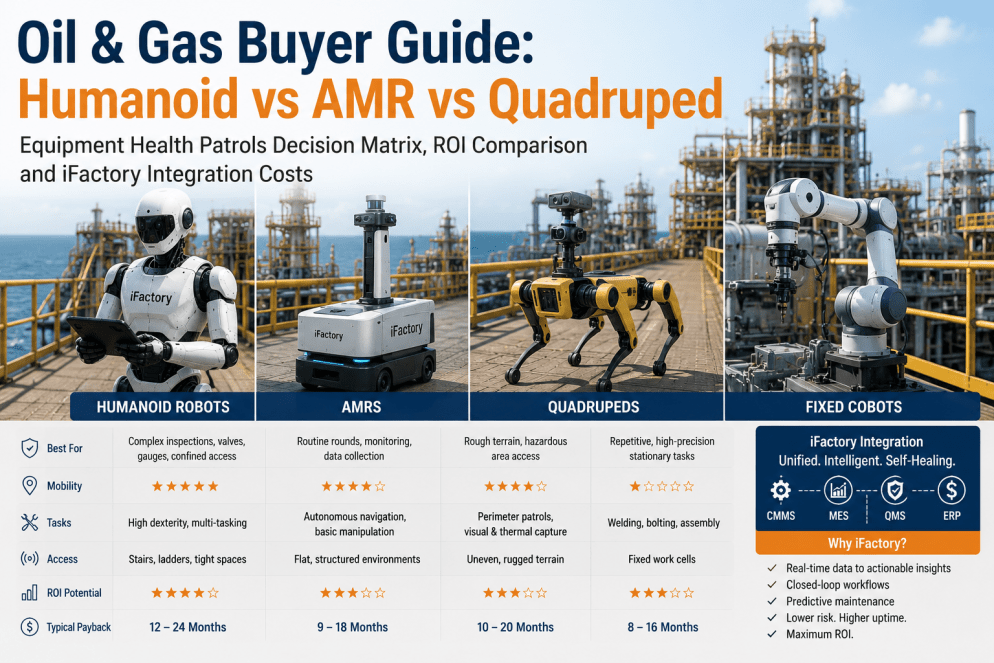
The following comparison evaluates each platform type across the dimensions that matter most for oil and gas equipment health inspection deployments: mobility and access, sensor payload capacity, autonomous operation capability, ATEX certification availability, enterprise integration readiness, and deployment cost profile.
| Evaluation Dimension | Humanoid Robot | AMR (Wheeled) | Quadruped Robot |
|---|---|---|---|
| Terrain & Access | Stairs, ladders, elevated platforms, confined valve skids, uneven gravel | Flat prepared surfaces only — paved roads, concrete floors, level gravel | Stairs, uneven terrain, moderate slopes, loose gravel — no ladder or vertical access |
| Sensor Payload | High — multiple simultaneous sensors including thermal, acoustic, gas, vibration | Moderate — single sensor head per pass; multi-sensor requires multiple patrol cycles | Moderate — limited by walking gait payload capacity; typically one primary sensor per deployment |
| ATEX Certification | Available — Zone 1/2 and Class I Div 1/2 certified configurations | Limited — typically Zone 2 / Class I Div 2 only; full ATEX rare | Available — Zone 2 and Class I Div 2 certified; full Zone 1 certification limited |
| Autonomous Operation | Full — autonomous patrol, obstacle avoidance, dynamic replanning, auto-charging | Full — autonomous patrol on prepared paths; limited dynamic obstacle handling | Full — autonomous patrol with stair climbing; moderate dynamic replanning capability |
| Enterprise Integration | Full — iFactory platform connects patrol data directly to CMMS, MES, QMS, ERP | Full — iFactory platform supports AMR data integration with same enterprise connectors | Full — iFactory platform supports quadruped data integration with same enterprise connectors |
| Relative Cost | Highest — full humanoid with multi-sensor payload and ATEX certification | Lowest — mature AMR technology with competitive pricing and low deployment complexity | Medium — emerging technology with moderate cost; sensor payload upgrades add cost |
| Best Use Case | Complex multi-level facilities, confined space entry, elevated equipment, ATEX Zone 1 | Large-area ground-level inspections, pipeline corridors, tank farm perimeters, storage yards | Uneven terrain inspections, stair-accessible equipment, well pad and flow line patrols |
03 / Deployment Timeline — From Procurement to Autonomous Patrol Operations
The deployment timeline for autonomous inspection platforms varies significantly by robot type, driven primarily by ATEX certification requirements, facility navigation mapping complexity, and enterprise system integration depth. The timeline below reflects typical deployment durations for each platform type in an oil and gas facility environment.
04 / ROI Decision Framework — Matching Platform Investment to Inspection Value
The return on investment for autonomous inspection platforms in oil and gas is driven by three primary value streams: personnel hazard exposure reduction, inspection frequency and coverage improvement, and equipment failure prevention through earlier anomaly detection. Each platform type delivers different performance across these value streams, and the optimal choice depends on facility-specific inspection requirements and cost structures.
Need stairs or uneven terrain but limited payload required? → Quadruped (terrain flexibility, moderate cost)
Need full human-equivalent access, multi-sensor diagnostics, and ATEX Zone 1 certification? → Humanoid (highest capability, highest cost)
Multi-platform deployment across different facility zones? → iFactory integrates all three into a unified inspection management platform with shared enterprise connectors
Expert Perspective — Insights from Oil and Gas Operations
I have overseen equipment health inspection programs across three refineries and two midstream gas processing facilities over 22 years. The recurring mistake I see in autonomous platform selection is treating the robot as a one-size-fits-all solution. A wheeled AMR will never inspect the top of a fractionation column. A quadruped cannot carry the sensor payload required for comprehensive compressor diagnostics. And deploying a full humanoid for pipeline corridor visual patrols is like specifying a $400,000 solution for a $40,000 problem. The question is not which robot is the most advanced. The question is which robot matches your inspection complexity at each facility zone. At our largest refinery, we deployed AMRs for tank farm and pipeline corridor patrols, quadrupeds for well pad and flow line inspections, and humanoids for our reformer unit and hydrocracker complex where multi-sensor diagnostics and elevated access are required. iFactory integrated all three platform types into a single inspection management layer connected to our SAP CMMS. The unified data environment was the critical enabler — without it, three robot types would have produced three disconnected data streams and none of the enterprise visibility we needed.
Conclusion — The Platform Decision Is a Facility-Specific Match, Not a Technology Competition
The comparison between humanoid, AMR, and quadruped robots for oil and gas equipment health inspections is not a competition between technologies — it is a matching exercise between inspection requirements and platform capabilities. Each robot type occupies a distinct position on the inspection complexity spectrum, and the optimal deployment strategy for most facilities involves matching the platform to the inspection zone rather than selecting a single platform for all applications. iFactory's autonomous inspection integration platform provides the unified data layer that makes multi-platform deployments practical — connecting patrol data from any robot type directly to CMMS, MES, QMS, and ERP workflows without requiring separate integration for each platform vendor. The inspection data that matters for equipment health, compliance documentation, and failure prevention is the same regardless of which robot collected it. iFactory ensures that data reaches the systems that act on it. To evaluate which autonomous platform matches your facility's inspection requirements, Book a Demo with iFactory's industrial operations team.
Frequently Asked Questions — Robot Platform Selection for Oil and Gas Inspections
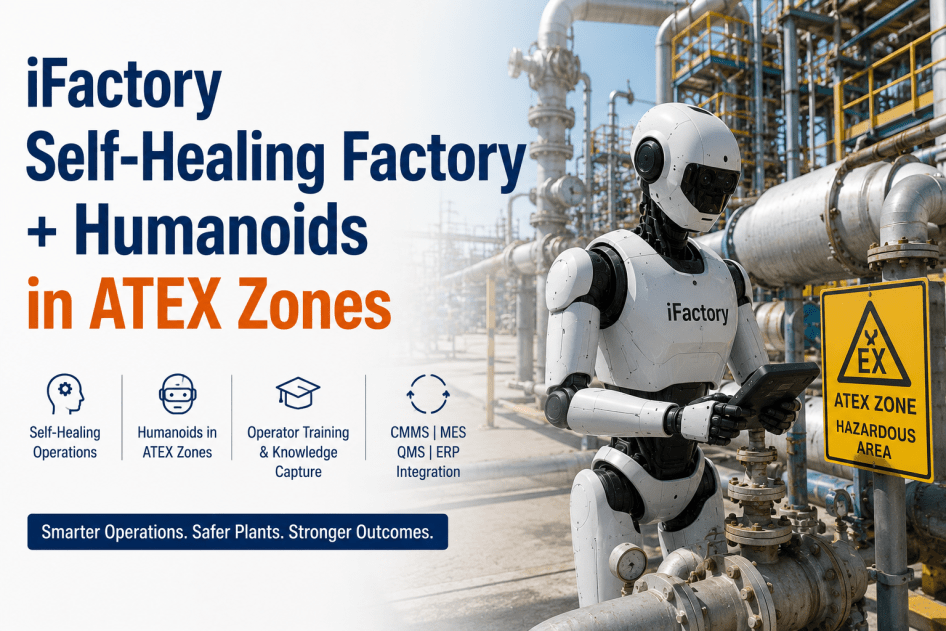
Yes. Humanoid robots deployed through iFactory's platform are available with ATEX Zone 1 and Zone 2 certified configurations for gas and dust hazardous areas, as well as Class I Div 1 and Div 2 certifications for North American regulatory compliance. ATEX certification covers the robot body, sensor payloads, and charging station — enabling deployment in the most demanding classified areas including compressor buildings, wellhead areas, and processing unit hazardous zones without additional containment. Quadruped and AMR platforms are typically available with Zone 2 and Class I Div 2 certification, with full Zone 1 certification limited or unavailable depending on the manufacturer and configuration.
iFactory's platform ingests patrol data from any robot type through standardized API connectors — normalizing sensor readings, location data, timestamps, and inspection outcomes into a unified data model regardless of the source platform. This means a facility deploying AMRs in tank farm areas, quadrupeds on well pads, and humanoids in processing units gets a single inspection management interface with consistent data formats, enterprise system integration, and anomaly correlation across all patrol zones. The platform abstracts the robot hardware layer, enabling operations teams to manage inspections by equipment location and inspection requirement rather than by robot type or vendor.
Total deployment cost varies by facility size, ATEX certification requirements, sensor payload configuration, and enterprise integration scope. As a general benchmark: AMR deployments typically range from $80,000 to $150,000 per unit including iFactory platform integration; quadruped deployments range from $150,000 to $250,000 per unit; humanoid deployments range from $250,000 to $450,000 per unit depending on sensor payload and ATEX certification level. Enterprise integration costs for iFactory's platform are consistent across robot types — the same integration effort serves any robot platform, and multi-platform deployments do not incur additional integration cost per robot type. Most deployments achieve full cost recovery within 12 to 18 months through hazard exposure reduction, inspection labor recovery, and failure prevention value.
Yes. iFactory's platform supports direct integration with SAP Plant Maintenance and SAP EAM modules, OSIsoft PI and PI AF data historians, GE Digital APM, and standard CMMS and ERP platforms through REST APIs, OPC-UA, and database-level connectors. The integration is bi-directional — the platform reads asset hierarchies, maintenance plans, and inspection history from these systems to enrich robot patrol data, and writes inspection findings, work order requests, and compliance records back into them. Integration is typically completed within 1 to 2 weeks per system and does not require modifications to existing enterprise software deployments or vendor engagement.
All three platform types available through iFactory are built to industrial environmental specifications. Humanoid and AMR platforms are rated for ambient operation from -20°C to 55°C with optional extended-temperature configurations for desert and arctic deployments. Quadruped platforms typically operate from -10°C to 45°C standard, with cold-weather packages available. All platforms include ingress protection (IP54 or higher) against sand, dust, and salt spray common in oil and gas environments. For extreme environmental conditions, iFactory's technical team performs a site-specific environmental assessment during the facility evaluation phase to confirm platform suitability and identify any required environmental protection upgrades before deployment. Book a Demo to discuss your facility's environmental requirements.