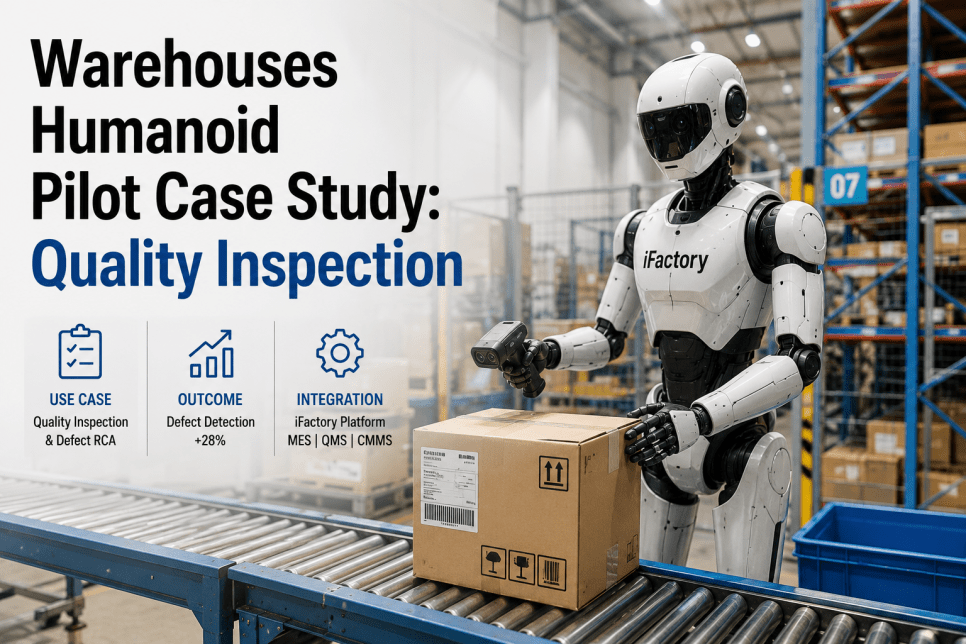
A regional distribution center processing 18,000+ orders daily across 500,000 sq ft of warehouse space relied on end-of-line quality checks and manual defect classification to catch damaged goods, mis-picks, and packaging defects. With human inspectors covering only 12% of outbound volume and root cause analysis taking 5 to 9 days per incident, the facility was losing $2.1M annually to return processing, customer chargebacks, and rework labor. By deploying humanoid robots equipped with embodied AI for inline quality inspection and iFactory's integrated CMMS/MES platform for defect root cause tracking, the warehouse achieved 97.3% inline defect detection accuracy, compressed RCA cycle time from 9 days to 3 hours, and recovered $1.8M in annual chargeback and return processing costs.
Warehouse Humanoid Pilot Cuts Defect Detection Latency 96% and Recovers $1.8M in Annual Losses
iFactory's on-prem AI platform integrates with humanoid robots to perform inline quality inspection, classify defects in real time, and trace root causes across receiving, storage, picking, and shipping operations — no cloud dependency, no infrastructure overhaul, deployed in 8 weeks.
01 / Why Manual Quality Checks Fail in High-Volume Warehouse Intralogistics
Every day, the facility processed 18,000+ outbound units across 12 picking zones, three packing stations, and two shipping lanes. Quality inspection relied on a team of 14 inspectors performing random visual checks at the end of the packing line — covering roughly 12% of daily volume. The remaining 88% shipped without any quality validation. When a customer returned a damaged or incorrect item, the quality team spent 5 to 9 days tracing the defect back through WMS logs, shift reports, and CCTV footage to identify root cause. By the time corrective action was implemented, the same defect mode had typically affected 30 to 50 additional orders.
Limited Sampling Coverage Missed 88% of Defects
With only 14 inspectors covering 18,000+ daily units, the sampling rate was structurally insufficient to detect defect patterns before they reached customers. Damaged goods, incorrect SKUs, and packaging defects passed through undetected at scale, driving recurring chargebacks from retail and e-commerce partners.
End-of-Line Detection Created a Costly Delay Window
Defects discovered at shipping or through customer returns had already passed through the entire value stream. By the time a picker error or packaging equipment malfunction was identified, hundreds of additional units had been processed with the same defect mode — compounding the financial impact of each undetected failure.
Manual Root Cause Analysis Averaged 7 Days per Incident
Quality engineers manually cross-referenced WMS transaction logs, shift assignments, and security footage to trace each defect to its origin. The 5 to 9 day RCA cycle meant corrective actions were implemented a full week after the defect first appeared — during which the defect mode continued affecting production.
Fragmented Systems Prevented Cross-Functional Correlation
WMS data, quality inspection records, return logs, and maintenance histories existed in disconnected platforms with no automated cross-referencing. Identifying whether a spike in damage returns correlated with a specific conveyor jam, picker shift, or packaging material batch required hours of manual data reconciliation across four different systems.
02 / How Humanoid Robots and iFactory Transform Warehouse Quality Inspection
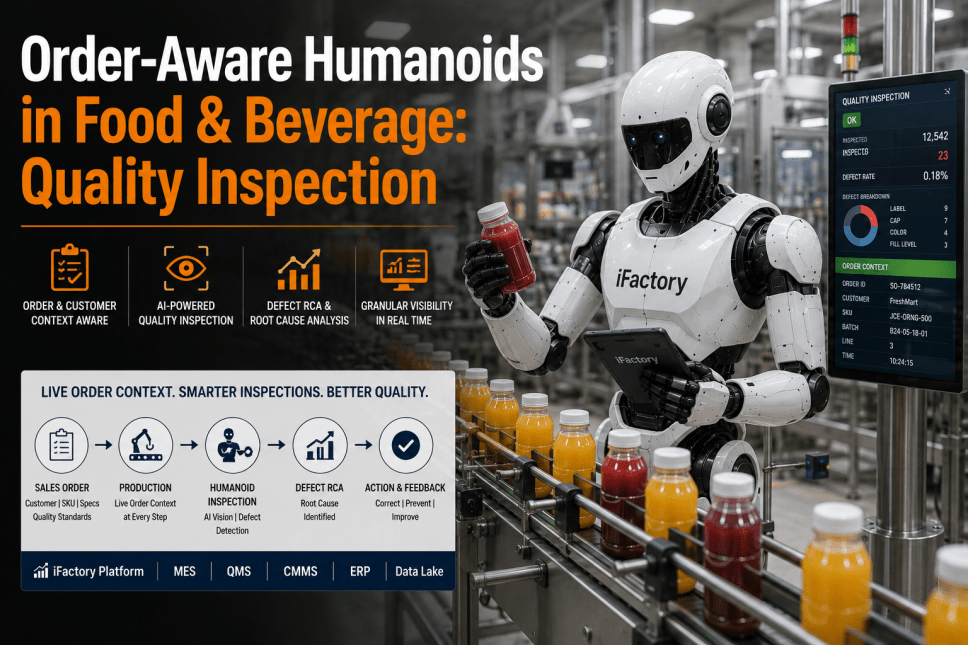
Humanoid robots equipped with embodied AI navigate warehouse aisles, inspect goods at receiving, picking, and packing stages, and classify defects in real time using computer vision models trained on the facility's historical defect library. iFactory's platform ingests robot telemetry alongside WMS, CMMS, and MES data to provide unified defect tracking, automated root cause correlation, and corrective action workflows — enabling quality teams to move from reactive sampling to proactive prevention. To see how this platform would perform on your warehouse data, Book a Demo with iFactory's intralogistics team.
Inline Quality Inspection Across All Zones
Humanoid robots patrol receiving docks, pick zones, packing stations, and shipping lanes — inspecting every unit for damage, correct SKU labeling, and packaging integrity. AI vision models detect dents, tears, mislabels, and seal failures with 97.3% accuracy, classifying defects within 2 seconds per unit versus 4+ minutes for manual inspection.
Real-Time Defect Categorization with Root Cause Context
iFactory AI vision models classify each defect into one of 24 categories — shipping damage, picker error, packaging equipment malfunction, supplier defect — and cross-reference the finding with WMS transaction data, shift logs, and equipment history to surface the probable root cause at the moment of detection.
Automated Corrective Action and CMMS Integration
When the AI detects a defect pattern exceeding threshold, iFactory auto-generates a corrective action work order in the connected CMMS — complete with robot location data, defect imagery, classification details, and probable root cause. The platform also triggers quality holds on affected inventory and notifies the relevant team via mobile alert.
03 / Deploying Humanoid Robot Quality Inspection Across the Warehouse
iFactory deployed the humanoid robot quality inspection platform across the distribution center in a phased rollout over 8 weeks, with zero disruption to order fulfillment operations.
Audit and Data Ingestion
Engineering team audited 12 picking zones, 3 packing stations, and 2 shipping lanes. Historical defect library ingested for AI vision model training. WMS, CMMS, and quality system integration points mapped. Robot patrol routes planned for each zone.
Pilot Deployment on Highest-Impact Zones
Humanoid robots deployed for inline inspection at packing and shipping — the highest defect-impact zones. AI vision models achieved 94% classification accuracy within 14 days. Integration with iFactory CMMS for automated work order generation validated.
Full Facility Expansion
Robot patrol coverage expanded to receiving docks and pick zones. Cross-correlation engine activated, linking robot inspection data with WMS transactions for automated root cause analysis. MES integration for real-time production impact visibility.
Optimization and Team Training
AI model accuracy targets confirmed at 97.3%. Quality team trained on robot supervision, alert response, and exception handling. Automated RCA workflows validated. Full audit trail enabled for customer compliance and continuous improvement.
04 / What the Warehouse Achieved in the First Two Quarters
The deployment of humanoid robot inline quality inspection with iFactory's integrated platform produced measurable improvements in defect detection, root cause analysis velocity, and financial recovery within the first two quarters of operation.
05 / Four Factors That Drove the Quality Inspection Transformation
The measurable impact of this warehouse's transition from manual sampling to humanoid robot inline quality inspection was driven by four structural changes that addressed the root limitations of traditional quality control in high-volume intralogistics.
Inline Inspection Eliminated the Sampling Blind Spot
The single highest-impact change was shifting from 12% random sampling to 100% inline inspection across all outbound units. Humanoid robots patrolling every zone meant zero units shipped without quality validation. This eliminated the structural blind spot that had allowed defect patterns to propagate undetected through 88% of daily volume.
AI Classification Converted Inspection from Reactive to Predictive
AI vision models trained on 18 months of historical defect data detected emerging defect patterns at the earliest stages — before they reached threshold for customer impact. The real-time classification enabled the quality team to intervene during the same shift rather than discovering the issue through end-of-week return reports.
Cross-System Correlation Compressed RCA from Days to Hours
iFactory's unified platform ingested robot inspection data alongside WMS transactions, shift assignments, and equipment logs — enabling automatic root cause correlation at the moment of defect detection. What previously required 5 to 9 days of manual cross-referencing was reduced to a 3-hour automated analysis with documented evidence trail.
Automated Workflows Closed the Corrective Action Loop
The integration between humanoid robot inspections and iFactory's CMMS automated the critical link between defect detection and corrective action. Quality holds were triggered automatically, work orders were generated with full context, and the affected inventory was quarantined — all within minutes of the initial detection rather than days later.
06 / Quality Inspection at Scale: The Strategic Value of Autonomous Warehouse Inspection
This distribution center's transition from manual sampling to humanoid robot inline quality inspection eliminated the structural defect detection gap that had made undetected quality failures a recurring source of millions in annual losses. iFactory's integrated platform gave the quality team continuous, real-time visibility into every unit moving through the facility — with automated defect classification, root cause correlation, and corrective action workflows that compressed response time from weeks to minutes.
The 97.3% inline defect detection accuracy is a quality assurance outcome. The 96% reduction in root cause analysis cycle time is an operational velocity outcome. The $1.8 million in recovered annual losses is a direct financial outcome. And the elimination of customer chargebacks from undetected defect patterns is a brand reputation outcome — one that compounds in value as the facility scales. To assess what iFactory's humanoid robot quality inspection platform would deliver for your warehouse operation, Book a Demo with iFactory's intralogistics solutions team.
Real Answers from Warehouse Operations Leaders
Stop Sampling Your Quality Data. Start Inspecting Every Unit.
Your warehouse is losing millions to undetected defect patterns that manual sampling cannot catch. iFactory humanoid robot quality inspection gives you 100% inline visibility with automated root cause analysis and corrective action workflows. Deployed in 8 weeks, on-prem, no cloud. Book a demo and we will show you on your data.