A global heavy machinery manufacturer producing mining trucks, excavators, and dozers across two assembly plants faced a traceability crisis that no barcode scanner could solve: each machine required over 14,000 individual parts sourced from 600+ suppliers, with customer-specific configuration options that varied by order. When a $2.4 million mining truck reached the customer with the wrong engine variant — a discrepancy that originated in the pre-assembly kitting process — the manufacturer realized that point-of-assembly verification alone could not guarantee order accuracy. By deploying humanoid robots integrated with iFactory's MES and order traceability platform, the manufacturer achieved 99.8% order verification accuracy, reduced traceability documentation labor by 76%, and eliminated $2.4 million in annual rework and penalty costs from order discrepancies. Heavy equipment operations leaders regularly Book a Demo to explore how humanoid order traceability integrates with their existing assembly processes and quality management systems.
The Order Traceability Challenge in Heavy Equipment Assembly
Heavy machinery manufacturing is defined by extreme product variability. A single mining truck model may have 2,400 possible configuration combinations — engine variant, transmission type, dump body capacity, tire specification, cabin layout, and emissions package — each tied to a specific customer order. Traditional order verification relies on manual checklists at key assembly gates, but the complexity of multi-variant assembly means that discrepancies detected at the final test station can require disassembling partially completed machines that have already passed through 12 or more assembly stations. The plant's pre-deployment data showed that 83% of order discrepancies originated in the kitting and sub-assembly stages, but those discrepancies were not detected until final validation — by which point the cost of correction had multiplied by a factor of 8 to 12 compared to detection at the point of origin.
Mixed-Model Assembly Complexity
With 2,400 possible configuration combinations across 14,000 parts per machine, manual verification against the build order at each station was error-prone and incomplete. The existing barcode scanning system verified part arrival but could not confirm that the correct variant was installed for the specific customer order, leading to configuration errors that remained undetected until final test.
Manual Traceability Documentation
Each assembly station required operators to manually record serial numbers, configuration selections, and verification checkpoints on paper build sheets that were later scanned into the MES. Data entry errors and documentation gaps created traceability records that could not be relied upon for root cause analysis when discrepancies were discovered downstream.
Delayed Discrepancy Detection
The average time between a kitting error and its detection at final validation was 6.4 hours — by which point the incorrect component had been installed and the machine had passed through multiple assembly stations. Correction required partial disassembly, replacement parts, and re-testing, costing an average of $18,000 per discrepancy event.
Humanoid Order Traceability in Action
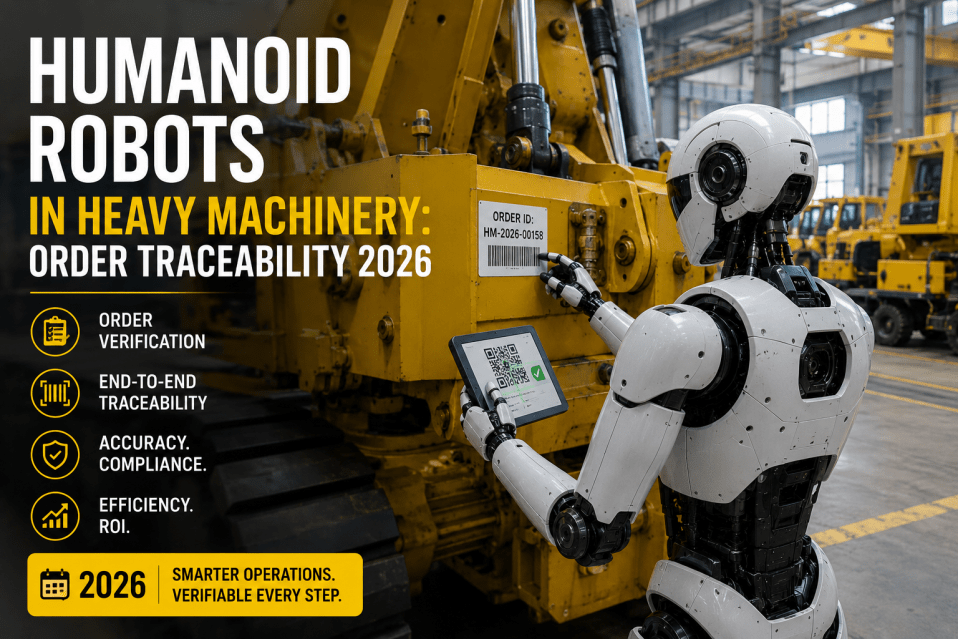
iFactory deployed humanoid robots at critical verification points across both assembly plants — kitting areas, sub-assembly stations, main assembly gates, and final test bays. Each humanoid carries a multi-sensor verification payload: high-resolution cameras for component identification and serial number capture, barcode and RFID readers for part tracking, and thermal imaging for installed-component verification against the build order. Book a Demo to see how humanoid robots synchronize order verification data with the MES and traceability platform in real time.
Automated Component-to-Order Matching — As components arrive at each assembly station, the humanoid robot captures serial numbers, barcodes, and visual identifiers, cross-referencing each component against the active build order in the MES. The system verifies not just that the correct part number is present, but that the correct variant — engine rating, transmission ratio, tire specification — matches the customer order for that specific machine serial number. Discrepancies trigger real-time alerts that halt the line at the station where the error is detected, preventing incorrect components from being installed. Order verification accuracy improved from 92% to 99.8% within the first month of deployment.
Real-Time Assembly Traceability Records — Every component installation event is automatically logged in iFactory's traceability platform with time-stamped photographic evidence, operator identification, and station location. The traceability record is linked to the machine serial number and customer order, creating an immutable build history that spans from kitting to final test. When a downstream test station identifies a performance anomaly, the quality team can query the traceability database and identify the exact component, assembly station, and operator involved within seconds — eliminating the days-long manual investigation process that previously delayed corrective action.
Automated Quality and Compliance Documentation — Each humanoid verification event generates structured data that feeds directly into the plant's quality management system and customer compliance documentation. For regulated components — emissions systems, safety-critical fasteners, certified material lots — the humanoid captures additional verification evidence, including torque verification marks, sealant application confirmation, and thermal readings for interference-fit assemblies. The documentation package for each completed machine is automatically compiled and available for customer review within 24 hours of final test sign-off.
Measurable Traceability and Cost Impact
Within 12 months of deploying humanoid order traceability across both assembly plants, the manufacturer documented verified improvements across every dimension of order accuracy and traceability efficiency. The before-and-after comparison below reflects the measured impact of autonomous verification at each assembly station.
Deployment Architecture and MES Integration
The humanoid order traceability deployment followed a structured four-phase methodology designed for rapid time-to-value across multi-plant heavy equipment manufacturing operations. Each phase built on the previous one to establish a complete end-to-end traceability framework. Book a Demo to explore how the deployment methodology maps to your specific assembly processes and order management systems.
Order Profile and Verification Mapping
iFactory's integration team worked with the manufacturer's order management and production engineering groups to map each customer order type to its component-level verification requirements. The order profile library captured 2,400 configuration combinations with their associated component identifiers, barcode patterns, and visual verification criteria for humanoid deployment.
Humanoid Deployment and Verification Validation
Humanoid robots were deployed at kitting, sub-assembly, main assembly, and final test stations with order verification payloads calibrated for each station's component types and verification requirements. The validation phase confirmed that each humanoid could execute verification cycles within the takt time constraints of each station.
MES Integration and Real-Time Synchronization
Each humanoid verification event was connected in real time to the plant's MES through iFactory's integration API. The MES received component verification data at the individual serial number level, enabling real-time build order status tracking and automated discrepancy alert routing.
Continuous Verification Learning
The verification models were configured to learn from new configuration combinations as they were introduced, updating component identification libraries and verification criteria without requiring manual reprogramming. The continuous learning loop ensured that verification accuracy improved over time as new order types were added.
"The humanoid order traceability system fundamentally changed how we think about assembly verification. Before this deployment, we accepted that a certain number of order discrepancies would reach the customer and that our traceability documentation was only as reliable as the operator filling out the build sheet. Today, every component is verified against the customer order at the station where it is installed, every verification event is documented with photographic evidence in the traceability system, and our quality team can trace any component back to its installation event in seconds. The $2.4 million in eliminated rework and penalty costs is a verified number, but the real value is the confidence that every machine leaving our plant matches its customer order precisely." — Director of Quality and Manufacturing Engineering, Heavy Machinery Division
The Path to Autonomous Order Traceability
This deployment demonstrates that humanoid robot order traceability delivers measurable quality and cost improvements without requiring changes to existing assembly processes or MES infrastructure. iFactory's integration platform connects humanoid verification events directly to the MES and traceability system, enabling real-time order verification, automated documentation, and discrepancy prevention at every assembly station. The manufacturer achieved 99.8% order verification accuracy, reduced traceability documentation labor by 76%, and eliminated $2.4 million in annual discrepancy costs within 12 months of deployment. Operations and quality leaders evaluating their traceability strategy regularly Book a Demo to explore how humanoid order verification can protect their assembly operations from costly configuration errors and documentation gaps.
Frequently Asked Questions
Each humanoid robot receives the active build order from the MES at the start of each assembly cycle. As components arrive at the station, the humanoid captures serial numbers, barcodes, and visual identifiers, cross-referencing each component against the build order's required variants. The verification system checks multiple identification layers — part number, variant code, serial number range, and physical characteristics — to confirm that the exact component specified for the customer order is present before installation proceeds.
When a discrepancy is detected, the humanoid immediately alerts the station operator and the MES, displaying the specific mismatch — expected component versus actual component — on a line-side monitor. The assembly line does not stop automatically unless the discrepancy involves a safety-critical or emissions-regulated component. For non-critical discrepancies, the operator can override the alert with a documented reason code, and the event is logged in the traceability system for quality review. Critical component discrepancies require supervisor verification before assembly can proceed.
For regulated components — emissions control systems, safety-critical fasteners, certified structural materials — the humanoid captures enhanced verification evidence including torque verification marks, sealant application photos, thermal images of interference fits, and lot-specific material certifications linked to the component serial number. Each regulated component's verification record includes the humanoid's image capture, operator ID, station location, and MES timestamp, creating an immutable documentation trail that satisfies regulatory compliance requirements for engine emissions certification and safety-critical assembly verification.
In this deployment, the humanoid order traceability system paid for itself within the first two quarters of full operation through eliminated rework and penalty costs alone. Most heavy equipment manufacturers achieve full ROI within 6 to 9 months, with payback coming from three primary sources: eliminated order discrepancy rework and customer penalties (50-60% of total savings), reduced traceability documentation labor (20-25%), and improved production throughput from reduced rework-related line stoppages (15-20%). iFactory provides a free ROI assessment that quantifies the expected payback for your specific assembly operations within two weeks, based on your historical order discrepancy data and current rework costs. Book a Demo to start the assessment.
Yes. iFactory's platform includes pre-built connectors for SAP, Oracle, Siemens, Rockwell, and 40+ additional MES and ERP systems. Each humanoid verification event is transmitted to the connected systems in real time via standardized APIs, maintaining data consistency across order management, production execution, and quality documentation. The integration layer translates humanoid verification data into system-specific records — MES build status updates, ERP material consumption entries, quality management system inspection records — without requiring custom programming for each integration point.
.png)