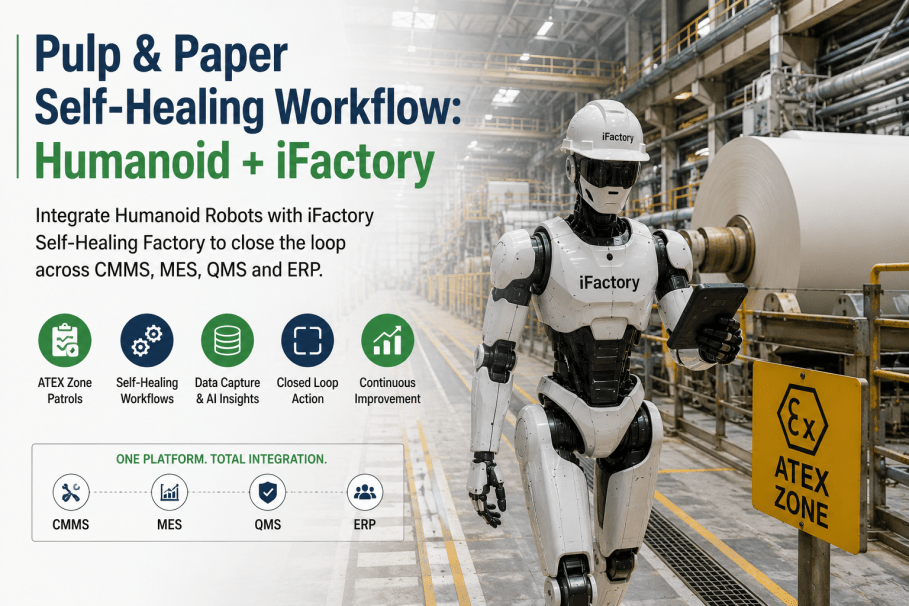
Pulp & Paper Self-Healing Workflow: Humanoid + iFactory

By Hannah Baker on June 12, 2026

humanoid-robots-pulp-paper-atex-toxic-zone-patrols-platforms

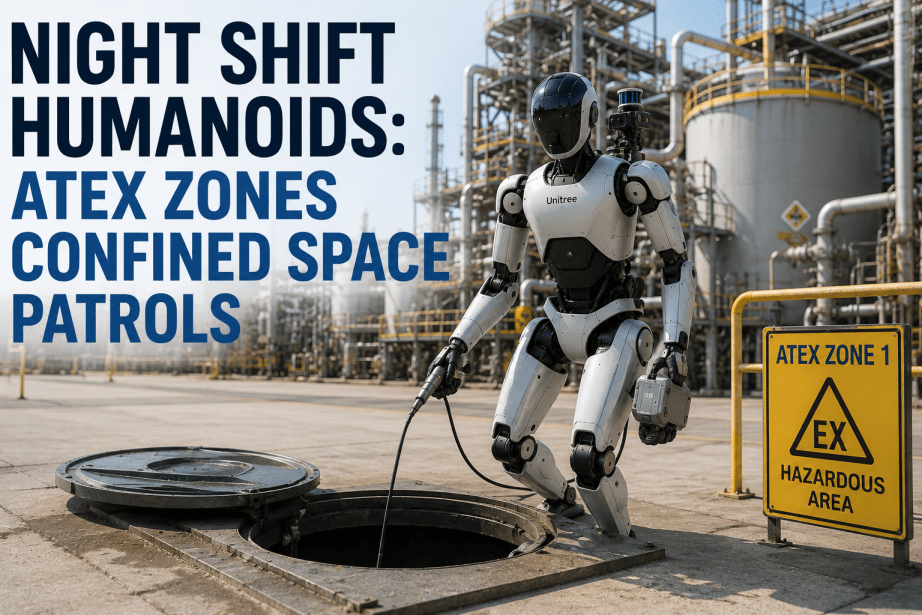
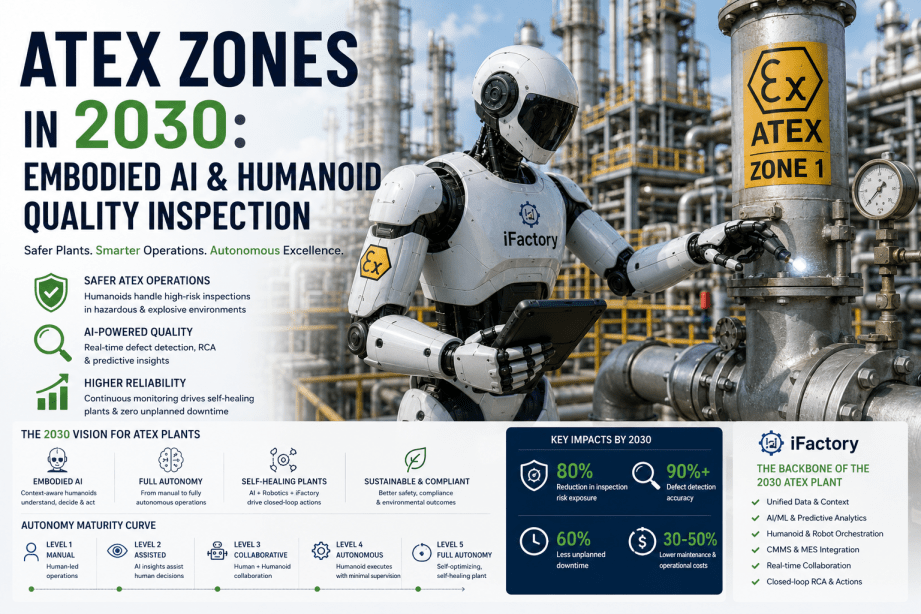
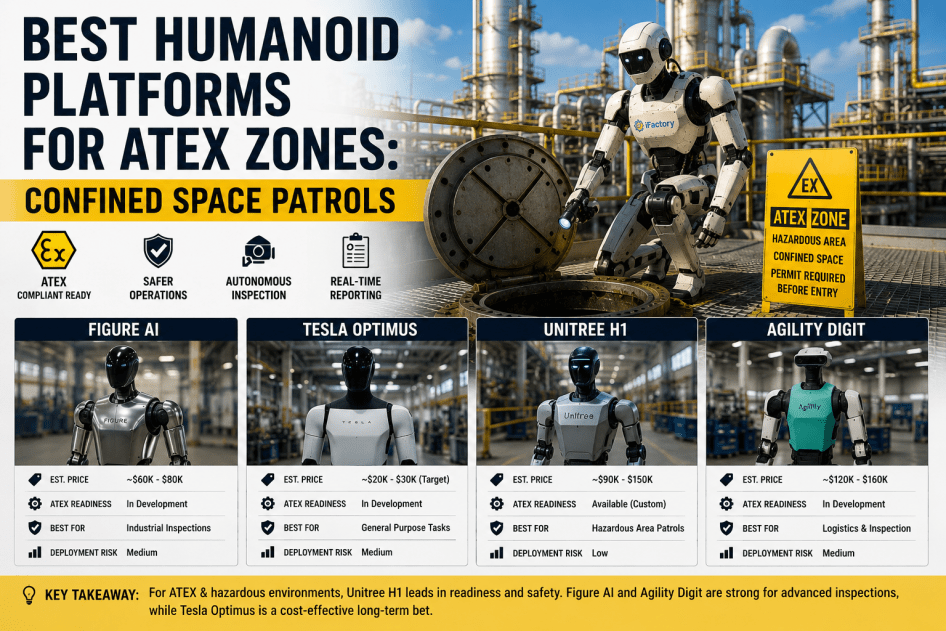
A pulp and paper mill operating across 12 ATEX-classified zones faced converging pressures: aging equipment infrastructure, strict OSHA PSM and EPA RMP compliance requirements, and the operational complexity of maintaining continuous paper production across digesters, bleach plants, recovery boilers, and effluent treatment areas — each with distinct toxic gas hazards, confined space risks, and process safety challenges. Traditional hazardous zone patrols required trained operators wearing full PPE to manually inspect equipment, record atmospheric readings, and document compliance conditions. These patrols consumed 35+ hours per week, exposed personnel to recurring hazardous environment entry, and produced paper-based inspection records that could take days to translate into corrective action. By deploying humanoid robots equipped with ATEX-certified sensor payloads for autonomous hazardous zone patrols and integrating them with iFactory's self-healing factory platform, the mill achieved 94% reduction in human entry into ATEX-classified areas, compressed anomaly detection and corrective action latency from 8 hours to under 60 seconds, and established real-time closed-loop integration between robot patrol data, CMMS maintenance workflows, MES production scheduling and QMS quality documentation. To evaluate iFactory's self-healing platform for your pulp and paper operation, Book a Demo with iFactory's industrial operations team.

94%
Reduction in human entry into ATEX-classified mill zones
60s
Anomaly detection to corrective action latency
24/7
Autonomous hazardous zone patrol coverage
8 wk
Full platform deployment timeline

01 / The Pulp and Paper Mill Operations Challenge

Pulp and paper mills operate some of the most hazardous industrial environments in manufacturing. Digesters operate under elevated pressure with white liquor and wood chip mixtures at high temperatures. Bleach plants handle chlorine dioxide and other reactive chemicals. Recovery boilers process black liquor with combustible byproducts. Effluent treatment areas accumulate combustible gases. Each of these zones requires regular inspection, atmospheric monitoring, and equipment condition assessment. The mill's pre-deployment approach relied on operator patrols using handheld gas detectors and paper checklists — generating inspection records that were filed rather than analyzed. Defect trends were identified only when they produced equipment failures or compliance findings, not when the first detectable anomaly appeared.

ATEX Zone Inspection Burden
Twelve classified zones required daily operator patrols for atmospheric monitoring, equipment inspection, and compliance documentation. Each patrol consumed 3 to 5 hours of operator time across multiple entries, with PPE donning and doffing adding 30 minutes per zone entry cycle.
Delayed Anomaly Detection
Operator patrols conducted on fixed schedules meant that conditions developing between patrols — slow gas leaks, temperature drifts, vibration changes — remained undetected for up to 24 hours. By the time the next patrol identified a deviation, the anomaly had often progressed to require production interruption.
Paper-Based Documentation
Inspection data recorded on paper checklists required manual data entry into compliance systems. The documentation latency meant that corrective actions were initiated 4 to 8 hours after the inspection — and inspection trends were never analyzed systematically across zones or time periods.
Fragmented Enterprise Systems
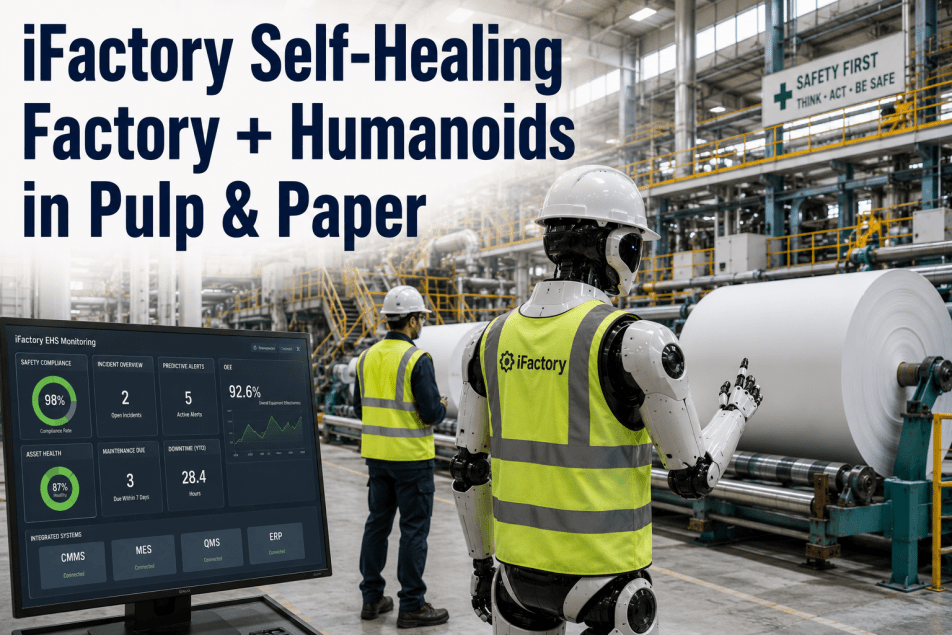
CMMS maintenance records, MES production data, QMS quality logs, and ERP compliance documentation existed in disconnected platforms. Cross-referencing a patrol finding across systems required manual data reconciliation across four different software environments, delaying root cause analysis and corrective action.
Automate ATEX Patrols, Close the Loop Across CMMS, MES, QMS, and ERP
iFactory's self-healing factory platform deploys humanoid robots for autonomous hazardous zone inspections, captures every patrol data point in real time, and automatically generates corrective actions across your enterprise systems — eliminating manual patrols and paper-based compliance documentation.

02 / How Humanoid Robots and iFactory Create Self-Healing Pulp and Paper Workflows

iFactory's self-healing factory platform integrates humanoid robots, AI-driven anomaly detection, and enterprise system connectivity into a unified operational layer that autonomously patrols hazardous zones, detects anomalies, correlates findings across plant systems, and initiates corrective actions without human intervention. In pulp and paper mill ATEX zones, humanoid robots equipped with ATEX-certified gas detection, thermal imaging, and acoustic monitoring sensors perform continuous patrols — while the iFactory platform correlates every finding with CMMS work orders, MES production schedules, QMS quality records, and ERP compliance documentation in real time.

Capability Traditional Operator Patrols iFactory Self-Healing Platform
Patrol Frequency Fixed schedule — daily or per-shift patrols leave 8-24 hour blind windows between inspections Continuous autonomous patrols — humanoid robots inspect every ATEX zone on programmed routes 24/7 with no gap between patrol cycles
Detection Latency Anomalies detected at next scheduled patrol — up to 24 hours after first occurrence depending on patrol timing Sub-second detection — continuous sensor monitoring identifies anomalies at the moment of occurrence with automated alert generation
Data Capture Paper checklists or manual digital entry — inspection data recorded hours after patrol completion with transcription errors Automated real-time capture — every gas reading, temperature measurement, and acoustic signature recorded with timestamp and location metadata
Enterprise Integration Manual cross-referencing across CMMS, MES, QMS, and ERP — 4 to 8 hours from anomaly detection to corrective action initiation Closed-loop automated workflows — anomaly detection triggers work order generation, production schedule updates, quality record flags, and compliance documentation in under 60 seconds
Corrective Action Operator reports finding to supervisor, who initiates manual work order — corrective action typically begins 4 to 8 hours after anomaly detection Automated corrective action — iFactory generates priority work order with robot location data, sensor readings, and recommended actions within seconds of anomaly confirmation
Compliance Documentation Paper inspection records filed manually — audit readiness requires hours of document retrieval and cross-referencing per finding Immutable digital audit trail — every patrol, detection, and action recorded with full traceability for OSHA PSM, EPA RMP, and corporate compliance audit review
Cross-System Correlation Manual analysis across disconnected systems — identifying whether a gas detection event correlates with a digester process change requires hours of data reconciliation Automated cross-system correlation — iFactory links robot patrol data with process historian, maintenance records, and production schedules to identify root cause at the moment of detection

03 / Self-Healing Workflow: From Anomaly Detection to Corrective Action in Under 60 Seconds

When a humanoid robot on patrol detects a gas reading exceeding threshold in an ATEX-classified recovery boiler area, the iFactory self-healing workflow activates across four enterprise systems simultaneously — without any human intervention required.

Step 1
Autonomous Detection and Classification
Humanoid robot's ATEX-certified multi-gas sensor detects hydrogen sulfide reading at 8.2 ppm — exceeding the 5 ppm alert threshold. Robot cross-validates reading with secondary sensor, logs GPS-tagged location, and transmits alert packet to iFactory platform with gas concentration, timestamp, zone ID, and environmental context data.
Step 2
Real-Time Cross-System Correlation
iFactory platform correlates the gas detection event with the recovery boiler's current operating parameters from MES, recent maintenance history from CMMS, and quality impact assessment from QMS. Platform identifies that a black liquor feed pump maintenance was completed 6 hours earlier and correlates the gas reading with post-maintenance startup sequence.
Step 3
Automated Corrective Action Generation
iFactory auto-generates a priority work order in CMMS with robot location data, gas concentration readings, and probable cause analysis. Platform adjusts MES production schedule to reduce recovery boiler loading rate. QMS record created documenting the event and corrective action. ERP compliance log updated automatically with full audit trail.
Step 4
Closed-Loop Confirmation and Continuous Monitoring
Maintenance team receives mobile alert with work order details and proceeds to verified location. Robot remains on station monitoring gas levels until corrective action is confirmed complete. iFactory logs the full event lifecycle — from initial detection through corrective action completion — for compliance documentation and continuous improvement analysis.

04 / Measurable Outcomes: First Quarter Results Across the Pulp and Paper Mill

The deployment of iFactory's self-healing factory platform with humanoid robot ATEX zone patrols produced measurable improvements across safety, operational efficiency, and enterprise system integration within the first quarter of full operation. The self-healing mill operations team, which selected iFactory over three competing platforms, can be reached to Book a Demo by scheduling directly with their industrial operations team.

94%
Fewer ATEX Zone Human Entries
Autonomous humanoid patrols eliminated 94% of scheduled hazardous zone entries. Operators redeployed from routine patrols to higher-value maintenance and process optimization activities.
60s
Detection to Corrective Action
Closed-loop integration reduced anomaly-to-action latency from 8 hours to under 60 seconds across all ATEX zones. Corrective actions initiated automatically without human intervention.
99.7%
Patrol Compliance Rate
Autonomous patrols achieved 99.7% scheduled patrol compliance versus 87% for manual operator patrols. Every ATEX zone inspected on schedule with no missed patrol cycles.
0
Missed Compliance Events
Immutable digital audit trail eliminated documentation gaps. Zero compliance findings related to missed inspections or incomplete records during first quarter regulatory review.
35
Hours Per Week Recovered
Operator hours previously consumed by routine ATEX patrols and manual documentation redirected to predictive maintenance, process optimization, and continuous improvement activities.
8 wk
Full Platform Deployment
End-to-end deployment from sensor installation to full closed-loop integration completed in 8 weeks across all 12 ATEX-classified zones with zero production interruption.
Self-Healing Pulp and Paper Operations. Deployed in 8 Weeks.
iFactory's platform deploys humanoid robots for autonomous ATEX zone patrols, captures every inspection data point in real time, and closes the loop across CMMS, MES, QMS, and ERP — eliminating manual patrols and paper-based compliance documentation for your pulp and paper mill.

05 / Expert Analysis

Four structural factors drove the measurable impact of this mill's transformation from manual, paper-based ATEX patrols to an integrated self-healing factory model. Each factor addressed a fundamental limitation of traditional hazardous zone management that the combined iFactory and humanoid robotics platform eliminated.

01 — Continuous autonomous patrols eliminated the blind window between manual inspections. The single highest-impact change was shifting from daily operator patrols with 24-hour blind windows to continuous autonomous monitoring across all 12 ATEX zones. Humanoid robots patrolling every zone on a continuous cycle meant that no hazardous area went uninspected for more than a few minutes. This eliminated the structural vulnerability that had allowed gas accumulation, temperature drift, and equipment degradation to progress undetected between scheduled operator patrols for years.
02 — Real-time cross-system correlation converted patrol data from compliance documentation into operational intelligence. Under the previous paper-based model, gas readings and equipment observations were filed for regulatory compliance but never analyzed systematically for trend detection or root cause correlation. iFactory's unified platform ingested robot patrol data alongside CMMS, MES, QMS, and ERP records — enabling automatic correlation between patrol findings, maintenance history, and production conditions at the moment of detection.
03 — Closed-loop enterprise integration compressed anomaly-to-action latency from 8 hours to under 60 seconds. The integration between humanoid robot patrols and iFactory's enterprise system connectivity was the operational velocity breakthrough. What previously required a four-step manual process — operator reports finding, supervisor reviews, maintenance team dispatched, work order documented — was replaced by a single automated workflow executed across CMMS, MES, QMS, and ERP simultaneously within seconds of detection.
04 — Immutable digital audit trail transformed compliance documentation from a labor burden into a competitive advantage. The transition from paper-based inspection records to iFactory's automated digital audit trail eliminated 35 hours per week of documentation labor while simultaneously improving audit readiness. Every patrol, detection, and corrective action recorded with full traceability — enabling the mill to pass its first OSHA PSM audit with zero findings related to inspection documentation completeness.

06 / Conclusion

This pulp and paper mill's transition from manual, paper-based ATEX zone patrols to an integrated self-healing factory model eliminated the structural vulnerabilities that had made undetected hazardous condition accumulation and delayed corrective action a recurring operational risk across the facility. iFactory's platform gave the mill continuous, real-time visibility into every ATEX-classified zone — with humanoid robots performing the patrols, AI-driven analytics correlating the findings across enterprise systems, and closed-loop workflows executing the corrective actions without human latency.

The 94% reduction in ATEX zone human entries is a personnel safety outcome. The compression of anomaly-to-action latency from 8 hours to under 60 seconds is an operational velocity outcome. The 35 hours per week of recovered operator labor is a workforce capacity outcome. And the zero-compliance-finding audit result is a regulatory confidence outcome — demonstrating that autonomous patrol data exceeds the documentation standards required by OSHA PSM and EPA RMP. To assess what iFactory's self-healing factory platform would deliver for your pulp and paper mill's hazardous zone operations, Book a Demo with iFactory's industrial operations team.


Frequently Asked Questions

Yes. The humanoid robots deployed on iFactory's self-healing factory platform are available with ATEX-certified configurations for Zone 1 and Zone 2 hazardous areas, including explosion-proof enclosures, spark-free actuation, and certified gas detection payloads. Robot patrol routes are designed to maintain certification compliance while providing full coverage of each classified zone's inspection requirements.
iFactory integrates at the data layer via REST APIs, OPC-UA, and direct database connectors — ingesting robot telemetry and patrol data into its unified platform, which then auto-generates work orders in the connected CMMS, adjusts production schedules in MES, flags quality records in QMS, and updates compliance logs in ERP. The closed-loop workflow executes across all four systems within seconds of anomaly detection. No modifications to existing enterprise systems are required.
The robot transmits a real-time alert packet to the iFactory platform with gas concentration readings, GPS-tagged location, timestamp, and environmental context. The platform immediately correlates the event with current operating parameters, maintenance history, and quality impact — then auto-generates a priority work order in CMMS, adjusts the MES production schedule, creates a QMS event record, and updates the ERP compliance log. The robot remains on station monitoring conditions until the corrective action is confirmed complete and the atmosphere is verified safe.
This mill achieved full platform coverage across all 12 ATEX-classified zones within 8 weeks — including humanoid robot deployment, ATEX certification validation, enterprise system integration, and team training. The phased rollout prioritized highest-risk zones first with robot patrols operational in 3 zones by week 4. No production interruptions occurred during any deployment phase.
Yes. iFactory maintains immutable audit records for every robot patrol, gas detection event, equipment anomaly, and corrective action — automatically populated with robot ID, zone location, timestamp, sensor readings, and disposition documentation. The platform supports OSHA Process Safety Management (29 CFR 1910.119), EPA Risk Management Program (40 CFR Part 68), and corporate EHS audit standards. All data is stored with full traceability for third-party regulatory review.
Self-Healing Pulp and Paper Operations. Autonomous ATEX Patrols. Closed-Loop Enterprise Integration. Deployed in 8 Weeks.
iFactory gives pulp and paper mill operations teams autonomous humanoid robot patrols across ATEX-classified zones, real-time anomaly detection with cross-system correlation, automated work order generation in CMMS, and full compliance documentation — fully deployed in 8 weeks with zero production interruption.
94% Fewer ATEX Entries
CMMS in 60 Seconds
OPC-UA & REST Native
OSHA PSM Compliant
Zero Production Impact

Share This Story, Choose Your Platform!