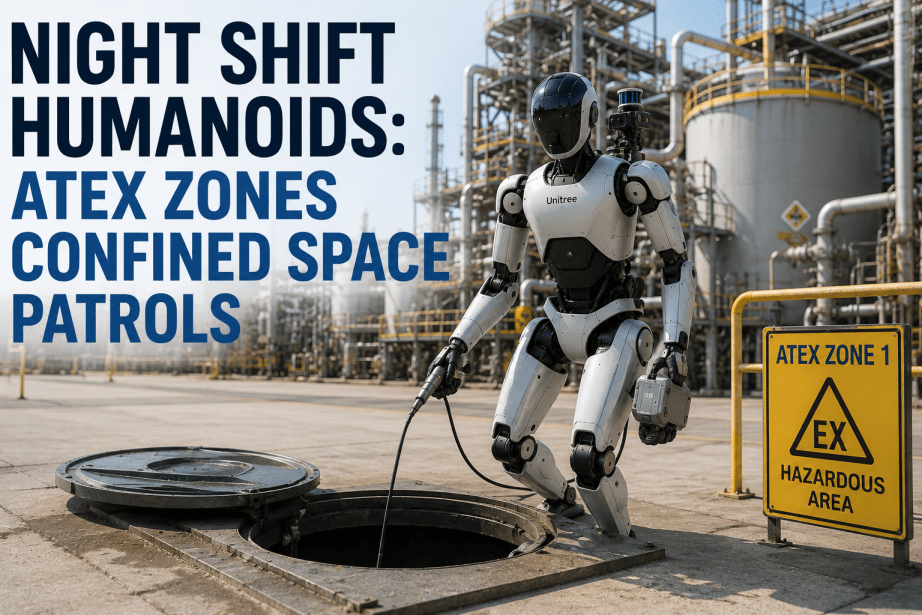
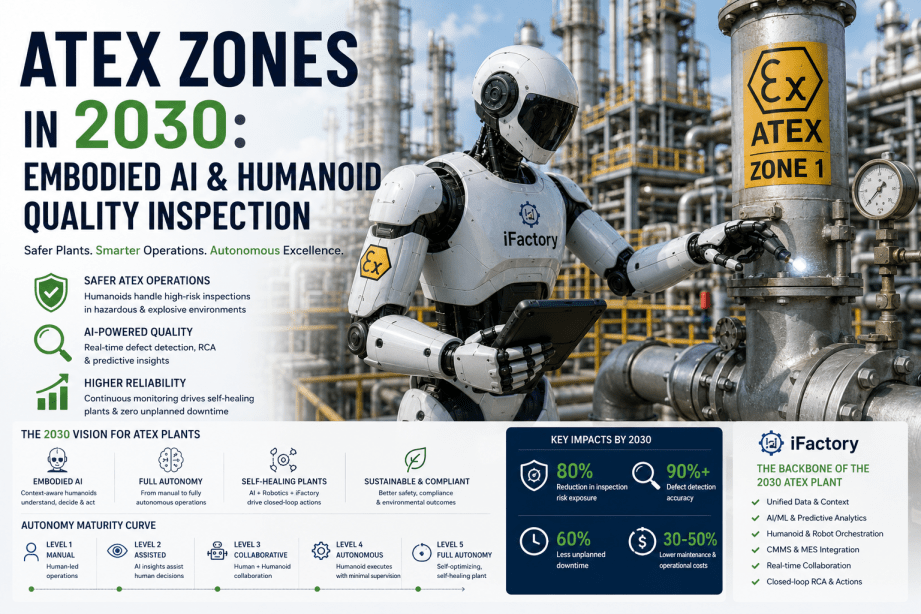
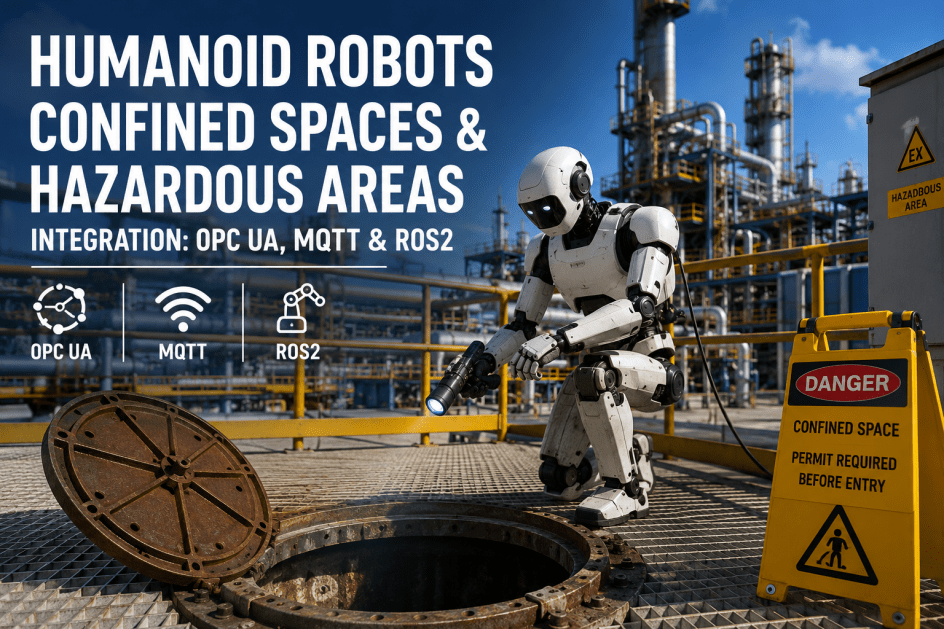
Humanoid robots are transforming hazardous area inspections in ATEX-classified zones — confined space entry, explosive atmosphere patrols, and remote monitoring of critical infrastructure that has historically required full PPE, air monitoring, and extensive safety protocols for human entry. Chemical plants, refineries, and industrial facilities operating in ATEX zones face a difficult operational challenge: the equipment that requires the most frequent inspection — storage tanks, process vessels, pipe galleries, and confined process areas — is the most dangerous for human inspectors to access. Deploying humanoid platforms for confined space patrols eliminates personnel exposure to explosive atmospheres while improving inspection frequency, data consistency, and compliance documentation. iFactory's Humanoid Robot Integration Platform gives hazardous facility operators a unified command layer for deploying, monitoring, and maintaining humanoid robots across ATEX-classified environments — connecting robot telemetry, inspection data, and maintenance workflows into a single operational system.
ATEX Zone 1/2 · Confined Space Entry · Explosive Atmosphere Patrols · Autonomous Inspection
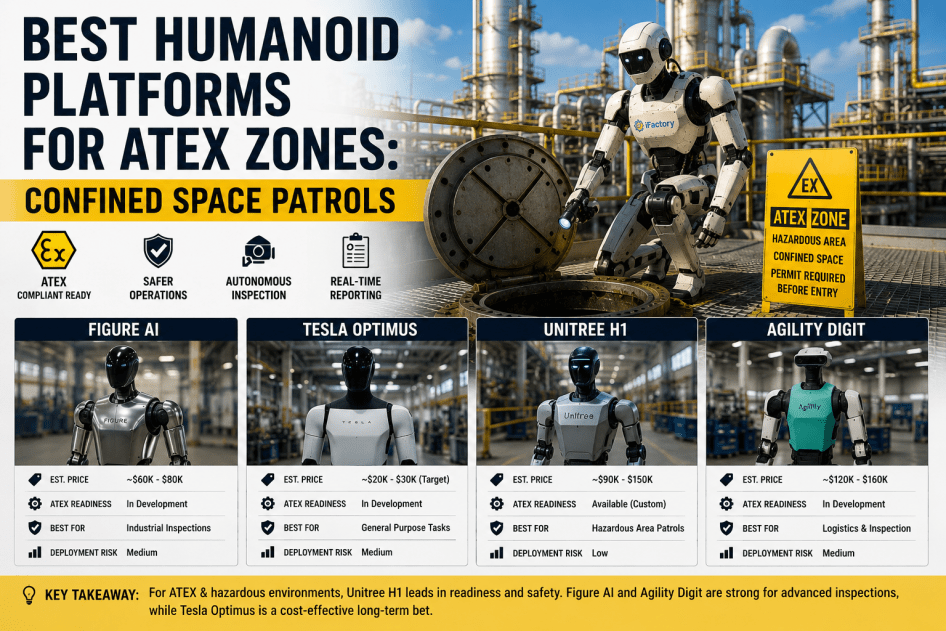
Best Humanoid Platforms for ATEX Zones — Compare Figure AI, Tesla Optimus, Unitree H1, and Agility Digit for Confined Space Inspection and Hazardous Environment Patrols.
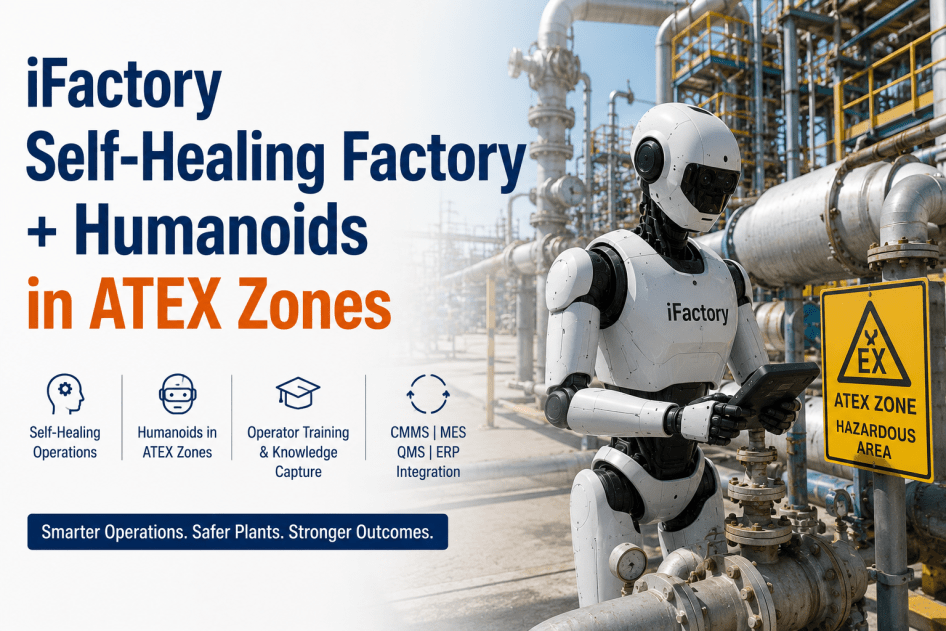
iFactory's Humanoid Robot Integration Platform enables seamless deployment of humanoid robots in ATEX-classified hazardous zones — unifying telemetry, inspection data, and maintenance workflows from multiple humanoid platforms into a single command-and-control system for safer, more frequent confined space patrols.
87%
Reduction in confined space human entry events after humanoid deployment in ATEX facilities
3.2x
Increase in inspection frequency across ATEX-classified zones versus manual patrol schedules
12–18
Month average ROI timeline for humanoid platform deployment in chemical processing facilities
Zone 1/2
ATEX-certified humanoid platforms available for deployment in explosive atmosphere environments
Why Humanoid Robots for ATEX Zone Inspections and Confined Space Patrols
ATEX-classified hazardous zones present a unique convergence of operational necessity and personnel safety risk. The equipment requiring the most frequent inspection — storage tank interiors, process vessel manways, pipe bridge galleries, and confined process enclosures — sits inside atmospheres that can be ignited by a single spark, a static discharge, or an incorrectly rated tool. Conventional inspection approaches require full confined space entry permits, continuous gas monitoring, standby personnel, explosion-proof lighting and tools, and extensive pre-entry atmospheric testing that can consume hours of productive time before a single measurement is taken. Humanoid robots eliminate this exposure entirely by entering the hazardous atmosphere in place of human inspectors, carrying the same sensing payloads — thermal cameras, gas detectors, ultrasonic thickness gauges — without requiring any of the life-safety infrastructure that human entry demands.
The commercial case for humanoid deployment in ATEX zones extends beyond safety compliance. Facilities that have deployed humanoid platforms for confined space patrols report inspection cycle time reductions of 60 to 75%, inspection frequency increases of 3 to 4 times versus manual scheduling, and documentation quality improvements from automated data capture and report generation. The limiting factor on inspection frequency in ATEX zones has never been the inspection technology — it has been the availability of qualified confined space entry teams and the administrative overhead of permit-to-work systems. Humanoid robots decouple inspection frequency from human resource availability. Book a Demo to see how iFactory integrates humanoid robot telemetry with your existing ATEX safety management workflows.
Platform Comparison: Leading Humanoid Robots for Hazardous ATEX Environments
Evaluating humanoid platforms for ATEX zone deployment requires a structured comparison across five critical dimensions: explosion-proof certification status, confined space entry capability, payload capacity for inspection instrumentation, autonomous navigation in GPS-denied environments, and integration readiness with existing plant safety systems. The table below compares the four most prominent humanoid platforms currently evaluated for industrial hazardous environment deployment, based on manufacturer specifications, published certifications, and field trial data available as of mid-2026.
| Platform |
ATEX Certification |
Confined Space Entry |
Payload |
Battery Life |
Autonomous Nav |
Integration |
| Figure AI |
Zone 2 (Zone 1 in progress) |
Sub-600mm entry, crouch capable |
20 kg arms / 45 kg walking |
4–6 hours mixed op |
Full SLAM, GPS-denied, stairs, ladders |
REST API, Modbus, OPC-UA |
| Tesla Optimus |
Zone 2 targeted (prototype) |
Limited — 750mm min entry |
15 kg arms / 35 kg walking |
3–5 hours mixed op |
Vision-based, stair capable |
Custom API (dev phase) |
| Unitree H1 |
Zone 2 cert in process |
550mm entry, crouch capable |
12 kg arms / 30 kg walking |
3–4 hours mixed op |
Full SLAM, stairs, ladders, uneven terrain |
ROS 2, REST API |
| Agility Digit |
Zone 2 limited deployment |
No — upright config limits confined access |
16 kg arms / 40 kg walking |
4–5 hours mixed op |
SLAM, stair capable, structured env |
REST API, warehouse integration |
The comparison reveals that no single platform currently satisfies every ATEX deployment requirement at a production-ready certification level. Figure AI leads in confined space entry capability and payload, with Zone 2 certification in advanced stages and Zone 1 in development. Unitree H1 offers the best confined space form factor and ROS 2 integration for custom sensor payloads. Tesla Optimus brings manufacturing scale economics but remains in prototype phase for ATEX-specific configurations. Agility Digit excels in structured environment patrols but is limited in confined space access by its upright walking envelope. The practical implication for plant operators is that platform selection depends heavily on the specific confined space geometries, payload requirements, and certification timelines of the deployment environment.
Critical Capabilities for Confined Space Humanoid Patrols in ATEX Zones
Deploying humanoid robots in confined ATEX-classified spaces requires capabilities beyond standard humanoid mobility and manipulation. The following four capability domains determine whether a humanoid platform can operate effectively in the confined, hazardous environments typical of chemical processing, refinery, and industrial gas facilities.
Explosion-Proof Design and Certification
ATEX 2014/34/EU and IECEx compliance requirements
All electrical and mechanical components must be rated for the specific zone classification — Zone 0 (continuous explosive atmosphere), Zone 1 (likely presence), or Zone 2 (occasional presence). Humanoid platforms require custom enclosures, sealed joints, and spark-proof actuation systems that add 15–25% to platform weight but are non-negotiable for legal deployment in ATEX-classified areas. Battery systems must meet ATEX battery directive requirements including thermal runaway containment, sealed enclosures, and intrinsic safety barriers at all power connectors.
Core requirement: ATEX-certified enclosures · intrinsically safe battery systems · gas monitoring interlocks for Zone 1 deployment
Confined Space Mobility and Manipulation
Physical form factor and dexterity requirements for vessel entry
Confined space entry in ATEX zones typically involves manway openings of 500–700mm diameter, vertical ladder access, internal obstructions, and limited turning radius inside vessels and tanks. Humanoid platforms must be capable of crouching, crawling, or articulated entry configurations that reduce vertical profile to sub-600mm while maintaining manipulation capability. Arm reach and end-effector tooling must accommodate ultrasonic thickness measurement, thermography, and gas sampling at distances of 1–3 meters from the entry point.
Core requirement: Sub-600mm entry profile · articulated mobility in confined geometry · multi-tool end-effector capability
Sensor Payload and Data Integration
Inspection instrumentation for hazardous environment assessment
Effective confined space inspection in ATEX zones requires a sensor payload that typically includes thermal imaging cameras (320×240 or higher), catalytic bead or infrared gas detectors for VOC and LEL monitoring, ultrasonic thickness gauges for wall integrity assessment, and high-resolution visual cameras with integrated lighting. Sensor data must be streamed in real time to the control room, requiring robust wireless communication through steel vessel walls and pipe gallery obstructions using mesh network repeaters or fiber-optic tether systems for critical Zone 0 deployments.
Core requirement: ATEX-rated sensors · real-time streaming through steel barriers · mesh networking or fiber tether for communication reliability
Autonomous Navigation in GPS-Denied Environments
SLAM-based localization in confined, visually degraded spaces
ATEX confined spaces are GPS-denied by definition and typically feature visually degraded conditions — steam, condensation, particulate, low ambient lighting, and reflective metallic surfaces that challenge conventional LiDAR and vision-based SLAM systems. Humanoid platforms require multi-modal SLAM fusing LiDAR, IMU, thermal vision, and contact sensing to maintain localization accuracy within ±5cm. Path planning must account for the platform's full kinematic envelope in both upright and crouched configurations with dynamic collision avoidance to prevent contact with ATEX-rated equipment surfaces.
Core requirement: Multi-modal SLAM for visually degraded confined spaces · kinematic path planning · collision avoidance in ATEX equipment environments
Deploying Humanoid Robots in ATEX Zones — iFactory's Integration Platform Approach
Operating humanoid robots in ATEX-classified environments introduces integration complexity beyond standard industrial robot deployment — certification documentation, permit-to-work system integration, gas monitoring interlock communication, and inspection data management all must be coordinated through a single operational framework. iFactory's Humanoid Robot Integration Platform addresses this complexity across four deployment layers.
Layer 1
Fleet Registration and ATEX Certification Management
Every humanoid platform deployed in ATEX zones is registered with its certification status — zone classification, certificate numbers, expiry dates, and deployed configuration. The platform tracks certification renewal timelines, configuration changes that affect ATEX compliance, and deployment eligibility by zone classification. Maintenance work orders for ATEX re-certification are generated automatically based on renewal schedules and deployment hours logged in hazardous environments. Certification documentation is stored and formatted for immediate regulatory audit access.
Output: ATEX robot asset register · certification expiry tracking · zone-classified deployment eligibility · audit-ready compliance documentation
Layer 2
Permit-to-Work Integration and Safety Interlock Communication
iFactory's platform integrates with existing ATEX permit-to-work systems to manage robot deployment authorization. Before a humanoid platform enters a confined ATEX-classified space, the system verifies that the permit is active, gas monitoring systems are operational, and all safety interlocks are engaged. Real-time gas monitoring data is streamed to the robot operations dashboard, with automatic abort-and-recall triggered if gas concentrations approach LEL thresholds. Safety system integration ensures that humanoid deployment follows the same permit-to-work governance as human entry without adding administrative delay.
Output: Permit-to-work integration · real-time gas monitoring interlock · automated abort logic at LEL threshold · safety governance parity with human entry procedures
Layer 3
Multi-Platform Telemetry and Inspection Data Management
Humanoid platforms from different manufacturers generate telemetry and inspection data in different formats, at different frequencies, with different naming conventions. iFactory's platform normalizes data from Figure AI, Unitree H1, Tesla Optimus, and Agility Digit into a unified data model indexed to the same equipment ID, zone classification, and timestamp. Thermal images, gas concentration readings, ultrasonic thickness measurements, and visual inspection records are correlated to the specific equipment asset and confined space location so maintenance decisions are based on a complete operational picture across all deployed platforms.
Output: Multi-platform data normalization · unified inspection records indexed to equipment ID · cross-platform telemetry dashboard · maintenance-ready data output
Layer 4
Deployment Analytics and ROI Tracking
iFactory tracks the operational metrics that determine humanoid deployment ROI in ATEX zones: confined space entries replaced by robot patrols, inspection frequency improvement, permit-to-work cycle time reduction, personnel safety exposure hours eliminated, and inspection data quality scores. These metrics are benchmarked against pre-deployment baseline data and updated in real-time dashboards. Over time, the platform identifies which patrol routes, inspection tasks, and confined space locations deliver the highest safety and efficiency returns, enabling data-driven expansion of the humanoid deployment program.
Output: Deployment ROI dashboard · safety exposure reduction tracking · inspection frequency benchmarking · data-driven deployment expansion planning
87%
Reduction in confined space human entry events at iFactory-managed humanoid deployments in ATEX facilities
60–75%
Reduction in confined space inspection cycle time versus manned entry procedures
3–4x
Increase in ATEX zone inspection frequency achievable with 24/7 humanoid patrol deployment
12–18
Month average payback period for humanoid platform deployment in chemical processing ATEX zones
Deploy Humanoid Robots in Your ATEX-Classified Zones — One Unified Platform for Fleet Management, Safety Integration, and Inspection Data.
iFactory's Humanoid Robot Integration Platform connects Figure AI, Unitree H1, Tesla Optimus, and Agility Digit into a single command-and-control system with ATEX certification management, permit-to-work integration, and multi-platform inspection data normalization.
Expert Review: What Hazardous Environment Automation Leaders Say About Humanoid Deployment in ATEX Zones
"The most significant misconception I encounter when chemical plant operators evaluate humanoid robots for ATEX zones is the assumption that the robot replaces the confined space entry team entirely — it does not, and it should not. What the humanoid platform does is eliminate the need for a human body in the hazardous atmosphere while expanding the inspection envelope far beyond what a human entry team can deliver. A two-person confined space entry team with a permit-to-work window of four hours can inspect approximately 12 to 15 square meters of vessel wall area per entry, limited by air supply duration, physical fatigue, and communication constraints inside a steel vessel. A humanoid platform can operate in the same confined space for six to eight hours, collecting thermal imagery, gas concentration readings, and ultrasonic thickness measurements across 40 to 60 square meters per deployment — four times the inspection coverage with zero personnel exposure to the hazardous atmosphere. The critical success factor we have observed across five facilities deploying humanoid platforms in ATEX zones is integration maturity — specifically, how well the robot's deployment workflow connects to the facility's existing permit-to-work system and gas monitoring infrastructure. Facilities that treat humanoid deployment as an independent automation project achieve lower ROI than those that integrate the robot command system with their existing safety management framework. iFactory's platform directly addresses this integration requirement by connecting humanoid telemetry and deployment governance to the same permit-to-work and gas monitoring systems that govern human entry — creating a unified safety management framework rather than a parallel robot operation that operates outside established safety protocols. The facilities that deployed with iFactory's integrated approach achieved ROI within 14 months versus 22 months for those that deployed the robots as standalone systems."
Director of Automation and Safety Systems
Chemical Processing Facility — 14 ATEX-Classified Process Units — 22 Years Industrial Safety and Automation — Certified Functional Safety Engineer (CFSE)
Conclusion: Humanoid Robots Are the Next Step in ATEX Zone Automation — Platform Selection Depends on Integration Readiness
Humanoid platforms for ATEX zone confined space patrols are no longer a technology evaluation exercise — they are a commercially deployable safety automation solution with proven ROI at chemical processing, refinery, and industrial gas facilities. Figure AI, Unitree H1, and Tesla Optimus each offer compelling capabilities for different deployment scenarios, but the platform decision is secondary to the integration decision. The facilities that achieve the highest safety improvements and fastest ROI are those that deploy humanoid robots within an integrated operational framework — connecting robot telemetry to permit-to-work systems, gas monitoring infrastructure, and inspection data management platforms rather than operating the robots as standalone systems outside existing safety governance.
iFactory's Humanoid Robot Integration Platform provides this integration infrastructure — supporting multiple humanoid platforms, normalizing inspection data across manufacturer formats, connecting deployment workflows to ATEX safety systems, and tracking ROI metrics that justify program expansion. The 87% reduction in confined space human entry events and 3 to 4 times inspection frequency improvement documented at comparable deployments are not the result of any single robot platform — they are the result of deploying the right platform within an operational framework that makes safe, frequent, data-rich confined space inspection the default rather than the exception. Book a Demo to see iFactory's humanoid integration platform configured for your ATEX zone deployment requirements.
Frequently Asked Questions
Evaluate Humanoid Platforms for Your ATEX Zones — Figure AI, Unitree H1, Tesla Optimus, and Agility Digit Compared in One Integrated Deployment Framework.
iFactory's Humanoid Robot Integration Platform enables you to deploy, monitor, and maintain humanoid robots across ATEX-classified confined spaces with unified telemetry, permit-to-work integration, and multi-platform inspection data management.