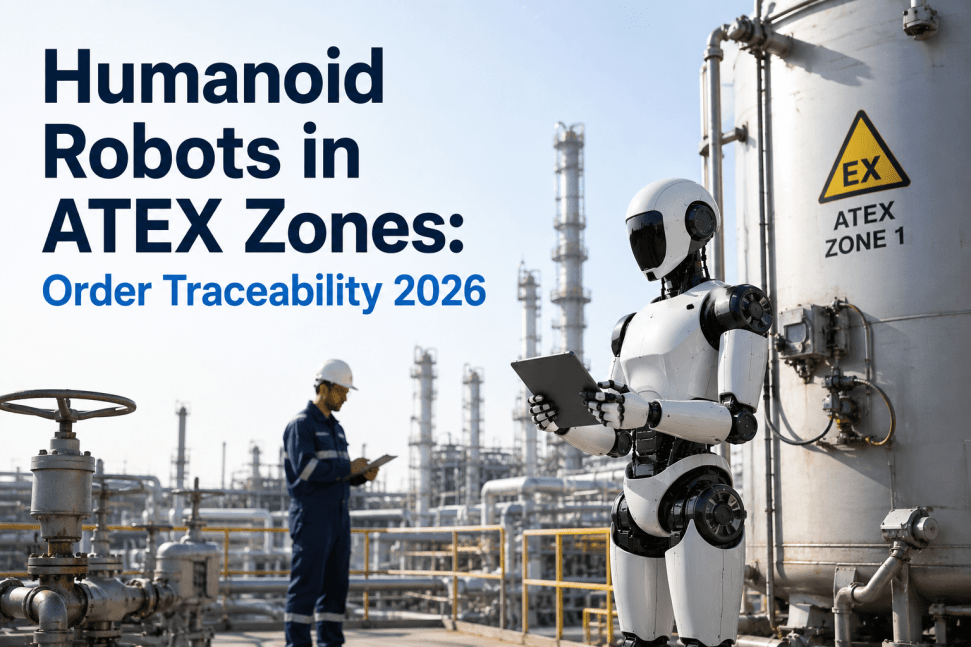
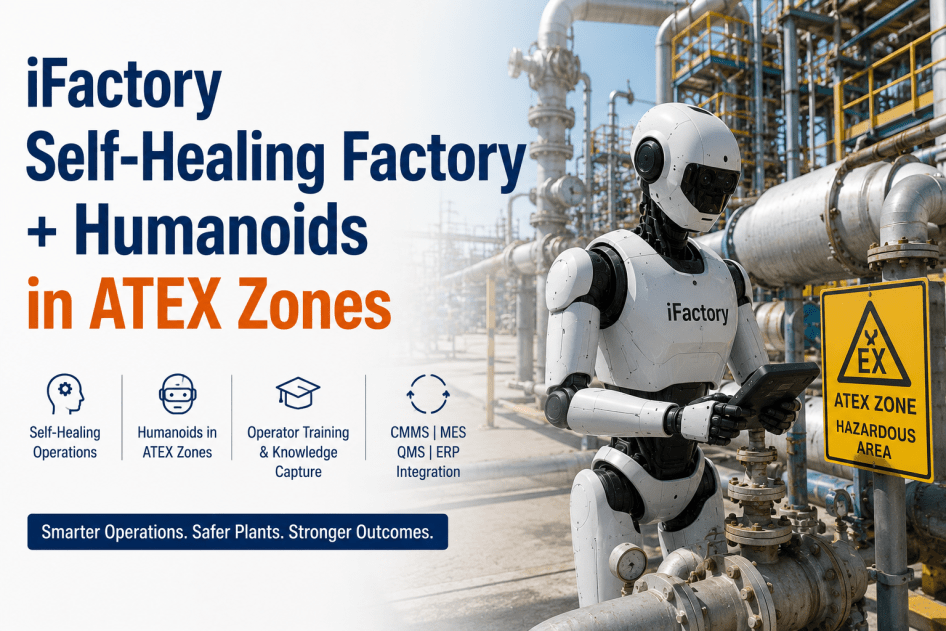
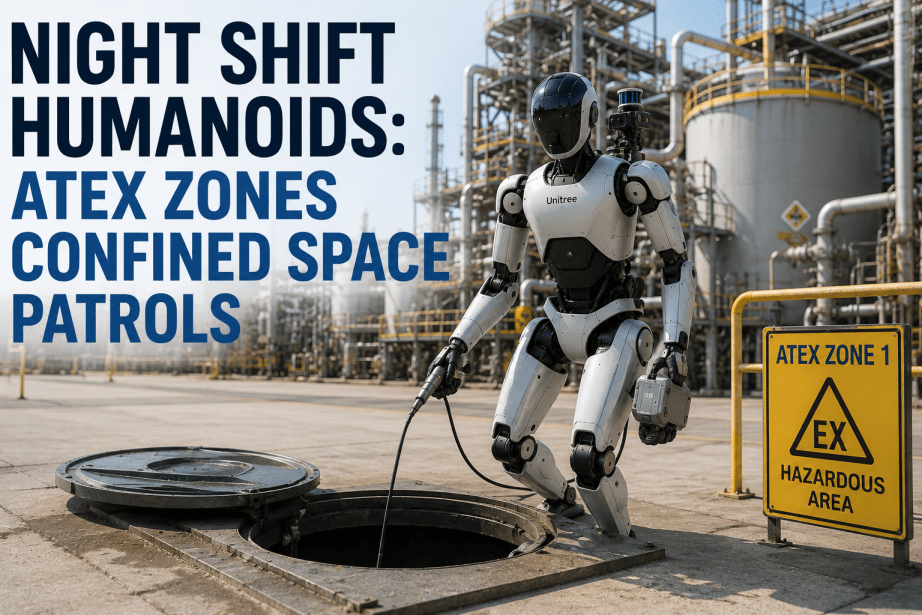
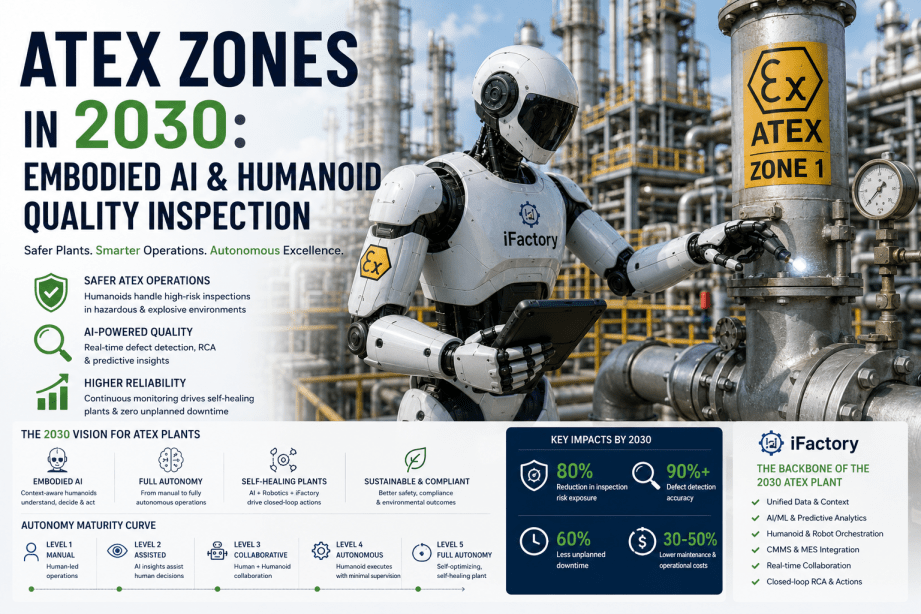
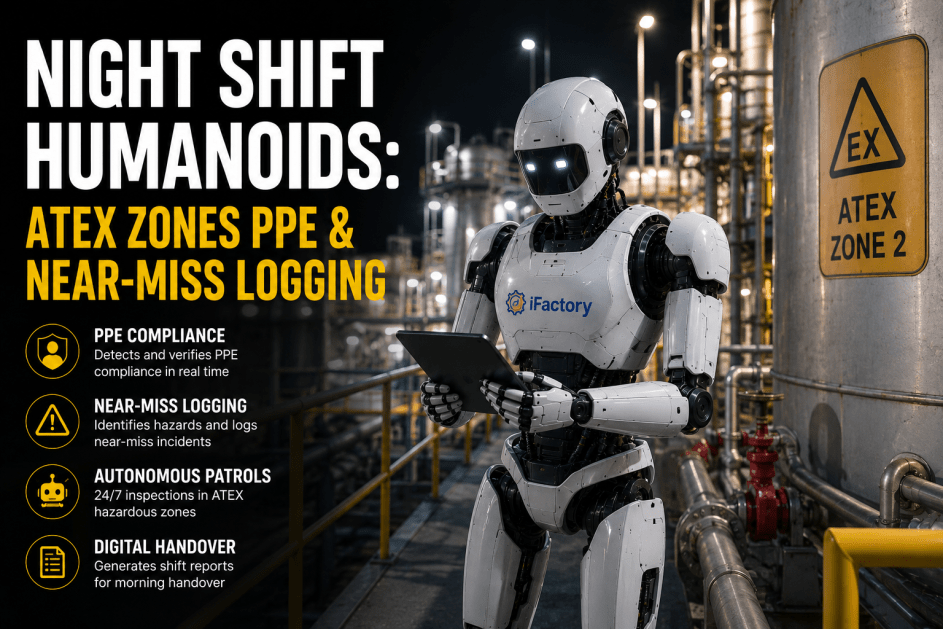
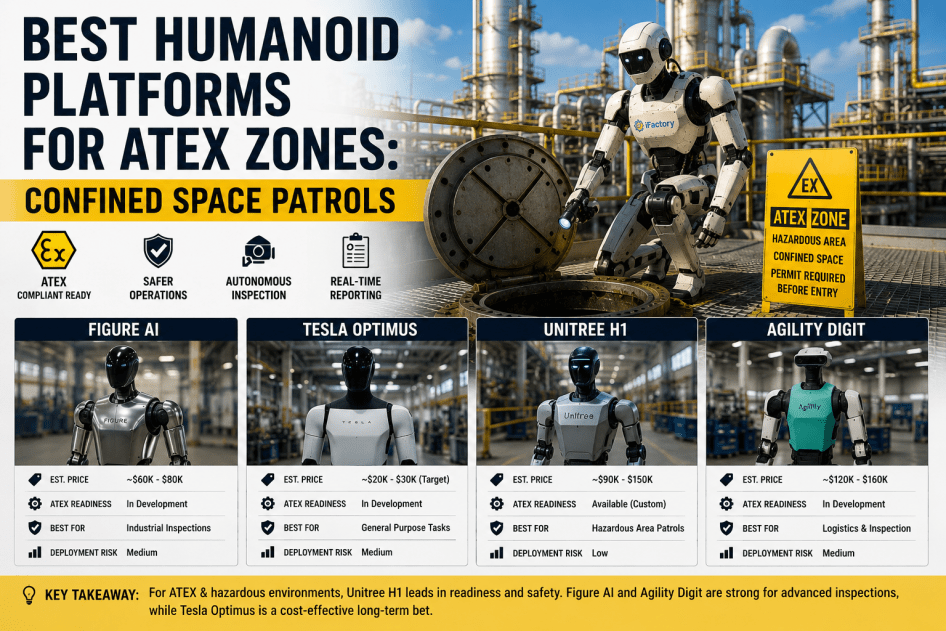
When a chemical plant operations director responsible for three ATEX-classified processing areas evaluated humanoid robots for hazardous zone inspections, PPE compliance monitoring, and near-miss logging, the selection process revealed that the leading platforms — Figure AI, Tesla Optimus, Unitree H1, and Agility Digit — each offered fundamentally different capabilities for operating in explosive atmospheres. One platform prioritized upper-body dexterity for valve manipulation in Zone 1 areas, another emphasized bipedal mobility across uneven terrain in Zone 2 storage yards, and a third delivered the lowest deployment cost for indoor inspection rounds in Zone 22 powder-processing environments. With a $1.8M safety automation budget covering two facilities and a corporate mandate to reduce personnel hours in ATEX-classified zones by 40% within the year, the team needed a structured comparison framework specific to hazardous environment requirements. Chemical plant safety and automation leaders evaluating humanoid platforms for ATEX deployment regularly Book a Demo to review platform-specific ATEX integration strategies and deployment timelines.
The ATEX Automation Challenge in Chemical Processing
Chemical plants operating ATEX-classified zones face a persistent safety-operations tradeoff: the personnel who need to perform inspections, monitor PPE compliance, and document near-miss events in hazardous areas are the same personnel the organization is obligated to protect from explosive atmosphere exposure. Traditional fixed automation — cameras, sensors, fixed robots — addresses some monitoring requirements but cannot navigate varying floor layouts, manipulate equipment, or respond to the unpredictable conditions that characterize daily chemical plant operations. Humanoid robots offer the mobility and dexterity to fill this gap, but each platform approaches ATEX readiness, PPE compliance monitoring, and near-miss logging differently, and selecting the wrong platform for a given zone classification can delay deployment by six months or more.
No humanoid platform ships with full ATEX certification. Each requires zone-specific ex-proof enclosure integration, gas-group rating verification, and surface temperature compliance testing that varies by platform design and intended deployment zone classification.
Vision-based PPE compliance monitoring in ATEX zones must distinguish between similar-colored equipment and protective gear under variable lighting conditions. Detection accuracy ranges from 88% to 96% depending on the platform's camera configuration and onboard processing capability.
Capturing near-miss events — gas detector alerts, unsafe approach distances, equipment anomalies — requires the platform to correlate sensor data with location, timestamp, and contextual imagery. Integration depth with existing CMMS and incident management systems varies significantly across platforms.
ATEX zone equipment must not exceed maximum surface temperature ratings (T1-T6 classifications). Humanoid robots with high-power computing payloads and battery systems require thermal management validation that adds 4-8 weeks to deployment timelines for Zone 1 and Zone 2 areas.
Platform base prices range from $85K to $250K, but ATEX enclosure integration, certification testing, and site-specific validation can add 40-60% to total deployment cost. Platforms with modular ex-proof enclosure designs reduce this premium compared to those requiring custom fabrication.
Connecting humanoid platforms to existing CMMS, MES, and incident management systems requires API maturity and data model alignment. Platforms with native OPC UA and MQTT support integrate in days versus weeks for those requiring custom middleware development.
Leading Humanoid Platforms for ATEX Hazardous Zones
The table below provides a structured comparison of the four leading humanoid platforms across the criteria most relevant to ATEX hazardous zone deployment: certification readiness, payload capacity, battery system classification, PPE detection capability, and integration maturity. Chemical plant safety and engineering teams evaluating these platforms are encouraged to Book a Demo to discuss their specific ATEX zone requirements and integration environment.
| Criterion | Figure AI | Tesla Optimus | Unitree H1 | Agility Digit |
|---|---|---|---|---|
| ATEX Readiness Path | Modular ex-proof enclosure | Custom enclosure required | Lightweight ex-proof shroud | Modular ex-proof enclosure |
| Payload Capacity | 25 kg (arms) | 20 kg (arms) | 15 kg (arms) | 16 kg (arms) |
| Battery ATEX Rating | Zone 2 / Zone 22 | Zone 2 only | Zone 2 / Zone 22 | Zone 2 / Zone 22 |
| PPE Detection Accuracy | 96% | 92% | 88% | 93% |
| Near-Miss Logging | Native CMMS integration | API-based integration | Custom integration required | API-based integration |
| Deployment Timeline | 10-12 weeks | 14-18 weeks | 8-10 weeks | 10-14 weeks |
| Total Cost (integrated) | $280K-$380K | $320K-$440K | $180K-$260K | $220K-$340K |
| Integration Protocol | OPC UA, MQTT, ROS2 | REST API | ROS2, custom SDK | REST API, MQTT |
Full-size humanoids with high payload and advanced manipulation — Figure AI and Tesla Optimus represent the upper tier of humanoid capability for ATEX environments. Figure AI's modular ex-proof enclosure design enables faster Zone 1 and Zone 2 certification compared to Optimus, which requires custom enclosure fabrication. Both platforms offer arm payloads above 20 kg, enabling them to manipulate valves, operate manual override controls, and carry inspection equipment into hazardous zones. Figure AI's native OPC UA and MQTT support enables direct integration with iFactory's CMMS for automated near-miss logging and work order generation. Tesla Optimus integrates via REST API, requiring additional middleware for equivalent data flow. Figure AI achieves 96% PPE detection accuracy with its onboard vision system, compared to 92% for Optimus. The higher total cost of $280K-$440K reflects the ex-proof enclosure engineering and certification testing required for both platforms.
Lightweight, fast-deploying platform for Zone 2 and Zone 22 — Unitree H1 is the most cost-effective humanoid option for ATEX hazardous zone deployment, with a total integrated cost of $180K-$260K and the shortest deployment timeline at 8-10 weeks. Its lightweight ex-proof shroud design reduces the engineering effort for Zone 2 gas-group and Zone 22 dust-group certification. However, the H1's 15 kg arm payload limits its ability to manipulate heavy valves or carry multiple inspection instruments. PPE detection accuracy of 88% is the lowest among the four platforms, reflecting the H1's standard-definition vision system compared to the higher-resolution cameras on Figure AI and Digit. The H1 connects via ROS2 and a custom SDK — integration with existing CMMS and MES requires middleware development that partially offsets the lower hardware cost. For facilities where the primary requirement is autonomous patrol and visual inspection rather than physical manipulation, the H1 offers the fastest path to ATEX deployment.
Proven platform with balanced capability and integration maturity — Agility Digit occupies the middle ground between the high-capability Figure AI and Optimus platforms and the lightweight Unitree H1. With 93% PPE detection accuracy, modular ex-proof enclosure design, and support for both REST API and MQTT integration, Digit provides a balanced option for facilities requiring both capable inspection and reasonable deployment cost. The 16 kg arm payload is sufficient for camera positioning, sensor deployment, and light valve operation but not for heavy manipulation. Digit's bipedal mobility is optimized for indoor floor surfaces common in chemical processing areas, but the platform requires additional gait configuration for outdoor uneven terrain found in storage yards and loading areas. Integration with iFactory's CMMS and MES through MQTT enables automated near-miss logging and incident documentation without custom middleware.
Select the Right Humanoid Platform for Your ATEX Zones
Chemical plant safety and automation teams evaluating humanoid robots for ATEX hazardous zones use iFactory's integration framework to compare certification readiness, deployment timelines, total cost, and CMMS/MES compatibility across all leading platforms — including ex-proof enclosure requirements specific to each zone classification.
PPE Compliance Monitoring and Near-Miss Logging Capabilities
The table below maps each platform's specific capabilities for the two highest-value ATEX zone applications: automated PPE compliance monitoring and near-miss incident logging. Chemical plant safety leaders who Book a Demo during their evaluation consistently report that the near-miss logging integration depth is the deciding factor in platform selection.
| Capability | Figure AI | Tesla Optimus | Unitree H1 | Agility Digit |
|---|---|---|---|---|
| PPE Detection — Hard Hat | 96% accuracy | 92% accuracy | 88% accuracy | 93% accuracy |
| PPE Detection — Safety Glasses | 94% accuracy | 90% accuracy | 85% accuracy | 91% accuracy |
| PPE Detection — Flame-Resistant Clothing | 93% accuracy | 89% accuracy | 84% accuracy | 90% accuracy |
| Near-Miss Event Capture | Automated with CMMS link | API-based logging | Manual trigger required | API-based logging |
| Gas Detector Integration | OPC UA direct read | REST poll | Not supported natively | MQTT subscription |
| Incident Report Generation | Fully automated | Semi-automated | Operator-initiated | Semi-automated |
Hard Hat Detection
Highest PPE compliance detection accuracy across all platforms, achieved by Figure AI's multi-spectral vision system with dedicated infrared channel for hard hat presence verification in variable lighting conditions.
Near-Miss to Work Order
Figure AI and iFactory integration automatically converts near-miss events — gas readings, unsafe distances, equipment anomalies — into CMMS work orders with attached sensor evidence and location data.
Zone Classification Coverage
Platforms offering modular ex-proof enclosure designs (Figure AI, Agility Digit) can be certified for Zone 1, Zone 2, and Zone 22 with the same base hardware — reducing re-certification cost for multi-zone facilities.
Personnel Hour Reduction
Target reduction in personnel hours spent in ATEX-classified zones achievable through humanoid deployment for routine inspections, PPE patrols, and near-miss documentation rounds.
Compare ATEX Platform Options Against Your Zone Requirements
Submit your ATEX zone classifications and target applications — PPE compliance monitoring, near-miss logging, or autonomous inspection — and iFactory will deliver a platform comparison tailored to your certification requirements, deployment timeline, and system integration environment.
"We evaluated three humanoid platforms for our Zone 2 processing area over a four-month period. The deciding factor was not hardware capability — all three could navigate the floor and read dials — it was the integration depth with our existing CMMS. Two platforms required manual near-miss data transfer, meaning the safety team would still need to review every event and create records. The platform that integrated directly with iFactory automated the entire near-miss-to-work-order workflow. Within two weeks of deployment, the system had logged 17 near-miss events that would have gone undocumented under our previous manual process. That automation capability alone justified the platform premium."
Conclusion — Matching Platform Capabilities to ATEX Zone Requirements
The selection of a humanoid robot for ATEX hazardous zone deployment depends on three factors: the zone classification requiring coverage, the primary application — PPE compliance monitoring, near-miss logging, or autonomous inspection — and the integration maturity of the plant's existing CMMS, MES, and incident management systems. Figure AI leads in manipulation capability and PPE detection accuracy, making it the preferred choice for facilities requiring valve operation and high-accuracy safety monitoring in Zone 1 and Zone 2 areas. Unitree H1 delivers the fastest deployment at the lowest cost for Zone 2 and Zone 22 inspection-only applications. Agility Digit offers the best balance of capability, cost, and integration readiness for multi-zone facilities with existing MQTT infrastructure. Tesla Optimus, while capable, requires the longest deployment timeline and highest total cost due to custom ex-proof enclosure requirements.
iFactory provides the integration layer that connects all four humanoid platforms with existing CMMS, MES, and incident management systems, ensuring that PPE compliance data, near-miss events, and inspection records flow automatically into the correct systems regardless of which platform is selected. Chemical plant safety and automation leaders developing their ATEX automation strategy are encouraged to Book a Demo to review platform options against their specific ATEX zone requirements and integration environment.
Humanoid Robots for ATEX Zones — Common Questions
No current humanoid platform is certified for Zone 0 (continuous explosive atmosphere) operation. The battery systems, computing payloads, and joint actuation mechanisms required for humanoid locomotion cannot achieve the intrinsic safety certification required for Zone 0. Humanoid robots are suitable for Zone 1 (likely to occur), Zone 2 (unlikely to occur), Zone 21 (dust likely), and Zone 22 (dust unlikely) classifications. For Zone 0 requirements, fixed ex-proof instrumentation or pneumatic remote-operated vehicles remain the appropriate solution. Humanoid platforms excel in the higher-volume Zone 2 and Zone 22 areas where their mobility and flexibility provide the greatest value.
Ex-proof enclosure integration typically reduces payload capacity by 15-25% and battery life by 20-30% depending on the enclosure design and zone classification. The enclosure adds weight that the robot must carry, and thermal management requirements for ATEX compliance may limit the robot's ability to dissipate heat from motors and computing payloads, reducing sustained operating time. Modular ex-proof enclosure designs — available for Figure AI and Agility Digit — reduce these penalties compared to custom enclosure fabrication, which typically requires larger, heavier enclosures. Facilities should budget for a 30% reduction in continuous patrol time when planning ATEX deployment rounds and schedule recharging accordingly.
The response sequence is automated through the iFactory integration platform. When the robot's onboard gas detector or atmospheric sensor exceeds a threshold, the platform: (1) logs the event as a near-miss with sensor data, location, and timestamp; (2) creates a work order in the CMMS assigned to the appropriate response team; (3) notifies the control room operator via dashboard alert and mobile notification; (4) commands the robot to retreat to a safe zone while maintaining sensor recording until personnel arrive. The robot does not attempt to isolate leaks or operate emergency shutdown valves without explicit human authorization — the integration is designed for detection and documentation, not automated remediation in hazardous atmospheres.
The humanoid patrols designated ATEX zone entry points and processing areas on a configurable schedule — typically every 30-45 minutes during operating shifts. Onboard vision systems capture personnel PPE status using infrared-optimized cameras that operate in low-light and variable weather conditions. Detection models are trained on facility-specific PPE types — hard hat colors, safety glass styles, flame-resistant clothing patterns — and achieve consistent accuracy across day and night shifts. Results are logged to the iFactory CMMS with shift, location, and timestamp data. Supervisors receive end-of-shift PPE compliance reports with trend data, enabling targeted safety interventions based on patterns rather than anecdotal observations.
Fully deployed costs for humanoid robots in ATEX classified zones range from $180K (Unitree H1 in Zone 22 with lightweight ex-proof shroud) to $440K (Tesla Optimus in Zone 1 with custom enclosure and full certification testing). The cost breakdown typically includes: base platform hardware 45-55%, ex-proof enclosure engineering and fabrication 20-30%, ATEX certification testing 10-15%, and iFactory CMMS/MES integration 8-12%. Facilities deploying in multiple zones with the same platform benefit from reduced per-unit costs after the initial certification investment. Annual maintenance and support contracts add 10-15% of total deployment cost per year. Most facilities achieve full ROI within 14-18 months through reduced personnel hours in hazardous areas, improved PPE compliance, and automated near-miss documentation.
Compare ATEX Humanoid Platforms Against Your Hazard Zone Requirements
iFactory provides the integration framework and platform evaluation methodology for chemical plant safety and automation teams selecting between Figure AI, Tesla Optimus, Unitree H1, and Agility Digit for ATEX hazardous zone deployment. Submit your zone classifications and target applications for a tailored platform comparison.