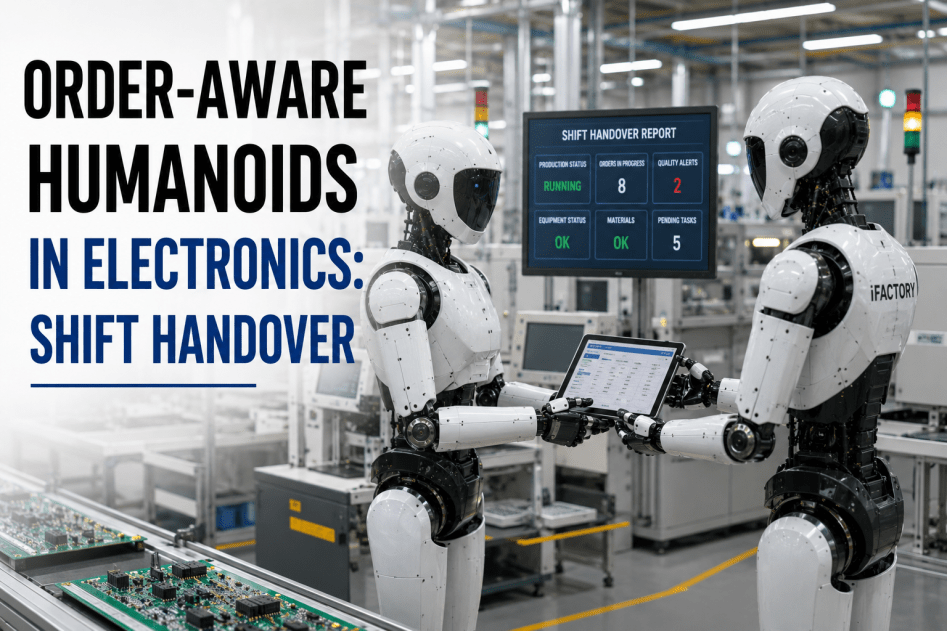
By 2030, process plants across chemicals, refining, food processing, and pharmaceuticals will operate with a fundamentally different workforce model — one where humanoid robots and embodied AI agents manage autonomous shift handovers, continuous inspection patrols, and first-response maintenance interventions alongside a smaller, highly skilled human operations team. This transformation is driven by the convergence of three technology vectors: bipedal humanoid platforms with the dexterity and mobility to navigate existing plant infrastructure, AI agents capable of contextualizing sensor data and generating structured shift reports without human transcription, and integration platforms like iFactory that connect autonomous robot patrol data directly to CMMS, MES, and process control systems. Early adopters who begin pilot programs between 2026 and 2028 will establish the operational playbooks, validation protocols, and integration architectures that define best practice for the 2030 embodied AI process plant — while operators who delay deployment will face a widening competitive gap in operational efficiency, unplanned downtime, and workforce cost structure.
Autonomous Shift Handovers — Self-Healing Factories — Humanoid Workforce Integration
iFactory's Humanoid Robot Integration Platform provides the standardized data layer that connects autonomous shift handover reports, inspection patrols, and maintenance interventions to your existing CMMS, MES, and process control systems.
Why Shift Handover Reporting Is the Gateway Use Case for Humanoid Deployment
In today's process plants, shift handover is a manual, paper-based ritual that consumes 30 to 45 minutes per shift change — time that compounds into thousands of lost production hours annually across a facility. The outgoing shift supervisor walks the control room, reviews equipment status, transcribes observations into a logbook or digital form, and briefs the incoming supervisor orally. Information is lost in translation: critical equipment anomalies are summarized imprecisely, sensor trends are described qualitatively rather than quantitatively, and follow-up actions are captured inconsistently. The handover quality depends entirely on the departing supervisor's communication skills and attention to detail on a given day.
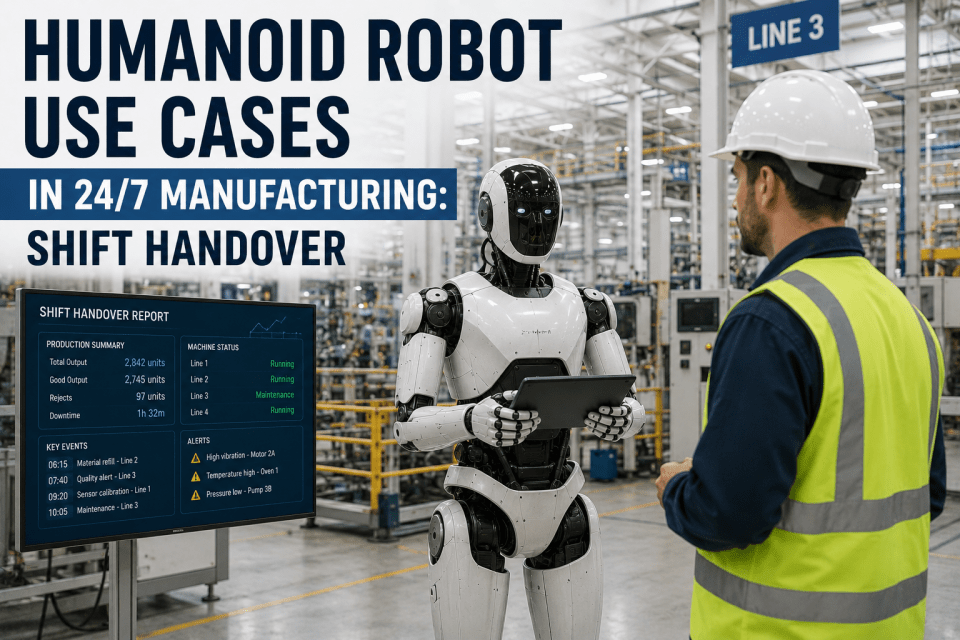
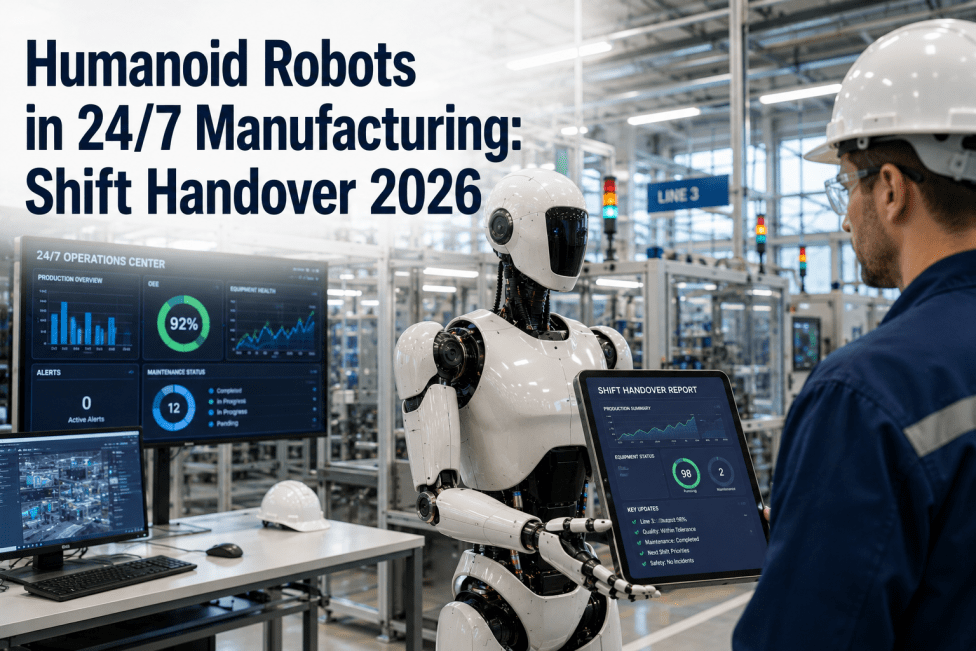
Embodied AI humanoid platforms fundamentally restructure this workflow. Instead of a human walking the plant floor reading gauges and writing notes, the humanoid performs a structured end-of-shift patrol — measuring equipment temperatures, recording vibration signatures, reading local panel indicators, and inspecting for leaks or visible defects — and generates a structured shift handover report automatically through the iFactory integration platform. The incoming supervisor reviews a complete, timestamped, sensor-verified status report before entering the control room, with the option to dispatch the humanoid to re-inspect any asset that requires closer examination. Book a Demo to see how autonomous shift handover patrols integrate with your existing shift reporting workflow.
How Humanoid Platforms and AI Agents Collaborate for Autonomous Plant Operations
The 2030 embodied AI process plant architecture consists of three layers: the humanoid platform layer (physical robots performing patrols and interventions), the AI orchestration layer (agents that contextualize sensor data, generate reports, and make dispatch decisions), and the integration layer (iFactory's platform connecting humanoid output to CMMS, MES, process control, and shift scheduling systems).
Humanoid Patrol Platforms
Bipedal humanoids navigate existing plant stairs, platforms, and catwalks without facility modification. Multi-spectral sensor payloads measure equipment temperature, vibration, gas concentration, and visual condition during every patrol route.
AI Orchestration Layer
AI agents receive and contextualize patrol data, comparing measurements against asset-specific baselines. Anomalies are classified by severity and routed to the appropriate response — CMMS work order, shift report entry, or immediate alert to the control room.
Integrated Shift Handover
iFactory's platform transforms patrol data into structured shift handover reports that include equipment status summaries, anomaly timelines, completed work orders, and recommended actions — eliminating manual transcription while improving report completeness and accuracy.
From Pilot to Production: The 2026–2030 Embodied AI Plant Deployment Timeline
The transition from today's manually operated process plant to the 2030 embodied AI plant follows a structured four-phase roadmap that prioritizes high-value, low-risk use cases in the early stages before progressing to autonomous operations. Each phase builds on the integration architecture and operational experience established in the previous phase.
Phase 1 (2026–2027): Observation Patrols
Single humanoid platforms deployed for end-of-shift observation patrols. Patrol data integrated with CMMS for work order generation. Shift handover reports created manually using patrol data as reference. Human operators remain in full control. Foundation for AI model training established. Duration: 12–18 months.
Phase 2 (2027–2028): Autonomous Reporting
AI agents generate structured shift handover reports directly from patrol data. Human supervisors review and validate reports before handover. Anomaly detection models achieve 90%+ accuracy. Humanoid coverage expands from one to three units per plant. Duration: 12–18 months.
Phase 3 (2028–2029): First-Response Maintenance
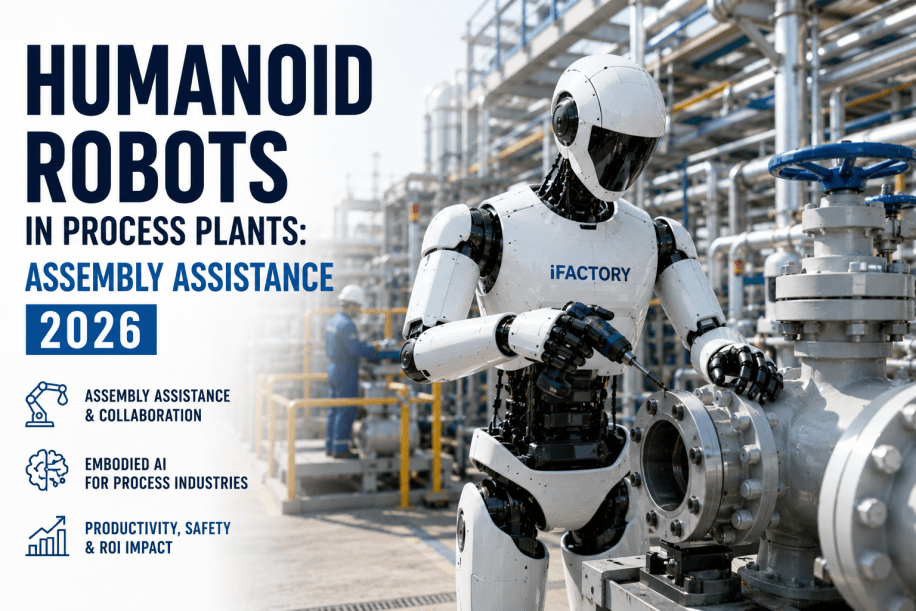
Humanoid platforms perform routine first-response maintenance interventions such as valve cycling, filter replacement, and local reset operations. AI agents triage anomalies and dispatch humanoids for initial assessment before human dispatch. Integration with process control systems for safe isolation verification. Duration: 18–24 months.
Phase 4 (2029–2030): Autonomous Operations
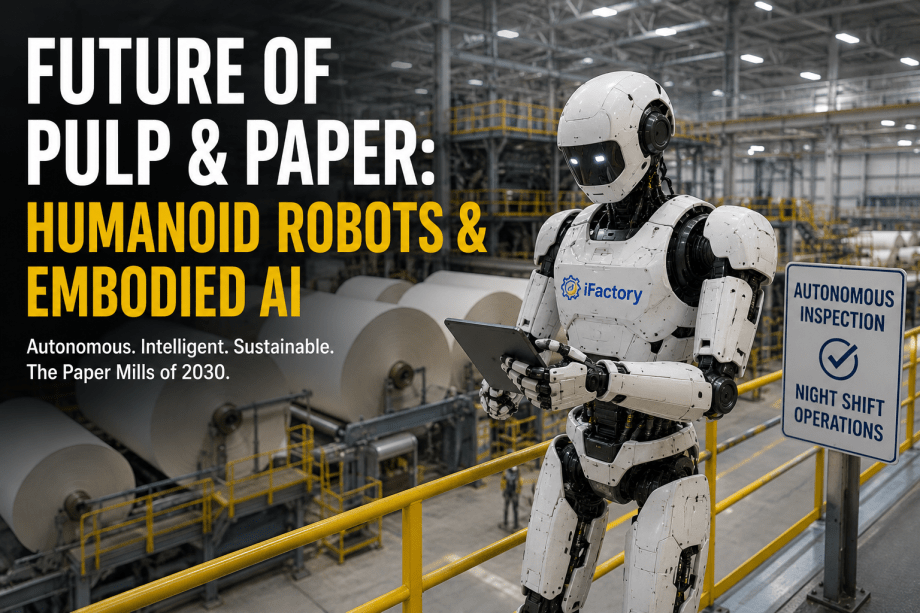
Humanoid platforms perform continuous autonomous patrols across all shifts. Shift handover reports are generated, validated, and distributed without human involvement for routine operations. Human operators focus on exception handling, continuous improvement, and strategic optimization. Self-healing plant capabilities begin to emerge. Duration: ongoing.
2030 Process Plant Performance Metrics: Human-Assisted vs. Embodied AI Operations
The projected performance improvements for embodied AI process plants are based on early pilot data from humanoid deployments in chemical, refining, and pharmaceutical facilities combined with industry modeling of AI-driven operational efficiency gains. These projections represent achievable outcomes for operators who begin structured pilot programs by 2028.
| Operational Metric | Current Manual Operations | 2030 Embodied AI Plant | Projected Improvement |
|---|---|---|---|
| Shift Handover Report Completion | Manual, 30–45 min per shift | Autonomous, <5 min per shift | 85% time reduction |
| Equipment Inspection Coverage | 2–3 patrols per day | Continuous, every 2 hours | 4x frequency increase |
| Anomaly Detection Lead Time | 4–8 hours after onset | Within 30 minutes | 85% faster detection |
| Routine Maintenance Response | Human dispatch, 60–90 min | Humanoid first-response, 10 min | 80% faster response |
| Shift Supervisor Workload | 40% reporting/admin | 10% reporting/admin | 75% admin reduction |
| Unplanned Downtime | Baseline | Reduced by 35–50% | Major reduction |
| Workforce Cost Structure | High manual labor | Optimized human + robot mix | 2.5x ROI projected |
We started our humanoid pilot focused on shift handover reporting because it was the use case with the lowest risk and the highest visible return. The first time the humanoid completed an end-of-shift patrol and our integration platform generated a structured handover report with equipment temperatures, vibration readings, and visual inspection results — all timestamped and correlated — the incoming supervisor had more actionable information in five minutes than they typically got from a 30-minute verbal handover. That was the proof point that convinced our plant manager to fund Phase 2. The shift handover use case is the gateway. Once the organization sees reliable autonomous reporting, the conversation shifts from whether to deploy to how fast we can scale.
How iFactory Connects Humanoid Patrol Data to Shift Handover, CMMS, and Process Control Systems
iFactory's Humanoid Robot Integration Platform is the standardized data layer that transforms humanoid patrol sensor telemetry into structured operational records. The platform receives patrol data via REST API, contextualizes it against the plant's asset hierarchy and shift schedule, and distributes structured outputs to the systems that operations teams already use — without requiring changes to existing workflows or validated interfaces. Schedule a personalized demo to see how iFactory's platform connects humanoid patrol data to your shift reporting workflow and process control systems.
At the end of each shift, the humanoid completes a structured patrol covering all critical equipment in its assigned zone. Sensor data flows to iFactory's platform, which generates a shift handover report that includes equipment status summaries (normal, caution, alert), anomaly timelines with sensor evidence, completed work order references, pending actions for the incoming shift, and recommended adjustments based on trend analysis. The report is delivered to the incoming supervisor's dashboard and mobile device before they arrive in the control room. During the pilot phase, supervisors reported that autonomous reports contained 100% of the equipment status information they needed for handover compared to an estimated 60–70% completeness from manual handovers.
When the humanoid's patrol detects an equipment condition requiring maintenance — a bearing temperature above threshold, a vibration signature consistent with misalignment, or a visual indication of leakage — iFactory's platform generates a structured CMMS work order with the asset ID, anomaly classification, severity rating, and sensor evidence. The work order is routed to the appropriate maintenance craft based on the anomaly type and asset criticality. During the shift handover, the CMMS status of all open and completed work orders is included in the handover report, giving both outgoing and incoming supervisors a complete view of maintenance activity during the shift.
For critical process parameters — pressure, temperature, flow, and level — the humanoid's patrol measurements are compared against process control system set points and alarm thresholds. Deviations detected by the humanoid that are not yet reflected in the control system's fixed sensor network are flagged in the shift handover report and, for high-severity deviations, sent as immediate alerts to the control room operator. This integration extends the control system's visibility to locations where fixed instrumentation is not installed or is not reliable, providing a mobile sensor layer that complements the fixed sensor network without requiring additional capital investment in permanent instrumentation.
Prepare Your Process Plant for the 2030 Embodied AI Workforce Transition
iFactory's Humanoid Robot Integration Platform provides the standardized data layer that connects autonomous patrol data to your existing CMMS, MES, and process control systems — enabling a phased transition from manual operations to embodied AI without rip-and-replace investments.
The 2030 Embodied AI Process Plant Starts with Shift Handover Automation Today
The transition to embodied AI process plant operations will not happen overnight, but the foundational use case — autonomous shift handover reporting — is deployable today with current humanoid platforms and integration technology. Operators who begin structured pilot programs between 2026 and 2028 will establish the operational experience, workforce acceptance, and integration architecture needed to scale toward fully autonomous operations by 2030. Those who delay risk falling behind on operational efficiency, workforce cost, and equipment reliability as early adopters compound their learning advantage.
The shift handover use case offers the ideal starting point: low risk, high visibility, immediate ROI. A single humanoid platform performing end-of-shift patrols and generating structured handover reports can eliminate hours of supervisor administrative time per week, improve information completeness from estimated 60% to 100%, and build organizational confidence in embodied AI technology. iFactory's Humanoid Robot Integration Platform provides the standardized data layer that connects any humanoid platform to your existing CMMS, MES, and shift reporting systems — enabling you to start your embodied AI journey today with the systems and workflows you already have. Book a Demo to discuss a phased deployment roadmap for your process plant.
Embodied AI and Humanoid Shift Handover — Frequently Asked Questions
Process plants with defined equipment patrol routes, existing sensor infrastructure, and structured shift handover procedures are the best candidates for early deployment. Chemical plants, refineries, pharmaceutical facilities, food processing plants, and water treatment facilities all share the common characteristics that make humanoid patrol deployment practical: repetitive inspection routes, accessible equipment layouts, and existing data systems that can receive structured patrol data. Plants with predominantly outdoor equipment on grade are easier to deploy than multi-story indoor facilities with narrow aisles, though the latest generation of bipedal humanoid platforms can navigate stairs and platforms without facility modification.
Embodied AI deployment shifts operator roles from routine inspection and reporting to exception handling and continuous improvement. Shift supervisors whose time is currently consumed by manual patrols and report writing will instead focus on analyzing anomaly trends, optimizing process parameters, and managing humanoid patrol coverage. The total workforce requirement for routine operations decreases, but the skill level and compensation of remaining operations roles increase. Early pilot participants in humanoid programs have reported higher job satisfaction as their roles shifted from repetitive inspection tasks to analytical and decision-making activities. Workforce transition planning should begin during Phase 1 deployment to ensure operators are trained for their evolving roles.
Current generation humanoid platforms are designed for a 5–7 year operational life in industrial environments with scheduled maintenance and component replacement. Battery systems typically require replacement every 2–3 years depending on patrol frequency and duration. Sensor payloads can be upgraded independently of the base platform as new sensor technology becomes available. AI models and integration software are updated continuously through the iFactory platform, providing ongoing capability improvements without hardware replacement. Operators should plan for a technology refresh cycle of 5–7 years for the base platform and 2–3 years for battery and sensor subsystems.
Humanoid platforms deployed in process plants must be certified for the hazardous area classifications in which they operate. Current platforms are available with ATEX and IECEx certification for Zone 2/Division 2 environments, with Zone 1 certification expected by 2028. For initial deployments, operators typically confine humanoid patrols to non-classified areas and general-purpose plant zones, with the platform using its gas detection sensors to confirm safe atmospheric conditions before entering any area. The platform's positive-pressure purge system and sealed enclosure prevent ignition source exposure in classified environments. Process safety reviews and hazard assessments should be completed during the Phase 1 deployment planning for each installation.
Yes. iFactory's integration platform is designed to connect with existing CMMS, MES, shift scheduling, and process control systems through standard REST API interfaces, SQL database connectors, and OPC-UA for process data. The platform does not require replacement or modification of existing systems — it extends them by providing a structured data ingestion layer that transforms humanoid patrol telemetry into the formats and workflows that existing systems already support. During pilot deployments, the integration architecture is validated against each facility's specific system landscape, with typical integration timelines of 4–6 weeks for the initial connection and data mapping.
Start Your Embodied AI Process Plant Journey with a Shift Handover Pilot
iFactory's Humanoid Robot Integration Platform connects autonomous patrol data to your existing CMMS, MES, and shift reporting systems — enabling a structured, low-risk transition from manual operations to embodied AI. Schedule a personalized consultation to review a phased deployment roadmap for your process plant, including pilot scope, integration architecture, workforce transition planning, and projected ROI.