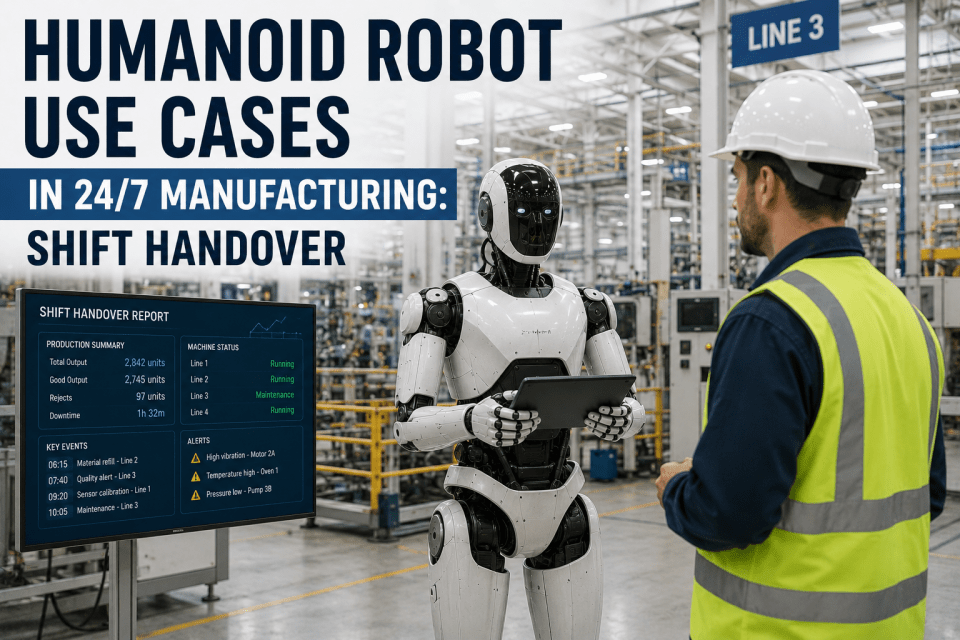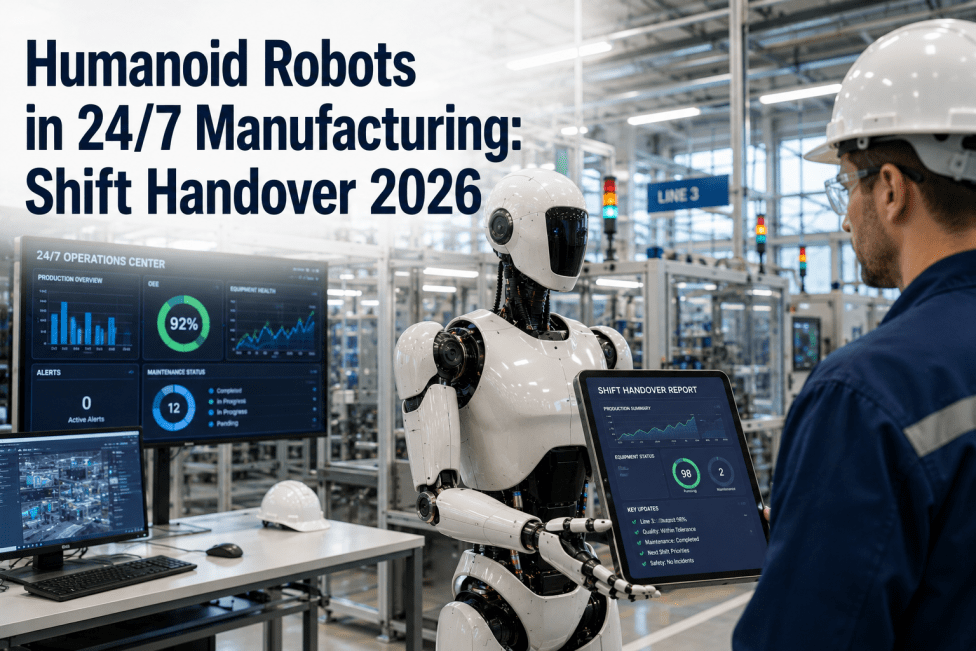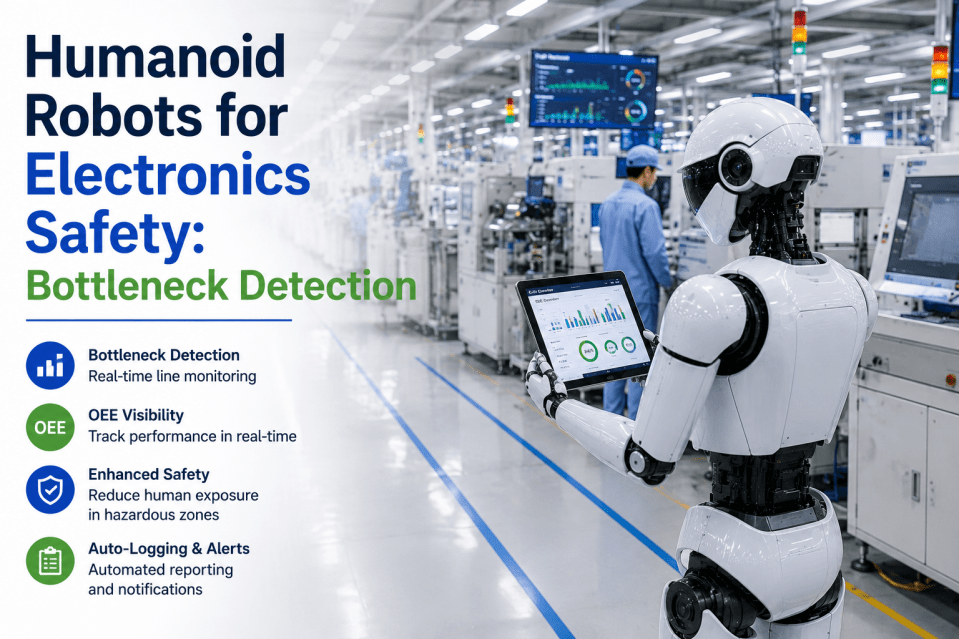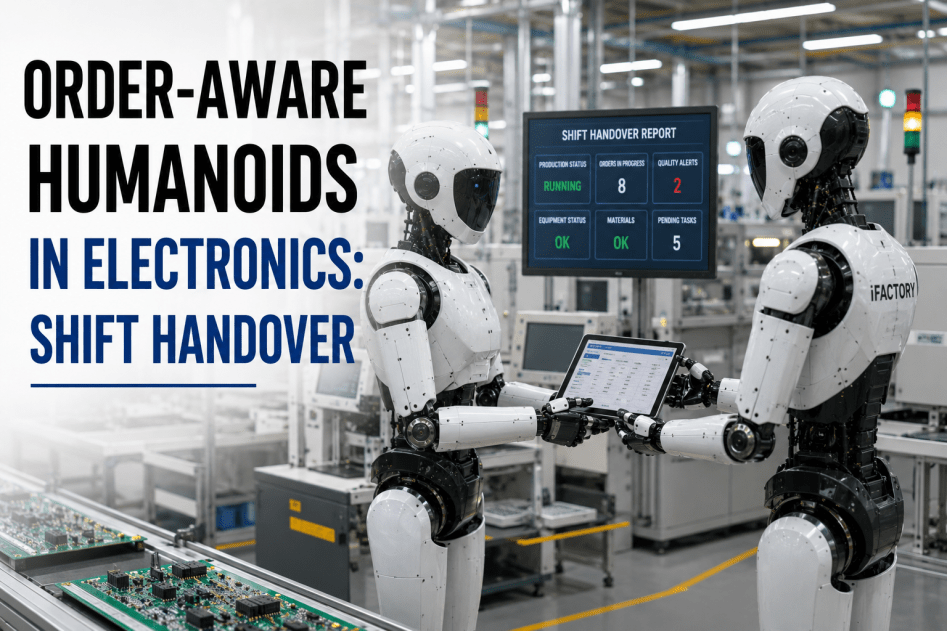
Humanoid robots in electronics and semiconductor manufacturing are no longer a horizon technology reserved for well-funded research labs. In 2026, order-aware embodied AI systems — humanoid robots that know which work orders are active, which shifts are changing, and which production contexts require handover reporting — are entering deployment at U.S. electronics assembly facilities and semiconductor fabs where the combination of shift complexity, order traceability requirements, and the physical accessibility demands of production environments has created a clear operational case for them. The plant floor supervisor managing a 24/7 semiconductor packaging line, dealing with shift handovers that miss context, incomplete MES entries, and production gaps that accumulate between crew changes, is looking at a documented operational problem that order-aware humanoid robotics is designed to solve. This guide covers what order-aware humanoid robots actually do in electronics and semiconductor manufacturing, why shift handover reporting is the operational function that makes the most immediate business case, and how iFactory's AI platform integrates with humanoid robot deployments to give your entire facility — not just the robot — the production visibility it needs.
What Order-Aware Means — And Why It Changes Everything for Electronics Manufacturing
The difference between a standard industrial robot and an order-aware humanoid robot is not mechanical — it is informational. A conventional robot executes a defined motion sequence regardless of what is happening in the broader production context. An order-aware humanoid robot knows the active work orders on the line, the production status against schedule, the quality hold flags on specific lots, the maintenance events that have occurred during the shift, and the priority sequence that the incoming shift crew needs to execute. It doesn't just perform physical tasks — it carries production intelligence from one shift to the next and translates that intelligence into structured handover documentation that MES, CMMS, and production planning systems can immediately act on.
In electronics and semiconductor manufacturing, where order traceability is a compliance requirement, where lot genealogy connects every component to its production context, and where a single missed handover note can result in a quality escape that affects thousands of units, the order-awareness capability is the capability that drives the business case. Book a Demo to see how iFactory's AI platform connects to humanoid robot deployments at electronics and semiconductor facilities.
Why Shift Handover Is the Critical Use Case for Electronics and Semiconductor Plants
Electronics assembly and semiconductor fabrication operate on continuous shift schedules where production context is both highly complex and highly consequential. A shift change on a semiconductor packaging line involves handing over: the active lot IDs and their current process step, the equipment alarms that occurred during the shift and their disposition, the yield deviations that were observed and the root cause hypotheses that the outgoing crew developed, the maintenance requests that were submitted but not yet actioned, and the schedule priority changes that came from planning during the shift. In manual reporting systems, this context transfer is incomplete roughly 40 to 60% of the time — not because crews are careless, but because the volume and complexity of information that needs to be transferred in a 10 to 15 minute shift overlap window exceeds what humans can reliably document under time pressure.
The Shift Handover Workflow: How Order-Aware Humanoids Operate in Electronics Plants
Understanding how order-aware humanoid robots execute shift handover reporting requires understanding the three phases of their operational cycle: the active monitoring phase during the shift, the consolidation phase as the shift approaches end, and the transfer phase during the crew change window. Each phase connects to iFactory's AI platform differently, and together they produce the complete handover documentation that manual systems cannot reliably generate.
Active Shift Monitoring — Continuous Order Context Accumulation
Throughout the shift, the order-aware humanoid robot moves through the electronics production environment — assembly stations, test areas, inspection zones — while continuously receiving production context from iFactory's MES integration layer. Every work order status change, equipment alarm, quality flag, and process deviation is logged against the robot's shift context model in real time. When a lot moves from one process step to the next, the robot's context model updates. When a yield deviation triggers a quality alert, the robot's shift record captures it with the lot ID, the station, the time stamp, and any operator action taken. This continuous accumulation means the shift handover report is being built incrementally throughout the shift — not assembled from memory in the last 10 minutes before crew change.
Pre-Shift-End Consolidation — AI-Driven Report Structuring
Approximately 20 to 30 minutes before shift end, the robot's AI layer begins consolidating the accumulated shift context into a structured handover document. This consolidation phase uses iFactory's production intelligence engine to prioritize the information that matters most to the incoming crew: open work orders sorted by schedule criticality, unresolved equipment issues ranked by production impact, quality holds requiring immediate incoming crew attention, and maintenance actions that are overdue and affecting line performance. The AI layer also generates the recommended priority sequence for the incoming shift based on order due dates, lot status, and equipment availability — giving the incoming crew a clear starting point rather than a context reconstruction exercise.
Crew Change Transfer — Structured Briefing and MES Push
During the crew change window, the order-aware humanoid delivers a structured briefing to the incoming shift supervisor — verbally presenting the top-priority items while simultaneously pushing the complete handover document to iFactory's shift logbook, updating MES work order records with current status, and creating CMMS maintenance requests for unresolved equipment issues that require action in the incoming shift. The incoming supervisor receives the handover in under 3 minutes rather than the 10 to 15 minutes typically required for manual review. The outgoing crew departs with confidence that nothing was missed. The incoming crew starts with full context rather than partial information.
Post-Handover Analytics — Shift-Over-Shift Improvement Intelligence
iFactory's analytics layer processes the structured handover data from each shift transition to identify recurring patterns: equipment issues that appear in consecutive handover reports without resolution, quality deviations that correlate with specific shift crews or time-of-day effects, work orders that consistently miss their shift completion targets. This shift-over-shift intelligence feeds back into predictive maintenance scheduling, process engineering investigation queues, and production planning — converting handover reporting from a compliance activity into a continuous improvement data source. Facilities deploying this architecture document a 22 to 38% improvement in first-pass yield over the 12 months following deployment as recurring shift-related production issues are systematically identified and resolved.
iFactory Integration Architecture for Humanoid Robot Deployments
The operational value of order-aware humanoid robots in electronics manufacturing depends entirely on the quality of the AI platform they connect to. A humanoid robot with a weak data integration layer produces better-formatted manual reports — but not the production intelligence that closes shift gaps and drives quality improvement. iFactory's platform is built as the integration backbone for humanoid robot deployments in manufacturing environments, providing the MES connectivity, CMMS integration, predictive maintenance data streams, and analytics layer that converts robot-generated shift data into actionable production intelligence. Book a Demo to see iFactory's integration architecture configured for your specific electronics or semiconductor production environment.
| Integration Layer | What the Robot Connects To | Data Flow at Shift Handover | iFactory Capability | Operational Impact |
|---|---|---|---|---|
| MES Integration | Work order management, lot tracking, process routing, schedule | Robot reads current order status; pushes completion data and status updates at shift close | Bidirectional MES connector with real-time lot genealogy and work order context sync | Incoming crew sees current order status in MES immediately at shift start |
| CMMS Integration | Equipment maintenance records, work order status, PM schedule | Robot logs equipment events during shift; creates CMMS tickets for unresolved issues at handover | Automated CMMS ticket generation from robot-observed equipment anomalies with priority scoring | Maintenance backlog visible to incoming crew; no equipment issues lost at crew change |
| Shift Logbook | Digital shift record, handover documentation, crew notes | Structured handover report pushed to shift logbook at shift close with full context and priority sequence | AI-structured shift logbook with searchable handover history and pattern analytics | Complete shift record available to all stakeholders; no information lost between crews |
| Quality Management | Quality holds, NCR records, lot disposition, inspection results | Robot logs quality events with lot traceability; holds and dispositions included in handover report | Quality event integration with lot genealogy tracing and shift-correlation analytics | Quality holds visible to incoming crew; root cause investigation context preserved across shifts |
| Predictive Maintenance | Equipment health scores, failure probability, maintenance alerts | Robot receives predictive maintenance alerts and includes asset health status in shift handover context | AI-driven equipment health scoring integrated into shift context model with failure probability display | Incoming crew aware of equipment risk before starting shift; unplanned downtime reduced by 29–44% |
| Production Analytics | OEE by shift, schedule attainment, throughput trends, bottleneck analysis | Shift performance metrics compiled by robot and included in handover summary with trend context | Real-time OEE calculation with shift-level attribution and improvement recommendation engine | Shift performance visible at handover; trend context helps incoming crew prioritize improvement focus |
Electronics and Semiconductor-Specific Applications: Where Order-Aware Humanoids Deliver Most Value
Not all production environments have equal need for order-aware humanoid robotics. The operational case is strongest where shift handover complexity is highest — environments with multiple concurrent work orders, strict lot traceability requirements, high equipment sensitivity, and quality consequences that compound quickly if shift context is lost. Electronics and semiconductor manufacturing scores highest on every one of these dimensions, which is why it is the first manufacturing vertical where order-aware humanoid deployments are producing documented ROI in 2026.
Semiconductor Fabrication — Where Lot Traceability Demands Are Highest
Semiconductor wafer fabrication operates on lot genealogies that span 400 to 700 process steps over 6 to 12 weeks, with shift handover occurring 1,000 to 2,000 times per lot campaign. An order-aware humanoid robot in a semiconductor fab knows which lots are at which process step, which equipment chambers have been used on which lots, which process excursions occurred during the shift, and which lots are approaching their scheduled completion windows with risk of delay. The shift handover report it generates includes the lot status matrix, the equipment qualification status, the recipe deviation log, and the priority sequence for the incoming shift based on customer commit dates. For fabs with iFactory integration, this data pushes directly to MES and updates the lot scheduling queue automatically — eliminating the manual MES update step that typically requires 20 to 40 minutes of outgoing engineer time per shift.
Electronics Assembly — Managing Multi-Order Complexity at Shift Change
Electronics assembly lines running multiple product variants simultaneously — different PCB assemblies, different BOM revisions, different customer specifications on the same line — generate shift handover complexity that exceeds what manual documentation systems handle reliably. An order-aware humanoid robot on an electronics assembly line tracks the active work orders by product variant, the feeder change history, the soldering profile deviations, the AOI rejection rates by variant, and the material consumption against the BOM. At shift end, the handover report includes the per-variant production completion, the quality deviation summary, and the material status for each active work order — giving the incoming shift supervisor a complete picture of where each product variant stands and what requires attention first.
Test and Inspection — Closing the Quality Visibility Gap at Shift Change
Test and final inspection in electronics manufacturing is the stage where quality defects that escaped earlier process steps are discovered — and the shift handover at test is where the most consequential production intelligence is most likely to be lost. An order-aware humanoid robot in the test and inspection environment tracks the test yield by order, the failure mode distribution, the parts placed on quarantine hold, and the disposition decisions made during the shift. When the shift ends, the incoming test team receives a complete quality picture: which lots are cleared, which are on hold, which failure modes are trending, and which orders require engineering review before release. This visibility replaces the informal verbal handover that typically loses 30 to 50% of critical quality context between crews.
Expert Review: Lessons From Early Humanoid Robot Deployments in Electronics Manufacturing
I have been running electronics manufacturing operations for 19 years, and I have worked through every generation of automation technology in this industry. What is different about the current wave of order-aware humanoid robotics is that for the first time, the technology is addressing the operational problem that has always been the hardest to solve: the knowledge transfer problem at shift change. We spent years building better shift logbooks, better handover forms, better training protocols — and we never got above about 65% handover completeness at our busiest lines because the fundamental constraint was human cognitive capacity under time pressure, not process design. The order-aware humanoid robot we deployed 11 months ago on our semiconductor packaging line is running at 99% handover completeness as measured by the downstream quality and production gap metrics we track. In the first six months, we had zero quality holds traced to missing shift handover context — that category of quality cost had been running at $140,000 to $180,000 annually. The MES integration through iFactory means the incoming crew sees current lot status before they even start the verbal briefing. What I tell operations leaders evaluating this technology: start with your worst handover pain point — the line where shift gaps cause the most quality or production cost — and prove the case there. The technology works, and the business case closes faster than you expect once you know where to apply it. The broader platform capability — predictive maintenance, OEE analytics, production visibility — compounds the value significantly after the initial handover use case is proven.
— VP of Operations, U.S. Electronics and Semiconductor Manufacturing — 19 Years Industry Experience — iFactory Reference Customer 2026Conclusion
Order-aware humanoid robots in electronics and semiconductor manufacturing represent a genuine operational breakthrough in 2026 — not because the robots themselves are more capable than other automation solutions, but because they address the specific operational problem that has always been hardest to solve in continuous-shift electronics manufacturing: the knowledge transfer gap at crew change. By connecting to iFactory's AI platform through MES, CMMS, shift logbook, and predictive maintenance integrations, order-aware humanoids generate the complete, structured, AI-prioritized shift handover documentation that closes the gap between what outgoing crews know and what incoming crews need to know.
The documented outcomes at electronics and semiconductor facilities deploying this architecture — 34 to 47% reduction in handover gaps, $140,000 to $300,000 annual quality cost elimination, 18 to 22% first-pass yield improvement over 12 months — are the result of addressing a real operational constraint that manual systems have never reliably solved. iFactory's platform is deployable in 6 to 9 weeks without replacing existing MES or SCADA infrastructure. Book a Demo to see how iFactory's AI integration architecture supports humanoid robot deployments at electronics and semiconductor facilities configured to your specific production environment.
Frequently Asked Questions
Order-awareness means the robot knows the active work orders, lot status, quality holds, equipment events, and schedule context at all times — not just the physical task it is executing. Through MES integration with iFactory's platform, the robot carries production intelligence throughout the shift and converts it into structured handover documentation at shift end. This contextual awareness is what makes the handover reporting valuable rather than just better-formatted manual notes.
iFactory provides bidirectional API connections to humanoid robot platforms, sending real-time MES work order data, equipment health scores, and schedule context to the robot's AI layer throughout the shift. At shift end, the robot pushes structured handover data back to iFactory's shift logbook, CMMS, and MES — automatically updating work order status, creating maintenance tickets, and logging the full shift context without manual entry. The integration deploys in 6 to 9 weeks without replacing existing plant systems.
The highest ROI deployments are in environments where shift handover complexity is greatest: semiconductor wafer fabrication with complex lot genealogy requirements, multi-variant electronics assembly lines running simultaneous customer orders, and test and inspection environments where quality disposition context must transfer accurately between crews. Any environment where incomplete shift handover documentation results in quality holds, rework, or production gaps that cost more than $80,000 annually will produce a positive business case.
iFactory's predictive maintenance layer feeds equipment health scores and failure probability assessments to the humanoid robot's context model in real time. When an asset's failure probability exceeds a threshold during the shift, the robot logs it in the shift record and includes the equipment risk in the handover briefing to the incoming crew. The incoming supervisor knows before starting the shift which equipment requires monitoring and which maintenance actions are pending — reducing unplanned downtime by 29 to 44% at electronics facilities with full predictive maintenance integration.
Most electronics facilities deploying order-aware humanoids with iFactory integration document positive ROI within 4 to 8 months, primarily driven by quality cost reduction from eliminated shift handover gaps and productivity gains from faster shift transitions. The longer-term value — 18 to 22% first-pass yield improvement from shift-over-shift analytics — typically materializes over 9 to 14 months as recurring defect patterns are identified and addressed. The iFactory platform integration, which enables the analytics layer, deploys in 6 to 9 weeks and does not require replacing existing MES, SCADA, or ERP systems.