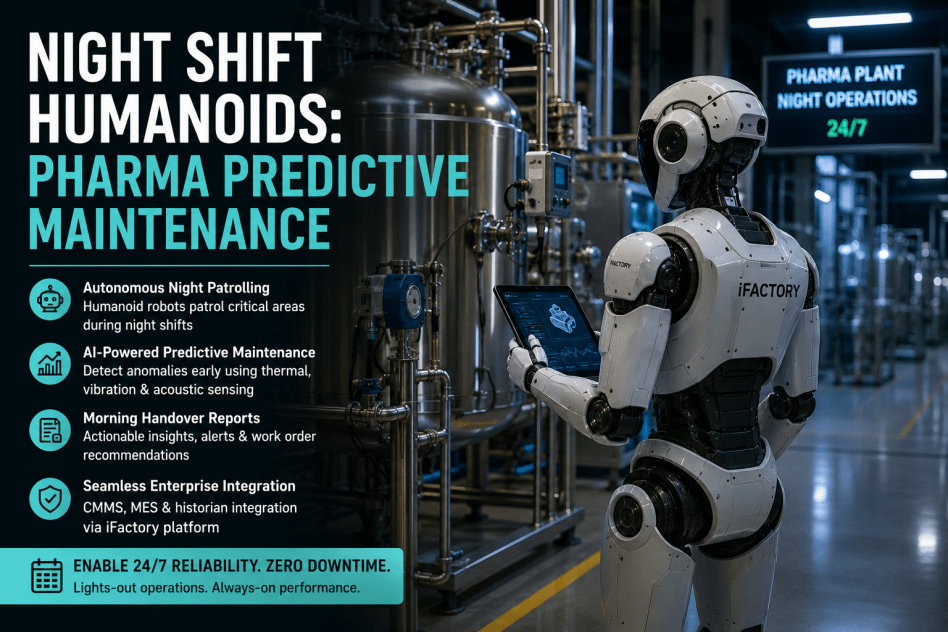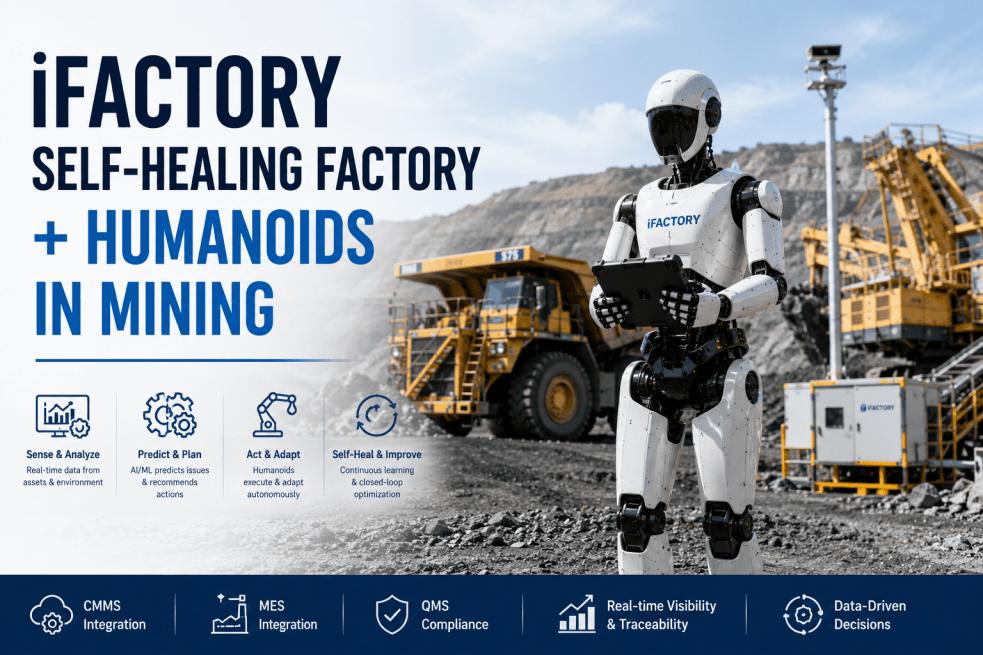
The mining industry has reached a pivotal operational intersection in 2026 where three converging capabilities — ruggedized humanoid robots capable of operating in underground and surface mining environments, AI-driven predictive maintenance platforms that convert sensor data into failure forecasts, and the self-healing factory architecture that closes the loop between anomaly detection and automated intervention — are transforming how mining operations manage asset reliability, safety risk, and production continuity. The self-healing factory concept, applied to mining, means that when a humanoid robot on patrol identifies a vibration anomaly on a conveyor drive, thermal irregularity on a crusher bearing, or gas concentration change in a ventilation shaft, the observation is not simply logged for later review. It is ingested by iFactory's platform, correlated with historical failure data and current production context, and converted into a prioritized maintenance action or automated control adjustment before the condition escalates into an unplanned event. Mining operations deploying this integrated architecture across surface and underground sites in 2025 and 2026 are reporting 40 to 55 percent reductions in unplanned downtime on monitored assets, 60 to 75 percent reductions in confined-space entry requirements for routine inspection, and documented payback periods of 11 to 18 months on combined humanoid and platform investments.
Is Your Mining Operation Running a Self-Healing Asset Management Model?
iFactory AI integrates humanoid robot patrol data, sensor networks, and predictive analytics into a unified platform that converts inspection findings into maintenance actions automatically — before failures occur.
Why Mining Needs the Self-Healing Factory Model
Mining operations face an asset management challenge that most industrial facilities do not. A typical surface mine operates hundreds of pieces of mobile and fixed equipment spread across kilometers of active pit, haul roads, and processing infrastructure. An underground mine adds confined-space access constraints, explosive atmosphere risks, and ventilation-dependent work environments that make routine inspection by human personnel both hazardous and logistically expensive. The conventional approach to mining asset management — scheduled maintenance intervals, periodic inspection campaigns, and reactive failure response — is structurally mismatched to an operating environment where equipment is mobile, geographically distributed, and operating under conditions that accelerate wear beyond what calendar-based schedules can predict. The self-healing factory model addresses this mismatch by embedding continuous condition monitoring into the operational fabric of the mine, using autonomous robotic patrols as the sensor mobility layer and AI analytics as the decision layer that converts sensor readings into maintenance actions automatically.
Humanoid Robot Patrols: The Mobile Sensing Layer for Mining Asset Intelligence
Humanoid robots deployed in mining environments serve a fundamentally different function from fixed sensor networks or traditional autonomous vehicles. Fixed sensors can monitor a single bearing or conveyor section continuously but cannot relocate to investigate anomalies, traverse stairs and ladders to access elevated platforms, or adapt patrol routes as mining faces advance and infrastructure is relocated. Autonomous haul trucks and drill rigs operate within defined operational envelopes and cannot perform the sensory inspection functions that humanoid robots bring to the patrol role. The humanoid form factor — bipedal or wheeled-base with articulated upper body — is purpose-suited to mining environments precisely because mines are designed around human dimensions: stairways, ladders, catwalks, confined access hatches, valve wheels, breaker panels, and tool storage areas that define the physical infrastructure of both surface and underground operations. A humanoid robot on patrol at a mine can traverse a conveyor gallery, climb an access ladder to an elevated crusher platform, read a vibration gauge, inspect a drive belt, record a thermal image of a bearing housing, and descend to continue the patrol route without requiring any infrastructure modification to accommodate the inspection platform. Book a Demo to review the specific humanoid platform compatibility assessment for your mine's infrastructure configuration.
Conveyor System Patrol and Anomaly Detection
Conveyor systems in mining operations represent kilometers of continuously operating mechanical infrastructure where belt damage, idler failure, pulley misalignment, and drive component degradation create both production interruption risk and fire safety hazards. Humanoid robots patrol conveyor routes at programmed intervals, using thermal imaging to detect overheating idlers and pulley bearings, acoustic sensors to identify belt damage patterns, and visual inspection to capture belt tracking, spillage, and structural integrity conditions. Patrol data feeds directly into iFactory AI's Predictive Maintenance module, which correlates thermal and vibration readings against historical failure patterns to generate prioritized maintenance alerts when readings exceed trend-based thresholds rather than fixed alarm limits. This enables maintenance teams to replace a single overheating idler during a scheduled shift rather than responding to a belt fire or spillage event during production hours.
Crusher and Mill Condition Monitoring
Primary crushers, cone crushers, and grinding mills operate under extreme mechanical loads in dusty, high-vibration environments where conventional sensor reliability is compromised and human inspection access is limited by safety constraints. Humanoid robots equipped with vibration analysis, thermography, and acoustic emission sensors perform structured inspection rounds on crusher and mill assets, capturing bearing temperature trends, drive train vibration signatures, and structural integrity conditions during operational windows that are unsafe for human entry. The patrol data populates iFactory AI's asset health models, which track degradation curves for each major component and generate predictive failure alerts when trend acceleration indicates developing failure modes. Operations using humanoid crusher inspection report 50 to 65 percent reductions in unplanned crusher downtime within six months of deployment.
Ventilation and Gas Monitoring Patrols
Underground mining operations require continuous monitoring of ventilation airflow, gas concentrations, and atmospheric conditions across extended underground networks. Fixed gas sensors provide point measurements but cannot identify spatial variation patterns or inspect ventilation control structures — doors, regulators, fans, and ducting — that degrade between maintenance cycles. Humanoid robots patrol ventilation routes carrying multi-gas detection payloads, measuring methane, hydrogen sulfide, carbon monoxide, and oxygen levels at programmed sampling points while simultaneously inspecting ventilation infrastructure integrity. Patrol data is integrated with iFactory AI's EHS Management module, providing continuous documentation of atmospheric conditions for regulatory compliance while enabling predictive identification of ventilation system degradation before air quality thresholds are compromised.
Pump Station and Slurry Pipeline Inspection
Slurry pumping systems and dewatering infrastructure represent a significant source of unplanned downtime at both surface and underground mines, with pump seal failures, pipeline wear, and settling basin blockages creating cascading production impacts. Humanoid robots patrol pump stations and pipeline routes, using ultrasonic thickness measurement on pipeline sections, vibration analysis on pump bearings, and thermal imaging on motor and drive train components. Inspection data populates iFactory AI's Predictive Maintenance asset models, which track wear progression on individual pipeline sections and pump components to predict remaining useful life and optimize replacement scheduling. The ability to execute pipeline thickness surveys at monthly rather than annual intervals through robotic patrol deployment enables mining operations to replace worn sections during planned maintenance windows rather than responding to rupture events.
Electrical Substation and Switchgear Patrol
Electrical distribution infrastructure at mining operations is distributed across the site, with substations, switchgear rooms, and transformer stations that require regular thermal inspection to detect loose connections, failing components, and developing fault conditions before they escalate into arc flash events or unplanned outages. Humanoid robots patrol electrical infrastructure routes using thermal imaging cameras rated for electrical inspection, capturing temperature differentials on breaker panels, bus bars, cable terminations, and transformer connections. Patrol data is integrated with iFactory AI's Work Order Management module, which automatically generates corrective maintenance work orders with associated thermal evidence images when temperature differentials exceed trend-based thresholds, enabling electrical maintenance teams to prioritize interventions by severity level across the distributed substation network.
Predictive Maintenance and Asset Intelligence: The Self-Healing Mechanism
The self-healing factory concept in mining depends on the transition from inspection data accumulation to automated maintenance action generation. A humanoid robot that captures a thermal anomaly on a crusher bearing is executing the sensing function. The value is realized only when that thermal anomaly is converted into a prioritized work order, a parts reservation, a schedule adjustment, and an intervention that prevents the bearing failure from occurring. iFactory AI's platform performs this conversion through three integrated capabilities: predictive failure models trained on mining equipment failure history that calculate remaining useful life from sensor data patterns; automated work order generation that creates maintenance tasks with associated evidence, priority scores, and recommended intervention windows; and asset health dashboards that present real-time condition data for every monitored asset across the mining operation in a unified interface accessible from the control room, maintenance office, or mobile device. The combination of humanoid robot patrol data and iFactory AI predictive analytics creates a closed-loop asset management system where inspection frequency is driven by asset condition rather than calendar schedule, maintenance actions are prioritized by consequence of failure rather than chronological order, and the gap between anomaly detection and intervention is measured in hours rather than weeks.
| Mining Asset Class | Humanoid Patrol Function | AI Predictive Model Output | Automated Maintenance Action | iFactory AI Module |
|---|---|---|---|---|
| Conveyor System | Thermal imaging of idlers and pulleys; acoustic belt inspection | Idler bearing remaining life by position; belt damage progression score | Work order for idler replacement at predicted failure date | Predictive Maintenance + Work Orders |
| Crusher / Mill | Vibration and temperature measurement on bearings and drivetrain | Bearing failure probability; drive train degradation trend | Priority-adjusted work order with intervention window recommendation | Predictive Maintenance + OEE Analytics |
| Pump Station | Ultrasonic pipe thickness; pump vibration and motor temperature | Pipeline section remaining life; pump seal failure forecast | Replacement schedule optimization for pipeline sections and pump seals | Predictive Maintenance + Parts Inventory |
| Ventilation System | Multi-gas measurement; fan vibration and airflow readings | Atmospheric condition trend; fan component degradation forecast | Ventilation adjustment or fan maintenance work order generation | EHS Management + Predictive Maintenance |
| Electrical Substation | Thermal imaging of connections, breakers, and transformer terminals | Connection resistance trend; component failure probability score | Corrective work order with thermal evidence and severity classification | Work Order Management + AI Vision |
| Slurry Pipeline | Ultrasonic wall thickness at programmed survey points | Wear rate calculation per pipeline section; rupture risk score | Section replacement work order generated at threshold thickness | Predictive Maintenance + Shutdown Management |
- Inspection executed on calendar schedule regardless of actual asset condition
- Human entry required for confined-space, elevated, and remote asset inspection
- Inspection findings documented on paper or basic digital forms; entered into CMMS hours or days later
- Maintenance decisions driven by operating hours or calendar intervals
- Unplanned failures detected when equipment stops or alarms trigger — no lead time for planned intervention
- Inspection coverage limited by crew availability, shift schedules, and safety permit requirements
- Asset health status unknown between scheduled inspection intervals
- Failure data captured after the event; used for reporting but not for prevention
- Inspection triggered by asset condition trends, usage patterns, and AI-predicted risk scores
- Humanoid robots execute confined-space, elevated, and remote patrols — human entry eliminated for routine inspection
- Patrol data feeds directly into iFactory AI platform; maintenance actions generated within the same shift
- Maintenance decisions driven by AI-predicted remaining useful life and consequence of failure analysis
- AI detects developing failure patterns 3 to 8 weeks before functional failure — planned intervention replaces emergency response
- Robotic patrols operate 24/7 across all shifts without crew availability constraints
- Continuous asset health monitoring between patrol cycles via sensor data fusion and trend analysis
- Failure prevention model: every anomaly detection event feeds the predictive model for all similar assets
Integration Architecture: Connecting Humanoid Patrol Data to Mining Asset Management
The value of humanoid robot patrol data in mining operations is entirely dependent on the integration architecture that connects patrol outputs to maintenance management, asset analytics, and operational decision systems. A humanoid robot that records a thermal anomaly but cannot write that finding to the CMMS or trigger a maintenance workflow produces a data point, not a maintenance action. iFactory AI's platform provides the integration layer that connects humanoid robot patrol data — structured inspection findings, thermal images, vibration signatures, gas concentration readings, and acoustic recordings — to the mining operation's existing asset management infrastructure without requiring replacement of the CMMS, EAM, or production monitoring systems the operation already deploys. The integration architecture is built on standard industrial data protocols and flexible API connectors that support the specific communication requirements of each mining operation's technology stack.
Predictive Maintenance
AI failure prediction for conveyor components, crusher bearings, pump systems, and electrical infrastructure. Condition-based alert generation with automated work order creation from humanoid patrol findings.
Work Order Management
Automated work order generation from humanoid patrol findings with priority scoring, evidence attachment, and resource assignment. Integration with existing CMMS platforms or standalone iFactory Work Order module deployment.
AI Vision Camera
Computer vision processing of humanoid patrol imagery for automated anomaly detection. AI classification of conveyor belt damage, crusher component wear, electrical connection degradation, and structural integrity conditions.
OEE Analytics
Mining equipment availability, performance, and reliability analytics integrating humanoid patrol data, sensor feeds, and maintenance history. Real-time dashboards for conveyor systems, crushers, pumps, and electrical infrastructure.
Digital Twin AI
Live digital replica of mining asset infrastructure integrating humanoid patrol data, operational sensor streams, and maintenance records. Enables scenario modeling for conveyor system availability, crusher reliability, and maintenance strategy optimization.
Shutdown Management
Condition-based maintenance planning driven by humanoid patrol findings and AI-predicted failure risk rather than calendar schedules. Outage scope optimization, resource planning, and work package management integrated with asset health data.
Structured Deployment Path for Humanoid Patrol and Self-Healing Platform Integration
Deploying humanoid robots and a self-healing analytics platform at a mining operation requires a structured implementation sequence that aligns technology deployment with operational priorities, existing system integration requirements, and workforce readiness. The deployment path below reflects the sequence used at mining operations that have successfully transitioned from conventional maintenance programs to AI-integrated, humanoid-patrolled asset management within 12 to 18 months.
Asset Criticality Assessment and Patrol Route Design
Begin by mapping the mining operation's asset inventory against failure consequence scores, current inspection coverage gaps, and confined-space entry risks. Conveyor systems with high fire risk, crushers with long replacement lead times, and electrical infrastructure with arc flash exposure represent priority deployment targets. Design humanoid patrol routes that maximize asset coverage per patrol cycle while respecting battery range, communication coverage, and safety system integration requirements. iFactory AI's Enterprise Asset Management module provides the asset hierarchy and risk scoring framework for this prioritization.
Platform Integration and Data Architecture Configuration
Connect iFactory AI to the mining operation's existing CMMS, SCADA, and production monitoring systems. Configure the data ingestion pipeline for humanoid robot patrol outputs — structured inspection reports, thermal image files, vibration data exports, and gas concentration logs — ensuring every patrol finding enters the asset management workflow automatically. Establish the asset registry hierarchy, measurement location identifiers, and data schema mapping that enable consistent trend tracking across patrol cycles and sensor data sources. Book a Demo to review the integration architecture for your specific mining operation systems.
Baseline Patrol Campaign and AI Model Training
Execute the initial humanoid patrol campaign across priority assets to establish baseline condition data — thermal profiles, vibration baselines, thickness measurements, and visual condition records that define the normal operating state for each monitored component. iFactory AI's predictive models use this baseline data combined with the mining operation's historical failure records to calibrate anomaly detection thresholds, failure probability algorithms, and remaining useful life models that will drive automated maintenance actions during ongoing patrol operations.
Predictive Alert Activation and Workflow Integration
With baseline data and trained models in place, activate iFactory AI's predictive alert logic — configuring asset-level failure probability thresholds, condition score degradation triggers, and anomaly classification rules that generate maintenance recommendations rather than raw data outputs. Integrate predictive alerts with the mining operation's work management workflow to ensure every AI-generated anomaly flag creates a documented, prioritized, and assigned maintenance task that enters the maintenance execution queue automatically.
Continuous Patrol Cycle and Performance Optimization
Establish the ongoing humanoid patrol frequency for each asset class based on degradation rates and failure consequence scores. Connect iFactory AI's trend analysis to maintenance planning and outage scheduling workflows, enabling condition-based scope development that adjusts patrol frequency, inspection detail level, and maintenance intervention timing based on actual asset condition trajectories rather than fixed calendar intervals.
Expert Perspective: The Self-Healing Mining Operation from the Maintenance Director's View
The single biggest operational risk at our operation was not that we lacked inspection data. It was that we had inspection data in fifteen different formats, collected by eight different people on three different shifts, entered into our CMMS whenever someone got around to it, and reviewed during the weekly maintenance meeting when the information was already days old. The humanoid patrol platform changed this completely. Every patrol cycle produces structured, timestamped, location-tagged inspection data that feeds directly into our predictive models. The self-healing aspect is real: the platform detected a developing hot idler condition on a 2.4 kilometer overland conveyor during the third patrol cycle, auto-generated a work order with the thermal image attached, and the idler was replaced during the next scheduled maintenance window — before it failed and caused a belt fire event that would have shut the conveyor down for 36 hours. That single event avoidance paid for the first year of the platform. We are now expanding to crusher monitoring and electrical substation patrols. The workforce response has been positive — the maintenance technicians appreciate that the robot takes on the dangerous patrol routes, and they are finally working from complete asset health data rather than assumptions and memory.
Key Engineering Observations
The value of humanoid patrol is not the robot walking — it is the structured data the patrol generates and the automated actions that data triggers.
The most expensive asset in our maintenance program is not the machine that fails — it is the machine that fails at 2 AM on a Sunday when the conveyor is running at full load.
We reduced confined-space entry permits by 68 percent in the first six months. That alone changed the safety profile of the operation more than any program we have implemented in the last decade.
Platform integration is the critical path. A robot without a CMMS connection is an expensive flashlight. The integration investment is where the ROI is made or lost.
The Self-Healing Mining Operation Is a Reliability Infrastructure Strategy, Not a Technology Pilot
The convergence of ruggedized humanoid robots, AI-powered predictive maintenance, and closed-loop asset management platforms is not an experimental technology stack in 2026. It is a proven, deployable operational model that is delivering documented reductions in unplanned downtime, confined-space entry events, and maintenance cost per ton at mining operations across North America and Australia. The self-healing factory model applied to mining means that asset condition data collected by autonomous patrols is converted into maintenance actions automatically, inspection frequency is driven by actual degradation rates rather than calendar schedules, and the gap between anomaly detection and intervention is measured in hours rather than weeks. iFactory AI's platform provides the integration layer that makes this model operational — connecting humanoid robot patrol data, sensor networks, and maintenance systems into a unified asset intelligence platform that delivers predictive failure alerts, automated work orders, and real-time asset health visibility without requiring replacement of the CMMS, EAM, or production monitoring systems the mining operation already uses. Book a Demo to see iFactory AI's platform configured for your specific mining operation profile and asset management requirements.
Deploy Self-Healing Asset Intelligence Across Your Mining Operation
iFactory AI integrates humanoid robot patrol data, sensor networks, and predictive analytics into a unified platform that converts inspection findings into maintenance actions automatically — enabling self-healing reliability for conveyor, crusher, pump, ventilation, and electrical infrastructure assets across your surface and underground mining operations.
Humanoid Robots and Self-Healing Mining Operations — Frequently Asked Questions
Can humanoid robots operate in underground mining environments with confined access and explosive atmosphere risks?
Humanoid robots deployed for underground mining patrols are available in configurations rated for explosive atmosphere environments, with sealed electronics, spark-resistant actuators, and gas detection payloads that enable safe operation in classified zones. The form factor advantage of humanoid robots in underground environments is their ability to navigate stairs, ladders, catwalks, and confined passageways designed for human entry — enabling patrol coverage of areas that wheeled or tracked platforms cannot access. Anybotics' ANYmal and Boston Dynamics' Spot (quadruped form factors) have established operational track records in underground mining environments, with humanoid platforms from Persona AI, Figure, and Agility Robotics entering mining trials in 2025 and 2026 with ATEX-rated configurations for explosive atmosphere compliance.
What is the typical deployment timeline for integrating humanoid patrol robots with iFactory AI at an existing mining operation?
The typical timeline from project initiation to operational patrol deployment is 8 to 16 weeks, depending on mine site complexity, existing system integration requirements, and the number of patrol routes to be deployed. The initial phase (weeks 1-3) focuses on asset criticality assessment, patrol route design, and integration architecture planning. Weeks 4-8 cover platform configuration, system integration, and baseline patrol execution on priority assets. Weeks 9-16 involve AI model calibration, alert threshold configuration, and workforce training for the transition to autonomous patrol operations.
How does iFactory AI's predictive maintenance platform handle the mobile and geographically distributed asset base typical of mining operations?
iFactory AI's platform is architected for geographically distributed asset management, with mobile equipment tracking, location-based asset hierarchy configuration, and patrol route integration that maps inspection findings to specific asset instances at their current operational location. The platform supports both fixed asset monitoring (conveyor systems, crushers, pump stations) and mobile equipment health tracking (haul trucks, loaders, drills) through appropriate sensor data integration and patrol route design for each asset class.
What is the estimated ROI timeline for a combined humanoid patrol and AI predictive maintenance deployment at a mid-size surface mining operation?
ROI timelines for combined humanoid patrol and AI predictive maintenance deployments at mid-size surface mining operations typically range from 11 to 18 months, driven by avoided conveyor fire events, reduced crusher unplanned downtime, elimination of confined-space inspection events, and optimized maintenance resource allocation. A single prevented conveyor belt fire or crusher bearing failure event at a mid-size surface mine frequently recovers 30 to 50 percent of the combined platform investment. Operations with higher baseline failure rates, longer conveyor networks, or greater confined-space inspection requirements typically achieve faster payback through greater avoided-cost impact per patrol cycle.
Does iFactory AI require a specific humanoid robot platform, or does the integration architecture support multiple robot types?
iFactory AI's platform is robot-agnostic, supporting data ingestion from any robotic inspection platform that produces structured inspection output through standard file formats or API integration. The platform has been integrated with quadruped platforms from ANYbotics and Boston Dynamics, humanoid platforms from Agility Robotics and Figure AI, and custom patrol robot configurations. The integration architecture maps robotic inspection data to the iFactory AI asset hierarchy, predictive model input schema, and work order generation workflow regardless of the specific robotic platform deployed — enabling mining operations to select the optimal robot configuration for each patrol environment without being locked into a single hardware vendor.