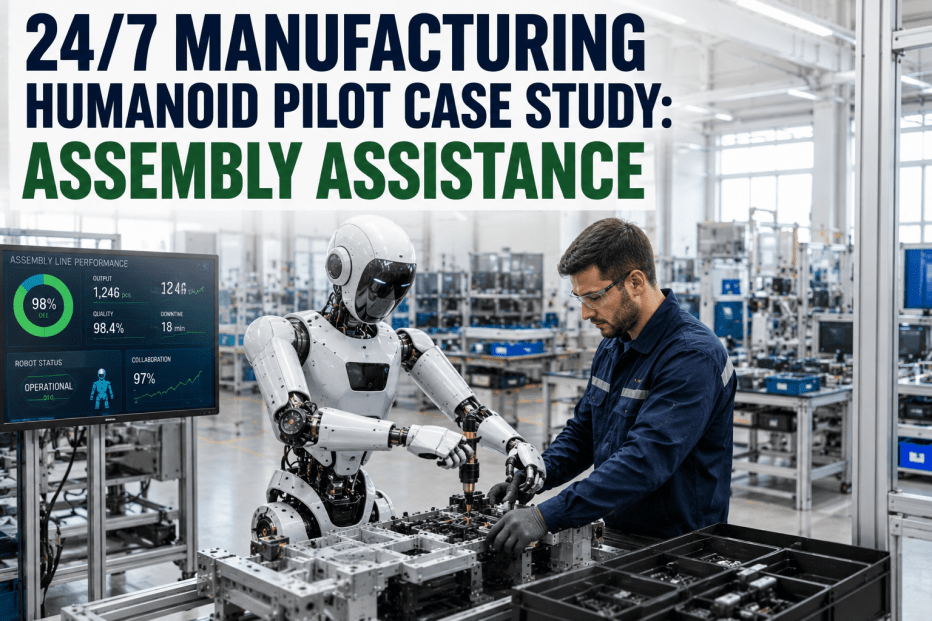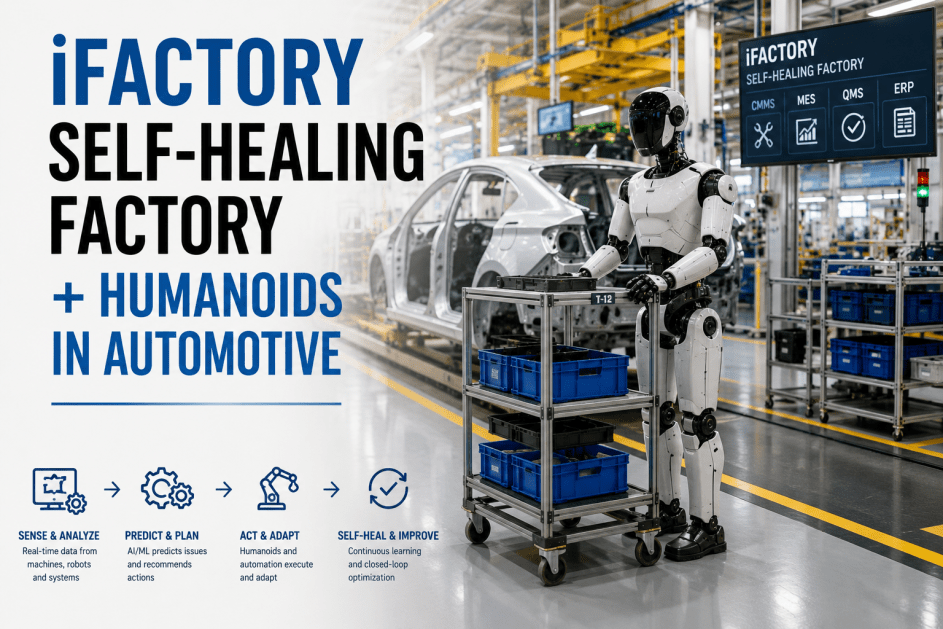
Automotive manufacturing has entered a new operational era — one where humanoid robots work alongside human teams on the assembly line, autonomous intralogistics vehicles move material without human dispatch, and the factory itself detects production disruptions and initiates corrective action before a supervisor is even notified. This is the self-healing factory model, and it is being built today at the most competitive automotive plants in North America. The integration challenge is not the robots — it is connecting humanoid robot actions, intralogistics data, and assembly line events to the CMMS, MES, and predictive maintenance platforms that run the plant. iFactory's automotive manufacturing platform provides that integration layer, giving plant managers real-time visibility across humanoid robot fleets, automated intralogistics networks, and production systems in a unified operational dashboard. Book a Demo to see how iFactory connects embodied AI and intralogistics automation to your existing plant systems.
Humanoid Robots + Self-Healing Factory Intelligence — Built for U.S. Automotive Plant Managers
Connect humanoid robot fleets, AI-powered intralogistics, and assembly automation to a unified platform that detects disruptions, triggers corrective action, and keeps your line running without manual intervention.
Why Humanoid Robots Are Reshaping Automotive Assembly in 2026
The automotive assembly line was designed around human dexterity — tasks like cable routing, clip insertion, overhead fastening, and torque verification require the fine motor coordination and contextual judgment that traditional industrial robots cannot replicate without fixed tooling and purpose-built cells. Humanoid robots change that constraint fundamentally. Because they operate in environments designed for humans — standard aisles, existing workstations, shared floor space — they can be deployed into existing automotive plants without facility reconfiguration. The operational advantage is not speed. A well-deployed humanoid robot in automotive assembly is not faster than a dedicated robotic cell on its specific task. The advantage is flexibility: a humanoid can perform a different task in the next shift with a software update, not a mechanical retooling.
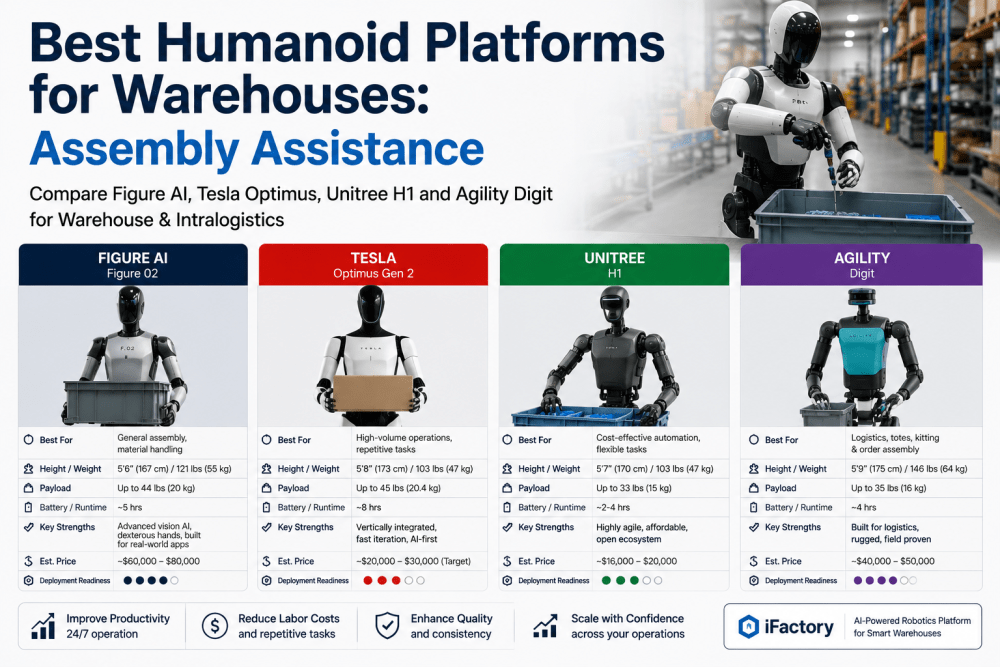
U.S. automotive plants adopting humanoid robots are concentrating deployments in three operational zones where flexibility delivers the highest return: quality inspection and rework stations, material replenishment and kitting operations, and end-of-line verification tasks that require judgment alongside physical capability. iFactory's platform provides the operational intelligence layer that makes humanoid robot deployments measurably productive — connecting robot task completion data, maintenance status, and production throughput in a system that plant managers can actually act on.
Assembly Flexibility
Humanoid robots execute variable assembly tasks across model variants without mechanical retooling — a software-defined workforce for mixed-model production.
Intralogistics Speed
AI-dispatched material replenishment eliminates line-side starvation events — parts arrive at the station before the buffer depletes, not after the stoppage occurs.
Self-Healing Logic
Integrated CMMS and MES data enables the factory to detect, diagnose, and initiate corrective action on production disruptions without waiting for human escalation.
The Four Automation Pillars of a Self-Healing Automotive Factory
A self-healing factory is not a single technology — it is four integrated operational capabilities that collectively reduce the lag between a production disruption and its resolution to near zero. iFactory's automotive manufacturing platform supports all four, connecting humanoid robot deployments to the broader production intelligence system that makes autonomous recovery possible. Book a Demo to see the full integration architecture.
Humanoid robots in automotive assembly are most productively deployed on tasks that combine physical dexterity with variable execution — cable routing across different vehicle configurations, ergonomically challenging overhead operations, and quality inspection steps that require both vision and manipulation. iFactory's MES integration captures humanoid robot task completion data at each station, feeds it into line OEE calculations in real time, and flags deviations between robot cycle time and takt time before they become downstream bottlenecks. When a humanoid robot's task completion time drifts above threshold, iFactory triggers a CMMS work order for inspection — proactive maintenance scheduling driven by operational performance data rather than fixed time intervals.
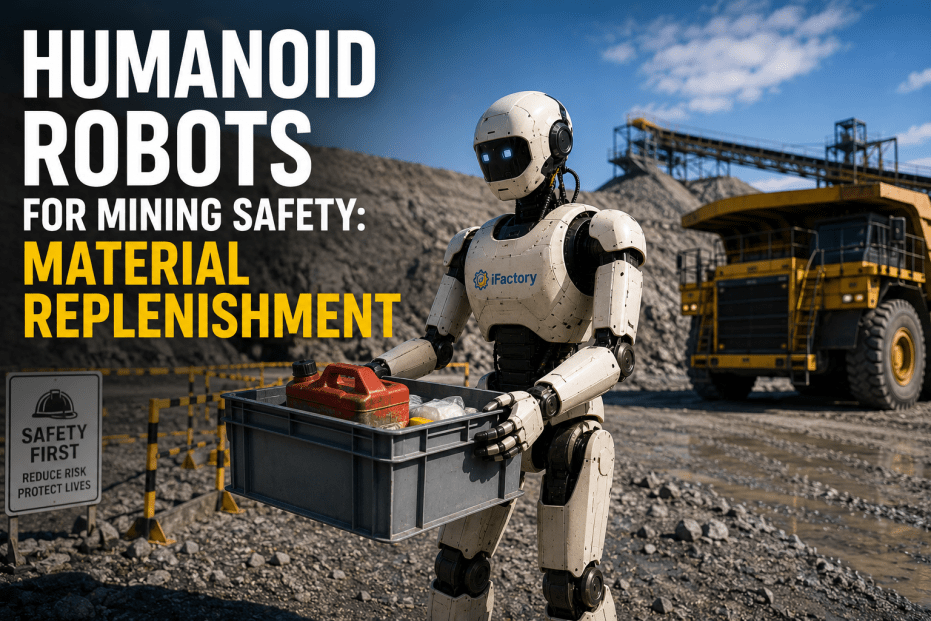
Material starvation — the condition where a line station runs out of parts before replenishment arrives — is one of the most preventable causes of automotive line stoppage, yet most plants are still managing replenishment on fixed-cycle milk runs that do not account for actual consumption variation by model mix or production rate. iFactory connects real-time MES consumption data to intralogistics dispatch, calculating dynamic replenishment triggers for each station based on actual part usage rate rather than schedule assumptions. When buffer inventory at a station reaches the calculated replenishment threshold, an autonomous replenishment order is dispatched to the nearest humanoid or AMR fleet — the part arrives at the station before the buffer depletes.
AI-powered intralogistics goes beyond automating the milk run — it optimizes the entire material flow network in real time based on production conditions. iFactory's intralogistics integration connects AMR fleet management data to the MES production schedule, enabling dynamic route prioritization when production urgency changes. A vehicle running behind takt time automatically generates a priority replenishment flag that routes the next available AMR to that station ahead of standard cycle deliveries. The platform's digital twin floor map provides real-time fleet position visibility, identifies routing conflicts before they cause delays, and tracks delivery performance against production demand at every station.
Humanoid robots introduce a new category of predictive maintenance requirements that conventional CMMS programs are not configured to handle — joint actuator wear, grasp force calibration drift, and vision system degradation that manifest as subtle cycle time increases before they cause task failures. iFactory's predictive maintenance module ingests robot telemetry data, establishes baseline performance signatures for each humanoid unit, and alerts the maintenance team when deviations indicate emerging component wear. CMMS work orders are generated automatically with the specific anomaly data, recommended inspection scope, and required parts — enabling maintenance technicians to resolve robot health issues during planned shift transitions rather than emergency line stoppages.
iFactory Automotive Integration: How Self-Healing Logic Works
Self-healing factory capability is not a feature that can be purchased as a standalone technology — it emerges from deep integration between the systems that generate production event data and the platforms that can act on it. The workflow below describes how iFactory connects humanoid robot deployments, intralogistics automation, and production management systems to create autonomous recovery capability.
Continuous event ingestion from robots and line systems
iFactory connects to humanoid robot telemetry, AMR fleet management APIs, MES production data, and CMMS asset records via OPC-UA and standard industrial protocols — building a live operational model of the factory floor updated in real time.
Anomaly detection and disruption classification
Machine learning models trained on automotive production patterns identify deviations from normal operation — cycle time drift, material buffer depletion trajectories, robot performance degradation — and classify each anomaly by disruption type and severity.
Automated corrective action dispatch
Classified disruptions trigger configured corrective responses automatically: an AMR dispatched for material replenishment, a CMMS work order generated for robot maintenance, a production schedule adjustment pushed to the MES, or an escalation alert to the responsible supervisor.
Resolution tracking and performance learning
Every disruption event, corrective action, and resolution outcome is logged for continuous model improvement. Recovery time performance is tracked against plant targets, and the system identifies recurring disruption patterns that indicate systemic issues requiring engineering intervention.
Automotive Intralogistics: Before and After AI Integration
The operational impact of connecting AI-powered intralogistics and humanoid robot fleets to a unified plant intelligence platform is measured in line stoppage minutes avoided, material delivery cycle times, and maintenance labor hours recovered.
Without iFactory
- Fixed-cycle milk run schedules that do not respond to actual consumption variation by model mix
- Line starvation events discovered when the station stops, not when the buffer reaches threshold
- Robot maintenance scheduled on fixed intervals regardless of actual health telemetry data
- No connection between humanoid robot task completion time and line OEE calculation
- Manual production disruption escalation — supervisor notified after line stoppage, not before
- AMR fleet routing managed separately from MES production priority data
With iFactory
- Dynamic replenishment dispatch triggered by real-time consumption rate — parts arrive before buffer depletes
- Predictive starvation alerts dispatched to intralogistics fleet with configurable lead time
- Condition-based robot maintenance scheduling from telemetry anomaly detection — CMMS work orders generated automatically
- Humanoid robot cycle time integrated into live OEE dashboard — deviations flagged instantly
- Autonomous corrective action dispatch within 8 minutes of disruption detection — before supervisor notification is needed
- AMR routing dynamically prioritized by MES production urgency flags in real time
Automotive plants deploying humanoid robots without integrated CMMS, MES, and predictive maintenance connectivity are operating expensive automation assets with reactive maintenance and no production intelligence loop. Book a Demo to see how iFactory closes that gap — turning your humanoid robot fleet and intralogistics network into a connected, self-healing production system.
iFactory Automotive Platform: Full Capability Overview
These are production capabilities running on U.S. automotive plant networks today — not roadmap features. Each is available at deployment for existing iFactory customers.
Humanoid robot fleet management
Real-time task completion tracking, cycle time monitoring, and health telemetry aggregation across humanoid robot deployments. Performance dashboards updated continuously and integrated with line OEE metrics.
AI-powered material replenishment
Dynamic replenishment dispatch driven by real-time MES consumption data. Predictive buffer depletion alerts trigger AMR or humanoid delivery before line starvation occurs. Priority routing synchronized with production schedule.
Autonomous disruption recovery
Configurable corrective action workflows for classified disruption types. Automated CMMS work order generation, AMR dispatch, and MES schedule adjustment triggered without manual escalation. Average recovery under 8 minutes.
Robot health and predictive maintenance
Telemetry-based health monitoring for humanoid joints, actuators, and vision systems. Anomaly detection generates condition-based CMMS work orders with inspection scope and parts requirements before failure occurs.
Real-time factory floor visibility
Live digital twin of the automotive plant floor showing humanoid robot positions, AMR fleet locations, production status at each station, and material inventory levels — updated continuously from integrated data sources.
MES, CMMS and ERP connectivity
Connects to existing MES platforms, CMMS systems, and ERP environments via OPC-UA, REST APIs, and standard industrial protocols. Zero cloud dependency — all data processed on your plant network.
Humanoid Robot Deployment ROI: What U.S. Automotive Plants Are Measuring
The financial case for humanoid robot integration in automotive manufacturing is measured across three value categories: production continuity improvement, maintenance labor recovery, and material handling cost reduction. The figures below reflect outcomes at comparable U.S. automotive assembly facilities.
Line stoppage reduction from self-healing integration
Automotive plants with integrated self-healing logic report a 60–72% reduction in unplanned line stoppages during the first 12 months of deployment — primarily driven by predictive replenishment and condition-based robot maintenance.
Material delivery cycle time with AI intralogistics
AI-dispatched intralogistics reduces average material delivery cycle time from line-side request to part arrival by 68% compared to fixed-schedule milk run operations — eliminating the buffer inventory excess that compensates for delivery unpredictability.
Cost of unplanned line stoppage in automotive assembly
An unplanned stoppage on a high-volume automotive assembly line costs an average of $22,000 to $50,000 per hour in direct production loss — making each prevented stoppage a measurable financial event, not an operational metric.
Maintenance labor hours recovered through condition-based scheduling
Transitioning humanoid robot maintenance from fixed-interval to condition-based scheduling recovers 35–55% of preventive maintenance labor hours annually — time redirected to corrective work that actually requires human expertise.
What Automotive Plant Managers Say About Humanoid Integration
We deployed six humanoid units on our trim line eighteen months ago and the technology performed exactly as the vendor demonstrated. The robots did the tasks. What we were not prepared for was the operational integration challenge — the humanoid fleet was generating performance telemetry, task completion data, and maintenance alerts that had nowhere to go in our existing CMMS and MES environment. We were managing a $4 million robot investment with spreadsheets and shift log notes. When we integrated with iFactory, the first thing that changed was visibility — we could see humanoid cycle time, robot health scores, and material delivery performance against takt in the same dashboard as our traditional line OEE. The second thing that changed was responsiveness. Before iFactory, a humanoid task completion time drift would be noticed by a supervisor on the next shift walk. After integration, the CMMS work order is generated automatically and routed to our maintenance technician within 12 minutes of the anomaly threshold breach. We have not had an unplanned humanoid-related line stoppage in seven months. The self-healing logic for material replenishment has been equally impactful — our line-side buffer inventory is down 40% because we are delivering on actual consumption signal rather than worst-case schedule assumptions. For any automotive plant manager deploying humanoids without platform integration, you are operating at a fraction of the technology's value.
Conclusion
Humanoid robots and AI-powered intralogistics are not future technologies in U.S. automotive manufacturing — they are active deployments at competitive plants today, delivering flexibility, throughput stability, and labor optimization that conventional automation cannot match in mixed-model, high-variability production environments. The operational ceiling of these deployments is determined not by the robots themselves but by the integration infrastructure that connects them to production intelligence systems.
iFactory's automotive manufacturing platform provides the CMMS, MES, and predictive maintenance integration layer that transforms isolated humanoid robot deployments into a connected self-healing factory network. Real-time fleet performance visibility, condition-based maintenance automation, predictive material replenishment, and autonomous corrective action dispatch are the capabilities that separate a productive humanoid deployment from an expensive experiment. The investment payback at a U.S. automotive plant with existing iFactory infrastructure begins with the first prevented line stoppage — typically within the first operating month of humanoid integration. Book a Demo to see how iFactory connects your humanoid robot fleet and intralogistics network to a unified automotive production intelligence platform.
Connect Your Humanoid Fleet to a Self-Healing Factory Platform
Your humanoid robots are generating the performance data needed for predictive maintenance, self-healing recovery, and production optimization. iFactory connects that data to your CMMS, MES, and intralogistics systems — deployed on your plant network in 4 to 6 weeks, with no cloud dependency.
.png)