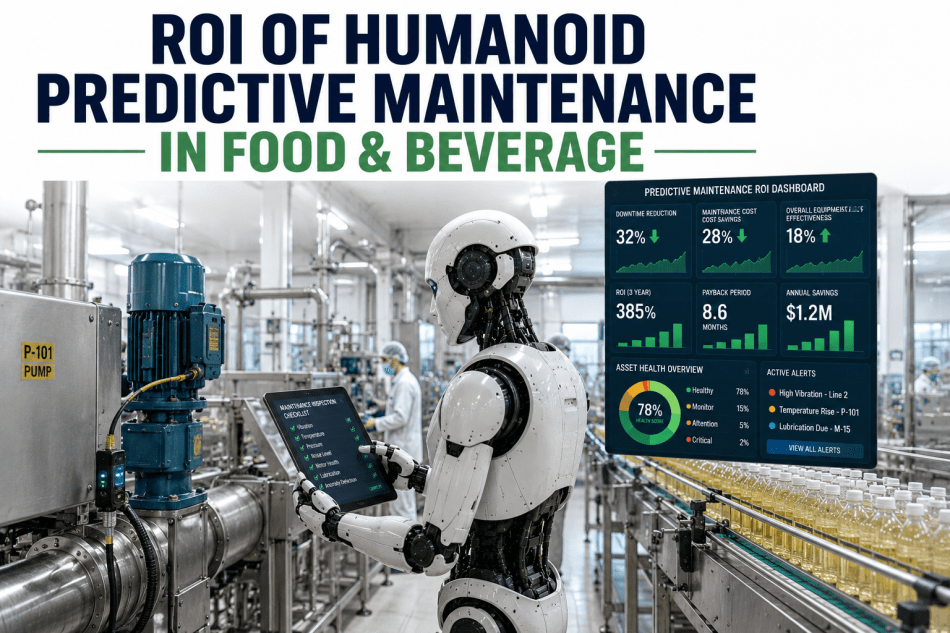
Food and beverage manufacturers face a persistent reliability challenge that directly impacts profitability. Industry data indicates that unplanned downtime in food processing operations costs between $10,000 and $30,000 per hour, with the average plant experiencing over 800 hours of machine stoppage annually. Humanoid robots purpose-built for predictive maintenance patrols are emerging as the highest-ROI automation investment available to F&B operators in 2026, delivering measurable payback within 12 to 18 months while reducing unplanned outages by 50 percent or more. Maintenance and engineering leaders evaluating this technology typically begin with a session to assess how iFactory's AI-driven CMMS and MES platform connects humanoid patrol data to work orders, compliance records, and ROI dashboards.
Quantify the Return on Humanoid PdM Patrols for Your Food & Beverage Facility
iFactory's platform bridges humanoid robotic patrols — vibration analysis, thermal imaging, acoustic monitoring — with audit-ready work orders, compliance documentation, and real-time OEE tracking for food and beverage plants.
Why Humanoid Predictive Maintenance Delivers Compelling Returns in Food & Beverage
The financial case for humanoid predictive maintenance patrols in food and beverage manufacturing rests on four interconnected drivers that together create a return profile unmatched by traditional condition monitoring investments. Understanding these drivers is essential for building a facility-specific ROI model that withstands CFO scrutiny.
Downtime Cost Exposure
Food and beverage plants lose an estimated $12 million or more annually to unplanned downtime when accounting for lost production, scrapped product, overtime labor, and cold-chain disruption. Humanoid patrols detect bearing degradation, belt misalignment, and thermal anomalies 24 to 72 hours before failure, converting reactive outages into scheduled interventions.
Labor Capacity Multiplier
Maintenance teams in food plants spend 40 to 60 percent of each shift walking between measurement points. Humanoid robots executing autonomous patrols free skilled technicians to focus on repair work, overhaul planning, and continuous improvement. Early adopters report an effective team capacity increase of 2.1 times.
Regulatory Compliance Automation
FSMA Preventive Controls, FDA 21 CFR Part 11, and SQF certification require documented, timestamped evidence of equipment inspections and maintenance actions. Humanoid patrols generate this evidence automatically — transforming compliance from a manual overhead into a continuous, audit-ready process that reduces regulatory risk.
Asset Life Extension
Over 60 percent of food and beverage plants operate equipment beyond its original design life. Continuous condition monitoring through humanoid patrols — vibration spectrum analysis, thermography, and ultrasonic detection — catches wear patterns early, extending mean time between failure by 85 percent and deferring capital replacement expenditure.
Industry Benchmarks: Downtime Costs and Maintenance Performance in Food & Beverage
The metrics below represent the current state of maintenance performance across North American food and beverage manufacturing, drawn from industry surveys and published operational data. These benchmarks establish the baseline against which humanoid predictive maintenance ROI is measured.
Comparative ROI Analysis: Humanoid Patrol PdM vs. Traditional Maintenance Strategies
The table below compares the five-year financial and operational outcomes of three maintenance approaches applied to a representative 500,000-square-foot food processing facility with 400 critical assets. The humanoid predictive maintenance scenario assumes two patrol robots operating across three shifts with iFactory platform integration for work order generation, compliance documentation, and ROI reporting.
| Metric | Reactive Maintenance | Fixed-Sensor PdM | Humanoid Patrol PdM |
|---|---|---|---|
| Five-Year Net ROI | −22% | 64% | 312% |
| OEE Improvement | — | +5 to 8 points | +12 to 18 points |
| Asset Coverage | — | 30 to 50% | 90 to 100% |
| MTBF Increase | — | +40% | +85% |
| MTTR Reduction | — | −25% | −55% |
| First-Year CAPEX | $0 | $850K to $1.2M | $420K to $680K |
| Five-Year TCO | $4.8M | $2.9M | $1.6M |
| Payback Period | Never | 24 to 36 months | 12 to 18 months |
| Compliance Documentation | Manual | Partial | Fully Automated |
Humanoid PdM Maturity Roadmap: From Pilot to Full-Scale Autonomous Patrol Operations
Deploying humanoid predictive maintenance patrols in food and beverage plants follows a structured maturity progression. Organizations building these programs typically Book a Demo to align their asset data maturity and CMMS readiness with the platform capabilities required at each stage of the journey.
Asset Baseline & Pilot Patrol
For: Reliability & Maintenance Teams
- Complete asset registry and criticality ranking in iFactory EAM module
- Map humanoid patrol routes across freezer, dry storage, processing, and packaging zones
- Establish vibration, thermal, and acoustic baselines for 200+ critical assets
- Deploy first humanoid unit on single-shift patrol with iFactory AI Vision integration
Multi-Robot Fleet & Automated Workflows
For: Operations & Engineering Directors
- Scale to two or three humanoid units covering three-shift patrol operations
- Automated work order generation from iFactory's ML-based anomaly severity scoring
- Connect patrol data to MES for real-time OEE impact tracking
- Regulatory compliance mapping to FSMA, FDA Part 11, and SQF requirements
Autonomous Operations & Cross-Site Scaling
For: Plant Management & Corporate Engineering
- Continuous model improvement from historical patrol data reducing false positives by 60%
- Humanoid fleet operating at 2.1× human maintenance team capacity
- Cross-site benchmarking and multi-plant ROI consolidation via iFactory analytics
- Board-ready autonomous maintenance performance reporting and year-over-year trend data
Measurable Outcomes from Humanoid Predictive Maintenance Deployments in Food & Beverage
Food and beverage operators that have moved beyond humanoid PdM pilots to governed production deployments are reporting material performance improvements across safety, efficiency, and compliance metrics. The results below reflect outcomes from early-adopter programs across dairy, protein processing, beverage bottling, and bakery facilities in 2025–2026.
"We deployed two humanoid patrol units across our protein processing facility in Q3 2025. Within six months, unplanned downtime dropped by 74 percent, and our maintenance team shifted from firefighting to proactive overhaul work. The payback on the entire deployment — robots, infrastructure, and iFactory platform integration — was 11 months. I have not seen a capital investment in 20 years of food manufacturing that delivered this kind of measurable return across safety, compliance, and production metrics simultaneously."
Humanoid Predictive Maintenance for Food & Beverage — Frequently Asked Questions
What is the typical payback period for humanoid predictive maintenance in a food processing plant?
Based on 2025–2026 deployments across dairy, protein, beverage, and bakery facilities ranging from 200 to 600 critical assets, the median payback period is 14 months with a range of 11 to 18 months. Facilities deploying two or more humanoid units in parallel typically achieve payback 20 to 30 percent faster due to shared infrastructure and supervision costs.
How does humanoid PdM compare to fixed wireless sensor networks on total cost of ownership?
Fixed sensor networks for a 400-asset food plant require $850,000 to $1.2 million in sensor CAPEX plus $80,000 to $120,000 per year in calibration and maintenance. A humanoid patrol deployment covering the same assets costs $420,000 to $680,000 for robots, charging docks, and iFactory platform — with zero wiring costs, no sensor calibration overhead, and the ability to reach assets in freezers, mezzanines, and confined spaces that fixed sensors cannot cover.
Can humanoid robots operate effectively in freezer, wet, and washdown environments?
Yes. Current-generation humanoid robots used in food plant deployments carry IP54 to IP65 ingress protection ratings suitable for chilled and freezer environments down to −30°C and wet processing zones. Robots feature food-grade corrosion-resistant materials, thermal battery management systems for 8-plus hours of continuous freezer patrol, and dedicated sanitation protocols that integrate with standard plant cleaning schedules.
What maintenance data do humanoid robots collect during autonomous patrols?
Humanoid patrol robots collect vibration data across 10 to 10,000 Hz for bearing and gearbox analysis, thermal imagery with ±0.5°C accuracy for electrical and mechanical anomaly detection, ultrasonic acoustic data for air leak and steam trap diagnostics, and high-resolution visual imagery for seal integrity, belt condition, and fluid level verification. All data is geo-tagged, timestamped, and uploaded to iFactory for trend analysis and regulatory recordkeeping.
How does iFactory integrate humanoid patrol data with existing CMMS and MES systems?
iFactory's platform ingests humanoid sensor data and anomaly detections via REST APIs and converts them into standardized work orders with severity ratings, recommended actions, and parts requirements. The platform supports bidirectional integration with major CMMS and MES platforms, enabling automated work order creation, real-time OEE impact tracking, and FSMA-compliant documentation without manual data entry. iFactory also provides a 21 CFR Part 11 compliant audit trail for all robotic inspection records.
Building the Business Case for Humanoid Predictive Maintenance in Your Food & Beverage Plant
Humanoid predictive maintenance patrols have moved beyond pilot programs into governed production deployments across food and beverage manufacturing. The data from early adopters is consistent: 312 percent five-year ROI, median 14-month payback, OEE improvements of 12 to 18 points, and 74 percent reduction in unplanned downtime. These results are not theoretical — they are being delivered today in dairy, protein, beverage, and bakery facilities using commercially available humanoid robots integrated with iFactory's operational data platform.
The cost of inaction is measurable. Every month of delayed deployment represents $80,000 to $240,000 in preventable downtime losses for a mid-size food plant. The operators that will capture the most value from this technology are not necessarily those with the largest capital budgets — they are the ones with the operational data infrastructure that converts robotic patrol data into auditable compliance records, predictive maintenance triggers, and board-level ROI metrics. iFactory is purpose-built to serve as that infrastructure layer, connecting humanoid patrol robots to a single source of operational truth that satisfies FSMA, FDA, and SQF requirements while demonstrating measurable return on every robotic asset deployed. Plant leadership teams ready to build their humanoid PdM business case are invited to Book a Demo with iFactory's food and beverage engineering team.
Build Your Humanoid Predictive Maintenance Business Case Today
iFactory connects humanoid patrol robots to audit-ready compliance workflows and measurable ROI dashboards — delivering documented returns from every robotic asset deployed in your food and beverage facility.