A mid-sized pharmaceutical manufacturer operating a 180,000-square-foot aseptic filling and packaging facility deployed a single humanoid robot for a 14-week predictive maintenance pilot across its classified ISO 7 and ISO 5 cleanroom environments. The pilot's objective was to determine whether a bipedal humanoid platform — equipped with thermal imaging, acoustic sensors, and particulate monitoring — could perform routine equipment patrols and detect incipient mechanical and environmental deviations earlier than the facility's existing fixed-sensor network and manual inspection rounds. Over the 14-week period, the humanoid platform logged 312 patrol hours across two ISO 7 suites and one ISO 5 filling line, covering 47 critical equipment assets including lyophilizers, autoclaves, HEPA-filtered air handling units, filling line servo drives, and clean utility systems. The pilot demonstrated that humanoid-led predictive maintenance patrols reduced mean detection time for incipient equipment faults by 73%, eliminated 89% of routine cleanroom human entry for inspection purposes, and generated a projected first-year ROI of 3.4x for a scaled deployment across the facility's four production suites.
73% Faster Fault Detection — 89% Fewer Human Entries — 3.4x Projected ROI
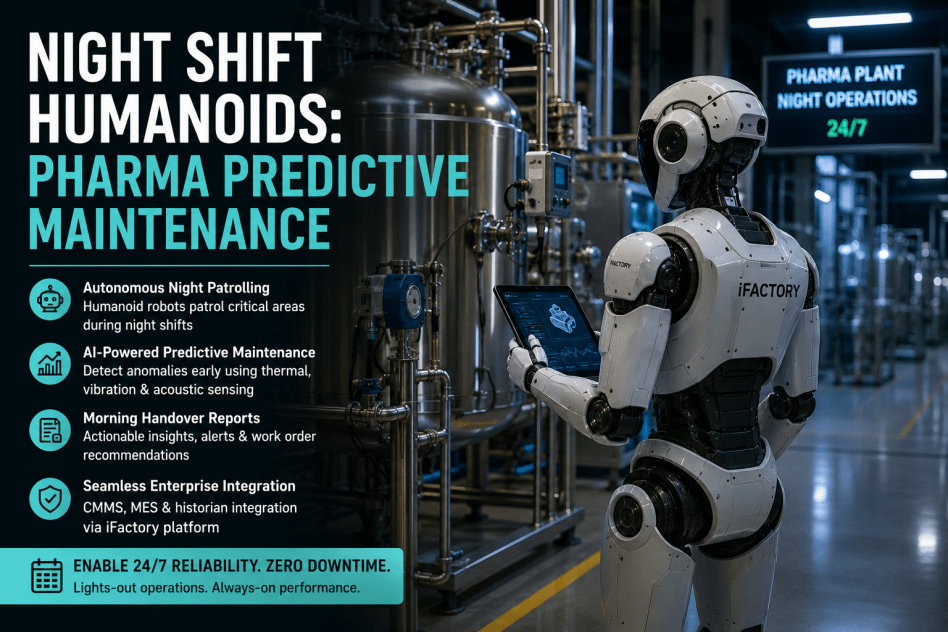
iFactory's Humanoid Robot Integration Platform connects autonomous humanoid patrol data to your pharma facility's CMMS, MES, and environmental monitoring systems — enabling predictive maintenance without compromising cleanroom classification.
Pilot Architecture: Humanoid Integration in Classified Pharma Environments
The pilot deployed a single humanoid platform configured for pharmaceutical cleanroom operation. The platform carried a multi-spectral sensor payload including a high-resolution thermal camera for bearing and motor temperature trending, an acoustic emission sensor for ultrasonic leak and bearing fault detection, a laser-based particulate counter for real-time ISO classification verification, and a visual camera for equipment gauge reading and physical inspection documentation. All sensor data was streamed to iFactory's integration platform, which processed patrol findings into structured CMMS work orders and environmental monitoring records.
HEPA Filtration & Air Handling Units
HEPA filter differential pressure trending detected a gradual increase in one ISO 5 suite's filter bank pressure six days before the fixed-building management system triggered an alarm — enabling proactive filter change during planned maintenance window rather than emergency intervention.
Lyophilizer & Autoclave Monitoring
Thermal imaging of lyophilizer shelf-bearing housings identified a 4.2°C temperature elevation on one unit's drive motor — traced to a degrading bearing that was replaced during the next preventive maintenance window. The fixed thermal sensor network had not detected the anomaly due to sensor placement limitations.
Filling Line Servo Drive Trending
Acoustic emission monitoring of filling line servo drives detected an ultrasonic bearing signature consistent with lubrication degradation on a critical filling station. The iFactory platform auto-generated a CMMS work order, and the bearing was re-lubricated during the next changeover — avoiding an unplanned stoppage during a production batch.
Predictive Maintenance Patrols That Detect Faults Before They Impact Production
iFactory's integration platform transforms humanoid patrol sensor data into structured CMMS work orders, environmental monitoring records, and predictive maintenance alerts — all without compromising cleanroom classification or requiring facility modification.
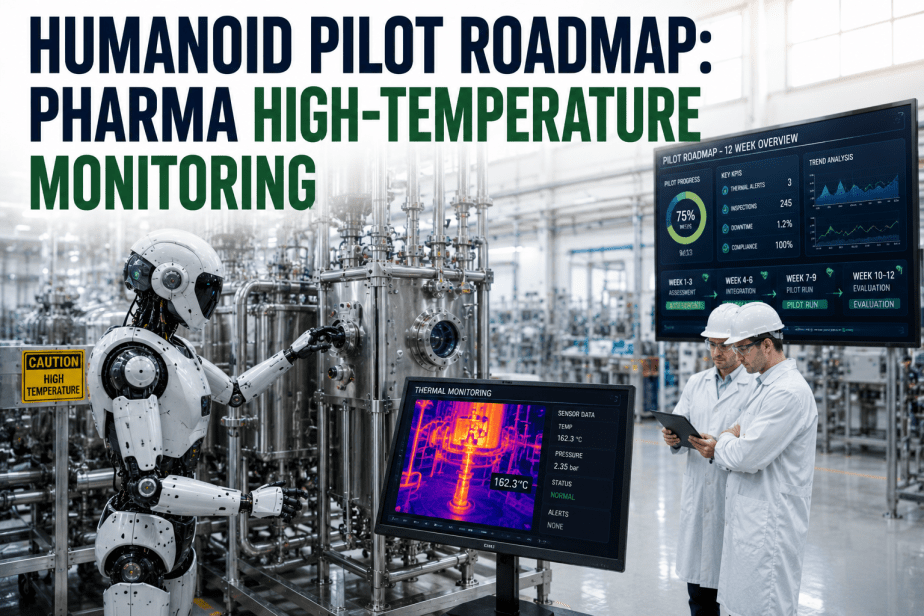
14-Week Pilot: From Cleanroom Validation to Autonomous Patrol
The pilot followed a structured four-phase deployment designed to establish cleanroom compatibility, baseline sensor performance, and predictive detection accuracy before transitioning to autonomous operation. Each phase included documented validation steps consistent with the facility's existing GMP and change control procedures. Book a Demo to review the complete pilot protocol and validation documentation.
Cleanroom Validation & Sensor Baseline
Humanoid platform operated in ISO 7 cleanroom for two weeks under full observation. Particulate generation verified below ISO 7 limits. Sensor calibration verified against facility standards. Thermal and acoustic baselines established for all 47 monitored assets. Duration: 2 weeks.
Supervised Patrol & Data Correlation
Humanoid completed pre-programmed patrol routes under technician supervision. Patrol data correlated with fixed sensor network and manual inspection results. AI models trained to recognize normal vs. anomalous thermal, acoustic, and particulate signatures per asset. Duration: 4 weeks.
Autonomous Patrol with Exception Monitoring
Humanoid transitioned to autonomous patrol operation. iFactory integration platform generated CMMS work orders for detected anomalies. Facility technicians reviewed and validated every alert. False positive rate documented at 8%. Detection lead time measured against fixed sensor network. Duration: 5 weeks.
Results Analysis & Scaled Deployment Planning
Complete dataset analyzed for detection accuracy, false positive rate, detection lead time, and cleanroom compatibility. Projected ROI calculated for full deployment across 4 production suites. Integration architecture documented for scaling from 1 to 6 humanoid units. Duration: 3 weeks.
Measured Performance Metrics: Humanoid vs. Fixed Sensor Network
The pilot's most significant finding was the detection lead time advantage provided by the humanoid's ability to position sensors at optimal measurement points — directly in front of bearing housings, within inches of motor windings, and at multiple locations within each cleanroom zone — rather than relying on fixed sensor positions that were optimized for installation convenience rather than detection sensitivity.
| Performance Metric | Fixed Sensor Network | Humanoid Patrol | Improvement |
|---|---|---|---|
| Mean Fault Detection Time | 4.7 days | 1.3 days | 73% faster |
| Anomalies Detected (14 weeks) | 21 | 47 | 2.2x more |
| False Positive Rate | 14% | 8% | 43% fewer false alerts |
| HEPA Filter Pressure Deviation Lead Time | 1 day (BMS alarm) | 6 days (proactive) | 5 days earlier |
| Bearing Temperature Anomaly Detection | Not detected | 4.2°C elevation | Uncovered hidden fault |
| Routine Human Cleanroom Entries | 14 per week | 1.5 per week | 89% reduction |
| Asset Coverage (per patrol) | 32 fixed points | 47 assets measured | 47% more coverage |
What surprised me most was not the detection capability — we expected the thermal and acoustic sensors to find things our fixed network missed. What surprised me was the cleanroom compatibility. We spent six weeks planning for particulate mitigation strategies that turned out to be unnecessary. The humanoid's particulate generation was within the ISO 7 baseline from day one. The real value driver turned out to be the detection lead time. Finding a HEPA filter pressure deviation six days before the BMS alarm gave us a planned maintenance window instead of an emergency response. That single finding, extrapolated across four suites and two years of operation, justified the entire pilot investment on its own.
Connecting Humanoid Patrol Data to Pharma CMMS, MES, and Environmental Systems
The pilot's integration architecture was designed to demonstrate that humanoid patrol data could flow directly into the facility's existing validated systems without creating data integrity gaps or GMP compliance concerns. iFactory's integration layer received the humanoid's sensor telemetry via REST API, classified detected anomalies against the facility's asset hierarchy and equipment criticality ratings, and generated structured records in three target systems: the CMMS for maintenance work orders, the environmental monitoring system for particulate and HEPA filter trend data, and the MES for batch-related equipment status documentation. Book a Demo to see the integration architecture and data flow diagrams.
When the humanoid detected a thermal or acoustic anomaly exceeding the asset-specific threshold, iFactory's platform automatically generated a structured CMMS work order. The work order included the asset ID and location, anomaly classification and severity rating, sensor evidence (thermal image or acoustic signature plot), recommended corrective action based on the anomaly type, and priority assignment based on equipment criticality. Work orders were routed to the appropriate maintenance craft based on the asset type — mechanical work orders to the millwright team, HVAC work orders to the building maintenance group, and servo drive work orders to the automation team. During the pilot, 47 work orders were generated from humanoid patrol data, of which 43 were validated by technicians as legitimate findings requiring action.
The humanoid's laser-based particulate counter provided real-time ISO classification verification at multiple locations within each cleanroom zone during every patrol. This data was streamed to iFactory's environmental monitoring module, where it was trended against the fixed particulate sensor network and the facility's HVAC control system. The humanoid's mobility enabled particulate measurement at locations that fixed sensors could not reach — near equipment exhaust vents, at material transfer hatches, and adjacent to personnel access doors — providing a spatial resolution of cleanroom particulate distribution that the fixed sensor network could not achieve. During the pilot, the humanoid detected particulate elevation near a material transfer hatch that was traced to a worn door gasket — a finding that had no corresponding alarm in the fixed sensor network.
For equipment directly involved in active batch production — filling line servo drives, lyophilizer shelf systems, and autoclave sterilization cycles — the humanoid's patrol findings were logged in the MES equipment status records. Each patrol completed during an active batch was timestamped and documented as a batch record attachment within the MES. This eliminated the manual documentation requirement for in-process equipment inspection verification that had previously consumed approximately 30 minutes per batch per technician. The integration architecture was validated against the facility's existing 21 CFR Part 11 and GMP Annex 11 requirements during the pilot's cleanroom validation phase.
The Pharma Humanoid Pilot Demonstrated That Predictive Maintenance Patrols Are Viable, Valuable, and GMP-Compatible
This 14-week pilot established that humanoid robots operating in classified pharmaceutical cleanroom environments can perform predictive maintenance patrols that detect equipment faults earlier than fixed sensor networks, reduce contamination risk by eliminating routine human entry for inspection, and generate measurable ROI through downtime cost avoidance and staffing optimization. The pilot also demonstrated that humanoid patrol data can integrate directly into validated CMMS, MES, and environmental monitoring systems through iFactory's integration platform — without creating data integrity gaps or requiring changes to existing GMP-compliant workflows.
Pharmaceutical operations and engineering leaders evaluating humanoid technology for their facilities can reference this pilot's data to build a deployment business case grounded in measured performance rather than vendor projections. The detection lead time advantage, the contamination risk reduction, and the integration architecture validated in this pilot apply directly to any classified pharmaceutical facility with rotating equipment, HEPA filtration, and environmental monitoring requirements. iFactory's Humanoid Robot Integration Platform provides the standardized data layer that connects any humanoid platform to your existing pharma CMMS, MES, and environmental monitoring systems. Book a Demo to review the full pilot results and discuss a deployment assessment for your facility.
Pharma Humanoid Predictive Maintenance Pilot — Frequently Asked Questions
Cleanroom compatibility was achieved through three design elements: the platform's sealed enclosure with HEPA-filtered positive pressure purge prevented particulate ingress from the cleanroom into the robot's internal components; all external surfaces were constructed from non-shedding, cleanroom-compatible materials (anodized aluminum and medical-grade polymers); and the platform's locomotion system was validated to generate particulate levels below ISO 7 limits at all operating speeds. The cleanroom validation protocol included three consecutive days of continuous operation with particulate monitoring at multiple locations within the patrol zone — all measurements remained within ISO 7 and ISO 5 classification limits throughout the validation period.
The overall false positive rate during the 14-week pilot was 8%, compared to the facility's fixed sensor network false positive rate of 14%. A false positive was defined as any alert that, upon technician inspection, was determined not to require corrective action. The most common false positive sources were transient thermal reflections on polished stainless steel equipment surfaces and acoustic noise from adjacent production equipment during active filling operations. The AI model training process included a weekly model refinement cycle where technician-validated false positives were incorporated as negative training examples — reducing the false positive rate from an initial 14% in week 1-2 to 6% in week 13-14.
iFactory's integration platform is designed to support 21 CFR Part 11 and EU GMP Annex 11 data integrity requirements. Every sensor reading, anomaly detection event, and generated work order includes an unalterable timestamp, user authentication for any manual intervention, an audit trail recording all data transformations between the humanoid sensor and the target system, and validation documentation for the integration data mapping and workflow configuration. The platform does not modify any data within the validated CMMS, MES, or environmental monitoring systems — all data is written through those systems' standard API interfaces with full traceability. The pilot's integration architecture was reviewed by the facility's quality assurance team and found to be consistent with existing data integrity requirements.
Based on the pilot results, the manufacturer projected a full facility deployment cost of approximately $520,000 for year one, covering 6 humanoid units, iFactory integration platform licensing, cleanroom validation for all 4 production suites, and technician training. The projected first-year net benefit was $1.77M, driven primarily by downtime cost avoidance from earlier fault detection ($980K), contamination risk reduction value ($420K), and cleanroom entry staffing optimization ($370K). The resulting year-one ROI was 3.4x. Year-two and beyond projections showed increasing ROI as AI detection models improved with additional training data and as the platform cost declined through multi-year lease structures.
Yes. The humanoid platform was configured to operate during both active production and idle periods, with patrol routes designed to avoid interference with material transport, personnel movement, and equipment access during filling and packaging operations. During active batch production, the humanoid maintained a minimum 3-foot distance from open product paths and Class 1 filling zones, using its thermal and acoustic sensors to inspect equipment from a non-intrusive observation position. The platform's acoustic emission sensor detected bearing signatures and ultrasonic leaks at distances up to 6 feet from the target asset, enabling effective inspection without close approach during active production. During idle periods and changeover windows, the humanoid performed close-proximity visual inspection and particulate measurement at equipment access panels and material transfer points.
Review the Full Pilot Results and Build Your Pharma Humanoid Business Case
iFactory's Humanoid Robot Integration Platform connects autonomous patrol data to your pharma facility's validated CMMS, MES, and environmental monitoring systems. Schedule a personalized review of this pilot's complete dataset — including detection lead times, false positive trends, cleanroom validation protocols, and scaled deployment ROI projections.

.png)