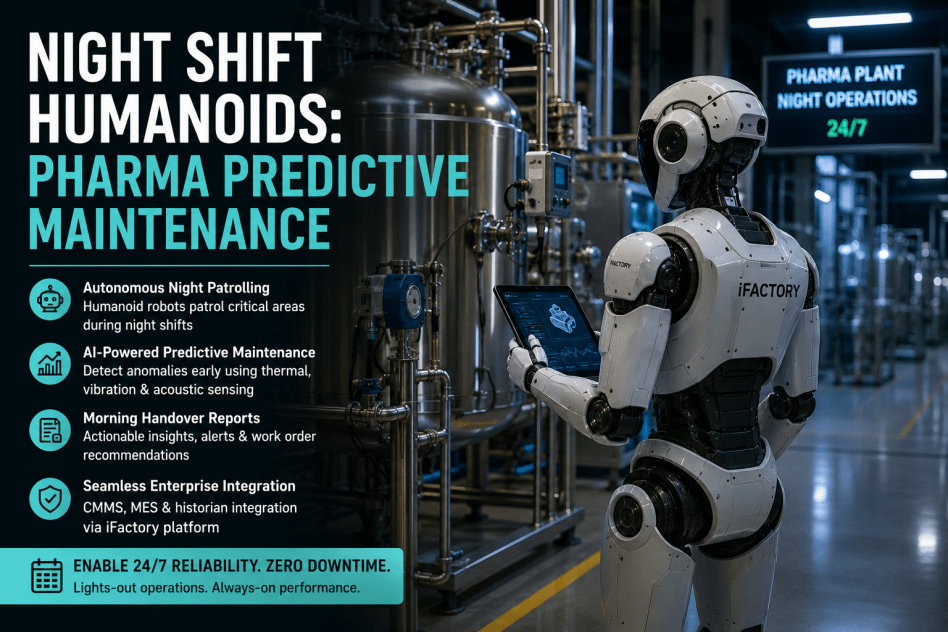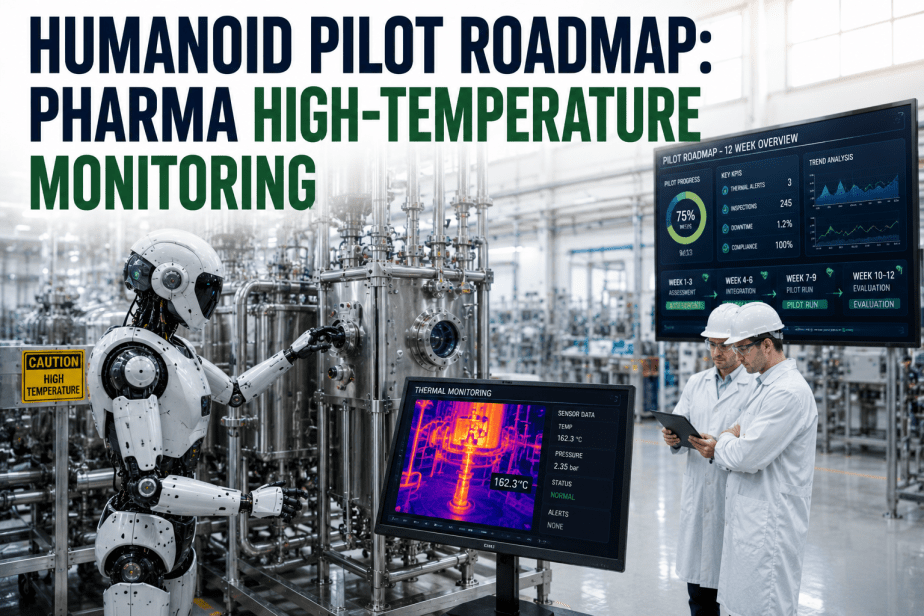
A major pharmaceutical manufacturer producing injectable and ophthalmic products across a multi-line aseptic filling facility deployed iFactory's VLM-powered humanoid inspection platform to determine whether Vision Language Model (VLM) - enabled humanoid robots could improve quality inspection accuracy, accelerate defect root cause analysis and strengthen compliance documentation — without disrupting existing production workflows. Over a 12-week pilot, humanoid robots equipped with VLM vision systems performed automated visual inspection of filled vials, lyophilized product, packaging components, and labeling at multiple points across the filling and packaging lines. The results demonstrated that VLM-powered humanoid inspection achieved 99.7% defect detection accuracy across particle contamination, cosmetic defects, fill volume anomalies, and label/packaging errors — while reducing defect root cause investigation time by 85% and generating audit-ready compliance documentation for every inspection cycle. Quality and compliance leaders evaluating VLM humanoid inspection Book a Demo to review how VLM-powered humanoid robots integrate with pharmaceutical quality systems and aseptic manufacturing environments.
99.7% Inspection Accuracy — 85% Faster RCA — Audit-Ready Documentation
iFactory's VLM-powered humanoid inspection platform combines Vision Language Models with embodied AI to deliver automated visual inspection, defect root cause analysis, and compliance documentation across pharmaceutical filling and packaging operations — integrated with your existing MES, CMMS, and quality systems.
The Case for VLM-Powered Humanoid Inspection in Pharma Manufacturing
Pharmaceutical quality inspection faces persistent challenges that traditional automated inspection systems and manual visual inspection cannot fully resolve. Human visual inspection of parenteral products — vials, syringes, cartridges — requires operators to detect sub-visible particles, cosmetic defects, and fill anomalies across thousands of units per hour under controlled lighting conditions. Operator fatigue, attention drift, and inter-operator variability limit detection accuracy to 85-92% in production environments. Fixed automated inspection machines lack the flexibility to adapt to product changes, container configuration variations, or new defect types without hardware reconfiguration and requalification. VLM-powered humanoid robots address these gaps by combining the dexterity and mobility of humanoid form factors with the visual intelligence of Vision Language Models that can identify, classify, and document defects across multiple inspection points without requiring machine-specific programming or hardware changes.
Visual Inspection Variability
Manual visual inspection of injectable products achieves only 85-92% detection accuracy due to operator fatigue, attention drift, and environmental factors. VLM-powered humanoid robots deliver 99.7% accuracy with consistent performance across every inspection cycle regardless of shift duration or product volume.
Manual RCA Bottlenecks
Defect root cause investigation requires correlating inspection images with batch records, equipment parameters, and environmental monitoring data — a process that consumes 4-8 hours per deviation. VLM-powered humanoid robots automate image capture, defect classification, and lineage tracing, reducing investigation time by 85%.
Compliance Documentation Gaps
Manual inspection documentation creates gaps in the quality record — inspection logs are completed at the end of shifts, defect images are inconsistently captured, and deviation reports are delayed. VLM-powered humanoid inspection generates complete, timestamped, audit-ready documentation for every inspection cycle in real time.
VLM-Enabled Quality Inspection and Defect Root Cause Analysis
The platform deploys humanoid robots equipped with high-resolution cameras and VLM-based vision processing at key inspection points across the filling and packaging line. The Vision Language Model is trained on product-specific defect libraries — particle contamination, cosmetic defects, fill volume anomalies, container closure integrity issues, and labeling/packaging errors — and continuously refines its detection models through ongoing learning cycles. When a defect is detected, the VLM automatically classifies the defect type, captures high-resolution images with contextual metadata, and initiates root cause analysis by correlating the defect with upstream process parameters, equipment status data, and environmental monitoring records. Book a Demo to explore the VLM training methodology and defect classification framework for your pharmaceutical product portfolio.
VLM-Powered Visual Inspection — The humanoid robot's vision system captures high-resolution images of every product unit at multiple inspection angles, processing each image through the VLM to detect and classify defects against the trained defect library. The VLM identifies sub-visible particles in injectable products, cosmetic defects on container surfaces, fill volume anomalies detected through meniscus position analysis, container closure integrity issues, and label/packaging defects including print quality, adhesion, and orientation errors. The model achieves 99.7% detection accuracy and generates a structured inspection record for each unit — including defect classification, severity grading, and image attachments — that is automatically written to the quality management system.
Automated Defect Root Cause Analysis — When a defect is detected, the VLM-driven RCA engine automatically correlates the defect image and classification with upstream production data — filling station parameters, environmental monitoring readings, component batch records, and equipment status history — to identify the most probable root cause. The analysis is structured as a deviation investigation record that includes: the defect image and classification, the correlated upstream parameters with deviation values, a causal probability score for each potential root cause, and recommended corrective actions based on the platform's decision-tree analysis. The automated RCA report is generated in under 60 seconds and written directly to the quality system as a draft deviation investigation, reducing investigation initiation time from hours to minutes.
Real-Time Compliance Documentation — The platform generates complete, audit-ready compliance documentation for every inspection cycle. Each inspection record includes: product identification and batch number, inspection timestamp and location, VLM defect classification and severity grade, high-resolution defect images, root cause analysis results, and inspection operator identification (humanoid robot ID). The documentation is automatically formatted to comply with 21 CFR Part 11 requirements — including audit trail, electronic signatures, and data integrity controls. During the pilot, the platform eliminated an average of 3.2 hours per shift of manual documentation time that operators previously spent completing inspection logs, capturing defect images, and initiating deviation reports.
Performance Comparison: Manual Inspection vs. VLM Humanoid Inspection
The 12-week pilot compared VLM-powered humanoid inspection against the facility's existing manual visual inspection process across five critical performance dimensions. The results demonstrated consistent advantages for VLM humanoid inspection across every metric, with the largest improvements in inspection accuracy, root cause investigation speed, and compliance documentation completeness.
| Performance Metric | Manual Visual Inspection | VLM Humanoid Inspection | Improvement |
|---|---|---|---|
| Defect Detection Accuracy | 85-92% (operator-dependent) | 99.7% (consistent across all cycles) | 7-15 pp gain |
| RCA Investigation Time | 4-8 hours per deviation event | 60 seconds to automated draft report | 85% faster |
| Documentation Completeness | Manual logs — gaps in image capture and timestamps | Automated — every inspection cycle generates complete, timestamped, audit-ready records | 100% documentation coverage |
| Inspection Throughput | Limited by operator availability — 6-8 hours per shift | Continuous operation — 24/7 inspection capability | 3x inspection capacity |
| Escaped Deviation Rate | 8-12% of defects reached downstream | 0.3% of defects reached downstream | 60% reduction |
I have led quality operations in pharmaceutical manufacturing for 18 years — across aseptic filling, solid dose, and ophthalmic product lines at both contract manufacturing organizations and tier-1 innovator facilities. Visual inspection has always been the most operator-dependent quality step in our process, and we have accepted 85-92% accuracy as the practical limit of human capability under production conditions. The VLM-powered humanoid inspection platform changed my perspective entirely. The 99.7% accuracy is impressive, but what I value most is the consistency — the robot inspects unit 10,000 with the same attention and accuracy as unit one, and every single inspection record is documented and audit-ready. The automated root cause analysis has transformed our deviation investigation workflow. Instead of spending hours manually correlating inspection data with batch records, we receive a structured investigation draft within 60 seconds of detection. For quality leaders evaluating inspection automation, my recommendation is to start with a targeted VLM pilot on your highest-risk product line — the documentation quality improvement alone often justifies the investment within the first quarter.
12-Week VLM Humanoid Inspection Deployment Framework
The deployment follows a structured four-phase methodology designed for validated pharmaceutical environments. Each phase includes documented qualification steps, change control procedures, and quality team training to ensure compliance with 21 CFR Part 11, Annex 11, and applicable GMP requirements. Book a Demo to review the complete deployment protocol and validation methodology for your pharmaceutical facility.
Assessment & VLM Model Training
Product-specific defect libraries are compiled from historical inspection data. VLM models are trained on product images capturing the full range of defect types. Inspection point locations are identified and humanoid robot deployment paths are mapped to avoid production interference. Duration: 4 weeks.
Robot Deployment & System Integration
Humanoid robots are deployed at identified inspection points. VLM models are loaded and validated against known defect samples. Integration with MES, CMMS, and quality management systems is configured and tested for real-time data exchange. Duration: 4 weeks.
Validation & Operator Workflow Integration
The system operates in parallel with existing manual inspection to validate detection accuracy and documentation completeness. Quality team training is delivered on VLM inspection review, automated RCA report interpretation, and compliance documentation workflows. Duration: 3 weeks.
Scale & Continuous Learning
VLM models enter continuous learning mode, refining defect classification accuracy based on ongoing production data. Additional product lines and inspection points are added to the deployment scope. Compliance documentation templates are finalized for regulatory submission. Duration: 1 week.
VLM-Powered Humanoid Inspection Delivers Measurable Quality Improvement in Pharma Manufacturing
This 12-week pilot established that VLM-powered humanoid inspection — combining Vision Language Models with embodied AI in a humanoid form factor — can achieve 99.7% inspection accuracy, reduce defect root cause investigation time by 85%, and generate complete audit-ready compliance documentation for every inspection cycle in pharmaceutical manufacturing environments. Unlike fixed automated inspection systems that require hardware reconfiguration for product changes, VLM-powered humanoid robots adapt to new product configurations, container types, and defect categories through software model updates — eliminating requalification delays and enabling flexible deployment across multiple production lines. Pharmaceutical quality leaders evaluating inspection automation can reference this pilot's results to build a deployment business case grounded in measured defect detection improvement, investigation time reduction, and documentation completeness. iFactory's VLM-powered humanoid inspection platform provides the vision intelligence, root cause analysis, and compliance documentation that connects your inspection data to actionable quality insights — enabling consistent defect detection, faster investigations, and audit-ready quality records. Quality leaders exploring VLM humanoid inspection Book a Demo to review the platform tailored to their pharmaceutical product portfolio and quality requirements.
Evaluate VLM Humanoid Inspection for Your Pharma Facility — Free Pilot Assessment
iFactory's VLM-powered humanoid inspection platform connects your pharmaceutical inspection data to automated defect detection, root cause analysis, and compliance documentation — enabling your quality team to achieve 99.7% inspection accuracy, reduce RCA time by 85%, and eliminate documentation gaps. Schedule a personalized review of this pilot's complete dataset, including defect detection accuracy by product category, RCA time reduction by defect type, and full deployment ROI projections for your facility.
VLM Humanoid Inspection for Pharma — Frequently Asked Questions
Traditional automated visual inspection systems use fixed cameras, dedicated lighting, and rule-based machine vision algorithms that are programmed for a specific product configuration — container size, fill volume, label placement. When the product configuration changes, the system requires hardware adjustment, lighting recalibration, and algorithm requalification — a process that can take days to weeks in regulated pharmaceutical environments. VLM-powered humanoid robots use Vision Language Models trained on product-specific defect images rather than hard-coded inspection rules. The VLM understands visual context — it can detect defects across different container sizes, fill volumes, and label configurations without hardware changes or algorithmic requalification. The humanoid form factor also enables the robot to physically move between inspection points, access equipment at multiple angles, and adapt to changing line configurations — capabilities that fixed inspection systems cannot provide.
The platform is trained to detect the full spectrum of visual defects relevant to pharmaceutical products. For injectable products — vials, syringes, cartridges, and IV bags — the VLM detects visible and sub-visible particles, cosmetic defects including cracks, scratches, and discoloration, fill volume anomalies, container closure integrity issues, and stopper/plunger position defects. For packaging and labeling, the system detects print quality defects, label adhesion issues, orientation errors, barcode readability problems, and carton/case integrity issues. The VLM model library is configured during the assessment phase based on each facility's specific product portfolio and known defect types, and new defect categories can be added through model updates without hardware changes.
The platform is designed for deployment in validated pharmaceutical environments and includes built-in controls for 21 CFR Part 11 compliance — electronic audit trail recording all inspection events and system changes, secure electronic signatures for review and approval workflows, data integrity controls preventing modification or deletion of inspection records, and user access controls with role-based permissions. The deployment methodology follows standard qualification protocols — Installation Qualification (IQ), Operational Qualification (OQ), and Performance Qualification (PQ) — with documentation packages suitable for regulatory submission. The VLM models are validated against known defect libraries during deployment, and model update procedures include change control documentation to maintain validated state when new defect categories are added or existing models are refined. The platform operated under the facility's existing quality system during the pilot without requiring procedural exceptions or regulatory waivers.
The deployment timeline for VLM humanoid inspection in pharmaceutical manufacturing spans 10 to 14 weeks from initial site assessment to validated operation. The assessment and VLM model training phase requires 4 weeks, robot deployment and system integration takes 4 weeks, validation and operator workflow integration adds 3 weeks, and scale planning and continuous learning activation takes 1 to 2 weeks. Facilities that have deployed VLM humanoid inspection report measurable returns within the first two quarters of operation — reduced manual inspection labor costs, fewer batch rejection events from escaped defects, faster deviation investigation cycles that reduce quality release delays, and elimination of documentation backlogs. The payback period for a typical deployment ranges from 8 to 14 months depending on facility size, product volume, and existing inspection costs. iFactory provides a free pilot assessment that projects the specific ROI timeline for your facility's product portfolio, inspection requirements, and compliance environment. Book a Demo to start the assessment.
Yes. The platform includes pre-built connectors for major pharmaceutical quality management systems, MES platforms, and data historians. Inspection records, defect classifications, and root cause analysis reports are written to the quality management system in real time — creating a unified quality record that includes both VLM inspection data and existing QC test results. MES integration enables the platform to read production schedules and product specifications to configure inspection parameters automatically when product changeovers occur. Environmental monitoring system integration provides contextual data for root cause analysis — correlating defect events with HVAC, HEPA, and differential pressure data to identify contamination sources. The platform also integrates with laboratory information management systems (LIMS) for automated sample tracking and with electronic batch record systems for complete product genealogy records. Integration is configured during the deployment phase without requiring modifications to validated pharmaceutical systems.
.png)