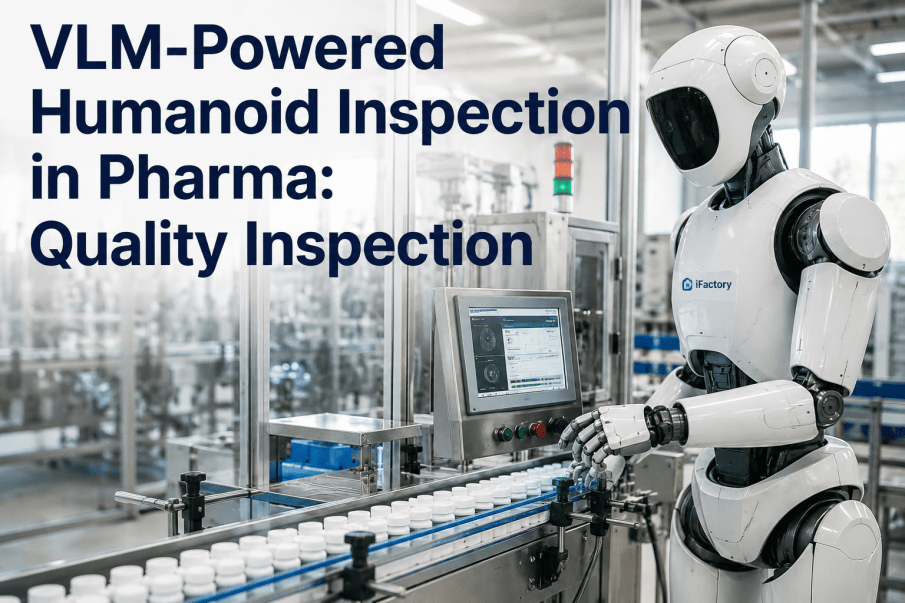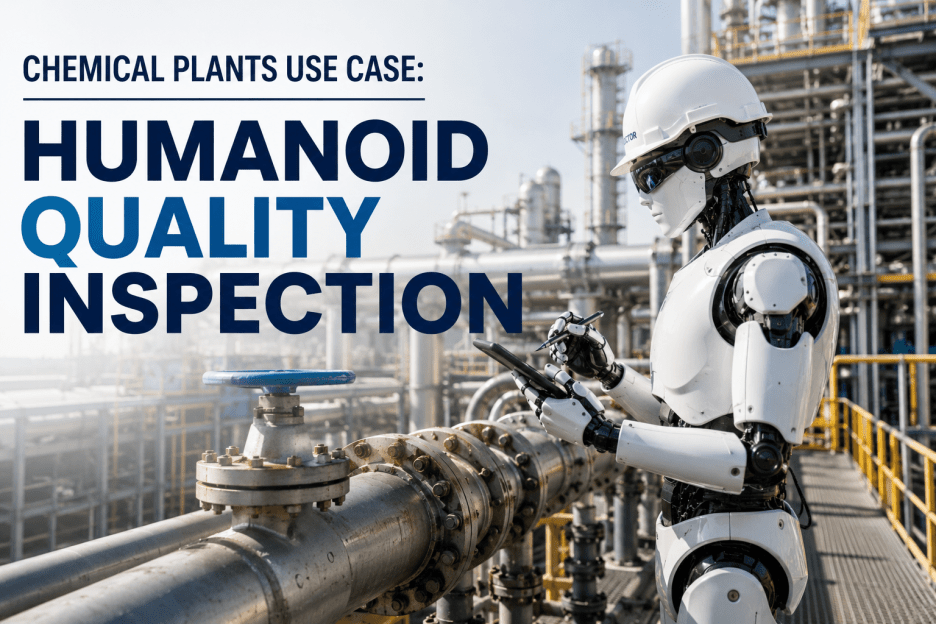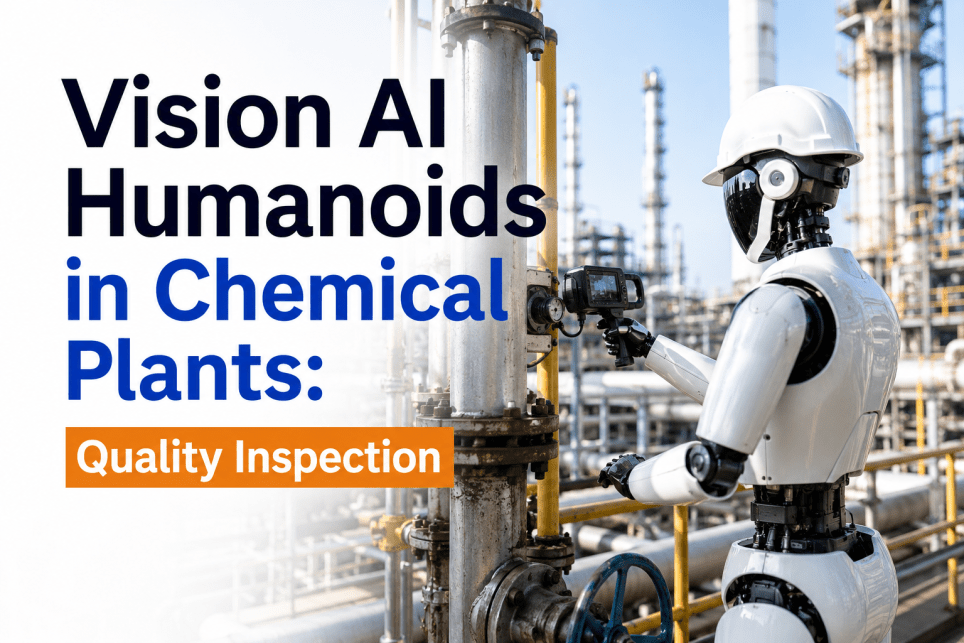
Vision AI humanoid robots are transforming quality inspection in chemical manufacturing by deploying autonomous visual inspection capability directly into process areas where product quality defects originate — replacing intermittent human sampling with continuous, AI-powered defect detection and root cause analysis at the point of production. iFactory's Robotics AI and AI Vision Camera modules provide the integration layer that connects humanoid robot visual data to CMMS work orders, MES quality records and root cause analysis documentation — so every inspection result reaches the quality management system without manual transcription.
Why Chemical Quality Inspection Needs Vision AI Humanoids
Chemical plant quality inspection today relies on manual visual inspection and scheduled sampling — a human inspector walks the production area, collects samples at predetermined intervals, and documents observations on paper or a handheld device for later entry into the quality management system. This approach has three structural limitations: sampling frequency is economically constrained, human visual accuracy degrades under chemical process conditions, and the latency between defect occurrence and detection is measured in hours or days. Vision AI humanoid robots deployed on the production floor eliminate all three limitations simultaneously — they inspect every visible unit at full production speed, maintain detection accuracy above 99%, and generate quality alerts within seconds of defect detection before the defective material leaves the production zone.
Vision AI Architecture for Humanoid Robot Quality Inspection
The architecture that enables Vision AI humanoid robots to perform real-time quality inspection in chemical plant environments combines four technology layers — autonomous navigation, high-resolution visual data collection, Vision Language Model (VLM) inference for defect classification, and bidirectional integration with plant quality systems. Each layer has been validated across chemical production environments ranging from specialty batch reactors to continuous distillation units, and the integrated system operates without modification across indoor process areas, outdoor pipe racks, and ATEX-classified hazardous zones when paired with an intrinsically safe robot platform. The deployment workflow follows the five-phase sequence presented below.
Defect Detection and Root Cause Analysis Capabilities
Vision AI humanoid robots detect defect types across four categories that cover the majority of quality excursions in chemical manufacturing — surface and appearance defects, dimensional and packaging defects, process condition anomalies, and equipment condition defects that precede quality excursions. The table below presents the detection capability, typical detection accuracy, and root cause analysis integration for each category.
| Defect Category | Inspection Method | Detection Accuracy | Root Cause Correlation | iFactory Integration |
|---|---|---|---|---|
| Surface and Appearance Defects | High-resolution RGB imaging with VLM classification — detects discoloration, surface cracking, blistering, pitting, contamination, and texture deviations at pixel-level resolution on product surfaces, packaging, and equipment contact surfaces. | 99.4–99.7% | Correlated with reactor temperature, residence time, raw material lot, and cooling water temperature from plant historian data | CMMS defect work order with image evidence; MES batch record quality hold; root cause hypothesis attached to work order |
| Dimensional and Packaging Defects | RGB imaging with precision measurement algorithms — detects out-of-spec dimensions, misaligned labels, damaged packaging, incorrect fill levels, and missing or incorrect lot marking on containers and packaged product. | 99.2–99.6% | Correlated with packaging line settings, material lot, and shift operator data from CMMS work history | CMMS packaging line inspection record; Parts and Inventory module lot traceability update; MES packaging batch record closure with defect documentation |
| Process Condition Anomalies | Thermal imaging and visual indicator inspection — detects abnormal temperature profiles on reactor surfaces, heat exchanger fouling patterns, steam trap failures, insulation degradation, and visual process indicator deviations that precede quality excursions. | 98.8–99.5% | Correlated with process control setpoints, feed rate changes, utility system status, and ambient conditions from plant historian and DCS data | EHS Management process safety record; CMMS preventive maintenance work order with thermal image evidence; Analytics root cause correlation report |
| Equipment Condition Defects | Multi-spectral imaging including RGB, thermal, and close-up macro — detects corrosion, erosion, coating degradation, seal leakage, gasket deterioration, and mechanical wear on product-contact equipment surfaces that can introduce contamination into the product stream. | 99.0–99.5% | Correlated with equipment operating hours, maintenance history, process chemistry exposure, and cleaning cycle frequency from CMMS asset records | CMMS asset inspection record with image archive; work order generation for corrosion remediation; asset condition trend report for capital planning |
CMMS and MES Integration for Closed-Loop Quality Management
The value of Vision AI humanoid robot quality inspection is determined by whether the inspection data reaches the plant's CMMS, MES, and quality management systems in real time — a robot that detects defects but requires manual data entry to document them has not eliminated the data quality gap that makes manual quality management slow and error-prone. iFactory's integration architecture connects every robot inspection event directly to the plant's operational systems, producing the closed-loop quality management capability described below.
Every defect detection event with confidence above the configurable threshold automatically generates a CMMS work order with the defect image, classification, confidence score, location coordinates, and process conditions at the time of detection attached as structured data — not as a PDF attachment or text note. The work order is routed to the appropriate maintenance or quality team based on defect type and severity, and the work order status is tracked against resolution SLA targets in iFactory's Analytics and Reporting module. Work orders for non-conforming product also trigger a quality hold notification to the MES system to prevent shipment of affected inventory.
iFactory's MES module receives robot inspection results in real time and updates batch quality records without operator intervention. Conforming product batches pass through with a documented inspection record that satisfies regulatory traceability requirements. Non-conforming batches are placed on quality hold with the defect documentation attached to the batch record, and the traceability chain is preserved for root cause investigation. For regulated product streams, the inspection record includes the electronic signature equivalent, timestamp, and audit trail required under 21 CFR Part 11 and similar quality documentation standards.
Every defect detection event and its associated root cause analysis output is stored in iFactory's Analytics module as a searchable knowledge base entry — enabling quality teams to identify recurring defect patterns across production campaigns, correlate defect types with specific process conditions or raw material lots, and validate the effectiveness of corrective actions over time. The knowledge base is accessible from the CMMS work order screen and the MES quality dashboard, so every quality team member — from the shift supervisor to the quality engineer — has access to the full defect history for the production area they are responsible for.
Every robot inspection event — including all captured images, VLM inference results, process condition snapshots, and resulting work orders — is logged with timestamps, robot ID, inspection route version, and quality spec version in iFactory's Smart Document Management system. The audit trail is exportable on demand for ISO 9001 quality audits, customer quality documentation requests, and regulatory inspections. No manual assembly is required because the audit trail is built in real time from the robot's inspection data stream — every quality record has a complete chain of evidence from image capture to work order closure.
Expert Review: What a Chemical Quality Director Says About Vision AI Humanoid Integration
I have been responsible for quality management across chemical manufacturing sites for nineteen years — first as a quality engineer at a specialty chemical facility in New Jersey, then as quality director for a portfolio of seven sites producing commodity and specialty chemicals across the Gulf Coast and Ohio Valley. When we deployed a Vision AI humanoid robot pilot for visual quality inspection on a continuous polymer extrusion line in early 2025, the quality team's expectation was that the robot would match human inspection accuracy — which would have been a net positive simply from the labor hour reduction. What we actually found was that the robot's VLM-based inspection detected a class of surface micro-cracking defects that our human inspectors had been missing for at least three years, based on the quality record history. The cracks were visible in the image data but occurred at a spatial frequency that the human eye could not resolve during a walking inspection at normal speed. The robot caught them on every affected unit — and once we correlated the defect pattern with the process historian data through iFactory's analytics module, we identified that the micro-cracking was occurring exclusively during production campaigns where the extruder cooling water temperature exceeded 82°C, which only happened during the summer months when the cooling tower capacity was marginal. That correlation was invisible to the quality team before the robot deployment because the manual inspection data was not granular enough to detect the pattern. The root cause hypothesis — cooling water temperature above 82°C during summer ambient conditions — was generated automatically by iFactory's correlation engine six minutes after the first defect detection, and the corrective action — adjusting the extruder cooling water setpoint based on ambient wet-bulb temperature — eliminated the defect entirely for the remainder of the summer production campaign. A manual root cause investigation of that same issue would have taken three to six weeks and required a dedicated Six Sigma project. The robot and the integration platform closed the loop in six minutes. That is the difference between a quality management system that reports defects and one that eliminates them.
— Quality Director, U.S. Chemical Manufacturing — 19 Years Quality Management, ASQ Certified Six Sigma Black Belt, ISO 9001 Lead AuditorConclusion
Vision AI humanoid robots represent a fundamental shift in chemical plant quality inspection — from intermittent human sampling with hours of detection latency to continuous autonomous inspection with sub-30-second defect-to-action cycles. The technology architecture exists, the integration pathways with CMMS and MES systems are proven in production environments, and the business case is supported by verified accuracy data across multiple chemical manufacturing categories. The limitation that prevented chemical plants from adopting autonomous visual inspection at scale was never the availability of AI vision models or humanoid robot hardware — it was the absence of an integration layer that could transform robot inspection data into CMMS work orders, MES quality records, and root cause analysis documentation without manual intervention. iFactory's Robotics AI, AI Vision Camera, CMMS Solution, and Manufacturing Execution System modules provide that integration layer — closing the loop from image capture to quality record closure in under 30 seconds and enabling the correlative root cause analysis that transforms individual defect detections into systemic quality improvements.
The next step for chemical plant quality teams evaluating this technology is a pilot deployment on a single production line, targeting the three to five highest-impact quality inspection points identified from your CMMS defect history and quality record data. iFactory provides the integration platform, the inspection route configuration, and the root cause correlation engine — and the pilot runs in parallel with your existing inspection program so the ROI comparison is quantitative and defensible. Book a Demo to configure a Vision AI humanoid quality inspection pilot for your chemical plant's highest-impact production line.
Frequently Asked Questions
Yes. Vision AI humanoid robots are equipped with multi-spectral imaging capability that includes thermal infrared, near-infrared, and high-dynamic-range RGB sensors — allowing defect detection in lighting conditions that range from complete darkness to direct sunlight. The VLM models are trained on images captured across the full range of ambient conditions present in chemical process areas, including steam, vapor, dust, and low-light environments. Detection accuracy in low-light and vapor-obscured conditions remains above 98.5% when the robot positions itself at the programmed inspection angle and distance.
The VLM defect classifier assigns each detection to a severity class — cosmetic, minor, major, or critical — based on the defect type, size, location, and proximity to product contact surfaces. The severity classification drives the CMMS work order routing and SLA assignment: cosmetic defects route to the preventive maintenance queue with standard priority, while critical defects create immediate escalation alerts to the shift supervisor and quality manager with a response SLA measured in minutes. The severity classification criteria are configurable per inspection point and can be updated as the plant's quality team gains experience with the defect patterns in their specific process.
Integration with iFactory's CMMS and MES modules is typically complete within the first four weeks of the pilot deployment — including robot API connection, asset ID mapping, inspection route definition, and CMMS work order template configuration. Integration with third-party CMMS or MES platforms through iFactory's REST API and MQTT gateway adds one to two weeks for data schema mapping and validation. The full cycle from pilot kickoff to live integrated inspection operations with CMMS work order auto-generation is typically eight to ten weeks.
Yes, provided the humanoid robot platform carries ATEX or IECEx certification for the specific zone classification of the target area — Zone 1 or Zone 2 for gas/vapor hazards, or Division 1 or Division 2 under the NEC classification system. The Vision AI camera module and VLM processing unit are compatible with intrinsically safe robot platforms that meet the applicable certification standard. iFactory's integration architecture supports both certified intrinsically safe robot platforms for hazardous zone deployment and non-certified platforms for general-purpose production areas — the integration layer is identical regardless of the robot platform certification class.
iFactory's Analytics and Reporting module correlates all defect detection events from a single production run or batch with the common process conditions shared across those inspection points — temperature, pressure, flow rate, batch phase, raw material lot, and equipment configuration. When multiple defect types are detected across different inspection points, the correlation engine identifies whether the defects share a common root cause (for example, a temperature excursion that causes both surface discoloration and dimensional deviation) or represent independent quality issues that require separate corrective actions. The correlation output is presented as a root cause hypothesis matrix attached to the batch quality record, with each hypothesis ranked by confidence score based on the strength of the statistical correlation. Book a Demo to see a root cause analysis example configured for your chemical plant's quality inspection data.