When a Gulf Coast chemical complex operating continuous process units across a 200-acre facility faced a 35% retirement eligibility rate among senior control room operators, the engineering and training leadership recognized that traditional classroom-and-shadowing programs could not preserve decades of process expertise before it walked out the door. The facility deployed VLM-powered humanoid robots as embodied training assistants capable of capturing, standardizing, and delivering expert knowledge at the point of work. Chemical plant operators and training directors evaluating next-generation workforce development platforms regularly Book a Demo to explore how vision AI humanoids accelerate operator competency while preserving critical process expertise.
The Knowledge Transfer Crisis in Chemical Plant Operations
Chemical process plants face a structural challenge that traditional training approaches cannot solve. The average age of experienced control room operators exceeds 48 years, and critical operational knowledge — developed over decades of hands-on experience — resides solely in the minds of senior personnel. Conventional classroom and shadow programs produce inconsistent outcomes and fail to capture the nuanced decision-making that distinguishes expert operators.
Aging Workforce and Knowledge Erosion
More than 30% of senior operators are eligible for retirement within five years. Each departing operator takes years of undocumented process knowledge — diagnostic patterns, equipment behaviors, and emergency instincts — creating a gap that documentation alone cannot bridge.
Inconsistent Training Quality
Shadow-based training depends on the assigned senior operator's availability and teaching ability. Shift rotations and production pressures create uneven competency levels and unpredictable time-to-qualification across the workforce.
High-Risk Training Constraints
Chemical environments limit hands-on training due to safety and production requirements. Trainees cannot practice emergency shutdowns or rare upset scenarios in live production — leaving critical skills undeveloped until an actual event occurs.
How VLM-Powered Humanoids Transform Operator Training
Vision Language Model humanoid robots combine multimodal perception — processing visual feeds, equipment readings, and verbal communication simultaneously — with physical mobility to serve as interactive training platforms within active chemical plants. The iFactory platform integrates VLM-humanoid data streams with existing CMMS and MES systems to create a continuous knowledge loop between training content and operations. Training leaders exploring this capability regularly Book a Demo to review the integration architecture and deployment requirements.
Humanoid-Led Procedure Training — The humanoid leads operators through structured walkthroughs of each process unit, combining visual observations with narrated expert knowledge. Trainees practice startup sequences, shutdown procedures, and parameter adjustments under real-time coaching that flags deviations from best practices. The iFactory integration logs progress and procedural accuracy within the operator qualification module.
Structured Tacit Knowledge Preservation — The humanoid shadows senior operators during operations, recording actions, verbal explanations, and control adjustments through its multimodal sensor suite. VLM models process these recordings into structured training modules that preserve the expert's diagnostic approach and decision-making framework, available for replay on any shift.
Safe Scenario-Based Practice — The humanoid generates realistic abnormal situations — pump failures, column pressure excursions, reactor temperature deviations — within safe environments. Trainees practice root-cause diagnosis while the VLM evaluates their approach against expert decision trees and dynamically adjusts scenario complexity based on performance.
Four-Phase Deployment for Chemical Plant Training Operations
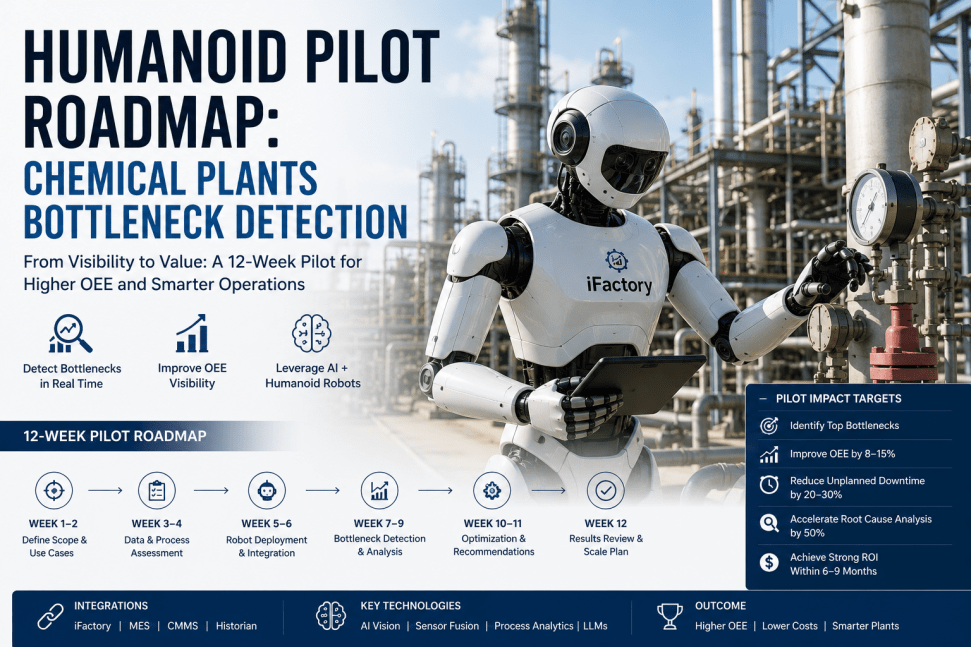
Deploying VLM-powered humanoid training assistants follows a structured methodology designed for chemical plant safety requirements, regulatory compliance, and minimum production disruption.
Knowledge Audit & Mapping
Training and operations teams identify critical knowledge domains, at-risk expertise areas, and priority process units. The iFactory platform maps existing training materials against the knowledge inventory to identify capture gaps.
Humanoid Deployment
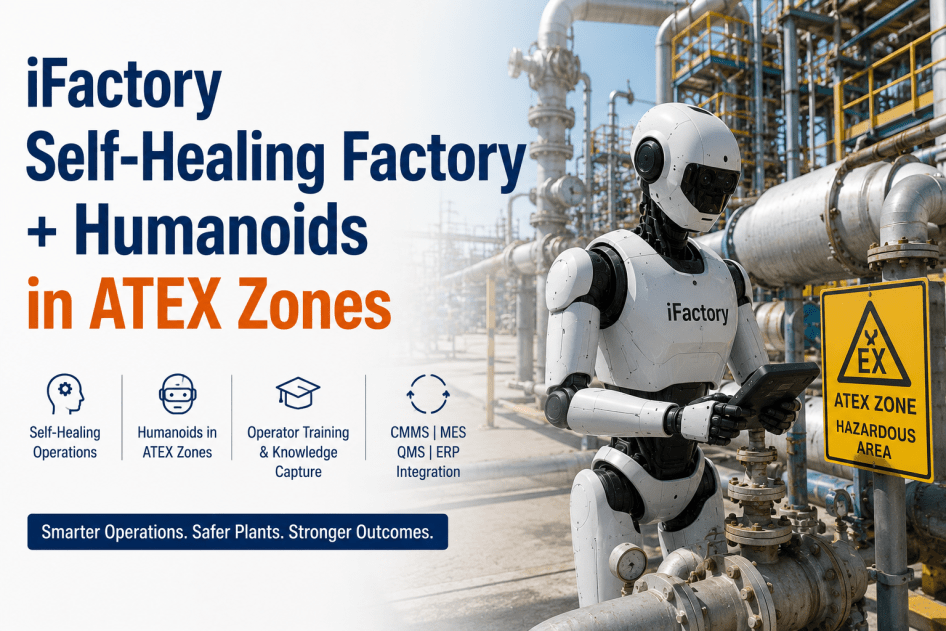
VLM-powered humanoids are deployed to designated areas with iFactory edge connectors linking sensor streams to existing CMMS, MES, and historian systems. ATEX-compliant enclosures ensure safe operation in processing environments.
Expert Shadowing & Creation
Humanoids shadow senior operators over a 4- to 6-week capture period. The iFactory VLM pipeline processes recordings into structured training modules indexed by process unit, scenario type, and skill domain.
Delivery & Refinement
New operators access humanoid-led training on-demand with progress tracked in iFactory's qualification management system. Captured knowledge is continuously updated as process changes and new expert insights emerge.
Measurable Training Outcomes
Within nine months of deploying VLM-powered humanoid training assistants, the chemical complex documented measurable improvements across every training metric, validated through qualification assessments and operational data.
| Training Metric | Traditional Program | VLM-Humanoid Program | Improvement |
|---|---|---|---|
| Time to Qualification | 8.1 months | 3.2 months | 60% faster |
| Knowledge Retention at 30 Days | 42% | 85% | 2X improvement |
| Scenarios Practiced per Quarter | 14 | 48 | 3.4X coverage |
| Assessment Consistency | 64% | 93% | +29 points |
| Training-Related Incidents | 12 per year | 7 per year | 42% reduction |
"The retirement wave we knew was coming hit us faster than anticipated. Our best operators carried knowledge that simply wasn't captured anywhere — nuanced judgment about when to trust a specific level transmitter based on historical fouling patterns, how to interpret subtle vibration changes in a recycle compressor. The VLM humanoid program captured that expertise in a structured, repeatable format that our new operators can access on any shift. The reduction in time-to-competency from over eight months to just over three has transformed our workforce development pipeline." — Director of Training and Development, Chemical Manufacturing Division
Building a Sustainable Knowledge Infrastructure
This case demonstrates that VLM-powered humanoid robots offer a practical, scalable solution to the workforce development challenges facing chemical plants. By combining embodied AI's ability to observe, learn, and instruct with the iFactory platform's integration into existing CMMS, MES, and qualification systems, chemical plants can preserve critical expertise while building a more consistent workforce for the future. Operations and training leaders evaluating their long-term workforce strategy are encouraged to Book a Demo to explore how iFactory's VLM-humanoid integration can accelerate their operator training initiatives.
Frequently Asked Questions
The humanoid shadows operators during normal duties using non-intrusive observation, recording visual data, verbal explanations, and control interactions through its onboard sensors. The platform processes recordings offline to extract structured knowledge without requiring operators to change their workflow or allocate dedicated documentation time.
Humanoid assistants support unit startups and shutdowns, batch reactor operations, distillation column management, catalyst changeovers, emergency shutdown sequences, and maintenance coordination. VLM models adapt to specific chemistries, equipment configurations, and site-specific procedures. iFactory integration aligns training modules with current CMMS work orders and MES schedules.
A full deployment covering knowledge audit, humanoid deployment, expert shadowing, and initial module creation requires 10 to 12 weeks. First training modules become available within four weeks of the capture phase. Ongoing expansion to additional process units follows a rolling schedule based on priority knowledge retention needs.
No. The humanoid serves as a force multiplier by standardizing knowledge capture and delivering consistent foundational instruction. Human trainers remain essential for advanced mentoring, complex judgment development, and interpersonal coaching. The platform is designed to augment training capacity — enabling a single coordinator to manage three times the operator throughput.
The platform generates automated reports tracking individual operator progress, retention scores, scenario completion rates, and competency gaps. Training ROI is calculated by comparing time-to-qualification reductions, consistency improvements, and incident rate changes against baseline metrics. Dashboards are configurable for training coordinators, plant management, and corporate stakeholders.