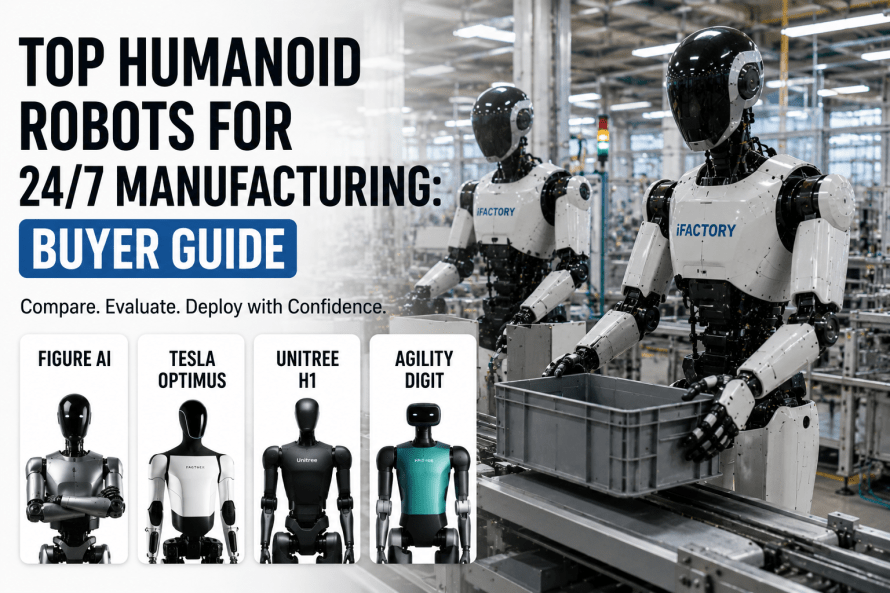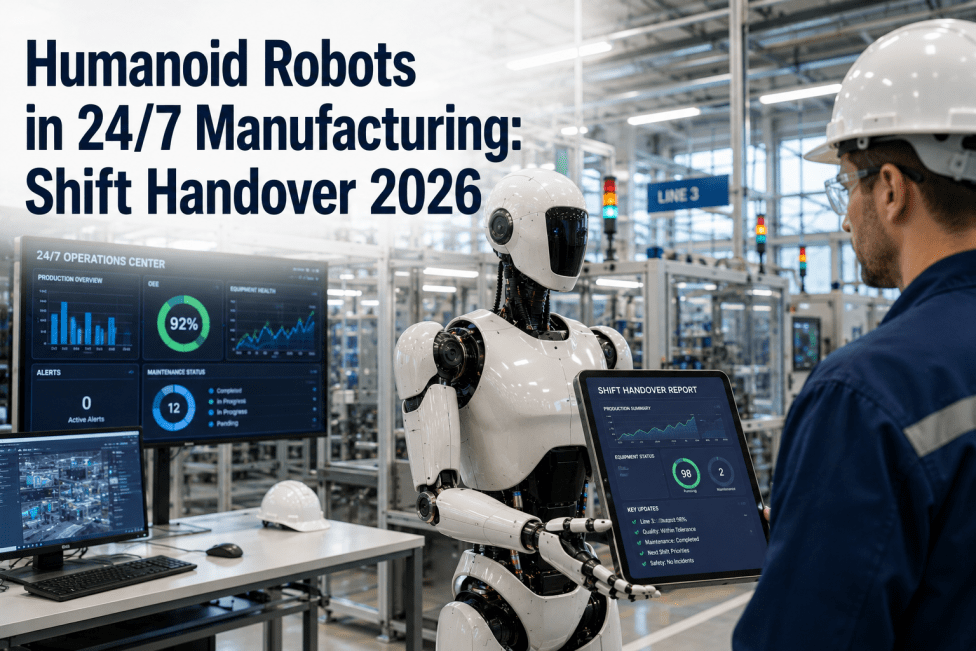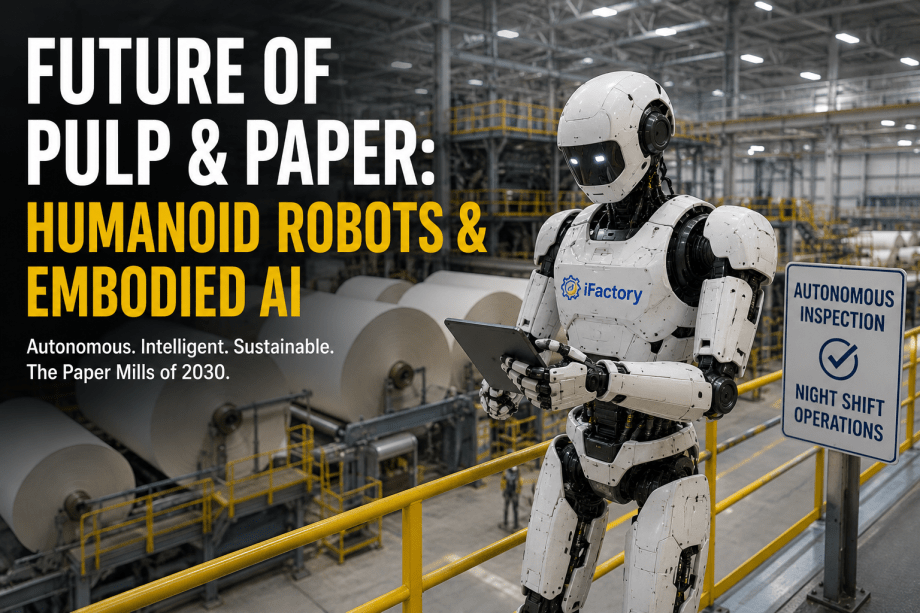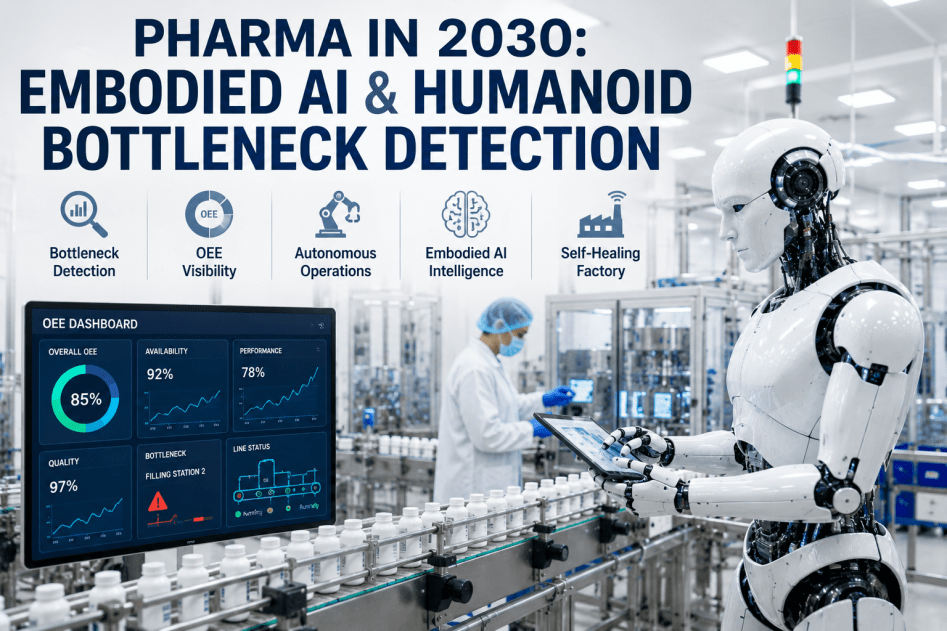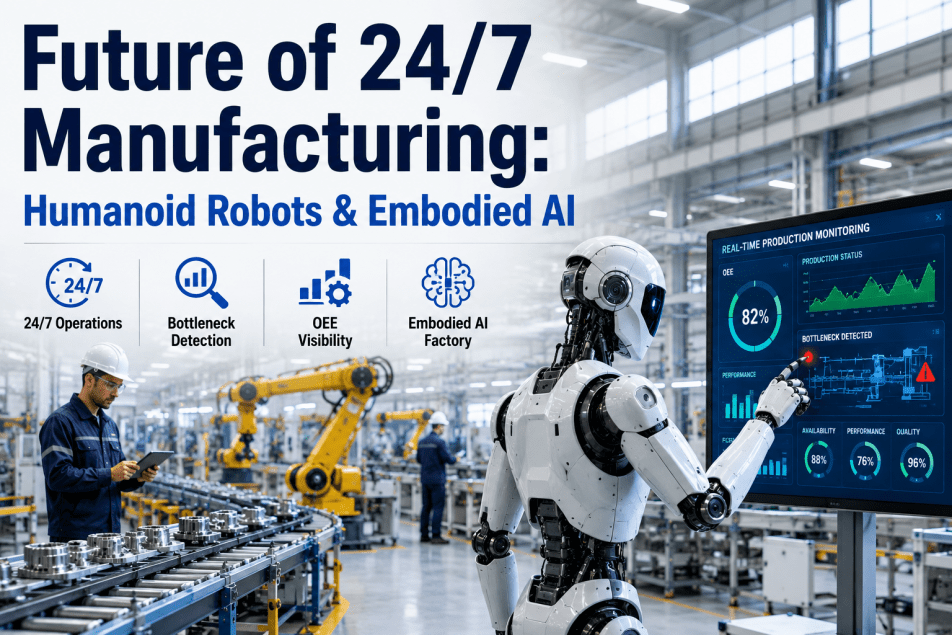
The manufacturing operations director reviewed the third-shift production report: 68 percent OEE, three undetected bottleneck shifts in the past two weeks, and a recurring quality issue on the night shift that had been producing out-of-spec product for approximately 90 minutes before the morning handoff identified the problem. The facility operated 24 hours a day, six days a week, but the production visibility, decision speed, and response capability that existed during the day shift degraded significantly after the process engineering team went home at 5 p.m. This is the operational reality that humanoid robots and embodied AI — autonomous machines that perceive, reason, and act within physical manufacturing environments — are poised to transform by 2030. Unlike conventional automation that executes fixed sequences in controlled conditions, embodied AI systems navigate dynamic plant floors, detect developing bottlenecks in real time, adjust production parameters within defined authority limits, and coordinate with human operators during all three shifts with equal capability. iFactory AI's Robotics AI module and production analytics platform provide the integration layer that connects humanoid robots, MES work orders, OEE tracking systems, and predictive maintenance into a unified operations architecture — enabling the transition toward 24/7 autonomous manufacturing without replacing the existing control infrastructure.
The Vision of 24/7 Autonomous Manufacturing — Why Embodied AI Changes the Operations Model
The traditional manufacturing operations model assumes that production visibility, decision quality, and response speed peak during the day shift when process engineers, maintenance teams, and operations leadership are present, then degrade progressively through the second and third shifts as staffing levels drop and the remaining workforce focuses on keeping production running rather than optimizing it. This pattern is baked into every OEE report that shows consistent 10–20 percentage point OEE gaps between day shift and night shift performance — not because the equipment behaves differently after dark, but because the human decision infrastructure that detects and resolves problems is thinner. Embodied AI systems — humanoid robots and AI agents that operate autonomously within physical factory environments — address this structural disadvantage by providing consistent production intelligence, bottleneck detection, and response coordination across all three shifts, independent of human staffing levels.
The capabilities that enable 24/7 autonomous manufacturing are distinct from conventional factory automation. Traditional industrial robots execute pre-programmed cycles in fixed, guarded work cells — they do not navigate dynamic factory environments, detect evolving process bottlenecks, or adjust production flows in response to changing conditions. Embodied AI systems combine physical dexterity, environmental perception, and operational decision-making within a single platform that can patrol production lines, monitor equipment health, identify developing constraint shifts, and communicate findings to the MES and the human operations team in real time. The technology is already deployed in pilot programs across automotive assembly, steel fabrication, and discrete manufacturing environments, with commercial availability expanding rapidly through 2027–2029. Manufacturing facilities that begin structured pilots in 2026 will be positioned to scale 24/7 autonomous operations as the technology matures toward 2030.
How Humanoid Robots and Embodied AI Transform Night Shift Manufacturing Operations
The practical deployment of embodied AI in 24/7 manufacturing environments spans four distinct operational domains — from physical patrolling and inspection to autonomous production flow management. Each domain addresses a specific gap in current off-shift operations, and each has a defined technology maturity trajectory toward 2030. The following sections detail the current capability state, the deployment approach, and the measurable impact in each domain.
Autonomous Patrol and Inspection — The Foundation of 24/7 Production Visibility
The most immediate application of embodied AI in 24/7 manufacturing is autonomous patrol and inspection — humanoid robots equipped with thermal cameras, vibration sensors, acoustic microphones, and optical sensors that traverse production lines on pre-programmed or AI-determined routes, inspecting equipment condition, detecting anomalies, and reporting findings to the MES and human operations team in real time. Unlike fixed sensors that monitor only the specific parameter they are installed to measure, a mobile humanoid robot can inspect multiple data points at each station — bearing temperature, belt tension, fluid levels, leak detection, alignment condition, and visual indicators of wear — covering in a single patrol what would require dozens of fixed sensors to match. Facilities deploying autonomous patrol robots document a 40–60 percent reduction in undetected off-shift equipment anomalies, with the robot typically identifying 3–7 developing issues per night shift that would have gone unnoticed until the day shift walkthrough.
- Thermal imaging patrol detects overheated bearings, electrical panels, and motor casings before failure
- Acoustic monitoring identifies air leaks, steam trap failures, and bearing wear patterns inaudible in daytime noise
- Visual inspection of fluid levels, belt alignment, guard positioning, and housekeeping conditions
- All findings logged to MES with location, timestamp, and severity classification for day shift follow-up
Real-Time Bottleneck Detection — Identifying Constraint Shifts Before They Impact Throughput
Production bottlenecks shift dynamically as equipment conditions change, material flow varies, and operator performance fluctuates — a constraint that moves from Station A to Station B over a 30-minute period is invisible to traditional OEE dashboards that report at shift boundaries. Embodied AI systems monitor each station's cycle time, queue depth, downtime events, and throughput rate continuously, calculating the system constraint in real time and alerting operations staff when a bottleneck shift is detected. The AI not only identifies where the constraint is but predicts where it will move next based on the rate of change in each station's performance parameters. This predictive bottleneck visibility enables proactive intervention — adjusting material flow, reallocating resources, or scheduling maintenance — before the constraint impacts overall line throughput. Manufacturing facilities with embodied AI bottleneck detection document a 20–30 percent reduction in throughput variability and a 10–15 percent improvement in overall line efficiency within the first 90 days of deployment.
- Real-time cycle time monitoring across all stations with constraint calculation updated every 60 seconds
- Predictive bottleneck modeling identifies the next constraint location 15–30 minutes before it materializes
- Automated throughput alerts when any station deviates more than 10 percent from target cycle time
- Constraint history logging enables root cause analysis of recurring bottleneck patterns
OEE Visibility and Autonomous Optimization — Closing the Day-Night Performance Gap
The 10–20 point OEE gap between day shift and night shift is the most quantifiable cost of the current operations model — and the single largest value opportunity for embodied AI deployment. Autonomous OEE optimization systems close this gap by providing the same level of production visibility, decision support, and response coordination during night shifts that the day shift receives from its process engineering and operations leadership presence. The AI system monitors availability, performance, and quality metrics continuously across all three shifts, identifying the specific factors driving OEE degradation during off-shift hours and implementing corrective actions within its defined authority — adjusting line speed, rebalancing workload across stations, or alerting the remote operations center when human intervention is required. Facilities deploying autonomous OEE optimization document a 50–70 percent reduction in the day-night OEE gap within three months, recovering $500,000 to $2 million annually in off-shift production value depending on facility size and shift structure.
- Shift-level OEE decomposed into availability, performance, and quality losses by station and shift
- Autonomous corrective actions within defined authority limits — speed adjustment, flow balancing, alert escalation
- Night shift OEE trends tracked against day shift baseline with automated gap analysis
- Weekly OEE improvement recommendations generated from accumulated shift performance data
Technology Architecture for Autonomous 24/7 Manufacturing Operations
Deploying embodied AI for 24/7 manufacturing requires an architecture that integrates humanoid robots, production monitoring systems, OEE tracking platforms, and maintenance management into a unified operations layer. iFactory AI's platform provides the integration backbone — connecting humanoid robot patrol data, production line sensors, MES work orders, CMMS maintenance records, and OEE dashboards into a single intelligence layer that supports both autonomous operations and human oversight. The platform connects to existing PLC, SCADA, MES, and CMMS infrastructure without requiring equipment replacement or control system modification. Book a Demo to see the iFactory AI architecture configured for autonomous 24/7 manufacturing operations in your facility.
| Architecture Layer | Data Source | AI Capability | iFactory Module | Operational Impact |
|---|---|---|---|---|
| Humanoid Robot Integration | Robot onboard sensors — thermal, acoustic, optical, vibration; patrol route and station inspection data | Autonomous navigation, anomaly detection, site-specific patrol pattern optimization | Robotics AI Module with patrol route planner and anomaly classification engine | 40–60% reduction in undetected equipment anomalies across all shifts |
| Production Monitoring | Station cycle times, queue depths, throughput rates, downtime events, speed data from PLC/MES | Real-time bottleneck detection and prediction; constraint shift alerts 15–30 minutes in advance | Production Analytics Module with dynamic constraint calculation engine | 20–30% reduction in throughput variability; 10–15% line efficiency improvement |
| OEE Tracking | Availability, performance, and quality data per station per shift; shift-level production targets | Autonomous OEE calculation, day-night gap analysis, corrective action recommendations within authority | OEE Analytics Module with multi-shift comparison and autonomous optimization workflow | 50–70% reduction in day-night OEE gap; $0.5–2M annual off-shift value recovery |
| Predictive Maintenance | Vibration, temperature, current draw, and acoustic data from humanoid patrols and fixed sensors | Equipment health scoring, failure probability prediction, maintenance timing optimization | Predictive Maintenance Module with shift-independent equipment health monitoring | 30–45% reduction in unplanned downtime; 72+ hour predictive alert lead time |
| MES and CMMS Integration | Work orders, production schedules, quality records, maintenance history from existing systems | Closed-loop work order generation from AI-detected anomalies; schedule-aware maintenance timing | Integration Layer with bidirectional MES and CMMS data synchronization | Eliminates manual data entry; maintenance decisions informed by real-time equipment health data |
Key Capabilities for 24/7 Autonomous Manufacturing — Deployment by Application Domain
The deployment of embodied AI for 24/7 manufacturing follows a capability progression that starts with autonomous patrol and inspection — the easiest entry point with the fastest ROI — and advances through bottleneck detection, OEE optimization, and ultimately full autonomous production management. Each capability domain has distinct technology requirements, deployment timelines, and measurable outcomes that operations leaders can use to build a phased implementation roadmap from 2026 through 2030.
Autonomous Patrol and Inspection — Available Now for Pilot Deployment
Humanoid robots with thermal, acoustic, optical, and vibration sensors are commercially available today for autonomous patrol and inspection in manufacturing environments. Deployment typically requires 8–12 weeks for route planning, sensor calibration, anomaly detection model training on facility-specific equipment, and integration with the existing MES and CMMS through iFactory AI's Robotics AI module.
Real-Time Bottleneck Detection — Deployable on Existing Production Data
Bottleneck detection analytics do not require humanoid robots — they can be deployed immediately on existing PLC and MES cycle time, queue depth, and throughput data through iFactory AI's Production Analytics Module. The dynamic constraint calculation engine generates real-time bottleneck identification and predictive shift alerts within the first 30 days of data connection.
Autonomous OEE Optimization — Phased Rollout 2026–2028
Autonomous OEE optimization combines production monitoring data, bottleneck detection output, and equipment health information to adjust line parameters within defined authority limits. Initial deployment focuses on visibility and recommendation — presenting OEE gap analysis and corrective action suggestions to human operators — with progression to autonomous execution as trust and accuracy metrics accumulate over 6–12 months of operation.
Full Autonomous Production Management — Maturation Target 2028–2030
The long-term vision for embodied AI in manufacturing is full autonomous production management — humanoid robots and AI agents that patrol, inspect, detect, analyze, and respond to production conditions across all three shifts without requiring human presence on the plant floor. This capability level requires advances in humanoid robot reliability, AI decision-making accuracy in unstructured environments, and regulatory frameworks for unsupervised autonomous operations — all of which are actively developing with commercial pilot programs underway across multiple manufacturing sectors.
Expert Review: What Manufacturing Operations Leaders Are Saying About Embodied AI
I have spent 18 years in manufacturing operations management across automotive and discrete assembly, and I have seen the same third-shift problem at every facility: the production line runs at a different standard after 11 p.m. because the decision-making infrastructure that exists during the day shift — process engineers, maintenance supervisors, quality technicians, operations managers — simply is not there at night. The equipment is the same, the product is the same, but the OEE drops 12 to 15 points consistently because the response time to problems goes from minutes during the day to hours at night. We began evaluating embodied AI for exactly this reason. We deployed iFactory AI's Production Analytics platform on two assembly lines in early 2025 to establish the bottleneck detection and OEE monitoring foundation, and the first insight was that our night shift throughput variability was being driven by a single recurring constraint — a cooling system on Station 7 that degraded slowly over 4 to 6 hours and was never detected until the morning maintenance team arrived. The analytics identified the pattern in the first week. We corrected the cooling issue, and the night shift OEE on that line improved 8 points in 30 days. The humanoid pilot is our next step — we plan to deploy autonomous patrol robots on the same lines in 2027 to close the inspection and anomaly detection gap that the analytics layer has already made visible. For any operations leader evaluating this technology: start with the analytics layer first. Install bottleneck detection and OEE visibility on your existing data infrastructure. The business case for embodied AI will write itself from the patterns you discover.
— Director of Manufacturing Operations, Automotive Assembly — 18 Years in Manufacturing Operations — iFactory AI Reference Customer 2026Conclusion — Building the Roadmap to Autonomous 24/7 Manufacturing
The transition to 24/7 autonomous manufacturing is not a single technology deployment — it is a capability progression that starts with real-time production visibility, advances through bottleneck detection and OEE optimization, and ultimately enables embodied AI systems — humanoid robots and autonomous AI agents — to patrol, inspect, analyze, and respond to production conditions across all three shifts with consistent capability. The foundational analytics layer — production monitoring, bottleneck detection, OEE tracking, and predictive maintenance — can be deployed today on existing PLC, MES, and CMMS infrastructure, delivering immediate value through reduced off-shift losses and improved production consistency while building the data framework required for autonomous operations.
The manufacturing facilities that begin this journey in 2026 will be positioned to scale humanoid robot deployment and embodied AI operations as the technology matures through 2028–2030, while facilities that delay start will face a widening competitive gap as early adopters capture the structural advantage of 24/7 autonomous operations. iFactory AI's platform provides the integration architecture that supports both current analytics deployment and future embodied AI integration — enabling facilities to start with bottleneck detection and OEE visibility today and add humanoid robot patrol, autonomous inspection, and production management capability as the technology evolves. Book a Demo to discuss your facility's autonomous manufacturing roadmap and see how iFactory AI enables the transition from traditional 24/7 operations to 24/7 autonomous manufacturing.
Frequently Asked Questions
Embodied AI refers to AI systems that perceive, reason, and act within physical environments — humanoid robots, autonomous mobile robots, and AI agents integrated with physical hardware. Unlike conventional factory automation that executes fixed sequences in controlled, guarded work cells, embodied AI systems navigate dynamic plant floors, detect changing conditions, adjust their behavior within defined authority limits, and coordinate with human operators. The distinction is fundamental: conventional automation replaces specific repetitive motions; embodied AI augments the entire operations model by providing consistent production intelligence and response capability across all shifts and conditions. Book a Demo to see how iFactory AI enables embodied AI integration in manufacturing environments.
Real-time bottleneck detection continuously monitors each production station's cycle time, queue depth, downtime events, and throughput rate — calculating the system constraint every 60 seconds using iFactory AI's dynamic constraint calculation engine. When the bottleneck shifts from one station to another, the system generates an alert within 2–3 minutes and predicts where the constraint will move next based on the rate of change in each station's performance parameters. This predictive capability enables operations teams to intervene — adjusting material flow, reallocating resources, or scheduling maintenance — before the constraint impacts overall line throughput. The system operates autonomously during night shifts, alerting the remote operations center or on-site supervisor only when human intervention is required.
Manufacturing facilities deploying the full stack — bottleneck detection, autonomous OEE optimization, predictive maintenance, and humanoid robot patrol — document a 15–25 percent overall OEE improvement within 6–12 months of deployment. The largest gains come from closing the day-night OEE gap, which typically accounts for 10–20 percentage points of the total OEE opportunity. Facilities that deploy only the analytics layer (bottleneck detection and OEE visibility) typically see 5–10 percent OEE improvement from the first 90 days. Adding autonomous patrol and inspection with humanoid robots contributes another 5–8 percent through reduced undetected equipment anomalies and faster problem identification during off-shift hours.
Yes. iFactory AI connects to existing PLC, SCADA, MES, CMMS, and ERP systems through standard industrial communication protocols including OPC-UA, Modbus TCP, Siemens S7, Allen-Bradley Ethernet/IP, and REST API interfaces. The platform does not require replacement of existing control infrastructure and deploys alongside current systems during a standard 8–12 week implementation. The humanoid robot integration layer connects to the same data infrastructure, enabling autonomous patrol data, bottleneck detection output, OEE metrics, and predictive maintenance alerts to flow through a single operations intelligence platform without requiring separate integration projects for each capability domain.
A humanoid robot pilot for autonomous patrol and inspection typically requires 8–12 weeks from contract to operational deployment. The timeline includes route planning and safety validation (weeks 1–3), sensor calibration and anomaly detection model training on facility-specific equipment (weeks 4–7), integration with MES and CMMS via iFactory AI's Robotics AI module (weeks 6–9), and supervised operation with progressive autonomy (weeks 8–12). The analytics foundation — bottleneck detection and OEE visibility — can be deployed in parallel during weeks 1–6, so the facility has production visibility running before the humanoid robot begins autonomous patrol. Most facilities running structured pilots document measurable OEE improvement and anomaly detection value within the first 90 days of deployment, with full ROI achieved within 3–6 months.