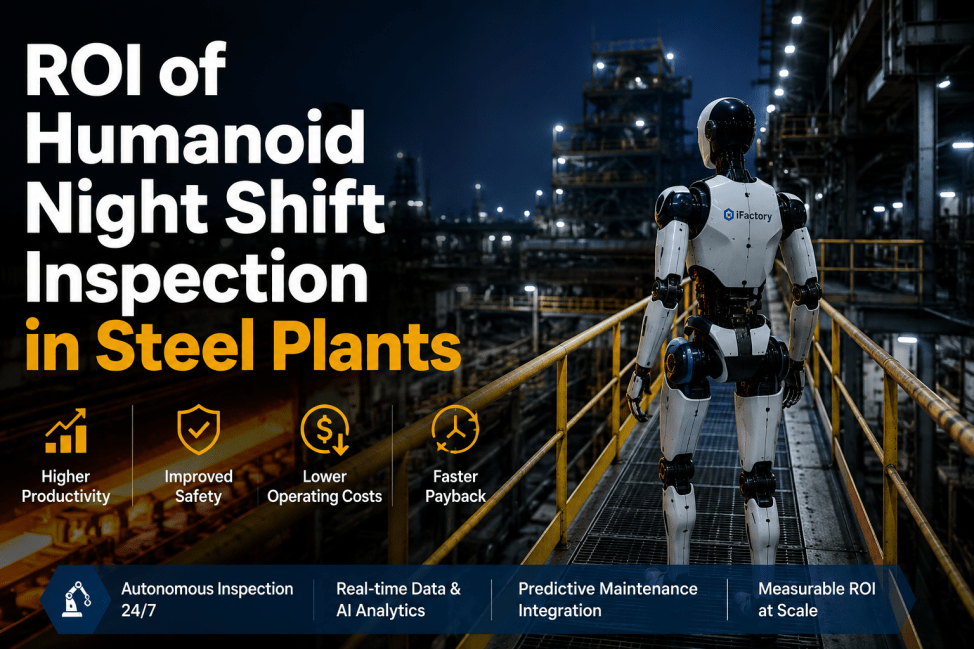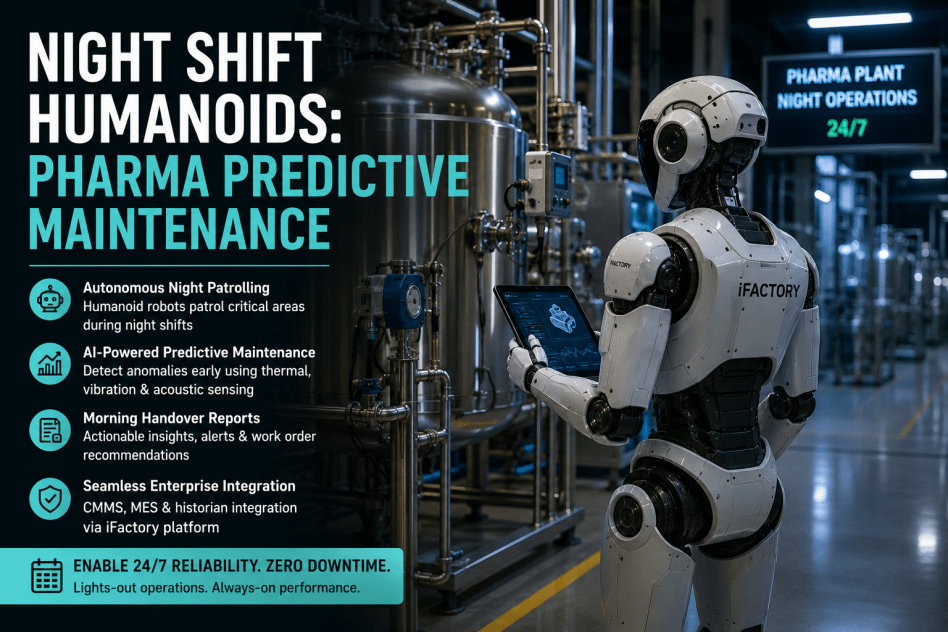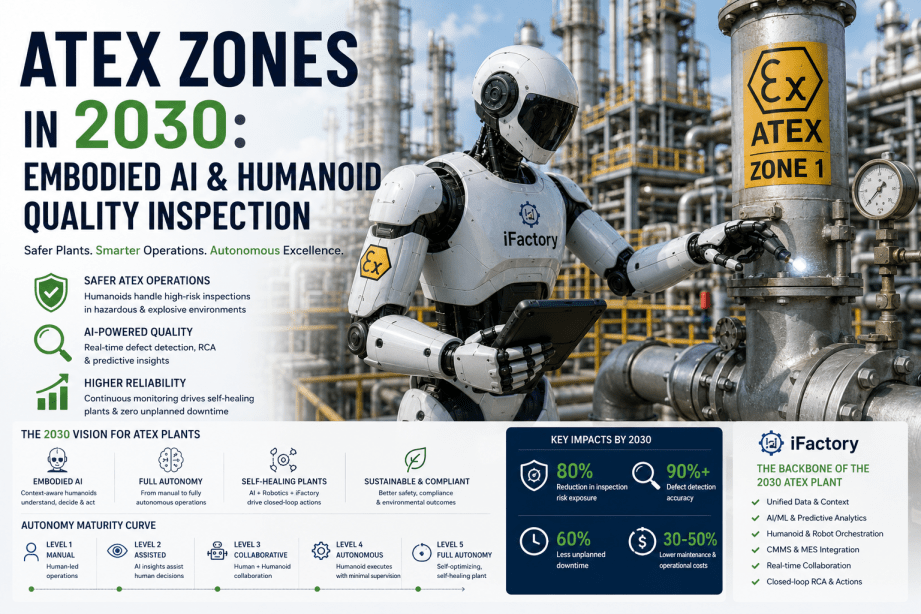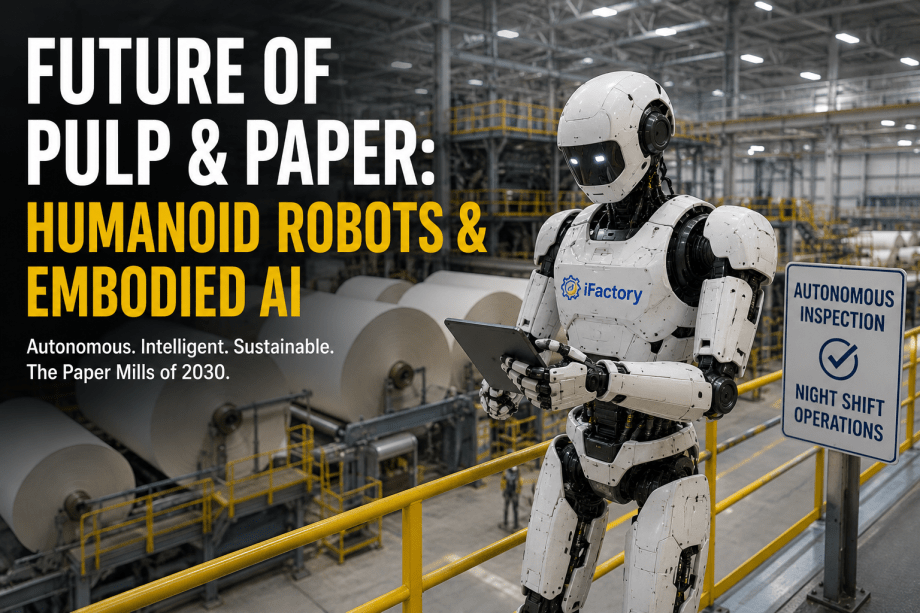
The pulp and paper mill production manager reviews the night shift log at shift change. Through the previous eight hours, the paper machine ran at 92% speed with two breaks, the recovery boiler logged three sootblower sequence faults that required operator intervention, and the digester temperature profile drifted outside the target band for forty-seven minutes before the control room operator caught it on the trending screen. None of these events caused a safety incident or a production outage, but each one consumed operator attention that could have been directed elsewhere — and each one required a human being to be physically present in a high-heat, high-noise, high-risk area of the mill during a shift when staffing is already at minimum levels. The night shift superintendent manages the entire mill with four operators, two maintenance technicians and one shift supervisor spread across 200,000 square feet of production floor, recovery area, and finishing line. The paper industry has automated its process control loops, its distributed control systems, and its material handling — but the fundamental model of human-centered mill operations has not changed in decades. Humanoid robots equipped with embodied AI, multi-sensor inspection payloads, and real-time integration with mill control systems are positioned to change that model by 2030 — enabling autonomous night-shift inspections, continuous equipment health monitoring, and self-optimizing production loops that reduce human exposure to hazardous mill environments while improving operational consistency and throughput.
The Self-Healing Mill: How Embodied AI and Humanoid Robots Will Reshape Pulp and Paper Operations by 2030
The concept of the self-healing mill — a production facility that detects, diagnoses, and corrects operational deviations without human intervention — has been a theoretical target for the pulp and paper industry since the advent of distributed control systems in the 1980s. The technology to close the loop between detection and correction has never been available at the physical, equipment-level layer of mill operations. Distributed control systems optimize process variables. Predictive maintenance platforms flag equipment degradation. Neither addresses the physical gap: the need for a mobile, dexterous, sensor-rich platform that can enter the hazardous areas of a paper mill — the wet end, the dryer section, the recovery boiler enclosure, the chemical handling area — to conduct inspections, verify conditions, and perform corrective actions that today require human entry.
Embodied AI — artificial intelligence embedded in a physical platform that can perceive, navigate, and manipulate its environment — closes that gap. A humanoid robot equipped with mill-specific sensor payloads, ROS2-based autonomy, and OPC UA integration to the mill's DCS and CMMS can patrol the paper machine, recovery area, and finishing line continuously, collecting thermal, visual, acoustic, and vibration data that feeds into the mill's predictive maintenance and process optimization models. The 2030 vision for the self-healing mill rests on six capability pillars that together create a continuous improvement cycle no longer dependent on human shift coverage for data collection and initial response.
Humanoid platforms patrol the mill on pre-defined and dynamically generated routes — paper machine wet end and dryer section, recovery boiler observation ports, chemical storage and handling areas, and finishing line conveyors — at hourly intervals versus the current once-per-shift human patrol frequency. Each patrol collects geo-tagged thermal, visual, acoustic, and vibration data that feeds directly into the mill's asset health and process optimization models.
- Hourly vs. shift-interval inspection frequency
- Geo-tagged multi-sensor data collection on every patrol
- Automatic ingestion to mill asset health and DCS historian systems
The humanoid's sensor payload — thermal camera, acoustic imaging array, electrochemical gas sensors, LIDAR, and high-resolution visual cameras — enables comprehensive inspection of mill hazard zones that are currently inspected visually or not inspected at all between human patrols. The platform detects steam leaks, overheating electrical equipment, chemical vapor releases, and structural degradation that human inspectors would miss during a walk-through inspection.
- Thermal, acoustic, gas, LIDAR, and visual sensing in a single pass
- Detection of issues invisible to human walk-through inspections
- Consistent, repeatable inspection methodology every cycle
Humanoid-collected sensor data flows directly into iFactory AI's predictive maintenance platform, where vibration trends, thermal anomalies, and acoustic signatures are analyzed against equipment-specific failure mode models for paper machine rolls, refiner plates, pump bearings, and recovery boiler tube condition. The platform generates maintenance recommendations with 48–72 hours of advance notice, routed to the day shift maintenance team for scheduled intervention.
- 48–72 hour advance warning for equipment failures
- Equipment-specific failure mode models for paper mill assets
- Automatic work order generation in mill CMMS
When the mill DCS detects a process deviation — temperature gradient outside target band, pressure fluctuation, consistency variation — the humanoid platform autonomously deploys to the affected area for a multi-sensor assessment. Thermal camera checks for steam leaks or hot spots, acoustic sensors detect steam trap failures or cavitation, and visual systems document instrument readings and equipment condition. The assessment is correlated with DCS trend data to determine required operator action or control system adjustment.
- Autonomous deployment triggered by DCS process deviation alerts
- Multi-sensor root cause assessment within 5 minutes of deviation detection
- Correlated analysis of process data and physical equipment condition
Continuous humanoid inspection data enables long-term trend analysis across all mill asset classes. Thermal trends on dryer cans reveal developing steam-side fouling months before it affects drying capacity. Acoustic trends on refiner motors track bearing degradation progression. Vibration trends on pump sets identify imbalance developing over weeks rather than detected at failure. The platform provides asset health dashboards that inform capital planning and outage scope decisions.
- Long-term trend analysis across all monitored mill assets
- Early detection of degradation that informs capital planning
- Data-driven outage scope decisions based on actual asset condition
By 2030, the integration of humanoid inspection data, predictive maintenance models, and DCS process optimization will enable a closed-loop production system where equipment condition data directly informs process parameter adjustment. A forming fabric showing early wear triggers an automated adjustment to slice opening and vacuum profile that compensates for the fabric condition change without operator intervention. The paper machine continues producing within specification while the fabric replacement is scheduled during the next planned outage.
- Equipment condition data directly informs process parameter adjustment
- Closed-loop optimization without operator intervention for defined scenarios
- Planned rather than reactive maintenance scheduling
Autonomous Night-Shift Inspections: The Highest-Impact Use Case for Humanoid Robots in Paper Mills
The night shift in a pulp and paper mill presents a concentration of operational risk that no other manufacturing environment matches. Staffing is at minimum levels — typically 50–60% of day shift headcount — while the production process continues at full speed and the hazards of high-temperature, high-pressure, and chemical-exposure environments remain unchanged. The night shift superintendent is responsible for the same 200,000 square feet of production area, the same recovery boiler operating at 900°F, the same paper machine running at 4,000 feet per minute, and the same chemical handling systems — but with half the people to monitor, inspect, and respond.
Humanoid robots equipped for autonomous night-shift inspection address this risk asymmetry directly. The platform conducts hourly patrols of the highest-risk areas — the paper machine wet end (rotating equipment, water and fiber spray, confined spaces under the machine), the dryer section (high heat, steam, moving fabric), the recovery boiler area (high temperature, chemical exposure, sootblower operation), and the chemical pulp mill area (digester, bleach plant, chemical recovery) — collecting sensor data that the day shift maintenance and engineering teams review at shift change. Issues that would otherwise go undetected until the morning shift discovers them at start-up — a steam leak developing in the dryer section, a bearing running hot on a critical pump, a chemical line showing signs of corrosion — are captured and documented during the night shift for day shift action.
The business case for night-shift humanoid inspection rests on three value streams: elimination of unnecessary human hazard-zone entry (40–60% reduction in night-shift entries for inspection-only purposes), earlier detection of developing equipment issues (hourly vs. shift-interval inspection frequency), and improved shift change information quality (structured sensor data vs. verbal handoff). A 2025 industry analysis by the Pulp and Paper Technical Association projected that mills deploying autonomous inspection platforms for night-shift operations could reduce unplanned downtime by 20–35% within the first 18 months of deployment, representing $500,000 to $1.8 million in annual avoided production loss for a typical 500-ton-per-day kraft mill.
Evaluate the night-shift autonomous inspection opportunity for your mill. Book a Demo to review iFactory's humanoid integration architecture for pulp and paper operations.
The Technology Stack for Embodied AI in Pulp and Paper Mills
Deploying humanoid robots in a pulp and paper mill environment requires a technology stack that addresses the unique challenges of the industry: high heat, humidity, corrosive atmospheres, confined spaces, rotating equipment hazards, and the need for real-time integration with existing mill control systems. The stack below represents the architecture that iFactory AI uses to connect humanoid platforms to mill DCS, CMMS, and analytics systems.
| Layer | Component | Function | Mill Integration Point |
|---|---|---|---|
| Autonomy | ROS2-based navigation and SLAM | Humanoid localization, path planning, obstacle avoidance in mill environments — paper machine aisles, recovery boiler platforms, chemical area corridors | Edge gateway with OPC UA bridge to mill DCS for equipment status data that informs navigation decisions (e.g., avoid area with active machine clothing change) |
| Sensing | Multi-sensor payload: thermal, visual, acoustic, gas, vibration, LIDAR | Continuous data collection across mill hazard zones — temperature mapping of dryer cans, steam leak detection via acoustic imaging, gas monitoring in chemical areas, vibration analysis on rotating equipment | Data ingested to iFactory analytics platform via MQTT and OPC UA; mill historian receives structured inspection records for long-term trend analysis |
| Integration | OPC UA and MQTT protocol bridge | Translates humanoid ROS2 topics to OPC UA variables for mill DCS integration and MQTT topics for high-bandwidth sensor data streaming to analytics platform | Direct OPC UA connection to mill DCS (Honeywell, ABB, Valmet, Siemens) and MQTT broker connection to iFactory analytics platform for real-time dashboard and alert generation |
| Analytics | iFactory predictive maintenance and process optimization | Equipment health monitoring, failure prediction, process deviation correlation across all mill assets with humanoid-collected sensor data | Bi-directional integration with mill CMMS for automatic work order generation and with DCS historian for long-term equipment and process trend analysis |
The technology stack is designed to integrate with existing mill infrastructure — no changes to the DCS, no additional network infrastructure beyond the humanoid's wireless communication link, and no disruption to ongoing production operations during deployment. The edge gateway runs on a DIN-rail-mounted industrial computer installed in the mill's existing control room or equipment room, connected to the mill network through the existing DMZ or firewall architecture. Book a Demo to review the technology stack architecture for your mill's specific DCS and network configuration.
iFactory's protocol integration layer connects humanoid robots to mill DCS, CMMS, and analytics systems through OPC UA and MQTT — eliminating custom middleware development and enabling autonomous inspection programs that reduce human hazard-zone exposure and improve equipment reliability.
2030 Vision: From Humanoid Pilot to Self-Optimizing Mill
The transition from today's human-centered mill operations to the self-optimizing mill of 2030 will follow a phased progression that mirrors the adoption curve of previous industrial automation technologies in the pulp and paper industry. Each phase builds on the data infrastructure and operational experience of the previous phase, with measurable value delivered at each stage to justify continued investment.
The comparison table below summarizes how mill operations are managed today versus the projected 2030 state with humanoid-enabled autonomous inspection and embodied AI integration.
| Operational Dimension | Current State (2025–2026) | 2030 Vision with Humanoid Embodied AI |
|---|---|---|
| Night-Shift Inspections | Human patrol every 4–8 hours; verbal shift handoff; paper log sheets | Humanoid patrol every 60 minutes; structured sensor data ingested to historian; digital shift report with inspection records and trend data |
| Equipment Health Monitoring | Vibration and temperature sensors on critical assets; manual weekly rounds for balance of equipment | Continuous humanoid-borne sensing covering 100% of production equipment; hourly thermal, acoustic, and vibration data for all assets in patrol zone |
| Maintenance Planning | Calendar-based PM; run-to-failure for non-critical assets; reactive night-shift maintenance for critical failures | Condition-based maintenance informed by humanoid inspection data; 48–72 hour predictive alerts for all asset classes; night-shift maintenance reserved for true emergencies only |
| Process Optimization | DCS-based control with operator monitoring; process deviations detected by control room operators on trending screens | DCS optimization models informed by equipment condition data from humanoid inspections; autonomous correction of defined deviation scenarios; operator exception management only |
| Hazard-Zone Exposure | Operators and technicians enter wet end, dryer section, recovery area, and chemical zones for inspections and minor corrective actions | Humanoid performs all routine inspections and first-response assessments in hazard zones; human entry reserved for hands-on maintenance requiring dexterity and judgment |
Expert Review: What Research and Industry Leaders Say About Humanoid Robots in Pulp and Paper Mills
Industry research and practitioner experience converge on a consistent assessment: humanoid robots and embodied AI represent the next logical step in pulp and paper automation, building on the foundation of DCS, predictive maintenance, and CMMS integration that leading mills have already established.
A 2025 analysis by the Pulp and Paper Technical Association's automation committee examined early autonomous inspection deployments across three North American kraft mills. Facilities using aerial drones and tracked robots for confined space and hazard-zone inspection reported 20–35% reductions in unplanned downtime, with the primary mechanism being early detection of steam leaks, bearing degradation, and recovery boiler tube condition issues before they caused production interruptions. The analysis projected that humanoid platforms — with their superior mobility and dexterity — would achieve equivalent or better results across a wider range of mill inspection tasks.
- 20–35% unplanned downtime reduction from autonomous inspection deployments
- Steam leaks, bearing degradation, and tube condition identified as highest-impact early-detection opportunities
- Humanoid mobility expected to expand inspection coverage vs. fixed or wheeled platforms
Research from the University of British Columbia's Pulp and Paper Centre evaluated the integration requirements for autonomous inspection platforms in mill DCS environments. The study found that OPC UA-based integration — the same protocol standard that iFactory uses — was the single most important technical factor in successful deployment, enabling inspection data to flow directly into the mill's existing control system architecture without custom middleware or network changes. Mills that deployed inspection platforms with DCS integration reported 3x higher operational value than those using standalone inspection systems with separate data repositories.
- OPC UA integration identified as critical success factor for autonomous inspection
- 3x higher value from DCS-integrated vs. standalone inspection deployments
- iFactory's protocol bridge directly addresses this integration requirement
The pulp and paper industry faces a workforce transition that makes humanoid deployment an operational necessity rather than a competitive option. The average age of the U.S. pulp and paper workforce is 52, with 35% of the workforce eligible for retirement by 2030. Mills already report difficulty staffing night-shift operations with experienced personnel, and the situation will worsen as the retirement wave accelerates. Humanoid platforms that can perform routine inspections, first-response assessments, and data collection tasks extend the productive capacity of the existing workforce while reducing the physical demands that drive early retirement in mill operations roles.
- 35% of U.S. pulp and paper workforce eligible for retirement by 2030
- Humanoid deployment addresses night-shift staffing shortages directly
- Reduced physical demands extend experienced operator careers
Conclusion: The Self-Optimizing Mill Is Within Reach
The pulp and paper industry has automated every layer of its operations except the physical layer — the need for a human being to walk the mill floor, enter hazard zones, read gauges, listen for unusual sounds, feel for unusual heat, and document conditions that no sensor network can fully capture. Humanoid robots with embodied AI close that gap, providing the mobile, dexterous, sensor-rich physical platform that completes the automation architecture for the 21st-century mill.
iFactory AI provides the integration layer that connects humanoid platforms to mill DCS, CMMS, and analytics systems — enabling autonomous night-shift inspections, predictive maintenance programs informed by continuous sensor data collection, and a phased path from pilot deployment to self-optimizing mill operations by 2030. The platform is protocol-agnostic (OPC UA, MQTT, ROS2, Modbus), mill-hardware-agnostic (Valmet, Honeywell, ABB, Siemens DCS environments), and structured for phased deployment with measurable ROI validation at each stage. Book a Demo to review iFactory's humanoid integration architecture for your mill's specific DCS environment, hazard-zone configuration, and inspection requirements.