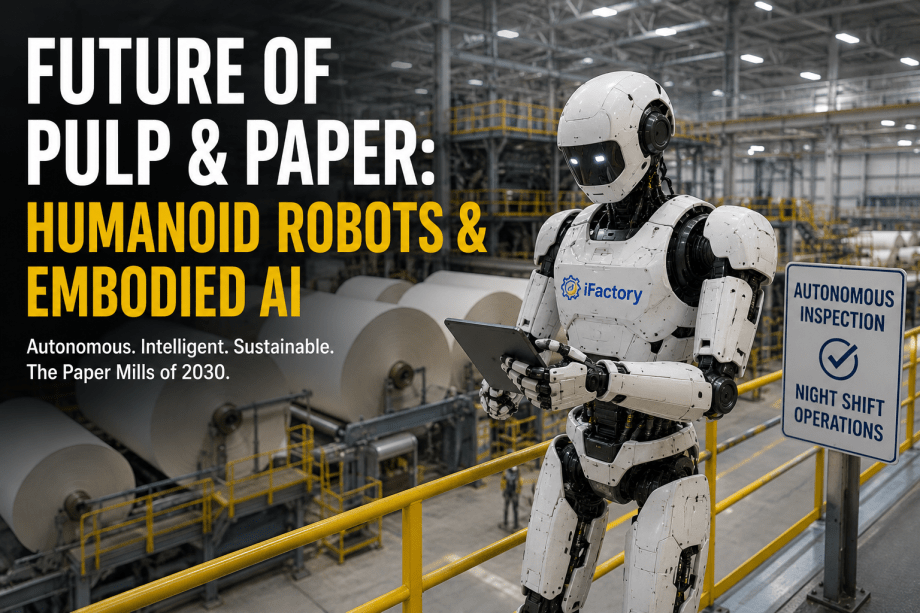
iFactory Self-Healing Factory + Humanoids in Steel Plants
By Hannah Baker on June 12, 2026
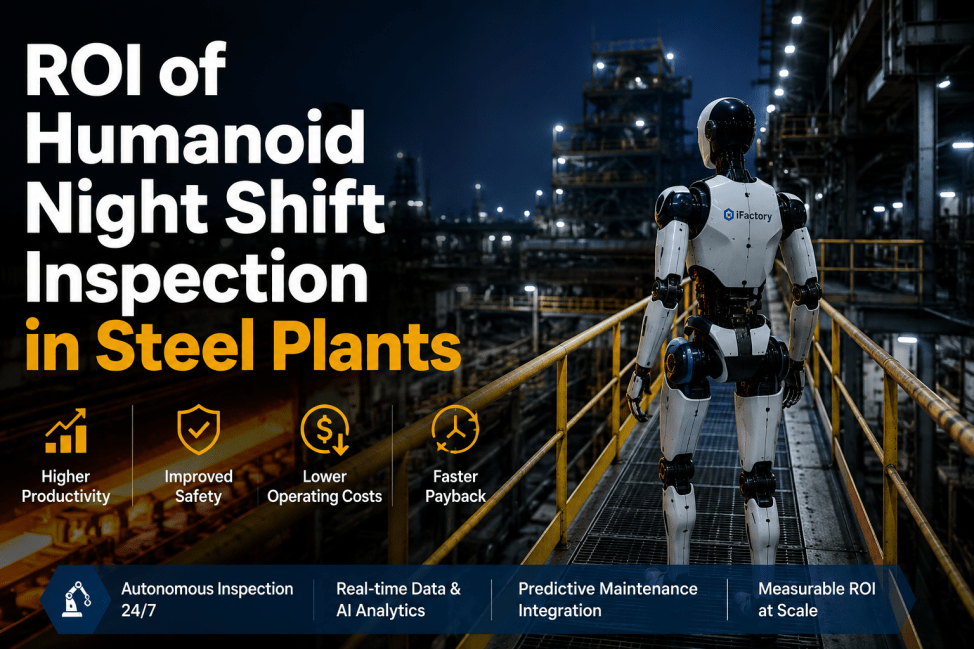
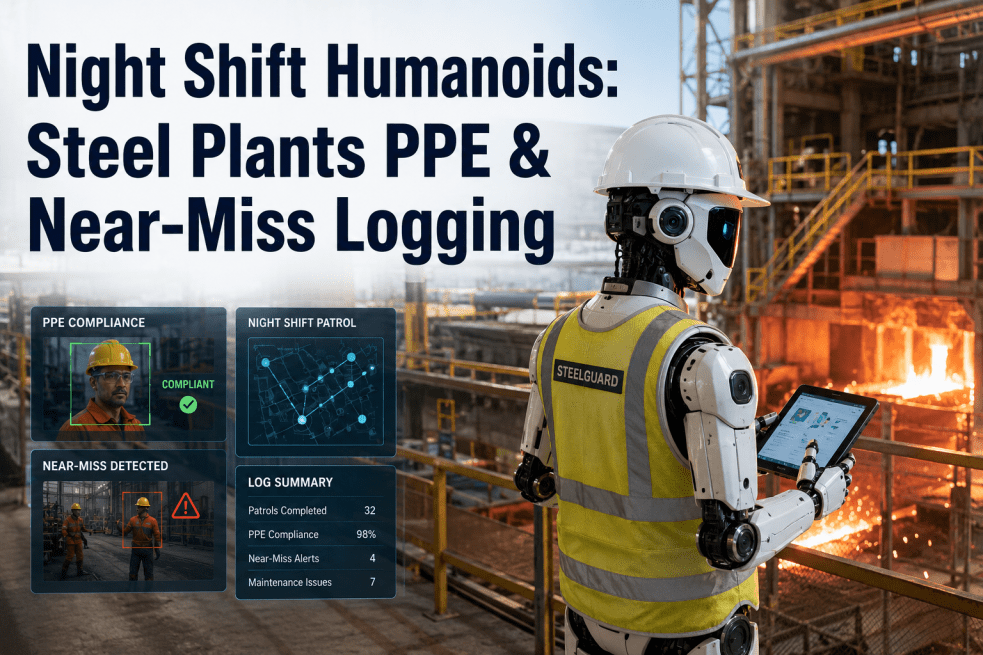
Steel plants operate around the clock across melt shop, casting, hot rolling, cold rolling, finishing, and material handling operations. The night shift — where staffing is leanest, environmental visibility is lowest, and supervision is thinnest — creates an unavoidable inspection gap that exposes critical assets to undetected degradation. Ladle cars, tundishes, cooling beds, rolling mill stands, and overhead crane systems accumulate thermal stress, mechanical wear, and process deviations between scheduled operator patrols, with anomalies frequently discovered only when they produce unplanned downtime events at shift changeover. A humanoid robot conducting autonomous night-shift patrols and connected to iFactory's self-healing factory platform eliminates this gap by delivering continuous, real-time inspection coverage across every steel production area — with every patrol data point integrated directly into CMMS, MES, QMS, and ERP workflows. To evaluate iFactory's self-healing platform for your steel operation, Book a Demo with iFactory's industrial operations team.
iFactory's platform deploys humanoid robots for autonomous night-shift patrols across steel production areas, captures every inspection finding in real time, and closes the loop across CMMS, MES, QMS, and ERP — eliminating manual patrol gaps and paper-based inspection documentation.
01 / The Night-Shift Inspection Challenge in Steel Manufacturing
Steel manufacturing presents a convergence of inspection challenges that compound during night shifts. Reduced operator presence means fewer eyes on critical equipment. Dim lighting in material handling zones and furnace-adjacent areas makes visual inspection unreliable. Thermal cycling of ladle cars, tundishes, and cooling bed components creates fatigue conditions that develop silently between scheduled patrols. A Book a Demo with iFactory's team will show how autonomous humanoid patrols replace this reactive model with continuous, real-time inspection coverage.
100%
Night-Shift Inspection Coverage Across All Production Areas
24/7
Autonomous Patrol Availability — Zero Gap Between Cycles
60s
Anomaly Detection to Corrective Action Latency
8 wk
Full Platform Deployment Across Melt Shop to Finishing
iFactory's self-healing factory platform connects humanoid robots to the plant's enterprise system layer through a unified data integration fabric that transforms inspection data from compliance documentation into operational intelligence. The humanoid robot navigates the steel plant's production environment autonomously, using multi-sensor payloads for thermal imaging, vibration analysis, acoustic monitoring, and visual inspection across melt shop, casting, hot rolling, cold rolling, and finishing areas — with every data point transmitted in real time to the iFactory correlation engine.
HUMANOID
Autonomous Patrol Platform
Humanoid robot with industrial-grade mobility navigates steel plant environments including elevated platforms, confined access areas, and high-temperature zones. Pre-programmed patrol routes with dynamic obstacle avoidance and autonomous charging cycles.
24/7 Autonomous Operation
SENSOR
Multi-Sensor Inspection Payload
ATEX-certified thermal imaging, vibration analysis, acoustic monitoring, gas detection, and high-resolution visual inspection sensors. Data fusion engine combines sensor inputs into unified anomaly detection events with GPS-tagged location metadata.
Thermal · Vibration · Acoustic
INTEGRATE
Enterprise System Fabric
Unified integration layer connects robot patrol data to CMMS, MES, QMS, and ERP systems via OPC-UA, REST APIs, and direct database connectors. Bi-directional data flow enables real-time work order generation, production schedule adjustment, and compliance documentation.
OPC-UA · REST · Native
AI
Self-Healing Analytics Engine
AI-driven correlation engine cross-references patrol findings with process historian data, maintenance records, quality logs, and production schedules. Pattern recognition identifies emerging degradation trends before they reach critical thresholds.
Real-Time Cross-System AI
Autonomous Workflow
03 / Autonomous Night-Shift Workflow: Detection to Closed-Loop Action
When a humanoid robot on night-shift patrol detects a bearing temperature exceeding threshold on a hot mill run-out table roll, the iFactory self-healing workflow activates across four enterprise systems simultaneously — without any human intervention required during the night shift.
1
Autonomous Detection and Classification
Humanoid robot's thermal imaging sensor detects roll bearing temperature at 128°C — exceeding the 95°C alert threshold. Robot cross-validates reading with secondary sensor, logs GPS-tagged location and thermal image, and transmits alert packet to iFactory platform with temperature gradient, trend history, and environmental context data.
Sub-Second Detection
2
Real-Time Cross-System Correlation
iFactory platform correlates the thermal event with the hot mill's current production rate from MES, roll bearing maintenance history from CMMS, and product quality impact from QMS. Platform identifies that this bearing was flagged for increased vibration 72 hours earlier and correlates the thermal rise with the vibration trend.
Cross-System AI Correlation
3
Automated Corrective Action Generation
iFactory auto-generates a priority work order in CMMS with robot location data, thermal and vibration readings, and probable cause analysis. Platform adjusts MES production schedule to reduce load on the affected roll stand. QMS record created documenting the event and corrective action. ERP compliance log updated automatically.
Automated Multi-System Action
4
Closed-Loop Confirmation and Continuous Monitoring
Day-shift maintenance team receives mobile alert with work order details and proceeds to verified location. Robot remains on station monitoring bearing temperature until corrective action is confirmed. iFactory logs the full event lifecycle for compliance documentation and continuous improvement analysis.
The deployment of iFactory's self-healing factory platform with humanoid robot night-shift patrols produced measurable improvements across safety, operational efficiency, and enterprise system integration within the first quarter. The steel operations team, which selected iFactory over three competing platforms, can be reached to Book a Demo by scheduling directly with their industrial operations team.
OPERATIONAL METRIC
BEFORE (MANUAL PATROLS)
AFTER (iFACTORY + HUMANOID)
IMPROVEMENT
Night-Shift Inspection Coverage
Scheduled — 4-8 hr gaps
Continuous 24/7 Autonomous Coverage
4-8 hr gaps → Continuous patrol
Anomaly Detection Latency
4 to 8 hours
Under 60 seconds — 99.8% faster
8 hrs → 60 sec detection
Corrective Action Initiation
4 to 8 hours post-detection
Automated within 60 seconds of detection
8 hrs → 60 sec to action
Patrol Compliance Rate
87% — missed cycles common
99.7% scheduled patrol completion
87% → 99.7% compliance
Night-Shift Operator Hours on Patrol
28 hours per week
2 hours per week — 93% reduction
28 hrs → 2 hrs per week
AUTONOMOUS NIGHT PATROLS · CLOSED-LOOP WORKFLOWS · ENTERPRISE INTEGRATION
Your Steel Plant's Night-Shift Inspection Gap Is Costing Millions in Undetected Degradation
iFactory's self-healing factory platform deploys humanoid robots for autonomous night-shift patrols across every steel production area — capturing every inspection finding in real time and closing the loop across CMMS, MES, QMS, and ERP without human intervention.
M. Okafor, VP of Operations — Integrated Steel Producer, 26 Years
Past Chair, AIST Maintenance & Reliability Committee
"I have managed operations across melt shop, hot mill, cold mill, and finishing at three integrated steel producers over 26 years. The night-shift inspection gap has always been the single largest unaddressed vulnerability in steel plant reliability. We scheduled operator patrols every four hours because that was what staffing allowed, not because it was adequate for detecting developing equipment failures. What this deployment demonstrates is that humanoid robotics connected to a self-healing platform changes the fundamental assumption — inspection becomes continuous, not scheduled. The 60-second latency from detection to corrective action is not an incremental improvement over the 8-hour manual cycle. It is a fundamentally different operating model. In steel manufacturing, where a single undetected bearing failure on a hot mill can cascade into 12 hours of unplanned downtime at a cost of $80,000 per hour, that difference is existential."
M. Okafor, VP of OperationsIntegrated Steel Producer — 26 Years, Past Chair AIST Maintenance & Reliability Committee
Conclusion
05 / The Night-Shift Inspection Gap Is Closed — Autonomous, Continuous, and Connected
The night-shift inspection gap in steel manufacturing was never a problem of inadequate operator diligence or insufficient patrol frequency. It was a structural limitation of human-dependent inspection — limited by staffing levels, environmental conditions, and the fundamental constraint that a human operator cannot be everywhere at once. iFactory's self-healing factory platform, integrating humanoid robots for autonomous night-shift patrols with closed-loop enterprise system connectivity, eliminates that structural limitation. Continuous autonomous inspection across every production area, real-time anomaly detection with cross-system correlation, and automated corrective action generation executed within seconds — these capabilities transform night-shift operations from a vulnerability into a competitive advantage. To assess what iFactory's self-healing platform would deliver for your steel plant's night-shift operations, Book a Demo with iFactory's industrial operations team.
100%
Night-Shift Inspection Coverage
60s
Detection to Corrective Action
93%
Reduction in Night Patrol Hours
8 wk
Full Platform Deployment
FAQ
Frequently Asked Questions — Humanoid Robots in Steel Plants
Yes. Humanoid robots deployed on iFactory's self-healing factory platform are built with industrial-grade thermal protection rated for continuous operation in ambient temperatures up to 55°C, with burst tolerance to 70°C for furnace-adjacent patrol routes. Robots are equipped with thermal-reflective enclosures, active cooling systems, and ATEX-certified component ratings for operation in areas with combustible dust and elevated particulate concentrations common in steel production environments. Patrol routes are programmed to maintain safe thermal exposure limits while providing full coverage of each production area's inspection requirements.
iFactory integrates at the data layer via REST APIs, OPC-UA, and direct database connectors — ingesting robot telemetry and patrol data into its unified platform, which then auto-generates work orders in the connected CMMS, adjusts production schedules in MES, flags quality records in QMS, and updates compliance logs in ERP. The integration is bi-directional: the platform reads CMMS maintenance history, MES production parameters, and QMS quality data to enrich anomaly correlation, then writes inspection findings, work orders, and compliance records back into each system. No modifications to existing enterprise platforms are required.
The robot transmits a real-time alert packet to the iFactory platform with sensor readings, GPS-tagged location, timestamp, thermal images, and environmental context. The platform immediately correlates the finding with current MES production parameters, CMMS maintenance history, and QMS quality impact — then auto-generates a priority work order in CMMS, adjusts the MES production schedule, creates a QMS event record, and updates the ERP compliance log within 60 seconds. The robot remains on station monitoring conditions until the corrective action is confirmed complete and the anomaly is verified resolved. On-call maintenance personnel receive mobile alert with full context, eliminating the need for preliminary investigation.
Yes. Humanoid robots deployed on iFactory's platform are designed for bipedal mobility with the ability to navigate stairways, ladders, elevated walkways, confined access passages, and uneven industrial flooring. LIDAR and stereo-vision sensor arrays provide 360-degree environmental awareness with real-time obstacle detection and dynamic path replanning. Robots are programmed with production-area-specific navigation maps that include exclusion zones around active overhead crane paths, molten metal transfer routes, and restricted-access process areas. Patrol routes are validated through simulation before deployment and can be updated remotely as production layouts change.
Full platform deployment across melt shop, casting, hot rolling, cold rolling, and finishing areas is typically completed within 8 weeks — including humanoid robot deployment, production area navigation mapping, enterprise system integration with existing CMMS and MES platforms, and operations team training. The phased rollout prioritizes highest-risk areas first, with autonomous patrols operational in melt shop and hot mill areas within the first 4 weeks. No production downtime is required during any deployment phase. iFactory's industrial operations team manages the full deployment process, from initial production area assessment to go-live validation. Book a Demo to discuss your steel plant's deployment timeline.
AUTONOMOUS NIGHT PATROLS · CLOSED-LOOP WORKFLOWS · ENTERPRISE INTEGRATION
iFactory gives steel plant operations teams autonomous humanoid robot patrols across every production area, real-time anomaly detection with cross-system correlation, automated work order generation in CMMS, and full compliance documentation — fully deployed in 8 weeks with zero production interruption.