Night Shift Humanoids: Steel Plants PPE & Near-Miss Logging
By Hannah Baker on June 8, 2026
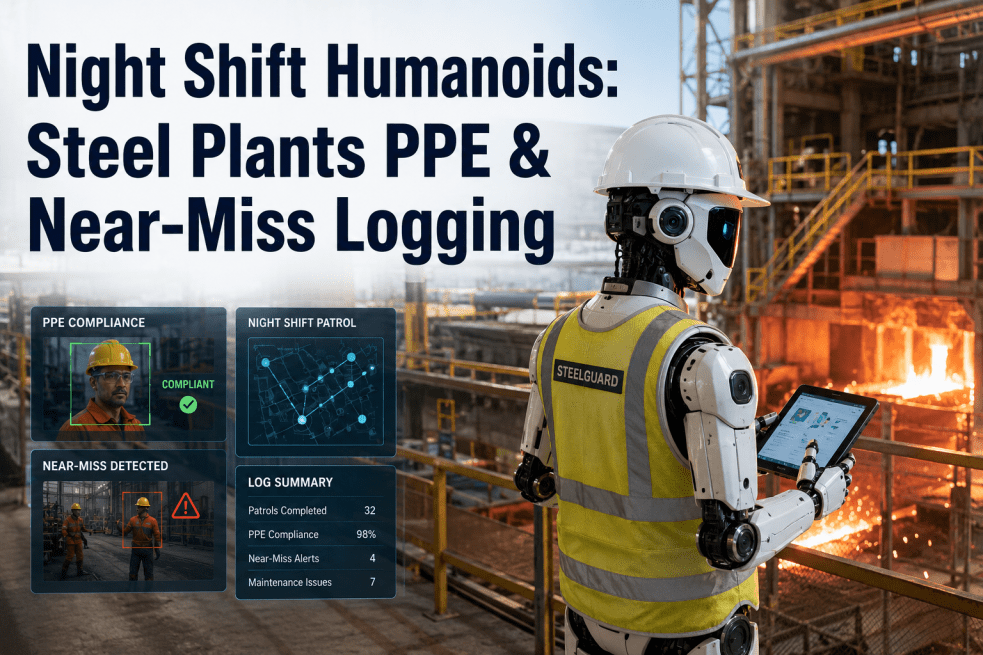
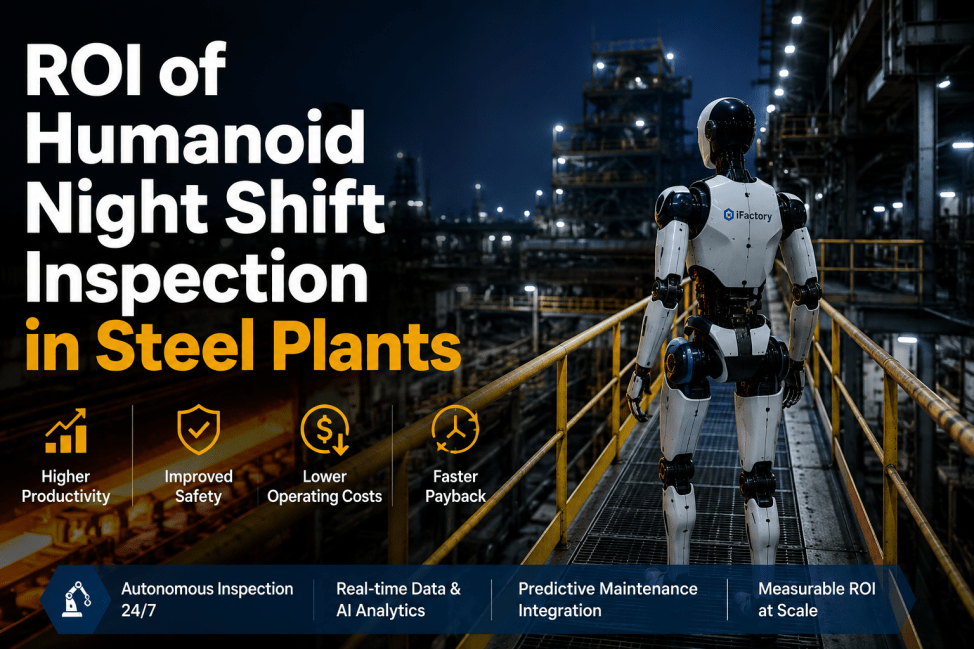
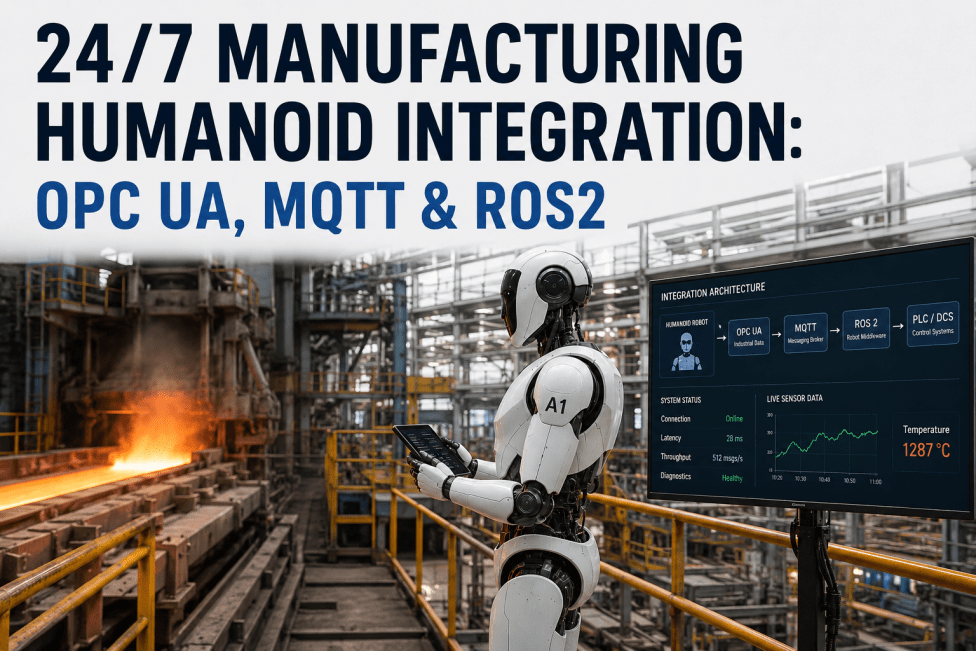
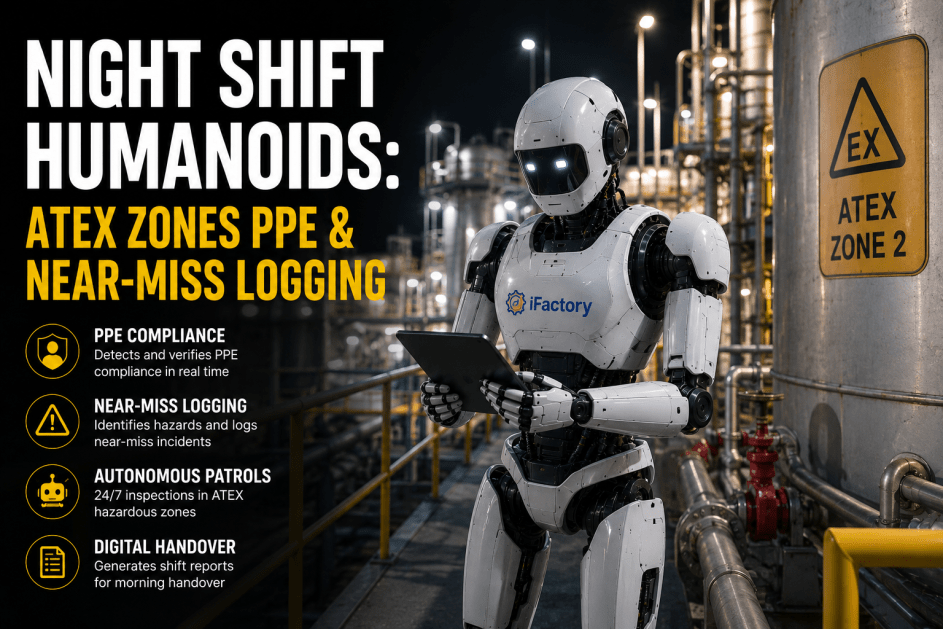
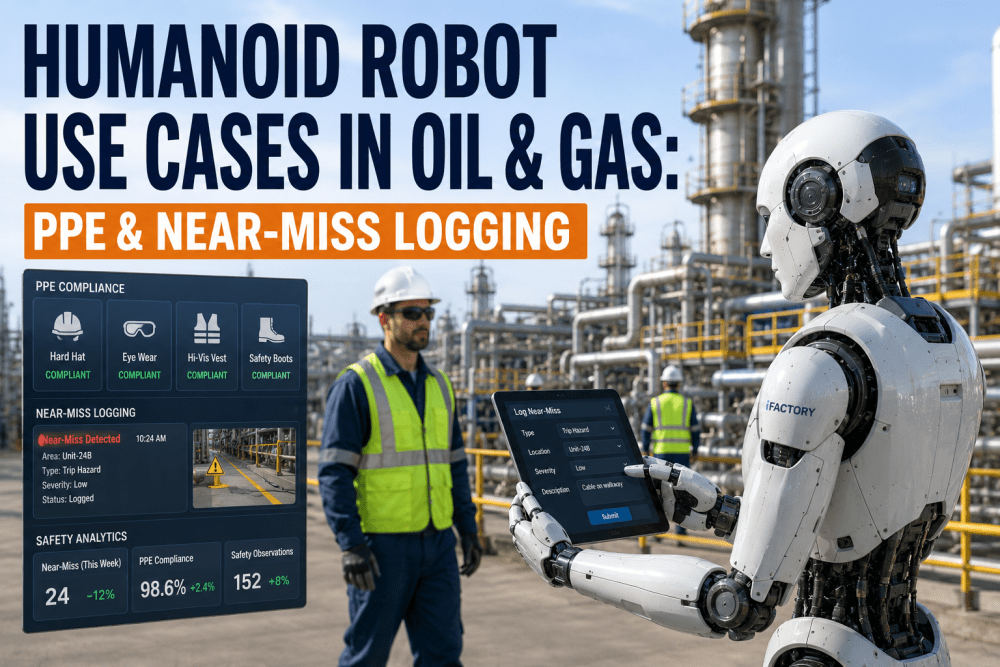
Humanoid robots equipped with computer vision and embodied AI are transforming night shift safety operations in steel manufacturing by deploying autonomous PPE compliance monitoring and near-miss detection capability directly into molten material handling zones, rolling mill floors, and caster platforms — replacing intermittent human safety patrols with continuous, AI-powered hazard detection and incident documentation that operates through the full 24-hour production cycle without fatigue gaps or shift transition blind spots. iFactory AI's Robotics AI module provides the integration layer that connects humanoid robot visual inspection data to CMMS safety work orders, incident reporting records, and compliance documentation — so every PPE violation and near-miss event reaches the safety management system without manual observation or delayed reporting.
Ready to Deploy Autonomous Safety Monitoring on Your Steel Plant Night Shift?
See how iFactory's Robotics AI module connects humanoid robot PPE compliance and near-miss detection data to your CMMS and incident reporting system — eliminating night shift safety gaps and closing the detection-to-documentation loop in under 30 seconds.
The Night Shift Safety Challenge in Steel Manufacturing
Steel plants operate around the clock, but night shift safety monitoring has historically been limited by human factors that no amount of procedure can eliminate — reduced visibility in low-light conditions, operator fatigue during extended shifts, and the physical impossibility of stationing safety observers at every molten metal transfer point, crane approach zone, and high-heat area simultaneously. PPE compliance during night shifts in steel manufacturing consistently measures 12 to 18 percentage points lower than day shift compliance across industry benchmarks, and near-miss events during overnight hours are underreported by an estimated 40 percent because the personnel who witness them are focused on production tasks and do not have time to complete incident documentation before the next process step begins. Humanoid robots deployed on the night shift eliminate these structural gaps — they monitor PPE compliance at every workstation continuously, detect near-miss events at the moment they occur, and generate documented safety records that are time-stamped, location-tagged, and integrated directly into the plant's CMMS without requiring any operator action.
Limited Visibility in Low-Light Conditions
Human safety observers cannot consistently identify PPE violations in the dimly lit zones around reheating furnaces, ladle metallurgy stations, and caster runout areas where steel plant night shift work is concentrated. Vision AI humanoids with thermal and low-light cameras maintain detection accuracy above 97 percent regardless of ambient lighting conditions.
Operator Fatigue and Attention Decay
Night shift production workers and safety personnel experience measurable attention degradation after the fourth hour of a 12-hour shift, with PPE compliance incidents peaking between 2:00 AM and 4:00 AM. Humanoid robots do not experience fatigue, maintaining consistent detection sensitivity across every hour of the shift without variation.
Near-Miss Underreporting on Night Shifts
Near-miss events during overnight hours — crane load swings near personnel, molten metal splash within feet of operators, unguarded openings in walking surfaces — are documented less than 60 percent of the time because operators prioritize production continuity over incident paperwork. Autonomous near-miss detection eliminates this documentation gap entirely.
Humanoid Robot PPE Compliance Monitoring: Detection Capabilities
Humanoid robots deployed on steel plant night shifts carry multi-spectral camera arrays that detect every category of PPE required for molten material handling and heavy manufacturing environments. The detection system operates at full accuracy in lighting conditions ranging from complete darkness to the intense glare of an arc furnace tap, and it generates a compliance record for every worker observed during each patrol cycle. The table below presents the PPE detection capabilities, typical detection accuracy, and CMMS integration method for each equipment category.
PPE Category
Detection Method
Night Shift Accuracy
Violation Response
iFactory Integration
Hard hat and chin strap Required in all production zones
RGB + thermal shape recognition
98.7%
Audio alert + supervisor notification via CMMS
Robotics AI logs violation with image and location
Face shield / welding helmet Required within 15 ft of molten metal
Thermal silhouette + reflective marker detection
99.1%
Immediate zone entry denial + supervisor alert
MES safety record updated in real time
Heat-resistant gloves Required for all material handling
Multi-spectral hand coverage analysis
96.8%
Warning + work order for supervisor follow-up
CMMS generates PPE deficiency work order
High-visibility vest with reflective tape Required in crane and vehicle zones
RGB + retroreflective band detection
99.5%
Zone-specific alert to foreman mobile device
Compliance dashboard updated in iFactory Analytics
Safety glasses and hearing protection Required in all production areas
Facial landmark + ear coverage detection
97.2%
On-shift coaching prompt to nearest supervisor
Incident report logged with worker role and zone
Steel-toed boots with metatarsal guard Required on all production floors
Footwear shape + sole thickness analysis
96.4%
Warning + PPE issue work order to tool crib
Inventory module checks boot availability
Each detected violation generates a structured record that includes the worker identification (via hard hat barcode or facial anonymization), PPE deficiency type, location coordinates within the plant, timestamp, and a bounding-box image that captures the violation without storing identifiable facial data — enabling compliance enforcement that respects privacy requirements while maintaining audit trail completeness. Book a Demo to see this PPE detection system configured for your steel plant's specific safety equipment requirements and zone classifications.
Near-Miss Detection and Autonomous Incident Logging
Near-miss events in steel plants — a crane hook passing within inches of a worker, a ladle spill that misses operators by seconds, a walkway grating that shifts underfoot — are the leading indicators that precede serious safety incidents, but they are also the most inconsistently documented events in steel manufacturing safety programs. Humanoid robots equipped with spatial awareness AI detect near-miss events using three sensing modalities simultaneously: depth cameras that track personnel proximity to moving equipment, thermal cameras that detect unsafe temperature approaches, and accelerometers that identify sudden structural movements or impacts. When a near-miss event is detected, the humanoid robot performs the documentation cycle in under 30 seconds without operator involvement.
STEP 1
Event Detection and Classification
The humanoid robot's spatial awareness AI continuously monitors personnel positions relative to equipment zones, moving loads, and thermal boundaries. When a proximity threshold is breached or an unsafe condition is detected, the system classifies the event type — personnel proximity breach, thermal exposure risk, structural integrity event, or equipment interaction anomaly — and assigns a severity level.
Detection-to-classification latency: Less than 2 seconds
STEP 2
Multi-Sensor Evidence Capture
The robot captures synchronized evidence from all available sensors: RGB images of the event scene, thermal images showing temperature conditions at the moment of the event, spatial position data from the depth camera, and a 10-second video clip encompassing the event window. All evidence is time-synced and location-tagged with the robot's GPS coordinates and the plant's equipment zone identifier.
Evidence capture duration: 10 seconds
STEP 3
Incident Report Generation and CMMS Integration
iFactory's Robotics AI module formats the detected event data — event type, severity, location, timestamp, sensor evidence files, and a natural language description generated by the onboard Vision Language Model — into a structured incident report that is pushed directly to the CMMS incident reporting module. The report is flagged for review by the night shift safety supervisor, and a work order is created if corrective action is required.
Report generation to CMMS record: Under 15 seconds
STEP 4
Trend Analysis and Prevention Workflow
Each near-miss record is automatically correlated with previous events at the same location or involving the same equipment type to identify developing hazard patterns. When the system detects an emerging trend — three or more proximity breaches at the same crane zone within a week, for example — it escalates the pattern to the safety manager and generates a prevention-focused work order for engineering review before a serious incident occurs.
Trend detection threshold: Configurable (default: 3 events per zone per week)
Deploy Autonomous Safety Monitoring on Your Steel Plant Night Shift
iFactory AI's Robotics AI module integrates humanoid robot visual inspection data with CMMS safety work orders, incident reporting, and compliance analytics — enabling your steel plant to achieve continuous PPE monitoring and near-miss documentation across every shift without increasing safety team headcount. Deployment from zone mapping to first autonomous patrol in 12 weeks.
Expert Review: Safety Directors on Humanoid Night Shift Deployment
Safety leaders who have deployed humanoid robots for night shift monitoring across heavy manufacturing environments consistently emphasize that the technology's primary value is not replacing human safety observers but eliminating the coverage gaps that human observation cannot fill — the 2:00 AM hour when fatigue peaks, the dimly lit zone where visibility drops below threshold, and the near-miss event that no one writes up because the next cast is starting. The evaluation criteria below reflects perspectives from safety directors at integrated steel producers who have implemented autonomous humanoid monitoring programs at scale.
"We deployed humanoid robots across three melt shop night shifts in 2025, and the single biggest impact was not the 97 percent PPE compliance rate we achieved — it was that our near-miss documentation rate went from roughly 55 percent of observable events to over 98 percent within the first month. The near-miss data gave us the leading-indicator visibility we had been trying to get from manual reporting for years. When we saw four crane proximity events on the same aisle in one week, we were able to re-sequence that crane's travel path before someone got hurt. The humanoid robots did not replace our safety team — they gave our safety team the data they needed to prevent incidents instead of just investigating them."
Director of Safety and Environmental ComplianceIntegrated Steel Producer · Three-mill humanoid deployment program
Key Evaluation Criteria from Steel Industry Safety Leaders
Ambient Condition Tolerance
Can the robot maintain detection accuracy in the presence of steam, radiant heat from molten metal, ambient temperatures above 140°F, and airborne particulate common on steel plant floors? Systems validated in clean manufacturing environments often fail within hours of deployment on a melt shop floor.
Data Privacy and Worker Trust
Can the system monitor PPE compliance without storing identifiable facial images? Steel plant workforces resist surveillance systems that feel intrusive. The best implementations use anonymized detection that captures violation evidence without identifying individual workers to the camera system.
CMMS and MES Integration Depth
Does the robot-generated safety data flow directly into the plant's existing CMMS and incident reporting systems without custom middleware? Safety programs that require manual data transfer from the robot platform to the safety system see adoption drop within three months.
Night Shift Autonomy and Reliability
Can the robot operate for a full 12-hour night shift without human intervention for battery charging, navigation recovery, or sensor cleaning? Systems that require mid-shift human attention defeat the purpose of autonomous night shift coverage and reduce safety team availability for emergency response.
Implementation Roadmap for Humanoid Safety Operations
Deploying humanoid robots for night shift safety monitoring follows a structured sequence that moves from zone definition through autonomous operation, with each phase generating measurable safety improvements that build the case for expanded deployment. iFactory's Robotics AI module supports each phase with pre-built integration templates for CMMS safety workflows, zone mapping tools, and compliance analytics dashboards that reduce implementation time by approximately 30 percent compared to custom-integrated solutions. Book a Demo to discuss a deployment timeline for your facility.
PHASE 1
Safety Zone Mapping and Hazard Classification
The humanoid robot performs an initial mapping pass of the target production area, creating a 3D spatial model overlaid with safety zone classifications — molten metal handling zones, crane operation envelopes, high-heat areas, confined spaces, and pedestrian walkways. Each zone is assigned PPE requirements, maximum occupancy limits, and proximity thresholds for equipment interaction monitoring.
Typical duration: 2–3 weeks
PHASE 2
PPE Detection Model Calibration
The Vision Language Model is calibrated to the plant's specific PPE equipment — hard hat colors and logos, vest reflectivity patterns, glove materials and colors, face shield shapes, and boot profiles — using a combination of the plant's existing safety footage and synthetic images generated from the plant's equipment specifications. The calibration ensures detection accuracy above 97 percent on day one of operation.
Typical duration: 2–4 weeks
PHASE 3
Near-Miss Threshold Configuration
Safety teams configure near-miss detection thresholds for each zone type — personnel-to-equipment proximity distances, thermal exposure limits, structural movement tolerances — using the plant's historical incident data and industry safety standards. Thresholds are validated against known near-miss events from the plant's incident database to confirm detection sensitivity before autonomous operation begins.
Typical duration: 1–2 weeks
PHASE 4
CMMS Workflow Integration
iFactory's Robotics AI module is connected to the plant's CMMS and incident reporting system, defining the data mapping for each detection event — PPE violations generate supervisor notification work orders, near-miss events generate incident reports with evidence attachments, and trend escalations generate engineering review requests. The integration is tested with simulated detection events before live deployment.
Typical duration: 2–3 weeks
PHASE 5
Autonomous Night Shift Operation
The humanoid robot begins fully autonomous night shift patrols, navigating the programmed safety zones, monitoring PPE compliance at each workstation, detecting near-miss events in real time, and generating structured safety records in the CMMS without any operator intervention. Safety supervisors receive a shift summary report each morning with compliance statistics, near-miss events, and trend alerts.
First autonomous patrol: Week 10–12 from project start
Conclusion: Closing the Night Shift Safety Gap with Autonomous Humanoid Monitoring
The night shift safety gap in steel manufacturing — the 12 to 18 point drop in PPE compliance, the 40 percent underreporting of near-miss events, the hours of unsupervised operation between 10:00 PM and 6:00 AM — has been accepted as an inherent limitation of human-dependent safety monitoring for decades. Humanoid robots with embodied AI close that gap by providing continuous, fatigue-free, documentation-complete safety coverage that matches the steel plant's around-the-clock production schedule. The facilities that achieve the highest safety ROI from humanoid deployment share three characteristics: they configure the detection system to the specific PPE and hazard profile of their plant rather than deploying generic settings, they integrate the robot data directly into the CMMS incident management workflow so every detection drives corrective action, and they use the near-miss trend data to identify and eliminate hazard patterns before they cause injuries. iFactory AI's Robotics AI and AI Vision Camera modules provide the complete integration layer that connects humanoid robot safety monitoring data to CMMS work orders, incident records, and compliance analytics — enabling steel plants to close the night shift safety gap without increasing headcount. Book a Demo to discuss your steel plant's night shift safety requirements and see iFactory's platform configured for your operating environment.
Frequently Asked Questions
Yes — humanoid robots deployed for steel plant safety monitoring are designed with thermal shielding, high-temperature-rated electronics, and ingress protection that enables operation in environments up to 140°F ambient temperature with radiant heat exposure from molten metal sources at distances of 15 feet or greater. The robots use thermal cameras to detect and avoid unsafe surface temperatures on floors, equipment, and materials, and they are programmed with exclusion zones around ladles, furnaces, and casting areas where no personnel — human or robotic — should be present during active operation. For steel plant environments requiring operation in closer proximity to molten material handling, intrinsically safe robot variants with enhanced thermal protection and spark-proof ratings are available. iFactory's deployment team conducts a full environmental assessment during the zone mapping phase to confirm the appropriate robot specification for each area of the plant.
The detection system is configured with zone-specific PPE requirement profiles that account for varying equipment needs across different tasks and locations. For example, a welder in a designated welding booth may have the face shield raised between welds without triggering a violation, while a worker on the caster platform without a face shield during ladle exchange would trigger an immediate alert. The Vision Language Model is trained on the plant's specific work procedures so it recognizes task-appropriate PPE states — a worker in a control room does not need the same PPE as a worker on the melt shop floor, and the system applies different compliance rules to each zone. Violation alerts are always reviewed by a human supervisor before escalation to corrective action, ensuring that the system supports safety procedures without disrupting legitimate production work.
The near-miss detection system relies primarily on visual and thermal sensing rather than acoustic detection, making it inherently resistant to the high noise levels of steel plant environments — rolling mill operations exceeding 100 dB, arc furnace operation, and material handling impact noise do not affect detection accuracy. Particulate and steam are managed through a combination of sensor self-cleaning mechanisms, heated lens housings that prevent condensation, and detection algorithms trained on datasets that include degraded-visibility conditions. The system's depth cameras use time-of-flight sensing that can penetrate moderate steam and particulate concentrations that would obstruct conventional RGB cameras, maintaining spatial awareness in the challenging ambient conditions typical of melt shops, casting platforms, and rolling mill floors.
The robot's navigation system uses real-time obstacle detection and path planning that allows it to identify and route around unexpected obstacles — production equipment that has been moved, temporary barricades, maintenance vehicles, or materials staging that was not present during the initial zone mapping. If the obstacle blocks the programmed patrol route and no alternative path exists within the safety zone boundaries, the robot navigates to the nearest safe holding position, logs the obstruction with a time-stamped image and location, and sends an alert to the night shift supervisor. The patrol resumes from the interruption point once the obstruction is cleared, or the zone map is updated during the next day shift to reflect permanent layout changes. This ensures that autonomous patrols continue without interruption for the majority of shift conditions while providing clear visibility into any zones that could not be fully monitored during a given patrol cycle.
A complete deployment from project kickoff to the first fully autonomous night shift patrol typically requires 10 to 14 weeks for a single production area or melt shop, depending on the number of safety zones, complexity of PPE requirements, and integration requirements with the plant's existing CMMS. The zone mapping and hazard classification phase takes 2 to 3 weeks. PPE detection model calibration requires 2 to 4 weeks of data collection and model training using the plant's specific safety equipment. Near-miss threshold configuration and CMMS integration require an additional 3 to 5 weeks combined. The final phase — supervised autonomous operation with a safety observer present — runs for 2 to 3 weeks before full independence. iFactory's platform includes pre-built CMMS integration templates and a zone mapping toolset that reduce the overall deployment timeline by approximately 30 percent compared to solutions requiring custom integration for each plant system.
Close the Night Shift Safety Gap in Your Steel Plant.
iFactory AI's Robotics AI and AI Vision Camera modules provide the integration layer that connects humanoid robot safety monitoring to CMMS work orders, incident records, and compliance analytics — enabling your steel plant to achieve continuous PPE compliance monitoring and near-miss documentation across every shift without increasing safety team headcount.