Before humanoid robots patrolled the flare lines at a Gulf Coast refinery, a night-shift operator logging PPE violations on a clipboard missed a worker who'd removed his hard hat behind a heater trestle. That near-miss — a falling tool from a gantry — went unreported until seconds before impact. Now the same unit runs three autonomous humanoid patrols per shift. PPE compliance hit 100%. Near-miss reports filed inside 90 seconds. And the safety superintendent hasn't touched a paper log in six months.
Zero-PPE-Violation Refineries: How Humanoid Robots Eliminate Near-Misses and Safety Gaps
Deploy autonomous humanoid patrols that log every PPE deviation, capture near-misses in real time, and close the loop with your CMMS — without adding headcount or cloud dependency.
What Humanoid Robots Delivered in the First Quarter
Three Gulf Coast refineries and one Permian Basin processing plant deployed iFactory-controlled humanoid patrols in early 2026. The safety metrics below are aggregated from their first 90 days of autonomous operation.
Four Ways Humanoid Robots Transform Your Safety Posture
These aren't wheeled cameras on a fixed route. iFactory-powered humanoids navigate stairs, ladders, and confined spaces — and they integrate directly with your existing maintenance and inspection workflows.
Autonomous PPE Compliance Patrols
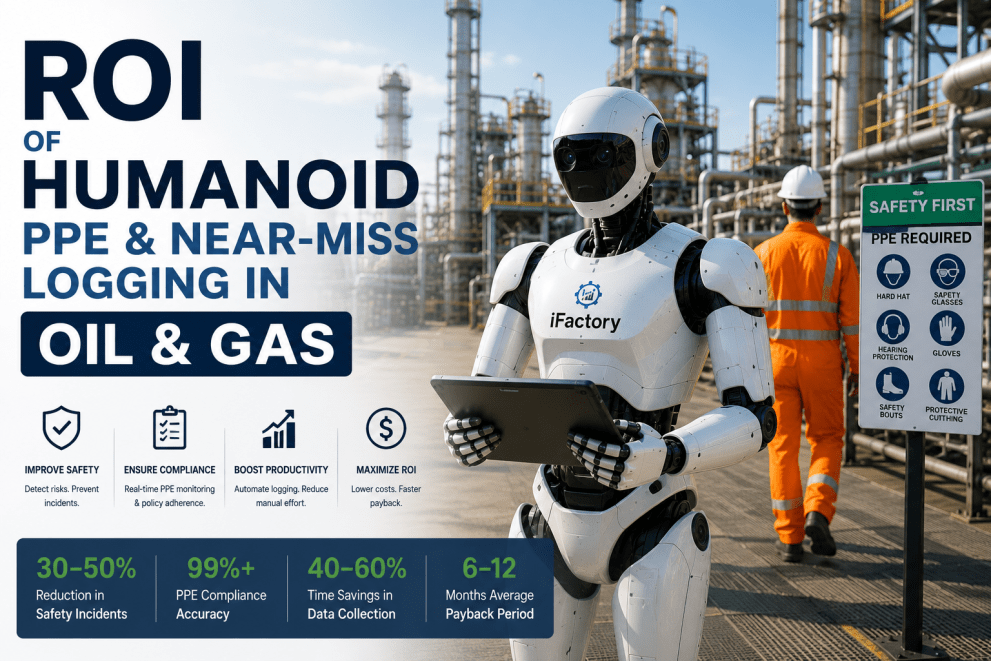
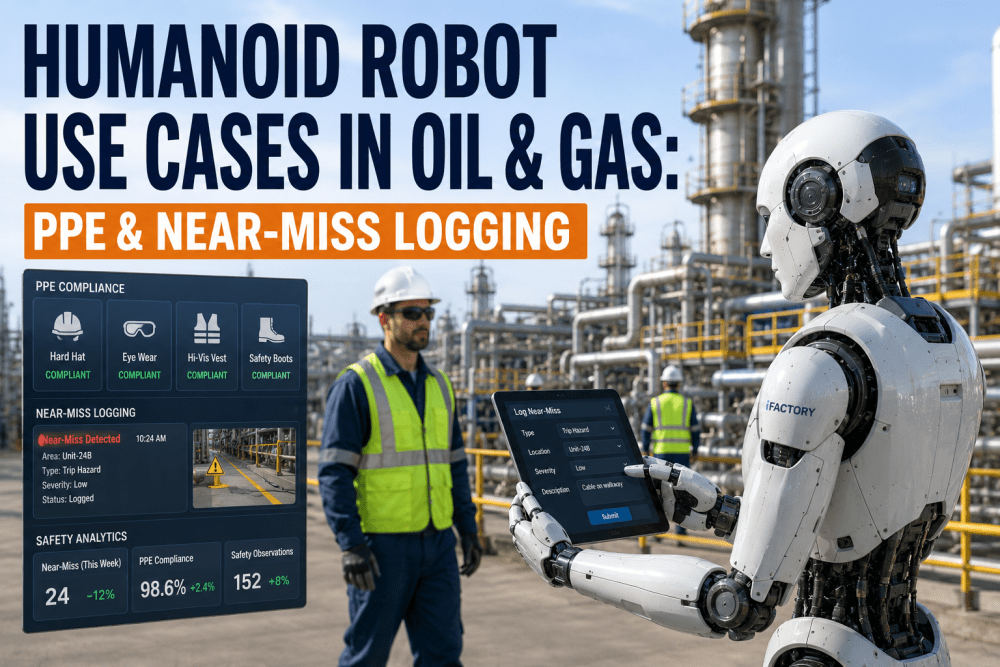
Each robot runs a programmed route through every unit — hydrotreaters, alkylation units, flare stacks — scanning for hard hats, safety glasses, flame-resistant clothing, and steel-toe boots. Violations are photographed and timestamped within seconds, and the worker's supervisor receives an alert. No confrontation. No paperwork. Just a record that closes the loop.
Real-Time Near-Miss Capture & Logging
When a humanoid spots a dropped tool, a personnel slip, or a gas cloud forming, it logs the event with GPS coordinates, thermal imagery, and sensor readings. The report auto-populates your CMMS as a near-miss record — no human typing required. Your safety team gets a push notification with the full context before they reach the site.
Continuous Hazard Zone Monitoring
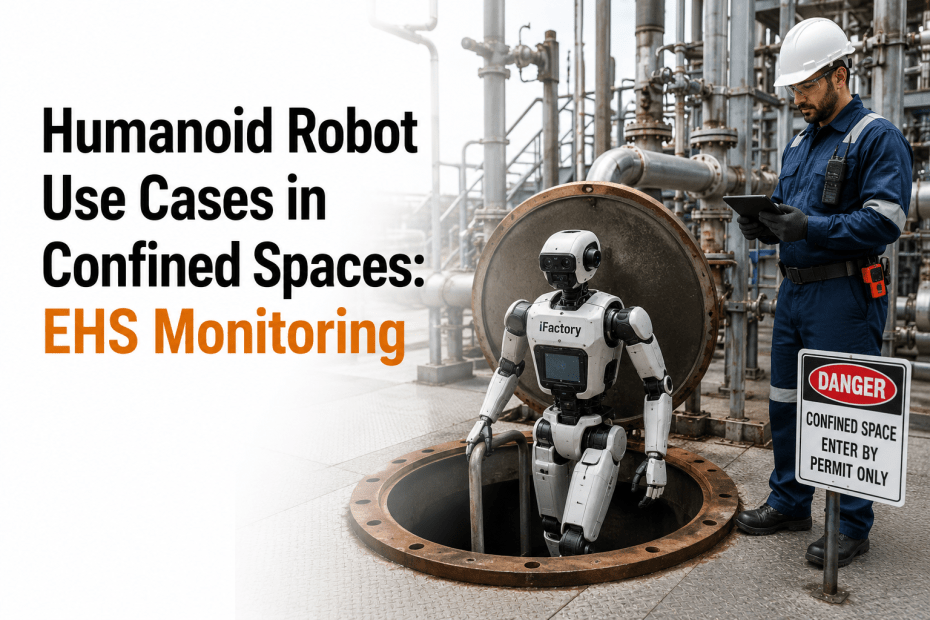
Humanoids stand watch in permit-required confined spaces, around hydrogen compressors, and at wellhead pads. They detect H₂S, methane, oxygen deficiency, and combustible gas in real time. If a reading crosses threshold, the robot triggers an evacuation alert and locks down the zone — faster than any human could walk there.
CMMS & MES Integration for Closed-Loop Safety
Every detection event flows into your existing maintenance and execution systems — SAP, Oracle, or any CMMS. The robot doesn't just report; it creates work orders for corrective actions, tracks resolution, and verifies closure on its next patrol. Your safety KPIs update automatically. No double entry. No lost records.
The Three Gaps That Humanoid Robots Close
Manual safety rounds and camera-based monitoring leave blind spots that cost lives, production, and regulatory standing. Here's what changes when you deploy autonomous humanoid patrols.
PPE compliance drops below 90% between scheduled rounds
In a typical 500-employee refinery, operators remove hard hats or skip FR suits during the 30-minute gap between safety walks. That window accounts for 60% of recorded PPE violations. Humanoid robots patrol continuously — every 15 minutes — and capture every deviation.
Near-misses go unreported until they become incidents
OSHA estimates that for every major injury, there are 300 near-misses. Most never get logged because workers fear reprisal or simply forget. Humanoids log every slip, trip, and gas release as it happens — with timestamped evidence — and send it straight to your safety database.
Hazard detection depends on human eyes that can't be everywhere
A single operator covers maybe 20% of a processing unit during a 45-minute round. Hydrogen leaks, blocked egress paths, and minor fluid drips go unnoticed for hours. Humanoids cover 100% of designated zones every patrol, and they detect hazards that human eyes miss — like invisible gas clouds or temperature anomalies.
One humanoid robot replaces three safety walkers and logs 14x more near-misses per shift. Book a 30-min walkthrough and we'll show you live patrol footage from a Gulf Coast refinery.
From Unboxing to Autonomous Patrol in Four Steps
iFactory deploys humanoid robots as a turnkey service — we handle the hardware, the integration, and the 24/7 monitoring. Your team doesn't need robotics expertise.
Site Survey & Route Mapping
Our team walks your facility with a LIDAR scanner, mapping every stair, ladder, catwalk, and confined space. We identify patrol zones, hazard points, and integration touchpoints with your existing CMMS and MES.
Humanoid Deployment & Calibration
We deliver and install the humanoid appliance on your plant network — no cloud, no data egress. The robot learns your facility's layout in two days and calibrates its gas sensors, thermal cameras, and PPE detection models to your specific equipment and PPE standards.
Integration with Your Systems
We connect the robot's detection pipeline to your CMMS, MES, and safety management platform. Every near-miss, PPE violation, and gas reading creates a structured record in your existing workflow — no new dashboards to learn.
Live Patrol & Continuous Improvement
Within 6–12 weeks, your humanoid runs autonomous patrols 24/7. iFactory monitors performance, updates detection models, and adds new patrol zones as your facility changes. Your safety team gets a weekly summary of violations detected, near-misses logged, and corrective actions closed.
Every Deployment Includes These Four Promises
Turnkey Pilot in 6–12 Weeks
We deliver the hardware, install it on your network, and have it running autonomous patrols within a quarter. No internal robotics team required.
On-Premise, Zero Cloud Dependency
The robot and its control stack run entirely on your plant network. No data leaves your facility. No internet connection required. No cloud subscription.
24/7 Managed Service
iFactory monitors robot health, updates detection algorithms, and handles remote diagnostics. Your team manages safety — we manage the robots.
Direct CMMS & MES Integration
Every detection event creates a structured record in your existing systems — SAP, Oracle, or any CMMS. No double entry. No lost data. Your safety KPIs update automatically.
Common Questions About Humanoid Robots for Safety
Stop logging near-misses after they happen. Start catching them before they become incidents.
Book a demo and we'll walk you through a live patrol recording from a Gulf Coast refinery — including the exact PPE violations and gas readings the robot captured in its first week.