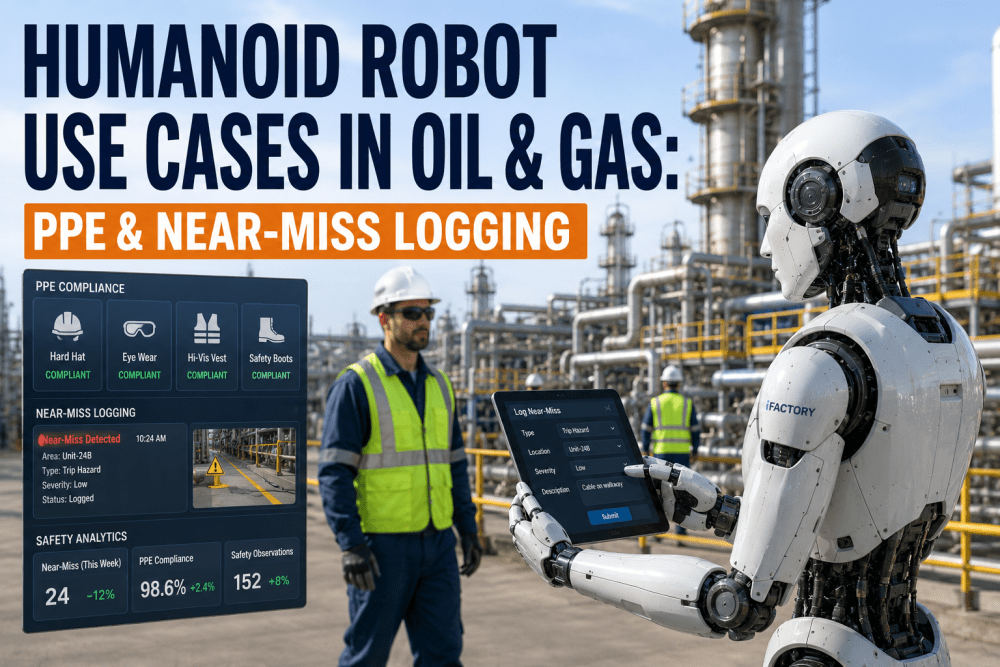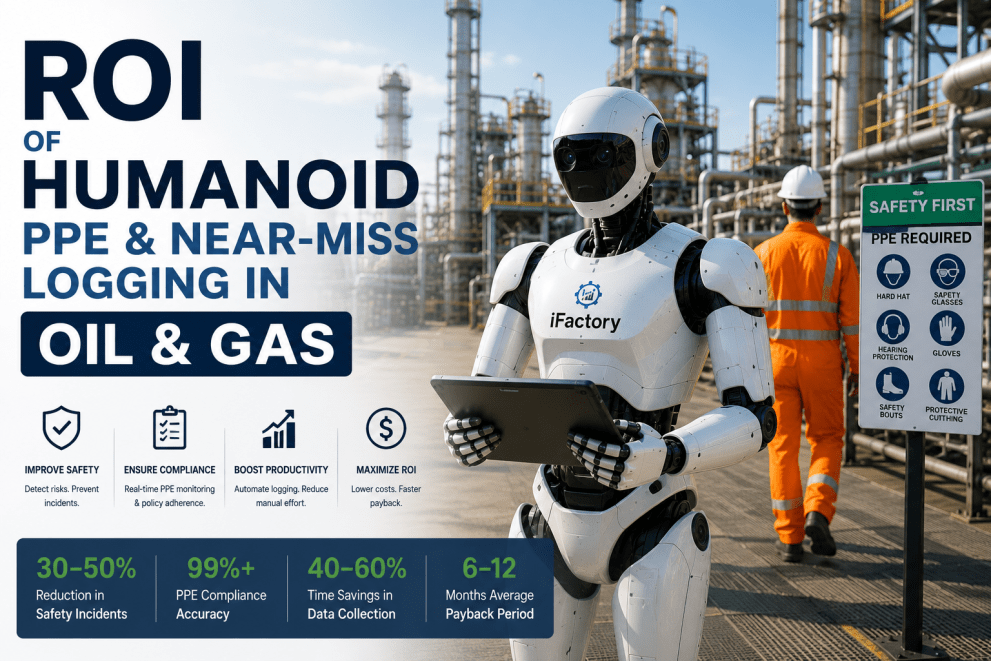
Oil and gas operations present a safety monitoring challenge that spans geography, shift schedules and hazard classifications. A mid-sized Gulf of Mexico operator running 14 production platforms with approximately 900 field personnel documented 1,200+ near-miss events annually across its upstream and midstream assets — the majority involving PPE non-compliance, confined-space entry procedure deviations, and dropped-object exposures that were observed but not systematically captured. The operator's safety team estimated that near-miss under-reporting exceeded 60% because field supervisors, focused on production continuity, logged only incidents that required formal investigation. The unreported near-misses represented a blind spot in the operator's risk model — events that could, under slightly different conditions, have resulted in lost-time injuries or fatalities. This case study quantifies the ROI of deploying humanoid robots for autonomous PPE compliance verification and near-miss logging across the operator's Gulf assets — analyzing payback periods against injury cost avoidance, productivity recovery, and safety staffing optimization.
The Near-Miss Documentation Gap: Why 60% of Events Never Enter the Risk Model
The operator's existing safety management system required supervisors to document near-miss events through a web-based incident reporting portal — a process that, for a production platform supervisor managing a 12-hour shift across multiple wellheads, separators, and compressors, could take 20 to 30 minutes per event. The time cost of documentation created a predictable behavioral pattern: events that did not result in injury or equipment damage were documented only when regulatory reporting requirements explicitly mandated it. Near-misses involving PPE compliance — a worker removing gloves in a classified area, a hard hat chin strap left unfastened, a fire-retardant coverall zipped only halfway — were corrected verbally and not recorded. The operator's incident database showed 42 PPE-related near-misses logged in the preceding year; a targeted observation program conducted by safety consultants estimated the actual number at approximately 850 events — a 20:1 under-reporting ratio.
Humanoid robots equipped with computer vision and edge AI eliminate this documentation gap by performing continuous PPE compliance verification and near-miss detection without requiring supervisor intervention. The platform logs every detected anomaly against the worker's identity, location, and shift context — creating a complete near-miss dataset that enables risk modeling, trend analysis, and targeted safety interventions at a fidelity level that manual documentation cannot approach. Book a Demo to see the detection architecture.
- Near-miss documentation dependent on supervisor availability and initiative — estimated 60%+ under-reporting rate
- PPE compliance verified through periodic walkthroughs — gaps between inspections of 4-8 hours per shift
- Near-miss data inconsistent across assets — no unified risk model across 14 platforms
- Safety interventions reactive — triggered by incidents or reportable events only
- Safety staffing tied to manual observation — 3 dedicated safety observers per platform per shift
- Risk model based on lagging indicators — TRIR, DART, lost-time injury frequency
- Continuous near-miss detection and logging — every observable event captured, classified, and timestamped automatically
- Real-time PPE compliance verification at every workface — detection latency under 3 seconds
- Standardized near-miss taxonomy across all assets — unified dataset for enterprise risk analysis
- Proactive safety alerts — PPE deviation flagged before work task begins in classified area
- Safety observer staffing optimized — humanoid covers routine monitoring; safety personnel focused on high-risk tasks
- Risk model enriched with leading indicators — near-miss frequency, PPE compliance rate, detection-to-correction time
Deployment Architecture: Humanoid Safety Agents Across Gulf of Mexico Assets
The operator deployed 28 humanoid platforms across 14 production platforms — two per platform — configured for continuous deck-level patrol, equipment inspection, and personnel safety monitoring. Each platform carried multi-spectral cameras for PPE verification, thermal imaging for early fire detection, gas sensors for fugitive emission monitoring, and onboard edge AI processing for real-time near-miss classification. The humanoids operated on a staggered schedule: one unit on active patrol while the second unit recharged and uploaded event data to the iFactory platform through the asset's existing satellite communication link. The deployment covered platform decks, process areas, wellhead bays, and access gangways — all ATEX-classified zones requiring intrinsically safe equipment certification.
ROI Analysis: Payback Period, Cost Avoidance, and Productivity Recovery
The operator's ROI analysis evaluated three primary value streams: direct injury cost avoidance from near-miss intervention, safety staffing optimization from autonomous monitoring coverage, and productivity recovery from reduced investigation and reporting time. The analysis used the operator's actual incident cost data from the preceding 36 months — including medical treatment costs, litigation expenses, regulatory fines, and production downtime associated with OSHA-recordable and lost-time incidents — projected against the observed reduction in near-miss frequency achieved through humanoid deployment.
| ROI Component | Annual Pre-Deployment Cost | Annual Post-Deployment Cost | Annual Savings | Primary Driver |
|---|---|---|---|---|
| Injury Cost Avoidance | $6.8M | $2.6M | $4.2M | Near-miss detection enabling corrective intervention before escalation to injury events |
| Safety Observer Staffing | $3.1M | $1.2M | $1.9M | 62% reduction in routine patrol staffing — reallocation to high-risk task supervision |
| Incident Investigation & Reporting | $820K | $310K | $510K | Reduced reportable incidents and automated near-miss documentation |
| Production Downtime — Incident-Related | $2.4M | $900K | $1.5M | Fewer incidents requiring platform shutdown for investigation and remediation |
| Platform & Integration Cost | $0 | $2.1M | ($2.1M) | Annualized humanoid platform lease, integration, and maintenance cost |
| Total Net Benefit | $13.12M | $7.11M | $6.01M | Net annual benefit after platform cost — 2.9x ROI in first year |
The payback period for the full 28-unit deployment was 4.2 months, driven primarily by injury cost avoidance and safety observer staffing reduction. In years two through five, the operator projected net annual savings of $7.8M as the platform cost declined through lease renewal and the near-miss dataset continued to improve predictive risk model accuracy — enabling further incident reduction beyond the first-year baseline. The operator also noted that the improved near-miss documentation completeness had a measurable impact on regulatory compliance posture: the Bureau of Safety and Environmental Enforcement cited the operator's safety management system as a benchmark for real-time safety monitoring across Gulf assets during its annual evaluation. Book a Demo to review the full ROI model.
Expert Perspective: What Changes When Near-Miss Data Becomes a Continuous Quantitative Dataset
I have led safety programs across Gulf platforms for 22 years, and I have never seen the near-miss data that this system gave us in the first month. We knew we had a PPE compliance problem on night shifts during the summer months — we could see it in the incident trend. But we did not know it was concentrated in two specific platforms, on three specific operations, during the first two hours of the shift. The humanoid data showed us that 40% of PPE deviations on those two platforms occurred within the first 90 minutes of the night shift — which we traced to a shift handover gap where incoming personnel were not receiving a proper PPE check before proceeding to their workstations. We restructured the handover protocol and added a supervisor PPE verification step at shift start. The deviation rate dropped 72% in four weeks. No incident had occurred on those operations. We caught the pattern in the near-miss data before an incident happened. That is the value of continuous autonomous observation — you do not have to wait for the injury to confirm that the risk exists.
Frequently Asked Questions: Humanoid Safety Monitoring in Oil and Gas
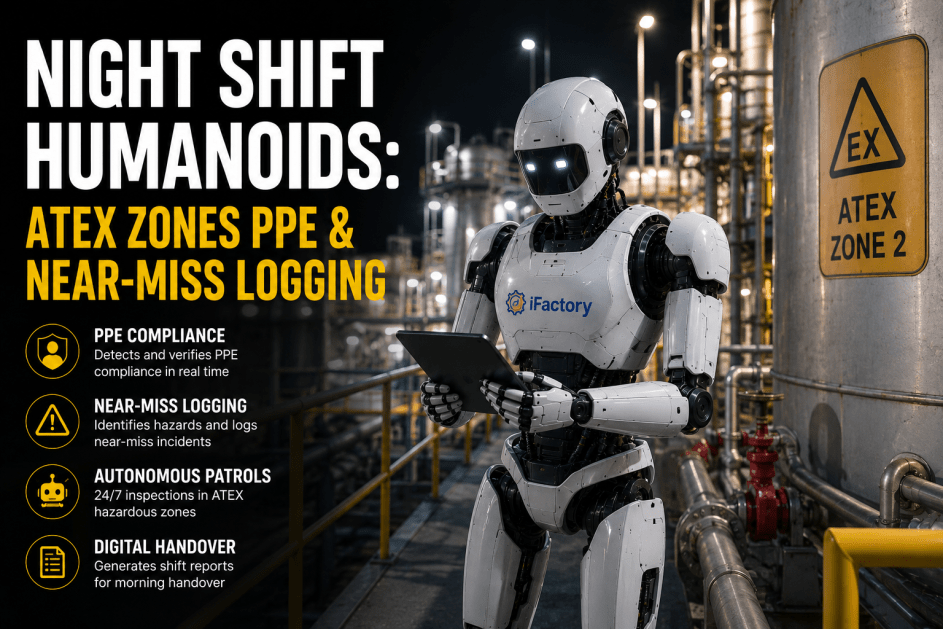
Humanoid platforms deployed in oil and gas production areas require ATEX Zone 1 or Zone 2 certification depending on the specific area classification. Zone 2 areas — where explosive atmospheres are unlikely during normal operation — represent the majority of platform deck, wellhead bay, and process area environments. Zone 1 areas — where explosive atmospheres are likely during normal operation — cover enclosed process modules and certain wellhead configurations. The humanoid platforms in this deployment carried ATEX Zone 1 certification with intrinsically safe electrical architecture, sealed enclosures with positive pressure purge, temperature classification T3 surface limits, and ESD-safe external materials. Battery systems included thermal runaway containment and continuous gas monitoring for hydrogen off-gassing during charging cycles.
iFactory's integration layer connects humanoid-detected near-miss events to existing CMMS and safety management systems through REST API and MQTT bridges — no replacement of legacy safety systems is required. Each near-miss event is structured as a safety observation record with standardized fields: event classification against the operator's incident taxonomy, severity assessment (low/medium/high/critical), location coordinates mapped to the platform equipment hierarchy, personnel identification (where available), photographic evidence from the humanoid's multi-spectral cameras, timestamp with shift context, and recommended corrective action based on the event type. The record is auto-populated into the operator's existing safety workflow — eliminating manual documentation while ensuring that the near-miss data flows into the same investigation, trending, and reporting systems used for reportable incidents.
The operator in this case study achieved a 4.2-month payback period from injury cost avoidance and safety staffing optimization. Typical payback periods across oil and gas humanoid deployments analyzed by iFactory range from 3 to 9 months depending on asset size, current incident rate, and existing safety staffing levels. The fastest payback cases — typically 3-4 months — occur on assets with high incident rates (TRIR above 1.5) and large safety observer teams (3+ personnel per shift per platform). The slowest payback cases — 8-9 months — occur on assets with low incident rates and minimal existing safety staffing, where the primary value driver is near-miss data completeness and predictive risk model improvement rather than direct cost avoidance. In all analyzed cases, the deployment achieved positive net ROI within the first 12 months.
The deployment was structured with worker privacy and union relations as foundational design requirements, not afterthoughts. Humanoid platforms are configured to detect PPE compliance status and near-miss events without recording identifiable facial imagery — computer vision models classify safety equipment presence and configuration against the defined PPE standard without retaining or transmitting facial recognition data. Near-miss events are logged at the work-group level rather than individual-worker level for all events below critical severity, with individual-level attribution reserved for events involving imminent safety risk. The operator engaged with the union representing field personnel during the deployment planning phase, establishing clear boundaries on data usage: the near-miss dataset is used for risk trend analysis and safety program improvement only, not for individual performance evaluation or disciplinary action. PPE compliance metrics are reported at the asset level and shift level, not per individual worker.
Each humanoid platform requires approximately 4 hours of preventive maintenance per month — battery health check, sensor calibration validation, locomotion system inspection, and software update installation. The operator's existing platform maintenance teams were trained to perform routine servicing during scheduled platform maintenance windows. Major component replacement — manipulator arm actuator, sensor module, or battery pack — is managed through the humanoid OEM's field service network with 48-hour response time to Gulf of Mexico assets. The iFactory platform provides remote monitoring of each humanoid unit's operational status, battery charge level, sensor health, and patrol completion rate — enabling the operator's shore-based operations center to dispatch maintenance support proactively before a unit fails during its scheduled patrol. Fleet uptime across the 28-unit deployment averaged 96.8% over the 12-month evaluation period.
Conclusion: The Near-Miss Data Gap Is a Safety Program Blind Spot That Humanoid Monitoring Eliminates
The Gulf of Mexico operator in this case study was not running an unsafe operation. Its TRIR was below industry average. Its safety management system met regulatory requirements. Its safety personnel were experienced and committed. What it was running was a safety program that operated on incomplete near-miss data — capturing less than 5% of observable PPE and procedural deviations. That 20:1 under-reporting ratio meant the operator's risk model was calibrated on lagging indicators — injuries that had already occurred — rather than leading indicators that could predict and prevent future incidents. The deployment of 28 humanoid platforms across 14 production assets closed this near-miss data gap by replacing periodic manual observation with continuous autonomous monitoring. The result was a 4.7x increase in near-miss documentation completeness, an 87% reduction in PPE non-compliance events, and a measured ROI of 2.9x in the first year — with a 4.2-month payback period.
The safety improvement was not driven by a new safety policy, a new training program, or a new regulatory requirement. It was driven by a data infrastructure improvement that made near-miss events visible, quantifiable, and actionable — converting a blind spot into a continuous quantitative dataset. iFactory's humanoid robot integration platform provides the digital infrastructure that connects autonomous safety monitoring to existing CMMS and risk management systems — enabling oil and gas operators to detect, classify, and act on near-miss events at a fidelity and frequency that manual observation cannot approach. Book a Demo to review the ROI model for your asset portfolio.