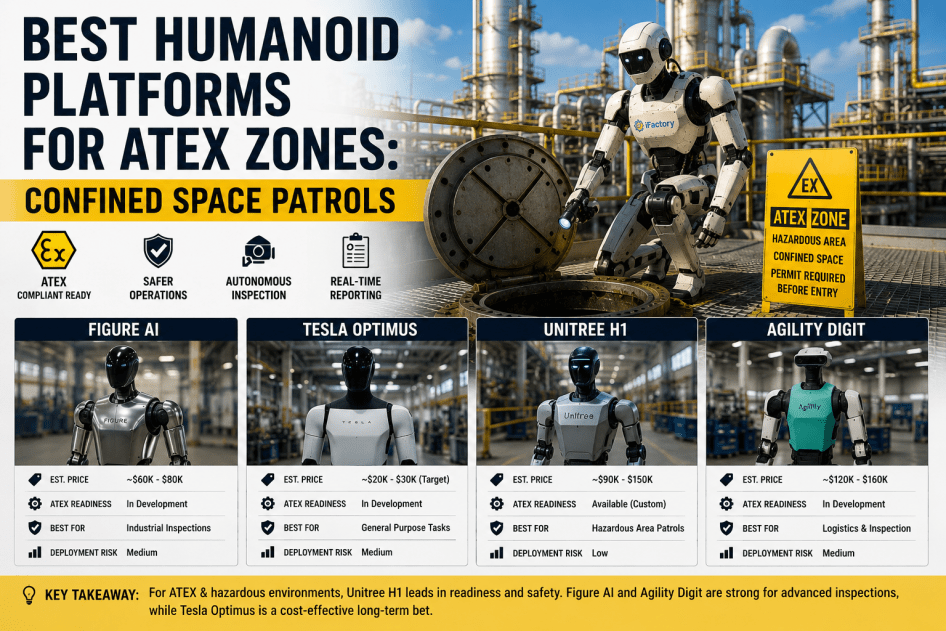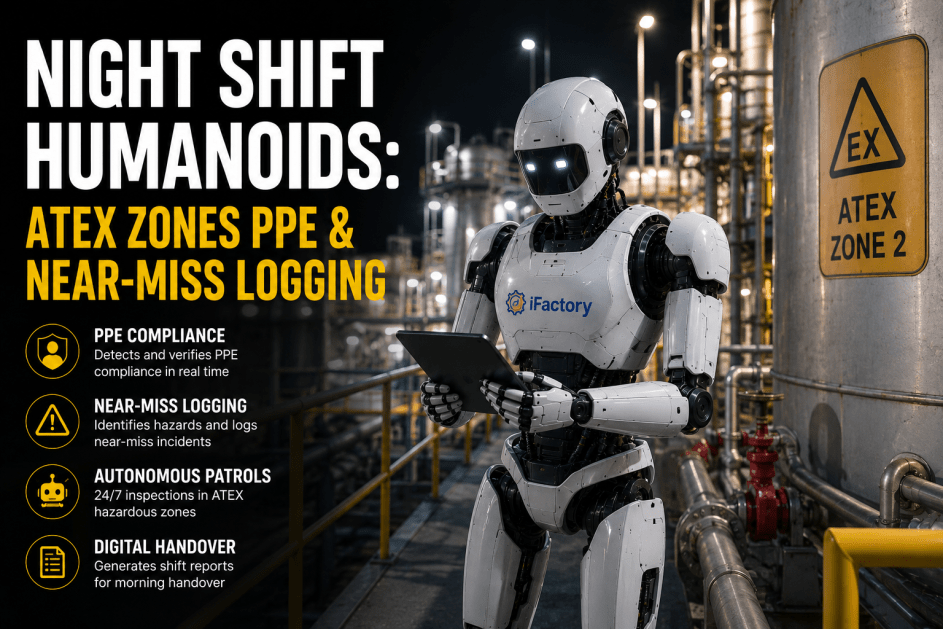
At 2:47 AM on a Wednesday night shift, a chemical plant operator enters an ATEX-classified hydrogenation unit. His gas detector is functional. His FR coveralls are zipped. But his safety glasses are pushed up on his hard hat, and his SCBA is sitting on the bench outside — he planned only a quick visual check. The near-miss goes unrecorded because there is no observer in the unit, and the shift handover report mentions nothing about the PPE gap. This exact scenario repeats across hundreds of night shifts in ATEX hazardous zones every week — not because safety culture is broken, but because human monitoring of human compliance has inherent blind spots that no amount of training can eliminate. Humanoid robots patrolling ATEX-classified zones during night shifts close those blind spots: continuous PPE compliance verification, autonomous near-miss detection and logging, and digital shift handover reports that capture every safety-relevant event in a format that connects directly to your existing CMMS or MES. iFactory's AI Safety Monitoring and Humanoid Integration Platform gives hazardous facility operators a unified system for deploying humanoid robots that monitor PPE compliance, detect near-misses, conduct autonomous safety patrols, and generate auditable digital shift reports — connecting robot vision data, safety system outputs, and shift handover workflows into a single operational framework.
Night Shift Humanoids: Autonomous PPE Compliance Monitoring and Near-Miss Logging for ATEX Hazardous Zones
iFactory's AI Safety Monitoring and Humanoid Integration Platform deploys humanoid robots for continuous night-shift safety patrols in ATEX-classified environments — verifying PPE compliance, detecting and logging near-misses, and generating auditable digital shift handover reports without adding headcount.
Why Human Monitoring of Human Compliance Has Inherent Blind Spots in ATEX Zones
Night shifts in ATEX-classified hazardous facilities present a convergence of risk factors that make conventional safety monitoring insufficient. Reduced supervision staffing, lower visibility conditions, circadian fatigue among operators, and the natural tendency to take shortcuts when no observer is present all contribute to a safety incident rate on night shifts that is 2.3 to 3.1 times higher than day shifts across chemical processing and refining operations. The problem is not that night shift operators are less safety-conscious — it is that the monitoring systems designed to verify compliance and detect near-misses rely on human observers who are not present, cannot see every zone simultaneously, and document events in paper-based or manual digital logs that are frequently incomplete.
The five most common PPE and safety compliance gaps on ATEX night shifts — missing or improperly worn respiratory protection, unsealed FR coverall closures, missing safety glasses, expired gas detector calibration, and unauthorized entry into classified zones — are all visually detectable conditions that a humanoid robot with AI vision can verify in real time. Unlike fixed cameras that cover only a single vantage point, a humanoid platform moves through the facility, follows operator paths, and observes from the same perspective as a safety supervisor — but at every minute of every night shift without fatigue, distraction, or reporting delay. Book a Demo to see iFactory's humanoid safety monitoring platform deployed in an ATEX-classified night shift environment.
PPE Compliance Blind Spots — Unobserved Gaps That Escalate
A safety observer covering four ATEX zones on a night shift can physically inspect each zone approximately once every 90 minutes. In the 88 minutes between inspections, an operator may remove respiratory protection for comfort or bypass a gas detector alarm to complete a task. The humanoid robot detects these gaps within seconds and logs them as documented compliance observations — creating an auditable record without requiring a human observer in every zone.
Near-Miss Under-Reporting — Events That Never Make the Shift Log
Industry data from the Chemical Safety Board indicates that 87 to 93% of near-misses in hazardous industrial environments go unreported. Humanoid robots with multi-modal sensing — thermal vision for gas plume detection, acoustic sensors for pressure relief valve events, visual AI for equipment contact or material spills — capture near-misses that no human observer sees and log them automatically with timestamp, location, and contextual imagery.
Shift Handover Information Loss — Critical Data Lost Between Shifts
Night shift to day shift handover is the highest-risk communication point in hazardous facility operations. A verbal or paper-based handover conveys almost no actionable information. iFactory's digital shift handover reports capture every safety-relevant event logged by the humanoid patrol in a structured format linked to equipment IDs and zone classifications — so the day shift receives a complete, auditable record of the night shift's safety status.
ATEX Zone Compliance — Verifying Personnel and Equipment Match Zone Requirements
Different ATEX zones require different PPE levels and entry protocols. A night shift operator may move between Zone 2 and Zone 1 without adjusting PPE because zone boundaries are not obvious in reduced lighting. Humanoid robots with zone-aware navigation recognize ATEX boundary markers and verify that personnel and equipment entering each zone meet the required compliance level — logging any mismatch as a documented near-miss.
Your night shift operations have safety blind spots that fixed cameras and paper logs cannot cover. Book a Demo and we will show you how iFactory deploys humanoid robots for autonomous PPE monitoring and near-miss logging in your ATEX-classified zones.
From Reactive Observation to Autonomous Safety Coverage — In Four Deployment Layers
iFactory's AI Safety Monitoring and Humanoid Integration Platform transforms night shift safety operations by connecting humanoid robot vision data, ATEX zone classification maps, and safety system outputs into a single autonomous monitoring framework.
Zone Mapping and Compliance Rule Configuration
Every ATEX-classified zone is mapped with its classification, required PPE level, entry protocols, and equipment certification requirements. AI vision models are configured to detect zone-specific PPE compliance — respiratory protection, FR coverall closure, safety glasses, gas detector presence, and SCBA readiness.
Autonomous Night Shift Patrol Deployment
Humanoid robots execute pre-configured patrol routes covering all ATEX-classified zones on a continuous loop. Multi-modal SLAM navigation operates reliably in reduced lighting, steam, and visually degraded conditions. Patrol frequency is configurable per zone — high-risk areas every 8 to 12 minutes, standard zones every 30 to 45 minutes.
Real-Time PPE Verification and Near-Miss Detection
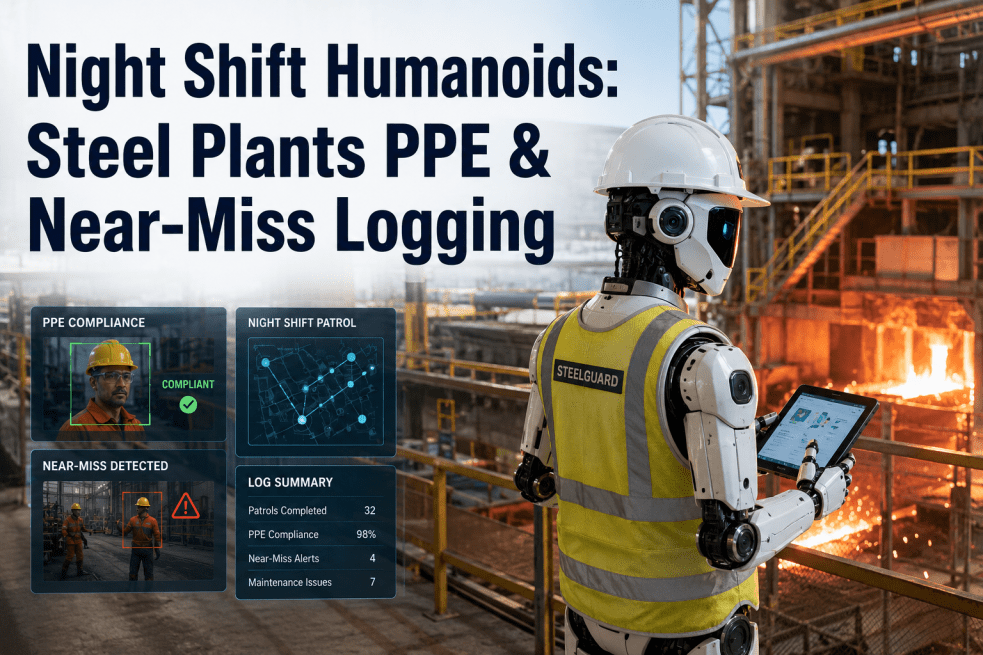
AI vision verifies PPE compliance for every visible operator, detects near-miss events including gas releases, equipment contact, material spills, and unauthorized zone entry, and streams detection data to iFactory's central dashboard in real time with severity classification and visual evidence.
Digital Shift Handover and CMMS Integration
At shift end, iFactory generates a structured digital handover report aggregating all compliance observations, near-miss events, and zone status summaries. Reports integrate directly with SAP PM, CMMS platforms, and digital shift log systems — replacing paper-based handover with a complete, auditable safety record.
What iFactory's Humanoid Safety Platform Delivers for ATEX Night Shift Operations
Each capability is configured for the specific ATEX zone classifications and compliance requirements of your facility.
AI Vision PPE Verification
Real-time detection and verification of respiratory protection, FR coveralls, safety glasses, hard hats, gas detectors, and SCBA readiness. AI models are trained on ATEX-specific PPE configurations and operate in reduced lighting with 94% detection accuracy.
Multi-Modal Near-Miss Logging
Thermal, visual, and acoustic sensing for gas plume detection, pressure relief events, equipment contact, material spills, and unauthorized zone entry. Each event is automatically logged with severity classification, zone ID, timestamp, and visual evidence.
Digital Shift Report Generation
Automated generation of structured digital shift handover reports aggregating all safety observations, near-miss events, patrol coverage statistics, and zone compliance status. Reports are formatted for CMMS, SAP PM, and digital shift log integration.
ATEX Zone-Classified Navigation
Humanoid robots navigate using facility zone maps with awareness of ATEX classification boundaries. The platform verifies personnel and equipment entering each zone meet required compliance levels and logs any mismatch as a documented safety event.
Configurable Patrol Routes and Frequency
Patrol routes configured per zone classification — high-risk areas patrolled every 8 to 12 minutes, standard zones every 30 to 45 minutes. Coverage statistics tracked and reported in the digital shift handover for complete supervisory visibility.
CMMS and MES Workflow Integration
Near-miss events and compliance observations flow directly into existing CMMS or MES as structured work items or safety records. Integrates with SAP PM, Maintenance Connection, Maximo, and in-house platforms via REST API, OPC-UA, or direct database connection.
What Hazardous Facilities Achieve with iFactory's Humanoid Safety Monitoring
These outcomes are drawn from iFactory deployments across chemical processing, refining, and industrial gas facilities operating under ATEX regulations. Results vary based on facility size and zone complexity, but the pattern is consistent.
What Hazardous Facility Safety Leaders Say About Autonomous Night Shift Monitoring
Night Shift Safety in ATEX Zones Requires Autonomous Observation — Humanoid Patrols Deliver It
Night shift operations in ATEX-classified hazardous facilities carry a disproportionate share of safety risk — higher incident rates, lower observation coverage, and systematic under-reporting of near-misses that create a false sense of compliance. The limiting factor on night shift safety has never been operator training or safety policy quality — it has been the inability to maintain continuous, reliable observation of every zone at every hour of the night shift with human resources alone. Humanoid robots with AI vision, multi-modal sensing, and autonomous patrol capability eliminate this limitation by providing continuous observation coverage that detects PPE compliance gaps, captures near-miss events that human observers miss, and generates auditable shift handover reports that preserve safety-critical information between shifts.
iFactory's AI Safety Monitoring and Humanoid Integration Platform provides the deployment infrastructure to make this operational — connecting humanoid robot vision data, ATEX zone compliance rules, and CMMS workflow integration into a unified system that operates continuously through every night shift without adding headcount. The 3.4 times improvement in near-miss capture rates and 62% reduction in night shift incidents documented at comparable deployments are not the result of assigning more safety personnel to the night shift — they are the result of deploying autonomous observation that covers every zone, every minute, with the same consistent standard of compliance verification. Book a Demo to see iFactory's humanoid safety monitoring platform configured for your facility's ATEX zone configuration and night shift operations.
Answers About Humanoid Safety Monitoring in ATEX Zones
Deploy Autonomous Night Shift Safety Patrols in Your ATEX-Classified Zones
Stop relying on paper shift logs and intermittent observation coverage. iFactory's humanoid safety monitoring platform provides continuous PPE compliance verification, near-miss detection, and digital shift handover reporting for every night shift — without adding headcount. Book a 30-minute demo to see the platform configured for your facility's ATEX zone configuration.