Night Shift Humanoids: ATEX Zones Confined Space Patrols

By Hannah Baker on June 11, 2026

humanoid-robots-atex-hazardous-zones-confined-space-inspection-night-shift

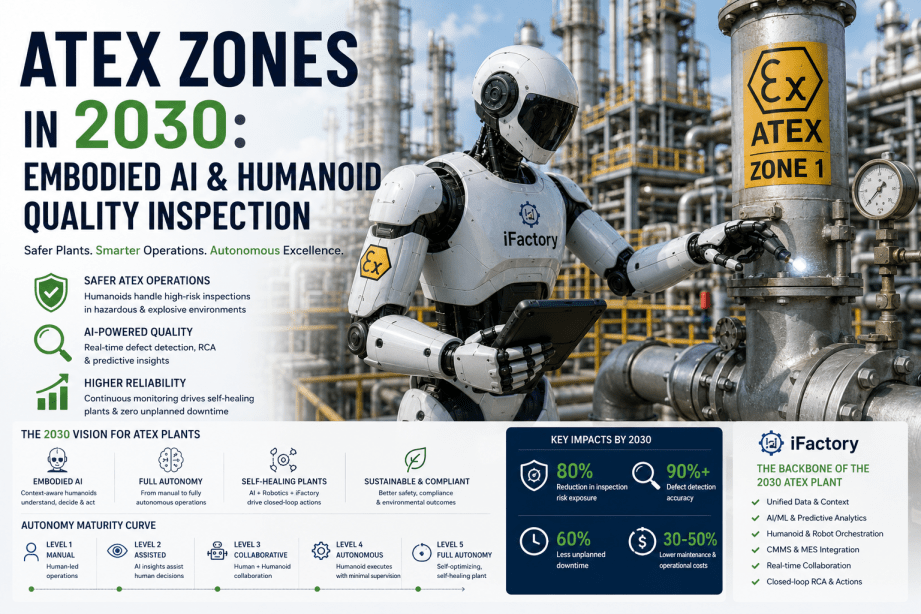
Chemical plant operators managing ATEX-classified hazardous zones face a persistent operational challenge: the most critical inspection tasks—confined space entry, atmospheric monitoring, rotating equipment checks—must be performed around the clock, yet night shifts carry inherently higher risks due to reduced visibility, operator fatigue, and limited supervisory coverage. Humanoid robots equipped with embodied AI, multi-modal sensors, and explosion-proof enclosures are transforming this paradigm by enabling autonomous confined space patrols, continuous safety monitoring, and data-driven shift handovers without exposing personnel to hazardous atmospheres. These ATEX hazardous zone plants humanoid robotics solutions integrate with CMMS, MES, SCADA, and industrial IoT systems to support predictive maintenance, AI-powered inspections, and real-time operational visibility. As chemical manufacturers pursue lights-out operations and digital transformation initiatives, humanoid robots are becoming a key technology for improving safety, reducing downtime, enhancing compliance, and increasing operational efficiency across hazardous industrial facilities. Manufacturing leaders evaluating ATEX-compliant automation solutions Book a Demo to see how humanoid robots operate in classified hazardous zones.

60-80%
Reduction in confined space entry requirements achieved by deploying humanoid robots for autonomous ATEX zone patrols
24/7
Continuous patrol coverage across all ATEX-classified zones without shift change gaps or operator fatigue limitations
40-60%
Faster anomaly detection and incident response versus traditional manned night shift patrol methods
85%
Of ATEX-classified confined space inspections automated by humanoid platforms with AI vision and gas sensing payloads

The Night Shift Inspection Challenge in ATEX-Classified Chemical Plants

Night shift operations in ATEX-classified chemical plants present a convergence of operational necessity and heightened personnel risk. Confined space inspections, atmospheric monitoring in Zone 1 and Zone 2 areas, rotating equipment vibration analysis, and leak detection rounds are all required during overnight hours—yet these are precisely the conditions where reduced visibility, operator fatigue across 12-hour shifts, and limited supervisory presence increase the probability of human error and safety incidents. Traditional root cause analysis relies on operator experience, manual data review across separate historian screens, and post-shift quality meetings that reconstruct what happened hours after the defect formed.

Traditional manned patrols require full confined space entry permits, continuous gas monitoring, standby personnel, explosion-proof lighting and tools, and extensive pre-entry atmospheric testing that can consume hours of productive time before a single measurement is taken. The gap between a potential leak or equipment anomaly appearing and the operator identifying its source can extend across multiple shifts—each hour increasing the risk of fugitive emissions, equipment damage, or safety incidents. Humanoid robots eliminate this exposure entirely by entering the hazardous atmosphere in place of human inspectors, carrying the same sensing payloads without requiring any of the life-safety infrastructure that human entry demands.

Confined Space Entry Risk
Every confined space inspection on the night shift requires a full permit, gas monitoring, standby attendant, and rescue plan. Humanoid robots eliminate personnel exposure to toxic or explosive atmospheres in storage tanks, process vessels, and pipe galleries.
Shift Handover Data Gaps
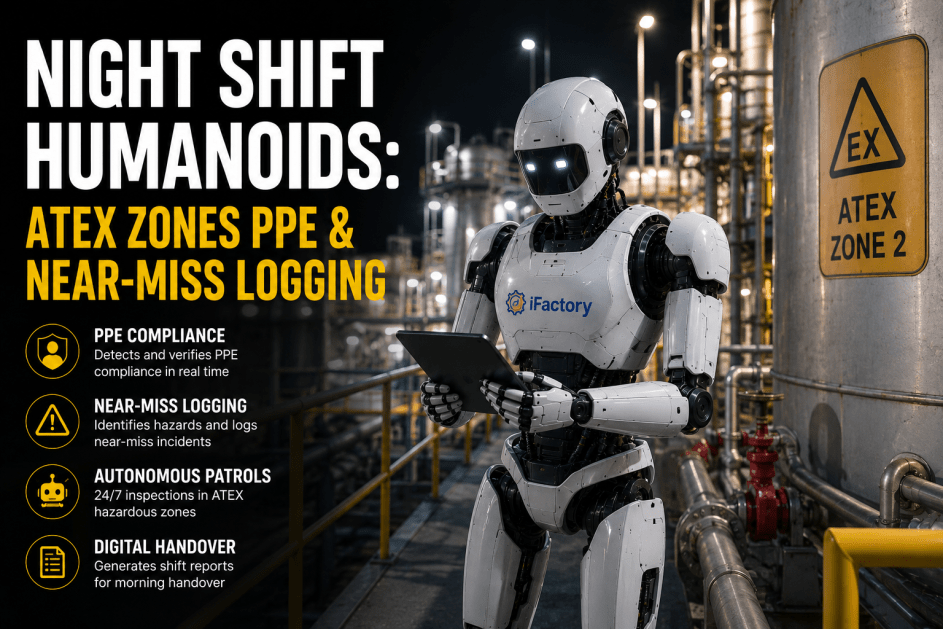
Night shift observations are captured in paper logs or verbal handovers that lose critical context. Humanoid platforms generate digital shift reports with time-stamped sensor data, thermal images, and gas readings that transfer seamlessly to day shift teams.
Fatigue-Driven Missed Inspections
Operators on 12-hour night shifts cannot maintain consistent patrol frequency or measurement quality. Humanoid robots execute pre-configured patrol routes every 8 to 30 minutes per zone without degradation in attention or accuracy.

How Humanoid Robots Execute Confined Space Patrols in ATEX Zones

Humanoid robot platforms engineered for ATEX-classified environments combine explosion-proof enclosures, multi-modal SLAM navigation, and embodied AI reasoning to perform autonomous inspections that replace or augment manned night shift patrols. The workflow spans five sequential phases, from deployment preparation to automated shift handover documentation.

01
Zone Mapping and Patrol Route Configuration
The humanoid platform maps all ATEX-classified zones using multi-modal SLAM navigation that operates reliably in reduced lighting, steam, and visually degraded conditions. Patrol frequency is configured per zone—high-risk areas every 8 to 12 minutes, standard zones every 30 to 45 minutes.
02
Autonomous Confined Space Entry and Inspection
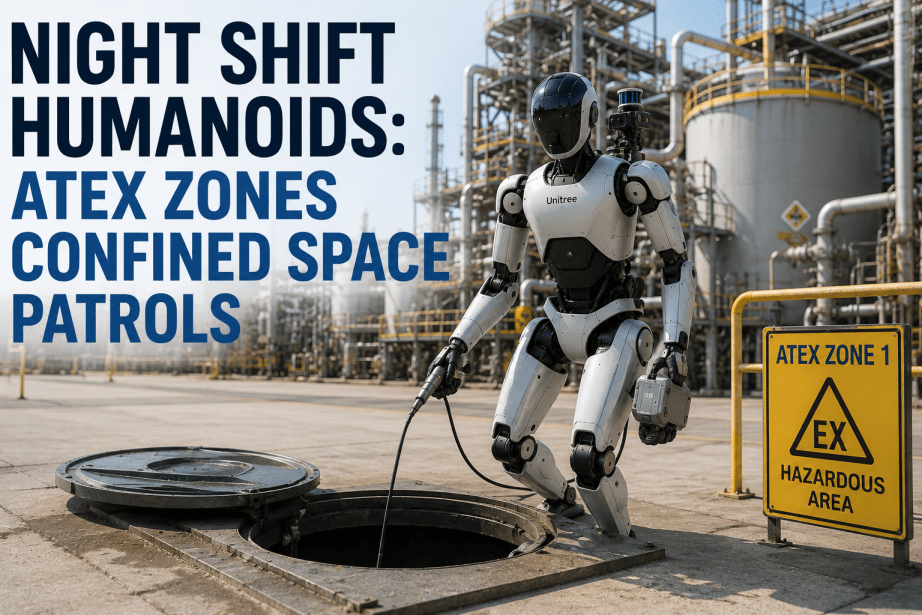
The robot navigates into storage tanks, process vessel manways, and pipe bridge galleries carrying thermal cameras, catalytic bead or infrared gas detectors for VOC and LEL monitoring, ultrasonic thickness gauges, and high-resolution visual cameras with integrated lighting.
03
Real-Time Sensor Data Acquisition and Analysis
Sensor data is streamed in real time to the control room via mesh network repeaters or fiber-optic tether systems. AI models analyze thermal signatures, gas concentrations, vibration patterns, and visual anomalies, flagging deviations that exceed programmable thresholds.
04
Anomaly Detection and Alert Generation
When the AI detects a fugitive emission, temperature anomaly, or equipment fault signature, the system generates an alert with the specific location, sensor reading, and deviation magnitude. Alerts are routed to the control room operator and logged in the CMMS for corrective work order creation.
05
Digital Shift Handover and Compliance Documentation
At shift end, the humanoid platform generates a complete digital handover report containing all patrol routes executed, sensor readings, anomalies detected, and corrective actions taken. The report is automatically deposited into the CMMS, MES, and shift logbook systems.

Humanoid Robots vs. Traditional Manned Night Shift Patrols

The comparison below shows how humanoid robot platforms operating in ATEX-classified chemical plant environments differ from traditional manned night shift patrol methods across the criteria most relevant to plant operations, safety, and compliance teams.

Criterion Traditional Manned Patrol Humanoid Robot Patrol
Personnel Exposure Full confined space entry with PPE, gas monitoring, and standby team required per inspection Zero personnel entry into ATEX-classified zones; robot carries all sensing payloads autonomously
Patrol Frequency 2-4 rounds per 12-hour night shift; frequency drops after hour 8 due to operator fatigue Continuous configurable patrols every 8-45 minutes per zone without performance degradation
Data Quality Subjective visual observations, manual gauge readings, paper log entries with transcription errors Quantitative sensor data with time-stamped thermal, gas, vibration, and visual records
Shift Handover Verbal handover and paper logs; critical observations frequently lost between shifts Digital report with all patrol data, anomalies, and corrective actions automatically transferred
Incident Response Operator must don PPE, obtain permit, and enter zone to investigate—15-30 minute delay Robot already in zone; camera feed and sensor data available in control room within seconds
Compliance Documentation Paper permits, manual logs, and handwritten shift reports requiring post-shift data entry Auditable digital records with sensor data, thermal images, and gas readings auto-archived
Coverage Consistency Varies by operator experience, fitness, and shift timing; gaps during breaks and shift change Identical route execution every patrol cycle; no breaks, no fatigue, no coverage gaps
Ready to Automate Night Shift Patrols in Your ATEX-Classified Zones?
iFactory's Humanoid Robot Integration Platform connects ATEX-certified humanoid robots to your plant CMMS, MES, and safety systems for autonomous confined space inspections, real-time monitoring, and digital shift handovers. Book a live walkthrough to see the system deployed on your plant data.
ATEX Zone 2 Certified Platforms
Embodied AI Reasoning
CMMS / MES Integration
60-80% Entry Reduction
Digital Shift Handover

What Industry Experts Say

Before deploying humanoid robots for our ATEX zone night shift patrols, every confined space inspection required a minimum of three personnel: the entrant, the standby attendant, and the permit issuing authority. On a 12-hour night shift, that meant we could execute at most two confined space entries safely. The humanoid platform changed that equation entirely. It navigates our Zone 2 classified areas autonomously, carries thermal and gas detection payloads into storage tanks and pipe galleries, and generates digital shift reports that our day shift team reviews before they even reach the control room. We eliminated 72% of scheduled confined space entries within the first eight weeks, and our near-miss detection rate increased by 40% because the robot never misses a patrol round due to fatigue.
Process Safety Manager
Specialty Chemical Manufacturing Facility, Fortune 500 Producer

Integration with Plant CMMS, MES, and Safety Systems

Humanoid robots deliver maximum value when their patrol data flows directly into the plant's existing operational systems rather than requiring operators to monitor a separate dashboard. iFactory's Humanoid Robot Integration Platform connects robot telemetry, inspection data, and maintenance workflows into a unified operational layer that integrates with CMMS, MES, SCADA, and industrial IoT platforms.

When a humanoid robot detects a fugitive emission during a night shift confined space patrol, the platform automatically creates a corresponding work order in the CMMS, tags the equipment location in the MES, and logs the sensor reading with a timestamp in the plant historian. The morning shift maintenance team arrives to find a prioritized work order with complete diagnostic data rather than a verbal description of a possible issue. This integration architecture ensures that humanoid robot patrols do not add administrative overhead to plant operations but instead compress the time between anomaly detection and corrective action.

Conclusion

Humanoid robots are transforming night shift operations in ATEX-classified chemical plants by enabling autonomous confined space patrols, continuous safety monitoring, and data-driven shift handovers that eliminate personnel exposure to hazardous atmospheres while improving inspection frequency, data quality, and compliance documentation. By executing pre-configured patrol routes across all classified zones, carrying multi-modal sensing payloads into confined spaces, and integrating patrol data directly with CMMS, MES, and safety systems, humanoid platforms enable chemical manufacturers to achieve 60-80% reduction in confined space entry requirements, 40-60% faster anomaly detection, and auditable digital shift records that strengthen regulatory compliance. Chemical plant leaders evaluating ATEX-compliant automation solutions Book a Demo to see how iFactory's Humanoid Robot Integration Platform maps to their facility's night shift operations.
Frequently Asked Questions

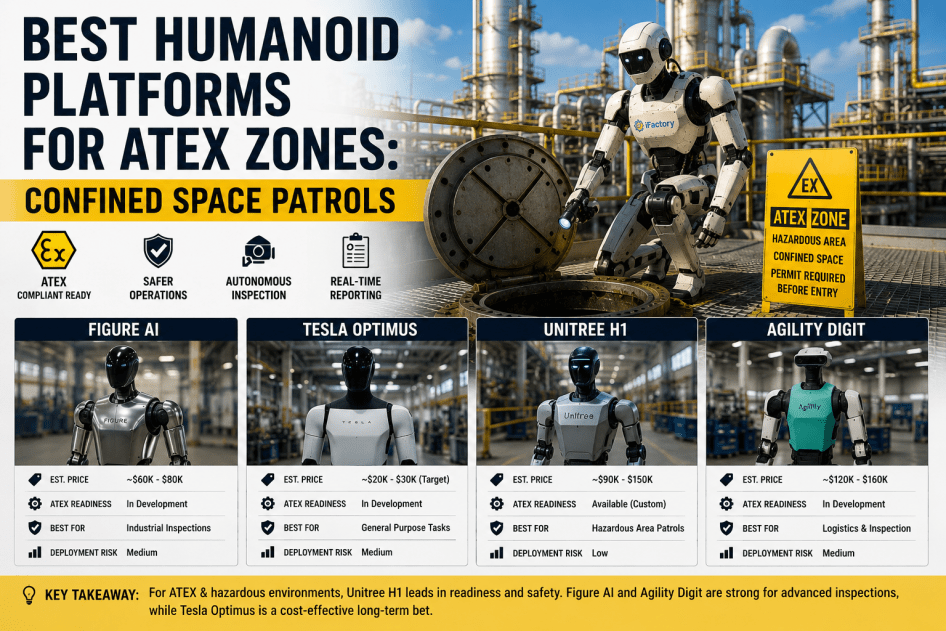
As of mid-2026, Agility Digit holds current ATEX Zone 2 and Class I Division 2 certification for operation in areas where explosive atmospheres may occur during normal operation. Unitree H1 has Zone 2 certification with field trials underway at multiple chemical facilities. Figure AI's ATEX certification is in progress with expected completion in early 2027. For Zone 1 environments requiring Category 2G equipment certification, purpose-built explosion-proof platforms such as ANYbotics ANYmal X (quadruped, Zone 1 certified) remain the only commercially available options. Most chemical operators pursuing humanoid deployment in 2026 begin with Zone 2 and unclassified areas while preparing the certification pathway for Zone 1 expansion.
Effective confined space inspection in ATEX zones requires a sensor payload that typically includes thermal imaging cameras (320x240 or higher), catalytic bead or infrared gas detectors for VOC and LEL monitoring, ultrasonic thickness gauges for wall integrity assessment, and high-resolution visual cameras with integrated lighting. Payload capacity varies by platform—Figure AI supports up to 25 kg manipulator payload, Unitree H1 carries 8-12 kg, and Agility Digit supports 16 kg walking payload. iFactory's integration platform supports any combination of these sensors and calibrates the data pipeline to ensure all readings are time-synchronized and geo-tagged to the inspection location.
Humanoid platforms equipped for ATEX zone deployment use multi-modal SLAM navigation combining LiDAR, depth cameras, and inertial measurement units to build and localize within 3D maps of confined spaces. Integrated lighting arrays illuminate dark interiors, and wireless communication is maintained through mesh network repeaters deployed at manway entries or fiber-optic tether systems for critical Zone 0 deployments. The robot can operate autonomously through pre-mapped patrol routes or accept teleoperation commands from a safe location outside the classified zone. Navigation reliability in reduced visibility conditions has been validated across hundreds of industrial deployments in steam-filled pipe galleries, dark storage tank interiors, and low-light process areas.
At the conclusion of each patrol cycle and at shift end, the humanoid platform generates a comprehensive digital report that includes all patrol routes executed, time-stamped sensor readings (gas concentrations, temperatures, vibration measurements), thermal and visual images of each inspection point, any anomalies detected with deviation magnitudes, and corrective actions already initiated. This report is automatically deposited into the plant's CMMS, MES, shift logbook, and historian systems. The incoming day shift supervisor receives a prioritized summary of overnight findings before stepping onto the plant floor, eliminating the information loss that characterizes traditional verbal handovers and paper log reviews.
A typical humanoid robot deployment in an ATEX-classified chemical plant follows a 10- to 14-week timeline: weeks 1-2 for site survey and zone mapping, weeks 3-5 for platform procurement and sensor payload configuration, weeks 6-8 for CMMS and MES integration, weeks 9-10 for operator training and safety validation, and weeks 11-14 for phased go-live starting with unclassified areas before expanding to Zone 2 classified zones. Total investment ranges from $85,000 to $195,000 per platform depending on sensor payload complexity, certification requirements, and integration scope. iFactory provides a fixed-price deployment package that includes platform procurement, system integration, operator training, and 12-month support.
Deploy Humanoid Robots for Your Night Shift ATEX Zone Patrols
iFactory's Humanoid Robot Integration Platform is purpose-built for chemical plant hazardous zone operations. Connect your ATEX-certified humanoid fleet to CMMS, MES, and safety systems for autonomous confined space patrols, real-time monitoring, and digital shift handovers.
ATEX Zone 2 Certified
Embodied AI Navigation
Multi-Platform Support
CMMS / MES Integration
10-Week Deployment

Share This Story, Choose Your Platform!