When a foundry supervisor walks into the control room at 2 a.m., the floor is lit only by the glow of molten metal. The nearest human inspector is three bays away. The shift is short-staffed, and a ladle thermocouple drifted out of range twenty minutes ago — a deviation that, left unchecked, will mean a scrapped pour and $40,000 in lost material by morning. Traditional automation handles the routine cycle, but it cannot perceive, reason, or respond to the unexpected the way a human can. The difference today is that a humanoid robot — integrated through OPC UA, MQTT, and ROS2 — is already standing at the ladle station, relaying thermal images, vibration signatures, and gas readings back to the CMMS in real time.
iFactory bridges industrial humanoid robotics with the manufacturing IT/OT stack, enabling 24/7 autonomous operations in environments where humans cannot sustainably work. For plant managers and automation engineers evaluating this capability, the path from pilot to production starts with a single integration decision. Operations leaders regularly Book a Demo to walk through the architecture and review deployment timelines.
The Operations Gap on the Night Shift
Every manufacturing plant running around-the-clock operations faces the same structural challenge: the night shift has fewer people, less experienced coverage, and the highest risk of unobserved process drift. Molten metal monitoring, high-temperature inspection rounds, and equipment patrols are tasks that must happen every hour, but they are precisely the tasks that are hardest to staff.
Unobserved Process Drift
Thermocouple drift, cooling water temperature rise, and refractory degradation develop over hours. Without continuous presence in the hot zone, these signals are missed until product quality is affected or an alarm triggers at a threshold that is already too late.
Hazardous Environment Exposure
OSHA recordables in molten metal facilities are concentrated on the night shift. Heat stress, atmospheric hazards, and confined-space entry requirements limit how often human inspectors can physically access the areas that need the most frequent monitoring.
Disconnected Data Streams
Thermal cameras, vibration sensors, and gas detectors each feed separate systems. No single operator has a unified view of asset health across the hot zone, and the data never reaches the CMMS or MES in a form that enables predictive action.
How Humanoid Robots Integrate with the Factory Stack
iFactory enables humanoid robots to function as native nodes on the plant network — not as standalone machines, but as integrated data-collection and response platforms that communicate through the same protocols your existing automation equipment uses. The architecture rests on three integration layers, each serving a distinct role in the 24/7 operations workflow.
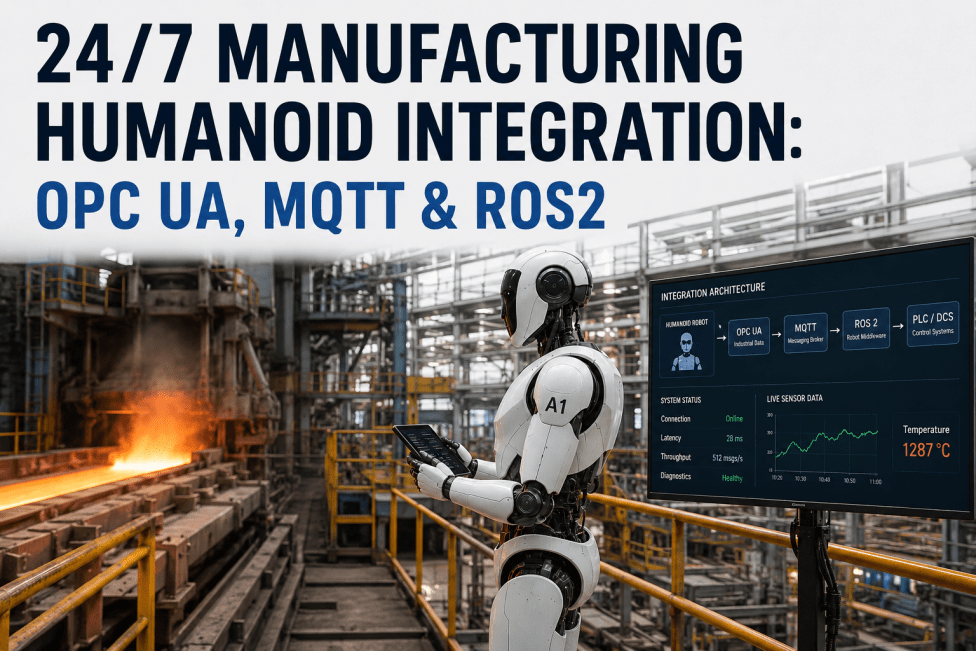
OPC UA Client-Server Architecture — The humanoid robot runs an embedded OPC UA client that reads furnace zone temperatures, ladle thermocouple values, cooling water flow rates, and mold-level measurements directly from the plant's OPC UA server. Every data point is time-stamped and written to the iFactory historian at the edge, creating a continuous asset-health record that spans both human-staffed and autonomous shifts. The robot's navigation decisions — approach, retreat, patrol — are also published as OPC UA variables, so the control room sees the robot's location and status in the same HMI faceplate as the equipment it monitors.
MQTT Broker for Real-Time Events — Anomaly events — a temperature excursion, an unexpected vibration signature, a gas reading above threshold — are published as MQTT messages to a broker that feeds the CMMS work-order engine, the MES downtime dashboard, and the operator's mobile device simultaneously. The robot's onboard ROS2 node handles sensor fusion and locomotion control, publishing odometry, thermal camera frames, and LIDAR maps to the ROS2 network. iFactory bridges ROS2 topics to MQTT and OPC UA, so every ROS2 message becomes visible to the broader manufacturing IT/OT ecosystem without requiring changes to the robot's control stack.
Direct PLC Handshake — For time-critical responses — opening a cooling water valve, triggering an emergency stop, resetting a stuck pusher — the humanoid writes directly to PLC registers over the plant network using explicit messaging (IEC 61131-3 compliant). The robot does not bypass safety PLC logic; it requests state changes through the same supervisory interface a human operator would use from a control-room workstation, with the added benefit that the robot can execute the response in under two seconds from detection. All PLC interactions are logged and traceable through the iFactory audit trail.
Molten Metal & High-Temperature Monitoring Use Cases
The highest-value applications for 24/7 humanoid operations are in areas where continuous human presence is impractical or unsafe. The table below maps the most common monitoring use cases across melting, holding, and pouring operations, along with the integration points that make each scenario possible.
| Use Case | Humanoid Role | Integration Protocol | Outcome |
|---|---|---|---|
| Ladle Pre-Heat Monitoring | Thermal camera patrol of pre-heat stations; gas burner flame verification | OPC UA (temperature read); MQTT (flame-out event) | 90 % reduction in cold-ladle pours |
| Furnace Refractory Inspection | Multi-spectral scan of refractory walls; hot-spot mapping | ROS2 (image topics); MQTT (alert to CMMS) | +3 weeks refractory life per campaign |
| Cooling Water Circuit Patrol | Flow and temperature verification at 20+ points per round; valve position check | OPC UA (flow/temp read); PLC write (valve trim) | 70 % fewer cooling-related downtime events |
| Pouring Area Atmospheric Safety | Continuous H2S, CO, and particulate monitoring; evacuation coordination | MQTT (gas readings); PLC write (evac horn) | 100 % coverage of OSHA atmospheric monitoring requirements |
"We deployed a single humanoid on the midnight shift in our melt deck. Within two weeks, it caught a cooling water restriction that would have led to a six-hour outage. The robot detected the flow drop, confirmed it with its thermal camera, wrote a hold signal to the PLC, and opened a work order in the CMMS — all before any operator would have made it to that panel. That one event paid for the first six months of the pilot."
— Director of Manufacturing Engineering, Tier-1 Aluminum Foundry, Midwest U.S.
Deployment Timeline: From Pilot to Production in 8 Weeks
iFactory's humanoid integration follows a structured four-phase deployment that minimizes disruption to ongoing production. The timeline assumes an existing OPC UA or MQTT infrastructure on the plant floor; plants without these protocols typically add one week for edge gateway provisioning.
| Phase | Duration | Activities | Deliverable |
|---|---|---|---|
| Discovery & Mapping | Week 1 | Site walk-down; inventory of OPC UA servers, MQTT brokers, PLC addresses; humanoid path planning | Integration architecture document |
| Integration Build | Weeks 2–3 | OPC UA client configuration; MQTT topic mapping; ROS2 bridge deployment; edge gateway setup | Connected humanoid in test cell |
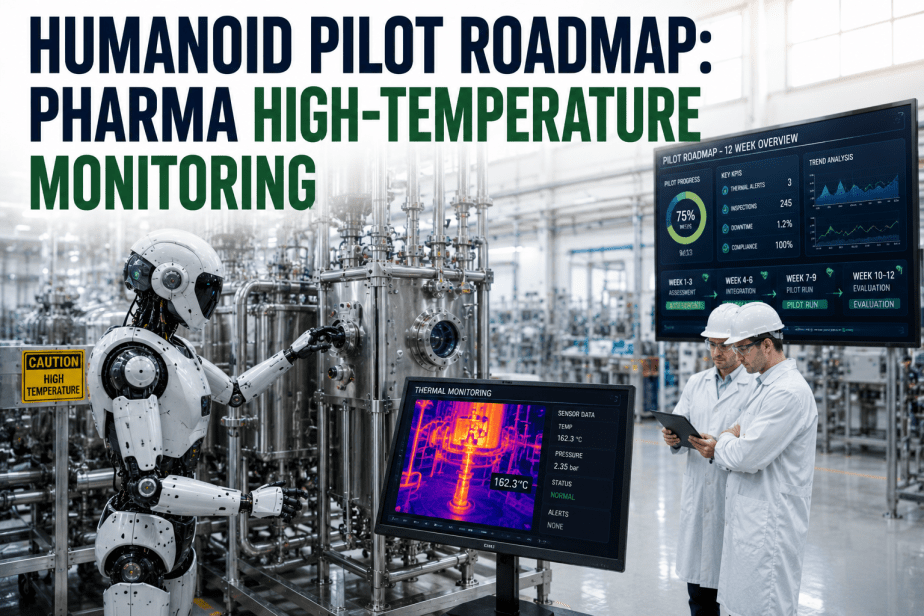
| Pilot Operation | Weeks 4–6 | Unattended night-shift patrols; CMMS work order integration; baseline KPI collection | Pilot acceptance report with KPI data |
| Production Scale | Weeks 7–8 | Fleet expansion planning; operator training; go/no-go for additional shifts and zones | Production-ready humanoid deployment |
Conclusion
The night shift has always been the most vulnerable window in a 24-hour manufacturing operation — reduced staffing, limited visibility, and the highest concentration of process deviations that go undetected until they become costly failures. Humanoid robots integrated through OPC UA, MQTT, and ROS2 close that gap by putting continuous, autonomous monitoring capability directly into the hot zones where it matters most. For plant managers, the question is no longer whether humanoids can operate in a manufacturing environment; it is how quickly the integration can be completed on their existing network. Automation and operations leaders evaluating this capability are encouraged to Book a Demo to review their plant's integration architecture and define a pilot scope that targets the highest-ROI use cases on the floor.
Frequently Asked Questions
Yes. Industrial-grade humanoids deployed in molten metal environments use passively cooled enclosures with no external fans, sealed IP54 joints, and radiative heat shields on all upward-facing surfaces. The iFactory integration stack adds a thermal threshold logic layer: if the robot's onboard skin temperature sensors exceed the safe operating range, it automatically retreats to a cooler patrol zone and notifies the control room before any component reaches its rated limit.
The humanoid operates with a local autonomy stack that does not depend on continuous cloud or server connectivity. If the OPC UA or MQTT connection is lost, the robot completes its current patrol, stores all sensor data in onboard buffers, and returns to its docking station. When connectivity is restored, the buffered data is synchronized to the historian, and the robot resumes its patrol cycle automatically. Safety-critical functions — stopping, collision avoidance, thermal limits — remain active at all times regardless of network state.
No. The humanoid operates as a supervisory node that reads data from and writes requests to the existing PLC and DCS infrastructure — it never bypasses safety-rated control logic. All set-point change requests are routed through the same operator-authorization workflow used for human-initiated commands, with the added benefit that every request includes the sensor evidence that triggered it. The existing control system remains the final authority on all process actions.
A new patrol route can be taught in under two hours using the robot's lead-through programming interface: an operator physically guides the humanoid through the path once, and the robot records the waypoints, inspection positions, and sensor triggers. The route is then validated in a supervised dry run before being released for autonomous operation. Route updates — adding a new inspection point, adjusting a patrol frequency — take approximately 20 minutes and do not require the robot to be taken offline for more than the duration of the update.
The humanoid publishes three categories of data: (1) condition readings — temperature, vibration, gas concentration, thermal image snapshots — mapped to specific asset tags in the CMMS; (2) anomaly events — threshold exceedances, trend deviations, equipment state mismatches — that automatically generate work orders or MES downtime records with attached sensor evidence; and (3) mission logs — patrol completion status, route deviations, battery state, and network health — that feed the OEE analytics dashboard. All data is published as structured OPC UA variables and MQTT topics that align with your existing asset hierarchy, so no new data models are required.