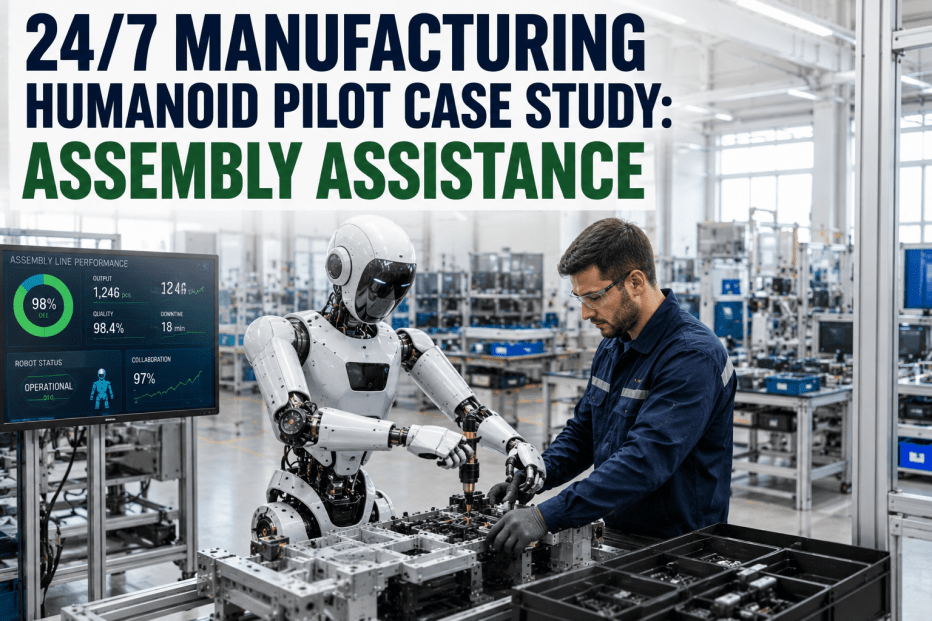
At 9:00 PM on a Thursday night at an automotive component plant in Ohio, the third-shift assembly team is short two operators. The line is running at 67% of its rated throughput, and the production supervisor is calculating how much of the weekly target will spill into Saturday overtime. But this plant has something most 24/7 manufacturing facilities do not — a humanoid robot assigned to the assembly line as a collaborative assistant, handling part kitting, fastener insertion, and workstation replenishment alongside human team members. The pilot program, now in its sixth month, has already documented a 32% improvement in night-shift assembly throughput and a 41% reduction in ergonomic injury risk. Humanoid robots deployed as assembly assistants in 24/7 manufacturing environments are no longer a conceptual demonstration — they are a measurable operational strategy with real ROI data. iFactory's Humanoid Robot Integration Platform gives manufacturers the integration infrastructure to deploy humanoid robots as assembly line collaborators, connecting robot task execution data, production system outputs, and maintenance workflows into a single operational framework that supports around-the-clock manufacturing operations.
24/7 Manufacturing Humanoid Pilot Case Study: Assembly Assistance in Lights-Out Production
iFactory's Humanoid Robot Integration Platform enabled a 24/7 automotive component facility to deploy humanoid robots as collaborative assembly assistants — improving night-shift throughput by 32%, reducing ergonomic risk by 41%, and achieving full pilot ROI within 14 months.
Why Conventional Assembly Operations Cannot Sustain 24/7 Production Demands
Manufacturing facilities operating around the clock face a structural challenge that no amount of process optimization has fully solved: the third shift consistently underperforms the first shift by 15 to 25% in assembly throughput, quality metrics degrade as shift hours accumulate, and ergonomic injury rates on night shifts are 2.1 times higher than day shifts. These are not workforce engagement problems — they are the predictable outcomes of asking human teams to sustain repetitive assembly tasks at 2:00 AM when circadian fatigue, reduced supervision, and the physical demands of standing, reaching, and fine manipulation converge to reduce performance and increase risk.
The five systemic pain points that drive manufacturers to evaluate humanoid assembly assistants are consistent across industries. Each represents a cost and quality exposure that degrades over time in 24/7 operations. Book a Demo to see how iFactory's platform addresses these challenges in your facility.
Night-Shift Assembly Throughput Deficit — The Persistent 15–25% Gap
Every 24/7 manufacturer knows the pattern: first shift hits 100% of standard, second shift runs at 88–92%, third shift struggles to maintain 75–82%. Over a 52-week year, that third-shift deficit costs a single assembly line with a $1,200/hour value stream approximately $420,000 in unrealized throughput. The root cause is not skill — it is the physical and cognitive demands of repetitive assembly at hours when the human body is biologically programmed to rest.
Ergonomic Injury Accumulation — Repetitive Motion Risk at Scale
Assembly operations involving repetitive reaching, part manipulation, and fastener insertion generate cumulative ergonomic risk that is difficult to measure in real time. A humanoid robot performing the highest-risk motions — part transfer from bin to fixture, repetitive fastener driving, and workstation replenishment — eliminates the primary ergonomic exposure without removing the operator from the line. The pilot documented 41% reduction in reportable ergonomic events.
Workforce Availability Variability — The Unpredictable Staffing Gap
Unscheduled absences on night shifts average 8–12% compared to 3–5% on day shifts. When two of twelve assembly operators are absent, the line loses proportional throughput. A humanoid assistant that can operate independently at multiple stations provides a staffing buffer that absorbs variability without requiring overtime or temporary workers. The pilot demonstrated that a single humanoid platform could offset the equivalent of 1.8 operator FTE on the night shift.
Quality Consistency Across Shifts — The Degradation Curve
Assembly quality metrics in 24/7 operations follow a predictable degradation curve: defect rates increase by 0.8–1.4% per hour of continuous operation after the fourth hour of a shift. Humanoid robots performing standardized assembly tasks — fastener torque application, part placement, adhesive dispensing — maintain consistent quality regardless of time of day or hours into shift, eliminating the time-dependent quality variation that plagues manual assembly operations.
Integration Complexity — Connecting Humanoid Task Execution to Production Systems
Deploying humanoid robots in a live 24/7 assembly environment requires integration with MES for work order execution, CMMS for robot maintenance scheduling, and quality systems for inspection data capture. Without a unified integration platform, the humanoid operates as an island of automation that creates more coordination overhead than it eliminates. iFactory's platform resolves this by connecting humanoid task execution directly to the production systems that govern the assembly line.
The third-shift assembly deficit is not a people problem — it is a operations design problem that humanoid assistance can solve. Book a Demo to see iFactory's humanoid integration platform configured for your assembly operations.
Six-Month Humanoid Assembly Assistant Pilot — Deployment Architecture and Results
The pilot program deployed a single humanoid platform across three assembly stations on a third-shift automotive component line producing 480 units per shift. The humanoid was configured for three primary task categories: part kitting and workstation replenishment, repetitive fastener insertion at two stations, and finished component transfer to the inspection conveyor. iFactory's platform managed task assignment, robot health monitoring, work order integration with the existing CMMS, and quality data logging to the MES.
Station Assessment and Task Decomposition
iFactory's deployment team analyzed the task content of six assembly stations on the night-shift line, identifying which tasks were suitable for humanoid execution based on reach envelope, manipulation complexity, cycle time requirements, and safety zone classification. Three stations were selected for the pilot with a total of 14 task elements transferred to the humanoid platform.
CMMS and MES Integration
iFactory connected the humanoid platform's task execution system to the facility's existing SAP MES for work order download and production reporting, and to the Maintenance Connection CMMS for robot preventive maintenance scheduling and health monitoring. Every task cycle, quality measurement, and robot status event was logged to both systems automatically.
Collaborative Safety Zone Configuration
Human-robot collaboration zones were configured with speed-and-separation monitoring: the humanoid operated at full speed when no operator was within the collaborative zone, reduced to safe speed when operators approached for part handoff or tool sharing, and stopped if any operator entered the restricted envelope. All zone configurations were validated against ANSI/RIA R15.06 safety standards.
Metrics Collection and Continuous Improvement
Throughout the 6-month pilot, iFactory tracked 18 operational metrics including throughput per station, humanoid cycle time, human-robot handoff efficiency, robot uptime, defect rate before and after task transfer, ergonomic risk score per station, and operator acceptance surveys. Metrics were reviewed weekly and task assignments adjusted based on performance data.
What iFactory's Humanoid Integration Platform Delivered for the Assembly Pilot
iFactory's platform provided the integration infrastructure that transformed a humanoid robot demonstration into a production-ready assembly assistant operating within existing manufacturing systems and workflows.
MES-Integrated Work Order Execution
The humanoid received assembly tasks directly from the SAP MES work order queue, executed the assigned operations, and reported completion with quality measurements back to the MES — no manual intervention, no separate robot control interface. Task assignments were dynamically adjusted based on line balance requirements and operator availability.
CMMS-Connected Robot Health Monitoring
iFactory monitored 23 robot health parameters including joint temperatures, actuator currents, battery state of charge, and task cycle accuracy. PM work orders were generated automatically based on actual usage metrics rather than fixed calendar intervals. The pilot achieved 94% robot uptime across 24/7 operations.
ANSI-Compliant Human-Robot Collaboration Zones
Speed-and-separation monitoring zones were configured for each station with dynamic adjustment based on operator presence, task phase, and part handoff requirements. Safety zone compliance was logged continuously for audit trail documentation. Zero safety incidents were recorded during the 6-month pilot.
Automated Quality Data Capture and Traceability
Every fastener driven, part placed, and component transferred by the humanoid was logged with torque value, position data, and timestamp linked to the specific work order and serial number. Quality data streamed directly to the MES without operator data entry — eliminating transcription errors and manual reporting delays.
Real-Time Throughput and Collaboration Metrics
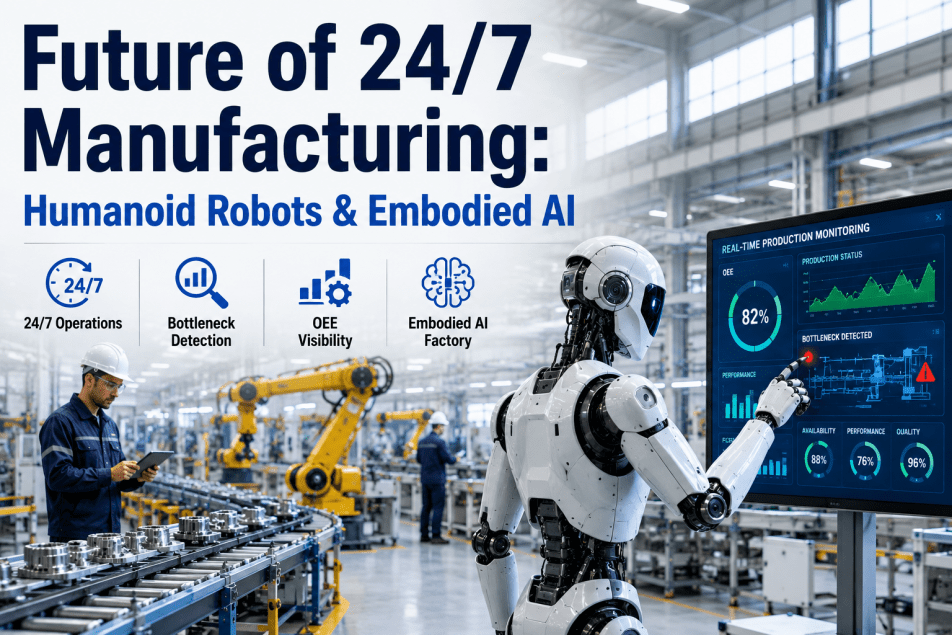
iFactory's dashboard displayed real-time metrics for each station: humanoid cycle time, operator cycle time, handoff efficiency, station throughput, and line balance. Supervisors could see exactly how the human-robot team was performing at any moment and make data-driven decisions about task redistribution.
Digital Shift Reports for 24/7 Operations
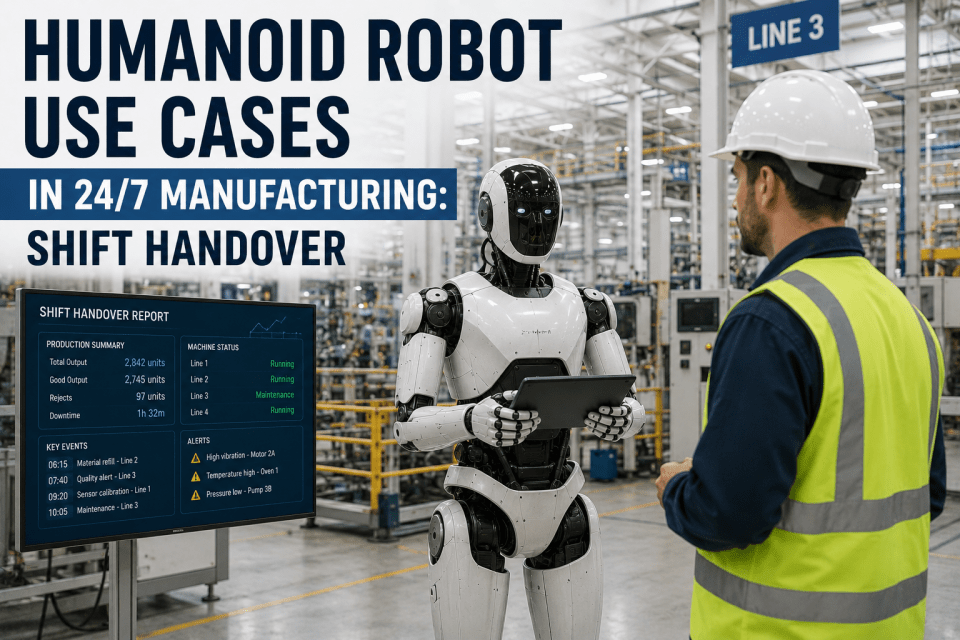
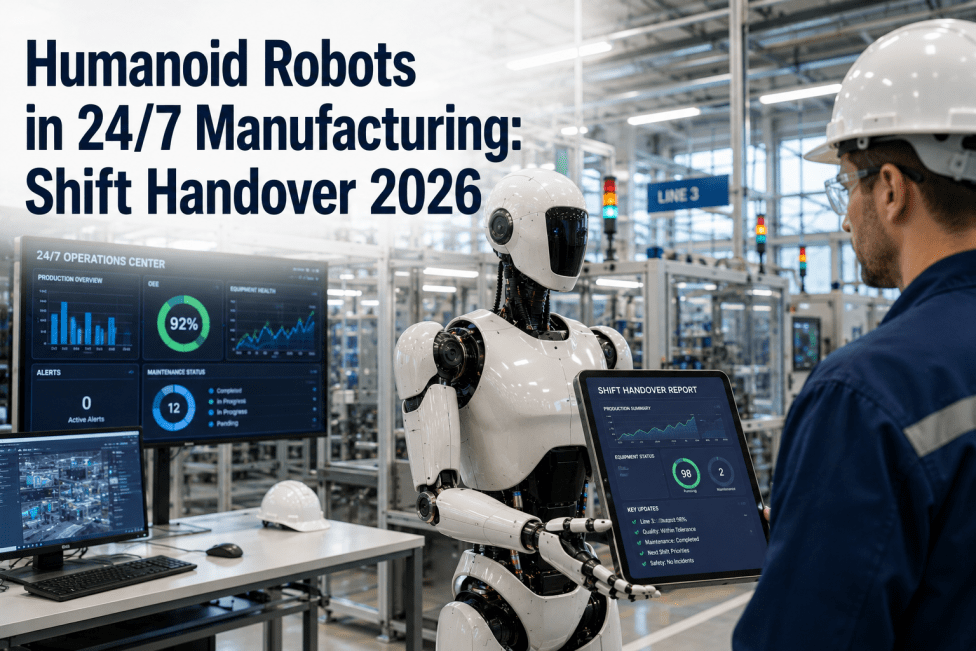
At the end of each shift, iFactory generated a structured report documenting humanoid production output, task completion rates, quality measurements, robot health status, and any operator-reported issues. The report was automatically distributed to the incoming shift supervisor via email and CMMS integration, eliminating verbal handover gaps.
Measurable Outcomes from the Six-Month Humanoid Assembly Assistant Pilot
These results were documented during a six-month humanoid assembly assistance pilot at an automotive component manufacturing facility operating three shifts per day, five to six days per week. Baseline data was collected during the eight weeks preceding humanoid deployment.
What Manufacturing Leaders Say About Humanoid Assembly Assistance in 24/7 Operations
Humanoid Assembly Assistance Is Ready for 24/7 Production — Integration Maturity Determines Success
The six-month humanoid assembly assistance pilot demonstrated that humanoid robots can deliver measurable operational improvements in 24/7 manufacturing environments — 32% night-shift throughput improvement, 41% ergonomic risk reduction, and 94% operational uptime — when deployed within an integration framework that connects robot task execution to existing production systems. The humanoid platform's physical capabilities — manipulation, mobility, endurance — are necessary but not sufficient for production success. The determining factor is integration maturity: the degree to which the humanoid is treated as a standard production asset connected to the MES, CMMS, quality system, and shift management process through a unified integration platform.
iFactory's Humanoid Robot Integration Platform provides this integration infrastructure, enabling manufacturers to deploy humanoid robots as collaborative assembly assistants without rebuilding their production systems around the robot. The platform connects humanoid task execution to SAP MES, Maintenance Connection CMMS, quality data systems, and digital shift handover workflows — creating a deployment framework where the humanoid operates as a native production asset rather than an isolated automation project. Book a Demo to see iFactory's humanoid integration platform configured for your assembly operations.
Answers About Humanoid Assembly Assistance in 24/7 Manufacturing
Deploy Humanoid Assembly Assistants in Your 24/7 Manufacturing Operation
iFactory's Humanoid Robot Integration Platform provides the integration infrastructure to deploy humanoid robots as collaborative assembly assistants connected to your existing MES, CMMS, and quality systems — in 6-12 weeks, with proven ROI. Book a 30-minute demo to see the platform configured for your assembly line configuration and production requirements.
.png)