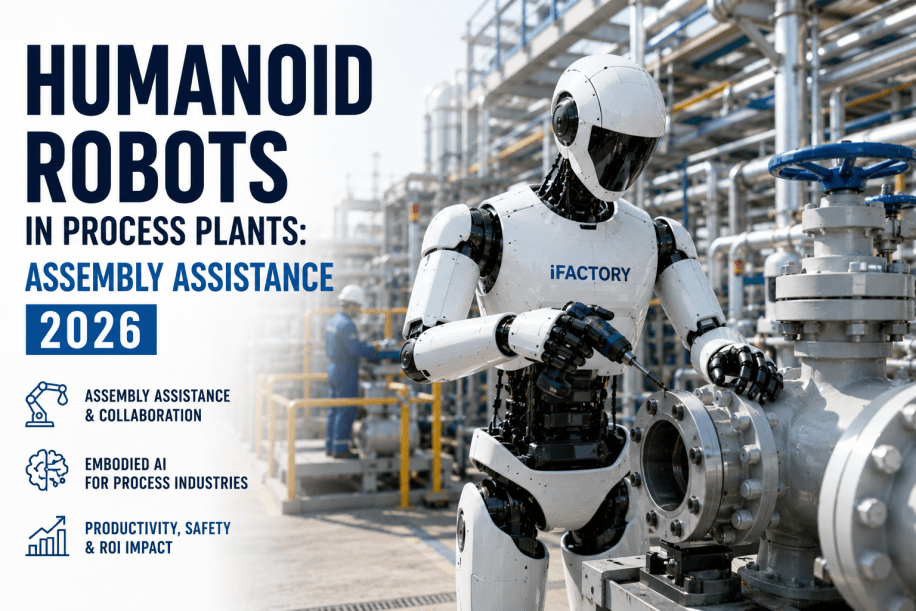
Process plants across chemical, pharmaceutical, food and beverage, and consumer goods manufacturing are confronting a structural challenge in 2026 that traditional fixed automation cannot solve: the growing gap between the complexity of mixed-product, high-mix assembly operations and the availability of skilled manual labor for those tasks. Unlike discrete automotive or electronics assembly lines where dedicated industrial robots perform single-task operations at high speed within caged workcells, process plant assembly environments typically involve frequent product changeovers, variable batch sizes, hygiene-controlled zones, and equipment layouts designed around human reach and mobility. Humanoid robots equipped with embodied AI, dexterous manipulation, and real-time MES and CMMS integration are now entering these environments as a new category of assembly assistance platform — not replacing fixed automation but filling the flexibility gap that neither traditional industrial robots nor human workers alone can economically address. The 2026 generation of humanoid platforms operating in process plant assembly roles is delivering documented cycle time improvements of 18 to 35 percent on mixed-model assembly tasks, reducing changeover downtime by 40 to 60 percent through adaptive reprogramming, and achieving payback periods of 12 to 18 months when deployed in structured assembly assistance workflows integrated with iFactory's AI-powered manufacturing operations platform.
Why Process Plant Assembly Demands a Different Automation Approach
The Flexibility Gap That Fixed Automation Cannot Close
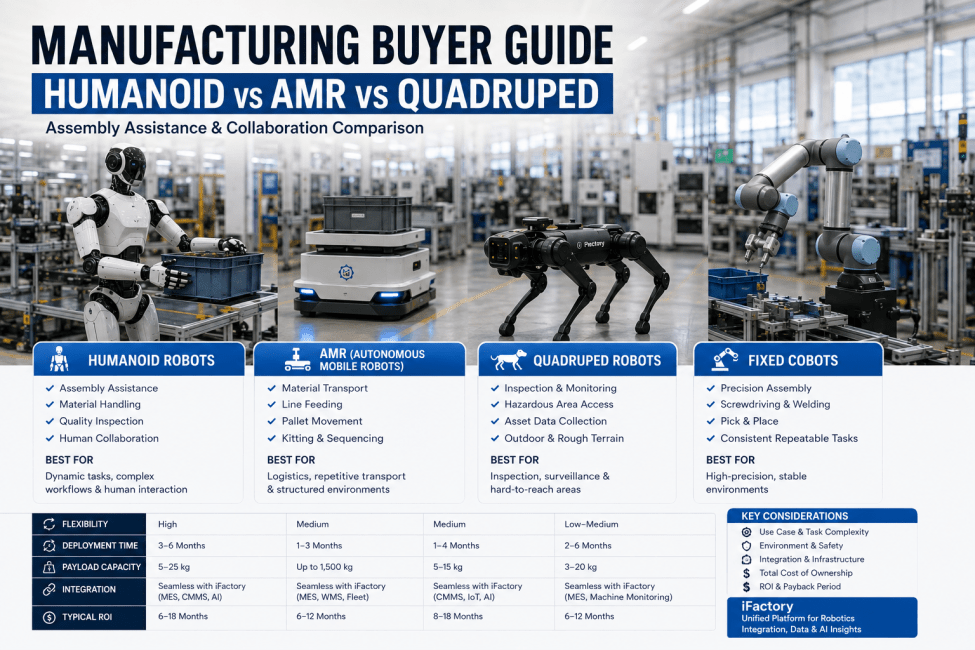
Process plant assembly environments differ fundamentally from high-volume discrete manufacturing in ways that create a specific opportunity for humanoid robots. A chemical plant assembling dosing pumps and control valves produces hundreds of variants with different materials, seal configurations, and calibration requirements. A pharmaceutical facility assembling fill-finish kits for clinical trial batches may run twenty product configurations in a single shift, each requiring different component presentation, torque specifications, and documentation. A food and beverage plant assembling packaging line change parts must accommodate seasonal product variations that alter every dimension of the assembly task. Traditional industrial robots — six-axis arms in fixed workcells with dedicated tooling — solve for volume and repetition but cannot economically adapt to the changeover frequency and task variety that defines process plant assembly. Collaborative robot arms address some of this flexibility but are limited by reach, payload, and the inability to move between assembly stations. Humanoid robots, with their full-body mobility, dexterous manipulation, and software-defined task switching, represent a structural solution to the flexibility gap that neither fixed automation nor human-plus-cobot workflows can close. To review the task suitability assessment methodology for your specific process plant assembly environment, Book a Demo with iFactory's process industry solutions team.
| Capability Dimension | Traditional Industrial Robot | Collaborative Robot Arm (Cobot) | Humanoid Robot (2026) |
|---|---|---|---|
| Task flexibility per shift | Single task; hours to retool | Multiple tasks; minutes to reprogram | Multiple tasks; software-based task switching |
| Mobile between stations | Fixed installation | Limited (mobile base optional) | Fully mobile; navigates plant floor autonomously |
| Changeover time | 2–8 hours | 30–90 minutes | 5–15 minutes |
| Human tool usage | Custom end-effector required | Limited (gripper-dependent) | Uses standard human tools directly |
| Hygiene zone compatibility | Difficult to sanitize | Moderate (wash-down options) | Designed for clean-in-place compatibility |
| MES / CMMS integration | PLC-level only | API-dependent | Native bi-directional integration via iFactory |
Humanoid Assembly Assistance in Process Plant Operations
Where Humanoid Robots Deliver Measurable Value Across the Process Plant Floor
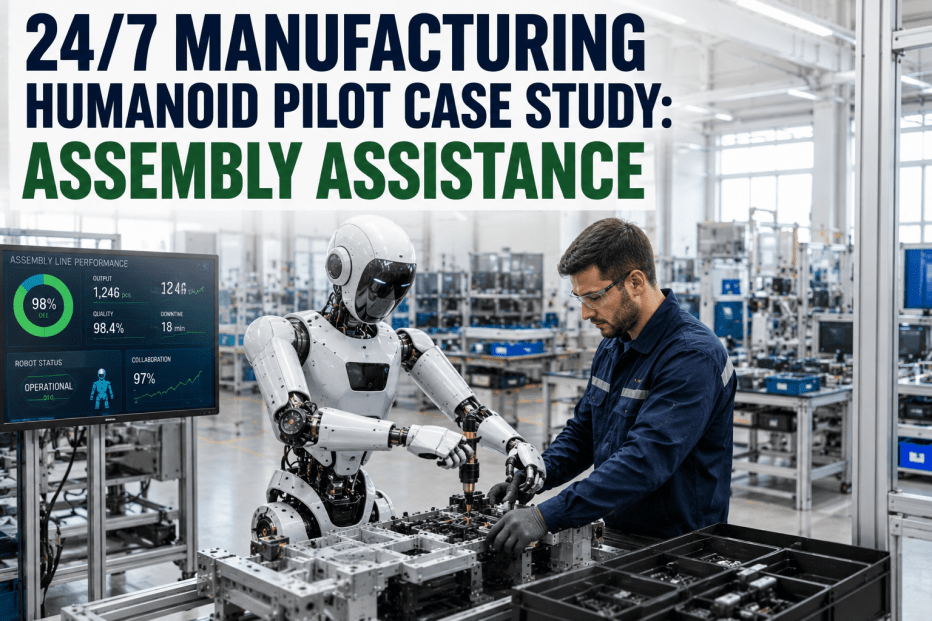
The value of humanoid assembly assistance in process plants is not theoretical in 2026. Multiple humanoid platforms are operating in real industrial environments, performing structured assembly tasks that combine material handling, precision placement, tool operation, and quality verification in workflows that previously required a human operator at each station. The defining characteristic of these deployments is that the humanoid robot operates as an assistive partner rather than a full replacement — taking on the repetitive, ergonomically demanding, or precision-critical elements of the assembly task while the human operator manages exception handling, quality judgment, and process supervision. This collaborative model has proven more effective in process plant environments than fully autonomous assembly because it preserves the human reasoning and adaptability that mixed-product operations require while eliminating the physical fatigue, inconsistency, and injury risk that manual assembly introduces at scale.
Integration Architecture for Humanoid Assembly Assistance
Connecting Humanoid Robots to the Process Plant's Digital Infrastructure
The value of a humanoid robot performing an assembly task in a process plant is directly proportional to the depth of its integration with the plant's existing digital infrastructure. A humanoid that can read the production order from the MES, retrieve the correct digital work instruction, verify component availability from the inventory system, record quality data to the QMS, and update the order status in the ERP is delivering value far beyond what a standalone assembly assistant can achieve. iFactory's 2026 platform provides the integration architecture that connects humanoid robots to the process plant's existing MES, CMMS, quality, inventory, and ERP systems through a connector-based middleware layer that maps data schemas between the robot platform and each production system without requiring replacement of any existing software. Book a Demo to see the integration architecture configured for your specific MES and plant systems environment.
Measured Outcomes from Process Plant Humanoid Assembly Deployments
ROI and Performance Metrics from 2025–2026 Pilots
The financial and operational outcomes from humanoid assembly assistance deployments at process plants in 2025 and early 2026 are documented across a growing set of pilot references spanning pharmaceutical fill-finish, chemical valve and instrumentation assembly, and food processing equipment manufacturing. The following table summarizes the documented performance range across eight deployment sites that have published results through Q1 2026.
| Performance Metric | Manual Assembly Baseline | Humanoid-Assisted Assembly | Improvement Range |
|---|---|---|---|
| Cycle time per assembly unit | 100% (baseline) | 65–82% of baseline | 18–35% reduction |
| Changeover time (product switch) | 45–90 minutes | 12–30 minutes | 40–60% reduction |
| First-pass yield | 91–95% | 96–99% | 3–7 point improvement |
| Quality documentation accuracy | 72–85% | 98–100% | 15–28 point improvement |
| Operator ergonomic risk exposure | High (repetitive tasks) | Low (robot handles high-risk motions) | 60–80% reduction in risk score |
| Training time per new product | 8–24 hours per operator | 0 hours (software update) | 90–100% reduction |
Frequently Asked Questions
What distinguishes humanoid robots from collaborative robot arms in process plant assembly applications?
Humanoid robots differ from cobot arms in three critical dimensions for process plant assembly: full-body mobility enables the robot to move between assembly stations, retrieve components from storage, and navigate the plant floor without floor-mounted tracks or gantries; dexterous bilateral manipulation allows the robot to use standard human tools, hold components in one hand while fastening with the other, and perform operations that require two-handed coordination; and software-defined task switching enables the robot to change between completely different assembly operations in minutes rather than hours, making it economically viable for the high-mix, low-to-medium volume production profiles typical of process plant assembly environments.
How does humanoid assembly assistance affect workforce requirements and operator roles in process plants?
The documented effect of humanoid assembly assistance on process plant workforces is role augmentation rather than headcount reduction. Operators are reassigned from repetitive physical assembly tasks — component retrieval, fastener driving, sealant application — to higher-value functions including quality supervision, exception handling, process optimization, and robot task monitoring. Facilities deploying humanoid assembly assistance report that operator job satisfaction improves as physically demanding and ergonomically hazardous tasks are offloaded to the robot, while overall production headcount remains stable or increases as throughput growth generates new roles in process improvement and production planning.
What is the typical timeline for deploying a humanoid assembly assistance system integrated with iFactory at an existing process plant?
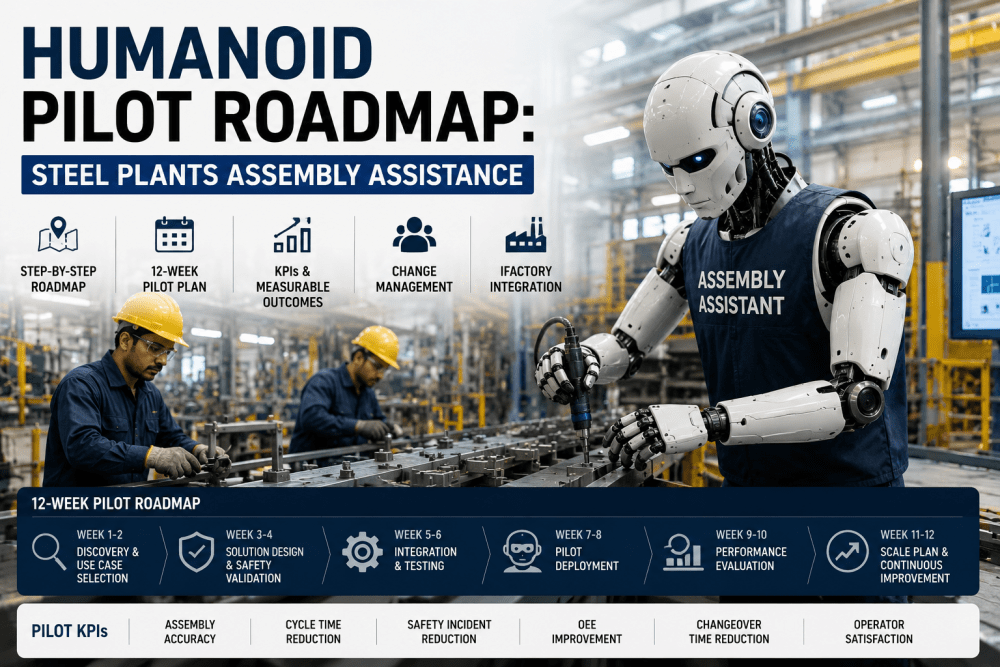
The typical timeline from project initiation to production deployment is 10 to 16 weeks for a single assembly line with two to three humanoid units. The initial phase (weeks 1-3) covers task suitability assessment, workstation layout evaluation, and integration architecture planning with the plant's MES and CMMS teams. Weeks 4-8 involve iFactory platform configuration, system integration, and robot programming for the initial assembly task set. Weeks 9-12 include operator training, safety case development, and pilot production runs. Weeks 13-16 cover ramp-up to full production, performance baseline validation, and continuous improvement tuning. Multi-line deployments typically follow a phased schedule with 4 to 6 weeks between successive line implementations.
What regulatory and compliance considerations apply to humanoid robots in regulated process plant environments?
Humanoid robots deployed in FDA-regulated pharmaceutical, medical device, or food manufacturing environments must comply with 21 CFR Part 11 (electronic records and signatures), EU Annex 11 (computerized systems), and applicable GMP requirements for equipment qualification and validation. iFactory's platform supports these requirements through user authentication, audit trail logging, electronic signature integration, and IQ/OQ/PQ documentation generation for the integrated humanoid and software system. The robot itself must meet applicable machinery safety directives and risk assessment requirements per ISO 10218 and ANSI/RIA R15.06 standards for robotic systems operating in collaborative applications.
How does iFactory's platform handle the integration of humanoid robots with existing MES and CMMS systems at process plants?
iFactory's platform uses a connector-based middleware architecture that maps data schemas between the humanoid robot and the plant's existing MES, CMMS, quality management, inventory, and ERP systems without requiring system replacement or parallel operation. The connector layer supports major MES platforms, CMMS solutions, ERP systems, and production historians through pre-built connectors and a configuration toolkit for custom or legacy system integration. Data flows are bi-directional: the robot reads production orders, work instructions, and equipment status from the plant systems, and writes completion records, quality measurements, material consumption, and traceability data back to those same systems in real time.
Conclusion
Humanoid robots for assembly assistance in process plant environments have crossed the threshold from pilot curiosity to deployable production tool in 2026. The documented 18 to 35 percent cycle time improvements, 40 to 60 percent changeover reductions, and 12 to 18 month payback periods across pharmaceutical, chemical, and food processing assembly operations represent outcomes that process plant engineers and operations leaders can evaluate against their own production profiles with confidence. The integration architecture matters as much as the robot hardware — a humanoid without deep MES and CMMS connectivity remains a standalone device that cannot deliver the real-time quality data, traceability, and workflow automation that make the economic case work. iFactory's platform provides the integration layer that connects humanoid robots to the process plant's existing digital infrastructure, enabling adaptive assembly assistance that fills the flexibility gap between fixed automation and manual operations. To evaluate the specific suitability and ROI for your process plant assembly environment, Book a Demo with iFactory's process industry solutions team.
.png)