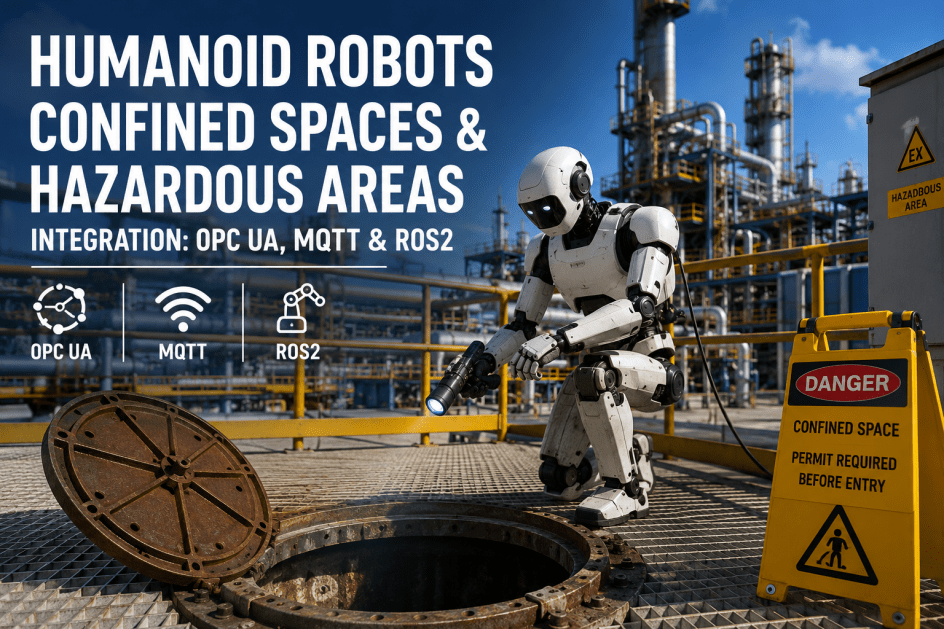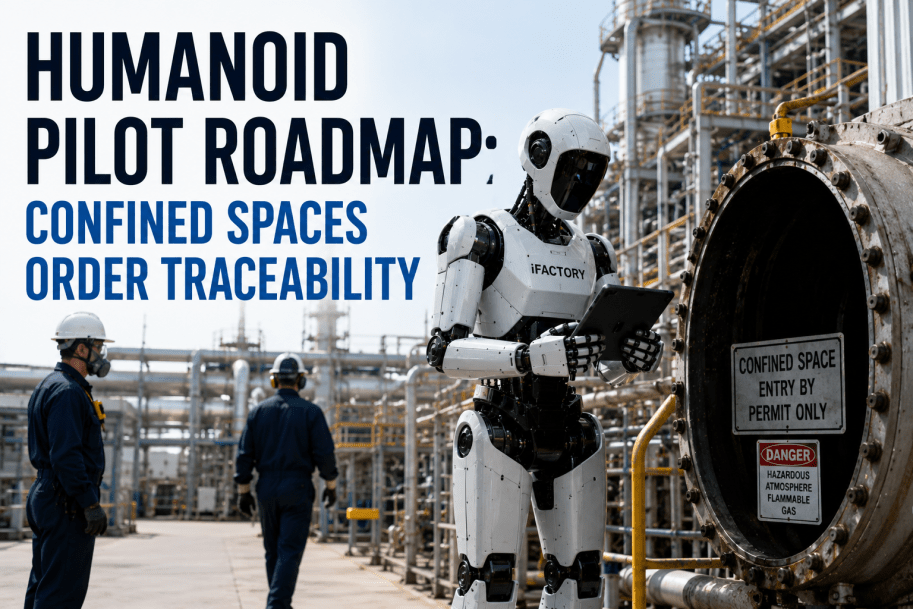
Deploying humanoid robots in confined spaces and hazardous process areas is no longer a research program — it is a capital deployment decision that chemical plant operations teams are making in 2026, with commercial platforms from Figure, Apptronik, and Agility Robotics demonstrating sub-18-month ROI in environments where human entry requires Level A PPE, continuous atmospheric monitoring, and confined space permit workflows that cost $800 to $2,400 per entry event. The business case is straightforward: a chemical plant with 300 to 600 annual confined space entries for order verification, inventory counting, pipe rack inspection, and process traceability data collection is spending $240,000 to $1.44 million annually on permitted human entry — plus the liability exposure from the OSHA 1910.146 confined space fatality rate, which averages 2.2 fatalities per year in chemical processing specifically. Humanoid robots eliminate permit entry costs for non-emergency verification tasks, collect order and traceability data with barcode, RFID, and vision-based scanning at higher accuracy than manual verification, and integrate directly with CMMS and MES platforms to close the digital traceability loop that most chemical plants currently manage through manual data entry at the end of each entry event. iFactory's Robotics AI and CMMS Solution modules provide the integration layer — connecting humanoid robot data collection to work order management, asset records, and traceability documentation — so the robot's field data reaches the compliance record without manual transcription. Book a Demo to see how iFactory's platform manages humanoid robot integration with your plant's CMMS, MES, and traceability documentation systems.
Why Confined Spaces and Hazardous Areas Are the First Deployment Target for Humanoid Robots in Chemical Plants
The confined space entry program is the most expensive and highest-risk routine maintenance and verification activity in a chemical plant's operational calendar. OSHA 29 CFR 1910.146 requires a written permit, atmospheric testing for oxygen deficiency, combustible gas, and toxic vapor, a trained attendant stationed outside the space, a rescue plan, and documented entry authorization for every permit-required confined space entry — regardless of whether the task inside takes four minutes or four hours. When the task inside is order verification, inventory count, or visual traceability inspection — a task that requires a human to read a tag, scan a barcode, or verify a drum label — the permit cost frequently exceeds the productive value of the entry itself. Humanoid robots address this mismatch directly: they operate in IDLH (immediately dangerous to life or health) atmospheres without respiratory protection, in spaces too small for safe human entry with full PPE, and in areas where heat, radiation, or chemical exposure limits human dwell time to minutes. The table below presents the confined space entry cost and humanoid robot displacement potential for the five most common verification and traceability tasks in chemical plant operations.
| Verification Task | Typical Entry Frequency | Cost Per Entry Event | Annual Entry Cost | Robot Displacement Potential | iFactory Integration |
|---|---|---|---|---|---|
| Tank Inventory Verification — Drum Count and Label Scan | Weekly to bi-weekly | $1,200–$2,400 | $62,400–$124,800 | High — 90–100% of routine inventory entries | CMMS inventory update, MES lot traceability record |
| Pipe Rack Visual Inspection — Flange, Valve, Corrosion | Monthly to quarterly | $1,600–$3,200 | $19,200–$38,400 | High — 80–95% of visual inspection entries | CMMS work order generation, asset inspection record |
| Process Order Verification — Batch Tag, Container ID Scan | Per batch, 3–8x per shift | $800–$1,600 | $140,000–$280,000 | High — 85–95% of order verification entries | MES batch record closure, traceability chain documentation |
| Atmospheric Monitoring — Pre-Entry and Continuous Survey | Every entry event | $400–$800 | $48,000–$96,000 | Moderate — 70–85% displacement (entry still required for some tasks) | EHS monitoring log, CMMS safety compliance record |
| Equipment Nameplate and Asset Tag Verification | Annually to bi-annually | $1,400–$2,800 | $8,400–$16,800 | High — 95–100% of nameplate verification entries | CMMS asset record update, regulatory documentation |
The 12-Week Humanoid Robot Pilot Roadmap — From Site Assessment to Live Operations in Confined and Hazardous Areas
The deployment framework below reflects implementation patterns from chemical plant humanoid robot pilots conducted across the U.S. Gulf Coast petrochemical corridor, the Midwest specialty chemical sector, and the East Coast pharmaceutical manufacturing base between 2024 and 2026. Each phase has defined entry criteria, deliverables, and iFactory integration milestones. The roadmap assumes a single confined space or hazardous area target zone for the pilot, with planned expansion to additional zones following 90-day operational validation.
Order Verification and Traceability Architecture — How Humanoid Robots Close the Digital Traceability Loop
Order verification and traceability in confined and hazardous areas represent the most significant data quality gap in chemical plant MES and CMMS systems — not because the data doesn't exist inside the space, but because the cost and risk of human entry means it is collected infrequently, entered manually after the fact, and subject to transcription error rates that average 3 to 7% for manual data entry in industrial environments. Humanoid robots with integrated scanning systems collect the same data in real time, at higher accuracy, and feed it directly into iFactory's integration layer without a manual data entry step. The architecture below presents the complete traceability data flow from robot scan event to compliance record.
iFactory Integration Architecture — Connecting Humanoid Robot Field Data to CMMS, MES, and Compliance Systems
The value of humanoid robot deployment in confined and hazardous areas depends entirely on whether the field data the robot collects reaches the plant's CMMS, MES, and compliance systems in real time without manual transcription. A robot that collects excellent data but requires a technician to re-enter that data into the plant systems after the fact has not eliminated the data quality risk — it has only moved the human effort from inside the space to a desk. iFactory's integration architecture eliminates that gap. The comparison below presents the data flow, latency, and accuracy performance across the manual entry baseline, a basic robot deployment without integration, and the iFactory-integrated humanoid robot deployment model.
What iFactory Configures and Monitors Across a Humanoid Robot Pilot Deployment
A fully operational iFactory humanoid robot integration deployment covers four functional domains — robot data ingestion, CMMS work order automation, MES traceability, and EHS compliance. Each domain is monitored continuously on the iFactory dashboard and exportable for OSHA documentation, corporate safety reporting, and capital project ROI verification. The coverage across all four domains is what differentiates a robot deployment that reduces labor cost from one that closes the full digital traceability loop.
iFactory establishes and validates the robot API connection, ingesting scan data, image captures, atmospheric sensor readings, and navigation telemetry in real time. An asset ID mapping table matches robot scan IDs directly to CMMS asset records so resolution is automatic — no manual lookup required. Unmatched or low-confidence scans are flagged and routed to human review with image evidence attached, and a pilot ROI dashboard tracks pre- versus post-deployment confined space entry costs continuously throughout the program.
Auto-close rules trigger on successful robot scan events, closing routine verification work orders without any operator input. Vision inspection anomaly flags automatically generate corrective work orders with image evidence and anomaly classification attached at creation. CMMS asset records update on robot inspection completion — last inspection date, condition rating, and image archive are all current without manual data entry — and the robot deployment schedule integrates directly with the CMMS preventive maintenance calendar so entries are triggered by schedule rather than manual dispatch.
MES batch records close automatically on lot verification scan — robot-confirmed lot ID and container count satisfy the verification requirement without manual sign-off for routine tasks. Every robot scan event is logged with robot ID, entry time, exit time, scan result, and image evidence as a traceable record in the MES audit trail. Scan count versus expected count discrepancies generate real-time MES alerts with image documentation for QC review, and for FDA-regulated facilities, robot verification records include the electronic signature equivalent, timestamp, and audit trail required under 21 CFR Part 11.
All atmospheric gas readings — O2, LEL, H2S, CO, VOC — are logged by spatial location and timestamp in iFactory's EHS module for trend analysis and risk stratification over time. Human permit entry counts are tracked before and after robot deployment for OSHA VPP and corporate safety performance reporting. Current-version robot safety protocols are stored in iFactory's Smart Document Management system and accessible from any device, and all robot malfunction, communication failure, or emergency retrieval events are logged in iFactory Incident Reporting for root cause investigation and corrective action tracking.
Expert Review: What Chemical Plant Automation Engineers Say About Humanoid Robot Deployment in Confined Spaces
I have been involved in industrial automation at chemical plants for twenty-two years — first as a process control engineer at a chlor-alkali facility in Louisiana, then as an automation director overseeing capital projects across a portfolio of six specialty chemical sites in the Midwest and Southeast. When we began evaluating humanoid robot deployment for confined space operations in early 2024, the internal skepticism was substantial: the technology was perceived as early-stage, the capital cost seemed disproportionate to the task, and the safety team was concerned that a robot malfunction inside a confined space would create a worse rescue scenario than the human entries we were trying to eliminate. All of those concerns were legitimate and had to be addressed systematically — and the 12-week pilot roadmap we developed at the first deployment site at a sulfuric acid alkylation unit turned out to be exactly the right framework for addressing them one phase at a time. The parallel run in weeks 9 and 10 was the single most important element of the roadmap. Running the robot and the human crew simultaneously for two weeks produced the accuracy and data quality comparison data that converted the safety team from skeptics to advocates — because the robot's atmospheric mapping data revealed a localized H2S pocket near the south wall of the drum storage area that the point-of-entry gas monitor had never detected in eleven years of human entries. That was a safety argument no one could dismiss. The CMMS integration was where iFactory's value was most visible to the business. Before the pilot, our traceability closure cycle for confined space verification tasks was averaging six hours from entry to record — because the technician came out of the space, changed out of PPE, debriefed with the attendant, and then manually entered the data into the MES system. After integration, the traceability record was in the system in under thirty seconds from the robot scan event. Six hours to thirty seconds. That is not an incremental improvement — that is a different operating model. The capital justification for expanding to four additional confined spaces at that site wrote itself.
— Automation Director, U.S. Specialty Chemical Manufacturing — 22 Years Process Automation and Capital Projects — Registered Professional Engineer (PE), Chemical — Certified Functional Safety Engineer (CFSE), IEC 61511Conclusion
Humanoid robot deployment in confined spaces and hazardous areas is a capital investment decision that chemical plant operations teams can now make with confidence — because the commercial platforms are available, the safety certification pathways are defined, and the CMMS and MES integration architecture that closes the digital traceability loop exists in production-ready form. The 12-week pilot roadmap presented here reflects the implementation pattern that has produced validated ROI across chemical plant environments from chlor-alkali to specialty coatings to pharmaceutical API manufacturing — and the consistent finding across all of those deployments is that the business case is determined by confined space entry cost reduction and traceability data quality improvement, not by the robot platform itself.
iFactory's Robotics AI, CMMS Solution, and EHS Management modules provide the integration layer that transforms robot field data into work order closures, MES batch records, and compliance documentation — without the manual transcription step that currently delays traceability closure by 2 to 8 hours after every confined space entry. The 80 to 90% reduction in human permit-required confined space entries, the 85 to 100% auto-closure rate for routine CMMS work orders, and the real-time audit readiness that iFactory-integrated humanoid robot deployments deliver are not the result of a different safety philosophy — they are the result of having a digital integration platform that makes the robot's field data immediately actionable across every system in the plant. Book a Demo to see how iFactory's platform manages humanoid robot integration with your plant's specific confined space program, CMMS configuration, and MES traceability requirements.
Frequently Asked Questions
iFactory's Robotics AI integration layer supports REST API, MQTT, and ROS 2 message bridge protocols — covering the communication architectures used by the major commercial humanoid robot platforms available in 2026. Integration is configured during the Week 3–4 phase of the pilot roadmap, and compatibility is confirmed before platform selection is finalized. iFactory is platform-agnostic: the integration standard is the data schema, not the robot vendor.
iFactory's MES traceability records generated from robot scan events include a reviewer approval workflow that satisfies 21 CFR Part 11 electronic signature requirements — the robot scan provides the data record, and a designated reviewer approves the record in iFactory before it closes the batch record. The approval workflow is configurable by record type, allowing auto-closure for routine inventory counts and requiring electronic signature approval for lot verification records in regulated product streams.
iFactory automatically detects incomplete robot missions — any work order or traceability task triggered by a robot deployment that does not receive a completion confirmation within the expected mission duration generates an escalation alert. The alert includes the partial scan data collected before the malfunction, the robot telemetry at the point of failure, and a task reassignment option — either to a second robot deployment or to a human entry team — with the partial data preserved so the follow-up entry only covers the unverified assets.
Yes. iFactory's Analytics and Reporting module generates a confined space entry reduction report that documents pre-pilot and post-pilot human entry counts by space, task type, and risk classification — providing the quantitative data that insurance carriers and risk management departments require for premium renegotiation. The report includes OSHA 1910.146 permit entry log comparisons, human dwell-time-in-IDLH-atmosphere reductions, and incident/near-miss rate changes attributable to the robot deployment program.
A single-zone pilot — including the humanoid robot platform, site-specific safety protocol development, scanning system configuration, and iFactory CMMS/MES integration — typically ranges from $280,000 to $480,000 depending on the robot platform selected and the complexity of the confined space. For a site with 200 to 300 annual permit entries in the target zone at $1,200 to $2,400 per entry, the payback period is typically 14 to 24 months from live operations. Book a Demo for a site-specific ROI model based on your plant's confined space entry program data.