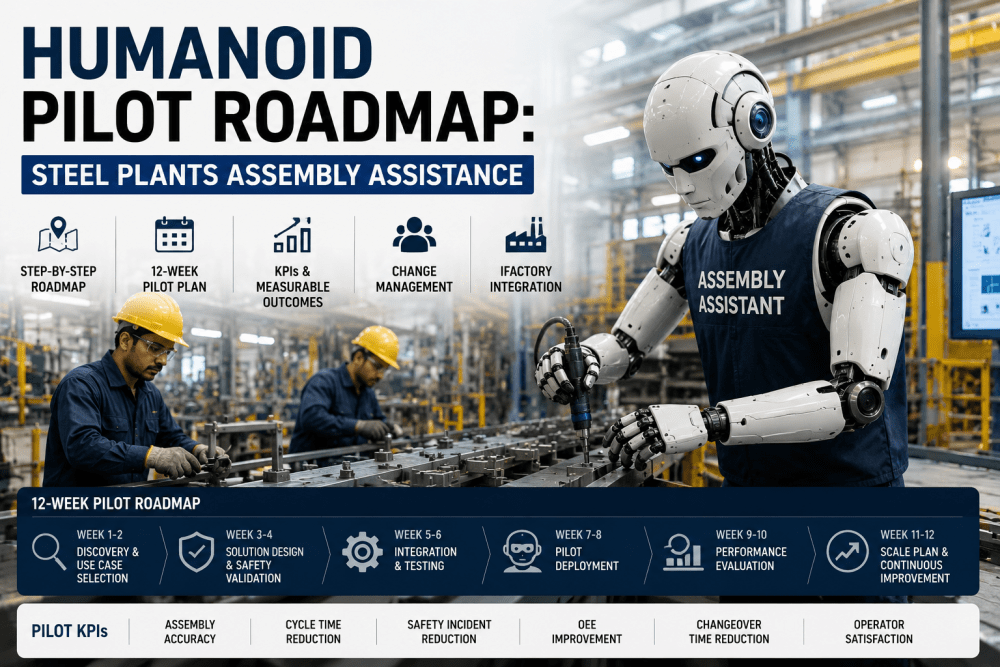
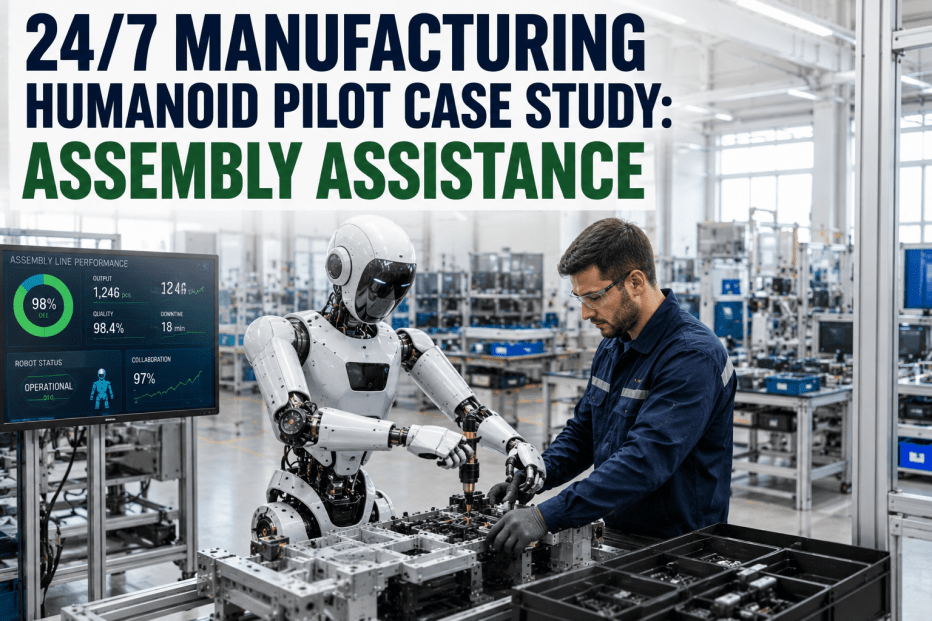
A manufacturing engineer evaluating robotic automation for the upcoming capital budget cycle faces a proliferating landscape of options that did not exist three years ago. Autonomous mobile robots promise material handling flexibility at low deployment cost. Quadruped robots offer inspection access to confined and hazardous spaces. Collaborative robot arms deliver precision assembly at fixed workstations. And humanoid robots — the newest entrant — claim to combine the mobility of AMRs, the manipulation of cobots, and the environmental adaptability of a human worker in a single platform. The challenge is not a shortage of options; it is the absence of a structured framework for comparing them on the dimensions that matter most to discrete manufacturing operations: ROI per square foot, deployment complexity, task flexibility, integration effort, and total cost of ownership. iFactory's robotics integration platform provides the common data layer that makes this comparison possible — ingesting telemetry from any robot type and correlating its performance with production throughput, quality metrics, and maintenance costs. To evaluate which robot category is right for your facility, Book a Demo for a structured robotics assessment.
4
Robot categories evaluated across 8 decision criteria
3.2x
ROI range between best-fit and worst-fit robot choice
64%
of facilities misapplied robot type to task in first deployment
8 wk
iFactory integration timeline for any robot category
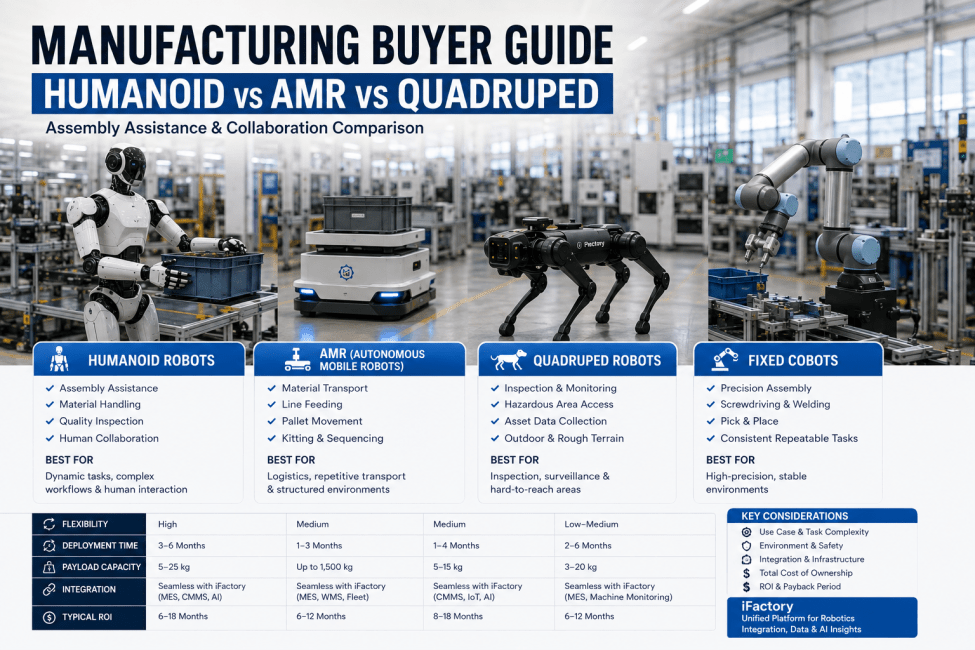
The Four Robot Categories for Discrete Manufacturing: A Functional Overview
Each robot category evolved to solve a specific class of manufacturing problem. Understanding the core design trade-offs is the first step in selecting the right platform for your operation.
HUMANOID
Humanoid Robots
Bipedal, full-torso robots designed to operate in human-centric environments without facility modification. Capable of walking, climbing stairs, manipulating valves and tools, and performing inspection rounds in spaces built for human workers. Typical payload: 20–35 kg. Battery life: 4–8 hours per charge.
Best for: Multi-task roles combining patrol, manipulation, and data collection in environments too hazardous or inaccessible for continuous human presence.
AMR
Autonomous Mobile Robots
Wheeled platforms optimized for material transport between production zones, warehouses, and storage areas. Navigate using LiDAR and vision-based SLAM. Available in tow, pallet, and shelf-carrying configurations. Typical payload: 100–1,500 kg. Battery life: 8–16 hours per charge.
Best for: Repetitive point-to-point material movement where the primary value is reducing walk-and-carry time for production operators.
QUADRUPED
Quadruped Robots
Four-legged robots designed for rugged terrain, stair navigation, and confined-space inspection. Equipped with thermal cameras, gas sensors, and acoustic monitoring payloads. Operate in environments where wheeled platforms cannot traverse. Typical payload: 10–20 kg. Battery life: 2–6 hours per charge.
Best for: Remote visual inspection, thermal scanning, and environmental monitoring in confined, wet, or uneven-terrain environments.
COBOT
Collaborative Robot Arms
Fixed-base or mobile-base articulated arms with force-limiting safety features for human-adjacent operation. Deployed at workstations for assembly, machine tending, and quality inspection. Typical payload: 5–35 kg. Continuous operation when integrated with production cycle.
Best for: Repetitive, precision tasks at a fixed workstation where cycle time consistency and quality repeatability deliver measurable yield improvement.
Side-by-Side Comparison: Eight Decision Criteria for Manufacturing Robotics
The following comparison evaluates each robot category across the eight dimensions that discrete manufacturing operations consistently identify as critical to deployment success. Scores reflect real-world performance in production environments, not theoretical specifications.
| Decision Criterion | Humanoid | AMR | Quadruped | Cobot |
|---|
| Task flexibility | High — walk, climb, manipulate, inspect | Low — transport only | Medium — inspect + monitor | Medium — precision manipulation |
| Facility modification required | None — uses human infrastructure | Moderate — charging stations, floor marking | None — navigates stairs, gratings | High — mounting structure, safety guarding |
| Deployment timeline | 6–10 weeks | 3–6 weeks | 4–8 weeks | 2–6 weeks |
| Payload capacity | 20–35 kg | 100–1,500 kg | 10–20 kg | 5–35 kg |
| Autonomy level | High — autonomous patrol, adaptive pathing | High — autonomous navigation | High — autonomous terrain traversal | Low — programmed cycle, supervised |
| Multi-tasking capability | Yes — patrol + manipulation + data | No — single-purpose transport | Limited — inspection + monitoring | No — single workstation task |
| Integration with MES/CMMS | Full — via iFactory platform | Limited — fleet manager only | Partial — inspection data only | Limited — cycle data only |
| Typical first-year ROI | 2.5–4.0x | 1.8–3.0x | 1.5–2.5x | 2.0–3.5x |
Which Robot Category Fits Your Manufacturing Operation?
iFactory's robotics assessment maps your production environment, task requirements, and integration infrastructure to the optimal robot category — before you commit capital. The assessment is complimentary and delivers a deployment-ready recommendation within 15 business days.
Decision Framework: Matching Robot Category to Manufacturing Task Profile
The selection of the right robot category depends on the dominant task profile in your production environment. The following decision framework maps the four robot types to the manufacturing scenarios where each delivers the highest ROI. For a detailed walkthrough of how this framework applies to your specific production lines, Book a Demo with iFactory's robotics integration team.
Multi-Zone Patrol & Manipulation
Tasks requiring a single robot to navigate multiple production zones, perform equipment inspections, manipulate valves or controls, and collect sensor data across an entire facility. Humanoid robots are the only category that combines mobility, manipulation, and data collection in a single platform.
Recommended: Humanoid Robot
Point-to-Point Material Transport
High-volume, predictable material movement between fixed locations — raw material from storage to line, work-in-process between stations, finished goods to shipping. AMRs excel in this role with high payload capacity, long battery life, and established fleet management software ecosystems.
Recommended: AMR
Confined Space & Hazardous Inspection
Thermal scanning of high-temperature equipment, visual inspection of sumps and confined spaces, gas detection in hazardous zones, and structural monitoring in areas inaccessible to wheeled platforms. Quadruped robots provide the terrain capability and sensor payload capacity required for these inspection-intensive roles.
Recommended: Quadruped Robot
Precision Assembly at Fixed Workstation
Repetitive assembly operations requiring consistent cycle times, precise force control, and integration with upstream and downstream automation. Cobot arms deliver the highest repeatability and lowest cost per cycle for fixed-station tasks where the robot does not need to move between positions.
Recommended: Cobot Arm
Total Cost of Ownership Comparison: 36-Month Projection
The total cost of ownership for manufacturing robotics extends well beyond the initial purchase price. The following 36-month projection includes hardware acquisition, facility modification, deployment engineering, integration software, maintenance, and training — normalized for a mid-size discrete manufacturing facility deploying 2–4 robot units.
| Cost Category | Humanoid | AMR | Quadruped | Cobot |
|---|
| Hardware (per unit) | $150K–$250K | $40K–$120K | $60K–$150K | $30K–$80K |
| Facility modification | $5K–$15K | $20K–$60K | $5K–$10K | $40K–$100K |
| Software & integration | $30K–$60K | $15K–$35K | $20K–$40K | $10K–$25K |
| Annual maintenance | $15K–$30K | $5K–$15K | $10K–$20K | $3K–$8K |
| Training & onboarding | $10K–$20K | $5K–$10K | $8K–$15K | $5K–$10K |
| 36-month total per unit | $280K–$480K | $90K–$240K | $120K–$270K | $100K–$190K |
| Tasks per unit | 4–6 | 1 | 2–3 | 1 |
| Cost per task per year | $15K–$27K | $30K–$80K | $15K–$33K | $33K–$63K |
When cost per task is considered — the most relevant metric for multi-application environments — humanoid and quadruped robots deliver the lowest per-task cost because they can perform multiple functions across the facility. AMRs and cobots achieve lower absolute hardware cost but are limited to a single task application, resulting in higher effective cost per function delivered.
Expert Analysis: Four Strategic Factors in Robot Category Selection
01
Task density determines ROI ceiling. The most common mistake in manufacturing robotics selection is matching robot capability to a single task when a multi-task platform could serve 4–6 applications. Humanoid robots deployed in facilities with high task density — patrol, inspection, manipulation, data collection — consistently achieve 2.5–4.0x first-year ROI because the same hardware investment serves multiple value streams. Facilities that assign a single task to a multi-capability platform leave 60% of the potential ROI unrealized.
02
Facility modification cost is often the hidden decision driver. Cobot installations requiring safety guarding, floor mounting, and workstation redesign frequently cost 2–3x the hardware price in facility modification. AMR deployment requires charging station infrastructure and floor marking. Humanoid and quadruped robots operate on existing human infrastructure with minimal facility changes — making them the lower cost option in facilities where modification budgets are constrained or production schedules cannot accommodate construction downtime.
03
Integration depth determines whether robots generate data or generate problems. A robot fleet operating without integration to MES, CMMS, and quality systems produces siloed data that requires manual transfer and interpretation. iFactory's robotics integration platform connects any robot category to production systems, ensuring that robot-collected data flows automatically into work order generation, quality tracking, and equipment health models — converting robot patrols from an operational expense into a data-generating asset.
04
The deployment timeline advantage of lower-complexity platforms is often offset by shorter useful life. AMRs and cobots can deploy in 3–6 weeks, but their single-purpose design limits adaptability as production requirements evolve. Humanoid and quadruped robots take 6–10 weeks to deploy but retain value across multiple task reconfigurations — extending useful life to 5–8 years compared to 3–5 years for single-purpose platforms. In facilities with changing product mixes or production volumes, the longer deployment timeline of multi-purpose platforms delivers lower total lifetime cost.
Conclusion: Select the Robot Category by Task Profile, Not by Hardware Specification
The selection of a manufacturing robot category should follow a structured decision process that begins with task profile analysis, proceeds through facility constraint evaluation, and concludes with a total cost of ownership projection that accounts for multi-application value. The four categories evaluated in this buyer's guide — humanoid, AMR, quadruped, and cobot — each occupy a distinct position in the capability-cost-flexibility matrix. No single category is universally superior; each is optimal for a specific set of manufacturing scenarios.
Humanoid robots deliver the highest task density and facility flexibility for multi-zone operations requiring mobility, manipulation, and data collection. AMRs provide the lowest cost per kg for dedicated material transport. Quadruped robots offer unmatched terrain capability for confined-space inspection. Cobot arms deliver the highest precision for fixed-station assembly. The manufacturers that achieve the highest robotics ROI are those that match robot capability to task requirements through a structured assessment process — and integrate every robot category into a unified operations platform that converts robot-generated data into production intelligence. To begin the assessment process for your facility, Book a Demo with iFactory's robotics integration team.
Robot Category Assessment for Your Manufacturing Operation. Complimentary. Deployment-Ready in 15 Days.
iFactory's robotics integration team will evaluate your production environment, task requirements, and existing infrastructure to recommend the optimal robot category — humanoid, AMR, quadruped, or cobot — with a deployment roadmap, cost projection, and ROI estimate specific to your facility.
Task Profile Analysis
Facility Constraint Review
TCO Projection
ROI Estimate
Integration Roadmap
Frequently Asked Questions
.png)