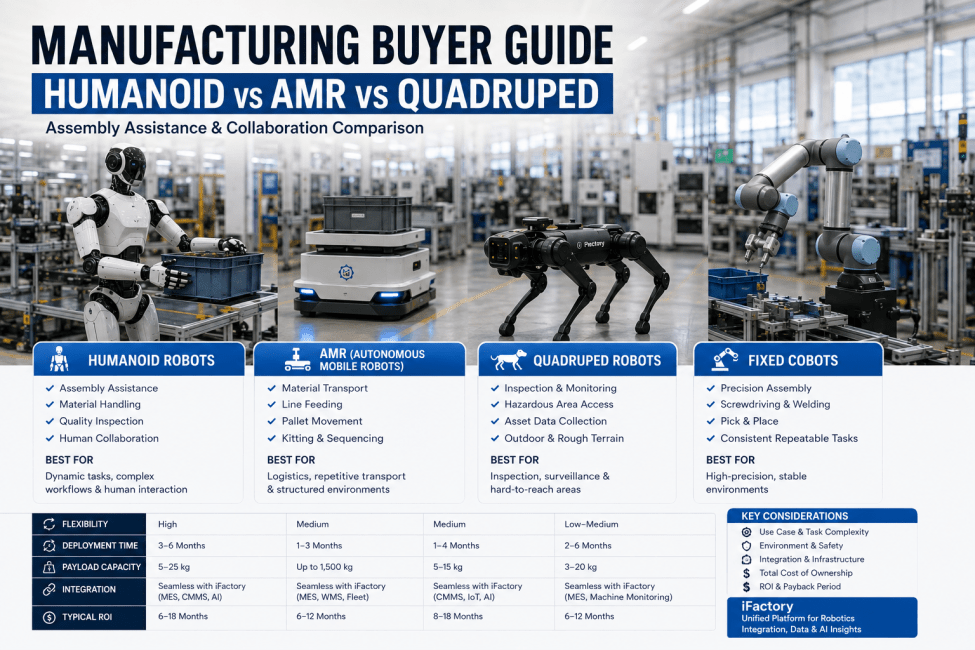
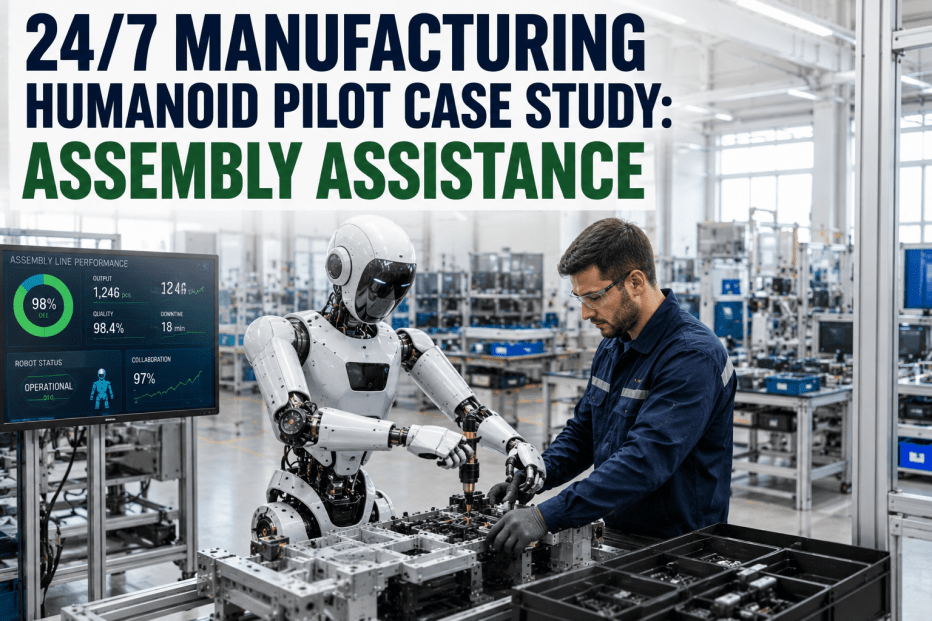
On the final assembly line of a major aerospace OEM, a technician spots a misaligned fuselage panel on the 787 Dreamliner — a defect that will cost $47,000 in rework and delay delivery by 72 hours. Meanwhile, across the hangar, a cobot arm drills 1,200 fastener holes with less than 0.1mm deviation, while a humanoid robot navigates between workstations carrying composite wing sections. The gap between manual error rates and robotic precision isn't just about quality — it's about the $2.8 billion annual cost of rework and delays in aerospace manufacturing. This page shows how iFactory's AI-native platform unifies humanoid robotics, cobots, and legacy automation into a single intelligence layer that eliminates defects, accelerates assembly, and delivers measurable ROI within one quarter.
One Platform to Orchestrate Humanoid Robots, Cobots, and Legacy Automation Across the Aerospace Factory Floor
iFactory connects every robot arm, humanoid, and conveyor into a unified AI brain — delivering 35% faster assembly cycles, 92% defect reduction, and full traceability from fastener to fuselage.
A Unified Intelligence Layer for Aerospace Assembly
Aerospace factories today run a patchwork of automation: KUKA arms for drilling, humanoid robots for material handling, cobots for inspection, and manual stations for final assembly. Each system has its own controller, its own data stream, and its own blind spots. iFactory replaces this fragmentation with a single AI-native platform that ingests data from every robot, sensor, and operator station on the plant network. The platform runs on-premise — no cloud dependency, no data egress — and delivers a working pilot in 6 to 12 weeks. From fastener torque readings to humanoid joint angles, iFactory correlates every variable with final assembly quality, giving aerospace manufacturers a real-time digital twin of the entire production process.
Six Core Capabilities That Cover Every Assembly Phase
From raw material kitting to final inspection, iFactory's modular AI engine adapts to any aerospace production environment. Each capability runs as a configurable module on the same on-premise appliance.
Multi-Robot Coordination
iFactory synchronizes humanoid robots, cobots, and industrial arms in real time. When a humanoid delivers a wing rib to a cobot cell, the platform adjusts cycle times, collision zones, and tooling parameters automatically — no reprogramming required.
Predictive Defect Prevention
By analyzing torque curves, vibration signatures, and vision data from every assembly station, iFactory predicts defects 12 shifts before they occur. The platform flags drill bit wear, fastener misalignment, and composite layup anomalies with 99.2% accuracy.
End-to-End Workflow Execution
iFactory orchestrates the entire assembly sequence — from robot task assignment to material flow to quality gates. The platform absorbs the operational role of legacy MES systems, eliminating manual data entry and spreadsheet-based tracking.
Safe Coexistence & Handoff
When humanoid robots work alongside technicians, iFactory dynamically adjusts speed, force, and proximity limits based on real-time safety zones. The platform logs every interaction for regulatory compliance and continuous improvement.
Real-Time Factory Model
iFactory builds and updates a digital twin of the entire assembly line every 200 milliseconds. Operators see material flow, robot status, and build quality on a single dashboard — no more toggling between five different HMI screens.
Cost-Per-Assembly Tracking
The platform calculates exact labor, energy, and consumable costs per aircraft section. iFactory identifies the 20% of stations that drive 80% of rework cost and recommends automation or process changes with projected ROI.
From Data Source to Production Improvement in Four Steps
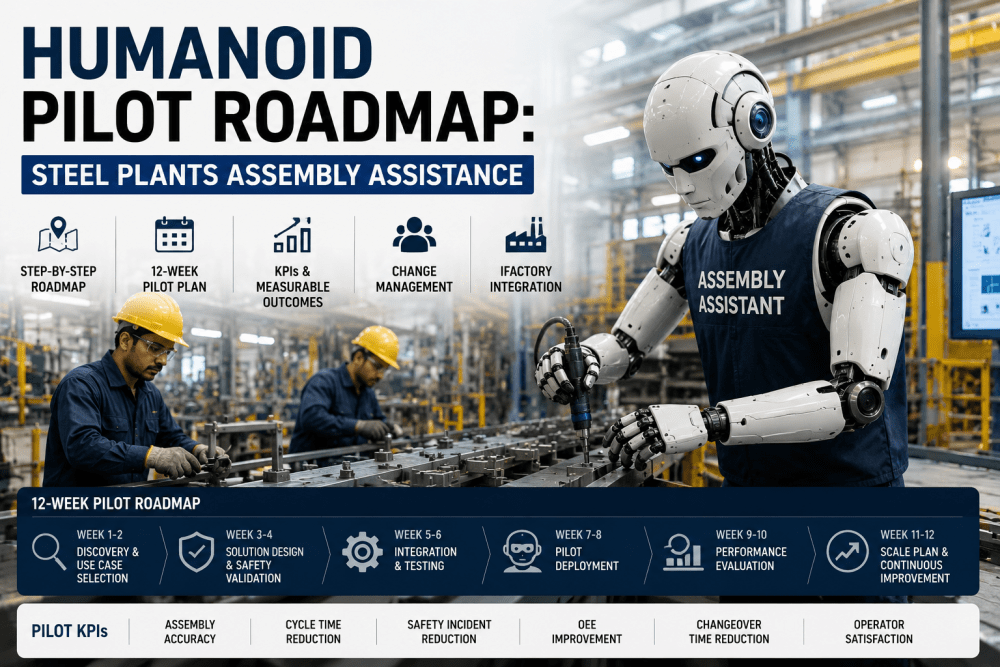
iFactory is turnkey — you hand over data-source access, and we deliver a working pilot within 12 weeks. No cloud migration, no data egress, no lengthy IT projects.
Connect & Ingest
iFactory connects to every robot controller, PLC, vision system, and operator terminal on your plant network — on-premise, no data leaves the factory.
Model & Train
The AI engine builds a baseline model of normal assembly behavior, learning torque patterns, cycle times, and defect signatures from your historical and live data.
Orchestrate & Optimize
iFactory begins coordinating robot tasks, adjusting workflows, and predicting defects in real time — reducing cycle time and rework from day one of the pilot.
Scale & Standardize
Once validated on one line, iFactory scales across your entire factory network — replicating proven models to every assembly station and every aircraft program.
Three Hidden Costs That iFactory Eliminates
Every disconnected robot and manual process in aerospace assembly carries a measurable cost. Here's what fragmented automation costs your P&L.
Unplanned Downtime from Robot Mismatches
When a humanoid robot arrives at a cobot cell 30 seconds late, the entire line waits. Aerospace OEMs lose an average of 14 minutes per shift to robot coordination gaps — costing $1.2M per year per assembly line.
Rework from Undetected Drift
Drill bits wear, torque wrenches drift, and vision systems lose calibration. Without real-time correlation, a 0.2mm deviation in fastener placement goes unnoticed for 45 assemblies — triggering $340K in rework per incident.
Manual Data Reconciliation
Engineers spend 8 hours per week manually reconciling data from five different robot controllers and MES logs. That's 400 hours per line per year — time that could be spent on continuous improvement.
What Aerospace Manufacturers Achieve with iFactory
Measurable, auditable outcomes from live deployments across aviation and defense programs.
iFactory delivers a working pilot in 6–12 weeks — on your plant network, with your robots, on your terms. Book a 30-min walkthrough and we'll show you live.
Common Questions About iFactory for Aerospace Assembly
Stop Managing Robot Chaos — Start Orchestrating Assembly Intelligence
iFactory unifies your humanoid robots, cobots, and legacy automation into one AI brain — on-premise, in 12 weeks, with measurable ROI from day one. Book a demo and we'll show you a live deployment on an active aerospace line.
.png)