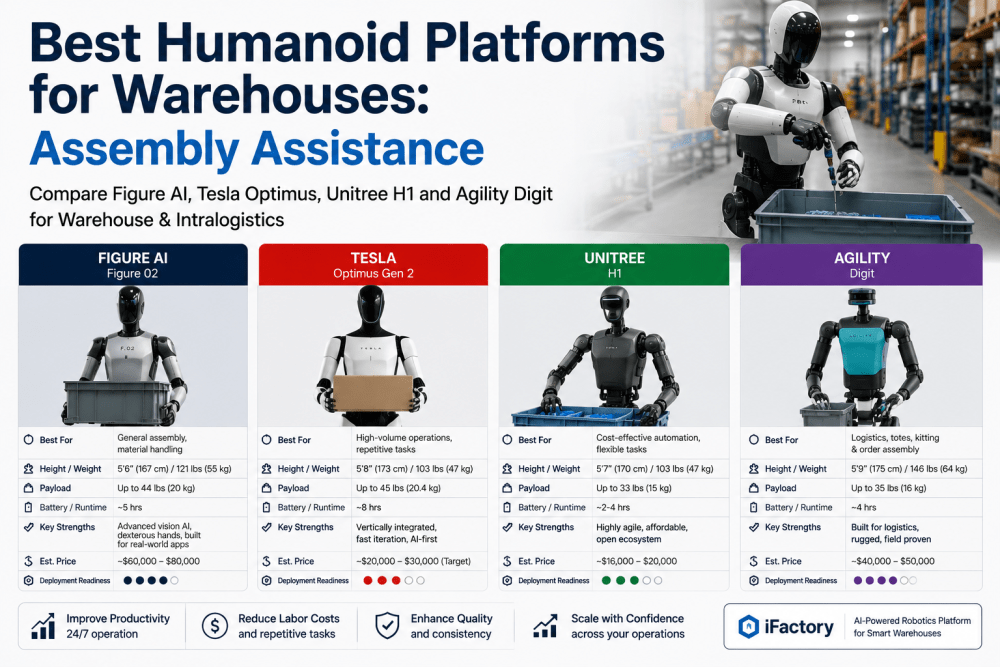
Warehouse and intralogistics operations managers evaluating humanoid platforms for assembly assistance face a rapidly maturing market with four leading contenders — Figure AI (Figure 02), Tesla Optimus (Gen 2), Unitree H1, and Agility Digit — each bringing distinct capabilities in dexterity, AI cognition, payload capacity, and operational autonomy to warehouse assembly workflows. As humanoid robots transition from research platforms to commercial deployment tools, logistics directors and automation engineers must assess which platform aligns with their specific assembly assistance requirements — precision kitting, machine tending, subassembly integration, and quality inspection — across diverse warehouse and distribution center environments. iFactory's industrial automation platform integrates with all four humanoid platforms, providing unified assembly workflow orchestration, performance analytics, and continuous improvement tracking. Book a Demo to evaluate which humanoid platform best supports your warehouse assembly assistance and intralogistics operations.
The Leading Humanoid Platforms for Assembly Assistance
Each humanoid platform approaches warehouse assembly assistance with distinct design philosophies, AI architectures, and deployment readiness levels. Understanding these differences is essential for operations executives and automation engineers evaluating which platform best fits their assembly workflow requirements. Warehouse managers assessing their options Book a Demo to review iFactory integration capabilities across all four platforms.
Head-to-Head Comparison — Assembly Capabilities
Selecting the right humanoid platform for warehouse assembly assistance requires evaluating each contender across the operational dimensions that matter most for intralogistics assembly workflows — dexterity, AI capability, payload, battery life, and integration readiness. The following comparison table provides a structured framework for warehouse automation engineers to assess how each platform addresses the critical requirements of assembly assistance in warehouse and distribution center environments.
| Capability Dimension | Figure 02 | Tesla Optimus G2 | Unitree H1 | Agility Digit |
|---|---|---|---|---|
| Height / Weight | 1.70 m / 60 kg | 1.73 m / 63 kg | 1.80 m / 47 kg | 1.75 m / 64 kg |
| Payload per Arm | 25 kg — highest in class for bimanual assembly tasks requiring heavy component manipulation | 10–15 kg — adequate for light assembly; optimized for rapid, repetitive pick-and-place workflows | ~15 kg per arm (30 kg total) — balanced payload for mixed assembly and material handling | 18 kg — proven for continuous subassembly operations with consistent force-controlled manipulation |
| Battery Life | 5 hours — enterprise-grade battery system with autonomous hot-swap capability for 24/7 operation | ~4 hours — leverages Tesla battery cell technology; charging infrastructure compatible with existing EV ecosystem | 2–4 hours — modular battery pack designed for rapid swap; best suited for shift-based operations | ~4 hours — production-validated battery life in continuous warehouse operation with scheduled charging cycles |
| AI / Cognition | Proprietary embodied AI with zero-shot task generalization, RL-based manipulation learning, and multi-modal perception fusion | Tesla FSD neural network adapted for warehouse perception with LLM integration for natural language task instruction | ROS 2 native architecture enabling custom AI stack integration; flexible but requires in-house ML engineering capability | Proprietary behavior-tree framework with cloud-based workflow programming; API-driven task sequencing for deterministic assembly execution |
| Precision & Force Control | Sub-millimeter repeatability with 6-axis force-torque sensing per wrist; tactile feedback for connector and fastener assembly | Vision-based precision ~1–2 mm; optimized for grasp-and-place assembly; force sensing through joint torque measurement | Moderate precision (~3–5 mm without external sensing); precision upgrades available through custom end-effector tooling | Sub-millimeter compliant manipulation with force-limiting safety for human-collaborative assembly; validated on snap-fit and peg-in-hole tasks |
| Navigation | Bipedal — stair and ladder capable; dynamic gait adaptation for uneven warehouse floor surfaces and ramps | Bipedal — basic stair capability; vision-based SLAM leveraging Tesla's mapping and localization stack | Bipedal — fastest locomotion (3.3 m/s); superior dynamic stability for unstructured warehouse environments | Bipedal — stair capable with production-validated navigation in active warehouse aisles and packing zones |
| Ecosystem & Integration | Enterprise API suite with WMS/MES connectors; remote operations center for fleet monitoring and exception handling | Tesla ecosystem integration; anticipated API ecosystem as deployment footprint expands within warehouse operations | Open ROS 2 architecture with SDK; direct WMS/MES integration through custom ROS nodes; requires robotics engineering team | Production-proven API with cloud-based Agility Arc platform; certified integrations with major WMS providers; longest operational track record |
Assembly Assistance Use Cases by Platform Strength
Each humanoid platform excels in specific warehouse assembly use cases, determined by its combination of dexterity, AI capability, payload capacity, and navigation characteristics. Warehouse operations leaders Book a Demo to review platform-specific use case mapping for their facility's assembly workflows.
Precision Component Assembly and Subassembly Integration — Humanoid robots bring unique value to precision assembly tasks requiring sub-millimeter accuracy combined with force-sensitive manipulation. Figure 02 leads in this category with its 6-axis force-torque wrist sensing and tactile feedback, enabling assembly operations such as connector mating, threaded fastener installation, and precision bearing insertion that would otherwise require dedicated automation cells. Agility Digit provides the most production-validated precision assembly capability with its compliant manipulation framework and force-limiting safety system, making it the preferred platform for human-collaborative assembly zones where workers and robots share workspace. Tesla Optimus leverages its FSD vision stack for visual-servo-based precision assembly, excelling at tasks where visual alignment and AI-driven grasp planning replace traditional mechanical fixturing. Unitree H1 addresses precision assembly through custom end-effector tooling and external vision systems, making it suitable for facilities with in-house engineering teams capable of developing application-specific precision tooling. iFactory's platform orchestrates precision assembly workflows across all four platforms, providing unified task scheduling, quality data capture, and continuous improvement analytics.
Dynamic Kitting and Mixed-Bin Picking for Assembly Lines — Kitting operations — assembling component kits for downstream assembly stations — represent the highest-volume humanoid application in warehouse environments today. Tesla Optimus excels at high-speed pick-and-place kitting with its FSD vision system providing rapid object recognition and grasp planning across diverse part geometries without fixture changeovers. Agility Digit's production-proven dual-arm coordination enables simultaneous pick-and-place operations, reducing kitting cycle time by 40–60% compared to single-arm robot configurations. Figure 02's higher payload capacity makes it ideal for kitting larger components — motors, gearboxes, and structural assemblies — that exceed the payload limits of other platforms. Unitree H1's ROS 2 native architecture enables custom kitting algorithms and integration with any vision system (pickit, Zivid, or proprietary), making it the most flexible platform for facilities with non-standard kitting workflows that require computer vision customization. iFactory's platform provides real-time kitting workflow orchestration, ensuring that each platform receives the correct kit assignments based on task complexity, component weight, and throughput requirements.
Machine Tending and Assembly Cell Loading/Unloading — Humanoid robots performing machine tending — loading and unloading assembly machines, presses, and test stations — combine the mobility to move between multiple machines with the manipulation dexterity to handle parts and tooling. Unitree H1's high-speed bipedal locomotion (3.3 m/s) makes it the fastest platform for multi-machine tending scenarios where the robot must traverse the floor between machine cells. Figure 02's superior payload capacity enables it to tend heavy machines — CNC routers, injection molding presses, and hydraulic forming equipment — that require component handling up to 25 kg per arm. Agility Digit's production-proven reliability and established safety certifications make it the preferred platform for machine tending in human-occupied manufacturing zones where safety-rated force limiting is required. Tesla Optimus leverages its neural network stack for adaptive machine tending — recognizing machine state indicators, loading parts into fixtures, and detecting process completion through vision-based monitoring. iFactory's machine tending module coordinates humanoid platform schedules with machine processing cycles, minimizing machine idle time through predictive arrival timing.
In-Line Quality Inspection and Assembly Verification — Beyond physical assembly tasks, humanoid robots provide mobile quality inspection capabilities that combine vision, thermal, and acoustic sensing with human-like mobility to verify assembly quality across multiple inspection stations. Agility Digit leads in production-validated inspection workflows, with published case studies demonstrating 99.2% defect capture rate on trained inspection operations. Figure 02's multi-modal perception system — combining RGB-D vision, thermal imaging, and acoustic sensors — enables comprehensive quality inspection that detects assembly defects invisible to single-sensor systems: incorrect fastener torque through acoustic signature analysis, thermal anomalies in assembled electronic components, and surface defects through high-resolution structured light scanning. Tesla Optimus leverages its vision neural network for rapid pass/fail inspection at production line speed, identifying assembly defects through learned visual patterns. Unitree H1's flexible payload architecture accommodates any inspection sensor payload, making it the most adaptable platform for facilities requiring custom quality inspection configurations. iFactory's quality intelligence platform aggregates inspection data from all humanoid platforms, applying ML-based trend analysis to identify emerging quality issues before they reach defect thresholds.
Evaluating ROI for Humanoid Assembly Deployments
The ROI timeline for humanoid robot deployments in warehouse assembly assistance varies significantly by platform choice, task complexity, deployment scale, and facility readiness. Understanding the cost elements and value drivers for each platform enables operations executives to make informed investment decisions aligned with their capital allocation frameworks and operational priorities. Warehouse managers evaluating deployment economics Book a Demo to receive a detailed ROI projection specific to their facility's assembly workflows and throughput requirements.
The ROI variance across platforms reflects fundamental trade-offs between capital cost, deployment speed, task complexity capability, and operational reliability. Figure 02 commands a premium price justified by its superior dexterity for complex assembly tasks that no other platform can automate, delivering value in high-mix, high-complexity environments. Tesla Optimus benefits from Tesla's manufacturing scale economics and ecosystem integration, with ROI projections improving as volume pricing matures. Unitree H1 delivers the fastest payback through aggressive pricing and rapid deployment, ideal for facilities seeking quick wins on simpler assembly tasks. Agility Digit offers the best risk-adjusted ROI through its production-proven reliability, established safety certifications, and fastest time-to-value for standard assembly applications. iFactory's platform maximizes ROI across all platforms by reducing integration time, optimizing task allocation, and providing real-time performance analytics that identify continuous improvement opportunities throughout the deployment lifecycle.
Expert Perspective — Selecting Humanoid Platforms for Warehouse Assembly
I have spent 18 years in warehouse operations and automation engineering — starting as a manufacturing engineer in automotive assembly, then moving through distribution center operations management, and for the last seven years serving as director of advanced automation for a Fortune 500 logistics provider operating 45 facilities across North America and Europe. When our team began evaluating humanoid platforms for assembly assistance in 2023, we ran structured pilot programs with three of the four platforms — Figure 02, Agility Digit, and Unitree H1. What we learned through 14 months of pilot operations was that the platform selection decision is fundamentally a task-matching exercise, not a platform quality assessment. Each platform has specific assembly tasks where it outperforms the others. Figure 02 dominates complex, high-precision assembly requiring tactile feedback and adaptive manipulation — it is the only platform that can reliably perform connector mating and threaded fastener assembly without custom fixturing. Agility Digit delivers the most predictable operational performance for standard assembly workflows — our Digit pilots showed 94% uptime over 6 months of continuous operation, with consistent quality metrics on kitting and subassembly tasks. Unitree H1 provided the fastest deployment cycle — 4 weeks from delivery to production operation for basic kitting workflows — at approximately one-third the cost of the other platforms. We are now deploying all three platforms in different roles across our network, unified through a common orchestration platform that assigns assembly tasks based on each platform's demonstrated strengths. The key lesson: do not standardize on a single humanoid platform too early. Deploy a pilot with two to three platforms on actual assembly workflows, measure performance against the specific tasks in your facility, and let the data drive your platform selection and allocation decisions.
— Director of Advanced Automation, Fortune 500 Logistics Provider — 18 Years in Assembly Operations and Warehouse Automation EngineeringConclusion
The humanoid robot market for warehouse assembly assistance has matured to offer four distinct commercial platforms — Figure AI's Figure 02, Tesla Optimus Gen 2, Unitree H1, and Agility Digit — each with specific strengths in dexterity, AI capability, payload capacity, and operational reliability. Figure 02 leads in precision assembly requiring tactile feedback and adaptive manipulation for complex assembly tasks. Tesla Optimus brings manufacturing scale economics and vision AI excellence to high-volume kitting and standard assembly workflows. Unitree H1 offers the fastest deployment cycle and lowest capital cost for facilities seeking rapid ROI on simpler assembly operations. Agility Digit provides the most production-proven reliability and fastest time-to-value for standard assembly applications with established safety certifications. The optimal approach for most warehouse operations is platform-agnostic task allocation — deploying two or more platforms based on specific assembly workflow requirements and measured performance data, unified through a centralized orchestration platform that assigns tasks to the best-suited platform for each operation.
iFactory's industrial automation platform provides the unified orchestration, performance analytics, and continuous improvement tracking layer that enables warehouse operators to deploy humanoid assembly platforms with confidence. The platform integrates with all four humanoid platforms, provides real-time workflow coordination, captures detailed task performance data, and applies ML-driven analytics to optimize platform-task matching over time. The next step for warehouse operations leaders is a humanoid platform assessment that evaluates your facility's assembly workflows, task complexity profile, throughput requirements, and integration readiness — delivering a data-driven recommendation for which platform or combination of platforms will deliver the best ROI for your specific warehouse assembly operations. Book a Demo to start your humanoid platform assessment and discover which assembly automation strategy best aligns with your warehouse operations goals.
Frequently Asked Questions
Figure AI's Figure 02 leads in precision assembly capability, offering sub-millimeter repeatability with 6-axis force-torque sensing per wrist and tactile feedback for tasks such as connector mating, threaded fastener installation, and precision bearing insertion. Agility Digit provides a close second with production-validated sub-millimeter compliant manipulation on snap-fit and peg-in-hole assembly tasks, combined with force-limiting safety for human-collaborative zones. The choice between the two depends on assembly complexity — Figure 02 excels at tasks requiring adaptive manipulation and real-time force feedback, while Digit provides more predictable operational performance for standardized precision assembly workflows with established safety certifications. iFactory's platform can integrate with either platform and provides detailed task performance data that helps facilities determine which precision assembly tasks are best suited to each platform's capabilities.
Humanoid robots and fixed cobots serve complementary roles in warehouse assembly. Fixed cobots offer higher precision (sub-micron), lower cost per station, and continuous operation at a single location, making them ideal for dedicated high-speed assembly operations with consistent part presentation. Humanoid robots bring mobility between multiple assembly stations, the ability to access parts from varied locations, and the dexterity to handle non-fixtured components requiring adaptive manipulation. In mixed-automation assembly cells, humanoid robots typically handle part transport, machine tending, and complex multi-step assembly while cobots perform high-speed repetitive operations within their fixed workspaces. The combination of humanoid mobility and cobot precision in a single assembly cell can achieve 60–70% cycle time reduction compared to either platform operating alone. iFactory's platform orchestrates both humanoid and cobot workflows in mixed-automation assembly cells, ensuring optimal task allocation and collision-free coordination between mobile and stationary robot types.
Deployment timelines vary significantly by platform and task complexity. Unitree H1 offers the fastest deployment cycle at 4–6 weeks from delivery to production for basic kitting workflows, leveraging its ROS 2 native architecture and lower task complexity requirements. Agility Digit typically deploys in 6–10 weeks for standard assembly workflows, including safety certification, workflow programming through its cloud-based API, and operator training — the fastest time-to-value for production-proven assembly operations. Figure 02 requires 10–14 weeks for complex assembly deployment, including task-specific AI model training, force-control calibration, and multi-step workflow programming. Tesla Optimus deployment timelines remain in development as the platform scales commercial availability. Across all platforms, iFactory's integration platform reduces deployment time by 20–30% through pre-built connectors, workflow templates, and standardized performance dashboards that eliminate custom integration development for each platform.
Yes, multi-platform humanoid deployments are increasingly common in large warehouse operations, and iFactory's platform is specifically designed to manage heterogeneous robot fleets with unified workflow orchestration. Figure 02, Tesla Optimus, Unitree H1, and Agility Digit can operate in the same facility when proper task allocation, traffic deconfliction, and charging station management protocols are in place. The key success factors are a centralized orchestration platform that assigns assembly tasks to the best-suited platform based on task requirements and real-time availability, clearly defined operational zones with standardized humanoid traffic management, and a unified data platform that captures performance metrics from all platforms for continuous improvement analysis. Most multi-platform deployments begin with a single platform for initial assembly workflows and add additional platforms as specific task requirements emerge, using the common orchestration layer to manage allocation across the growing fleet. iFactory's platform provides the multi-vendor orchestration, integration, and analytics layer that enables seamless multi-platform humanoid operations.
The skill requirements vary significantly by platform. Agility Digit and Figure 02 offer the most accessible deployment models — Agility's cloud-based programming environment enables assembly workflow definition through a visual interface requiring minimal robotics expertise, while Figure 02's enterprise API allows integration teams to define tasks through high-level workflow specifications without low-level motion programming. Both platforms include vendor-provided deployment support and operator training programs. Unitree H1 requires the most in-house technical capability — its ROS 2 native architecture provides maximum flexibility but requires skilled robotics engineers to develop custom manipulation routines, vision system integration, and assembly workflow programming. Tesla Optimus aims to leverage its FSD ecosystem's ease-of-use paradigm, but commercial deployment documentation remains limited pending wider availability. Across all platforms, iFactory's platform reduces the technical skill barrier by providing pre-built workflow templates, standardized API connectors, and visual workflow orchestration tools that enable facilities to deploy humanoid assembly assistance without specialized robotics engineering teams.
.png)