.png)
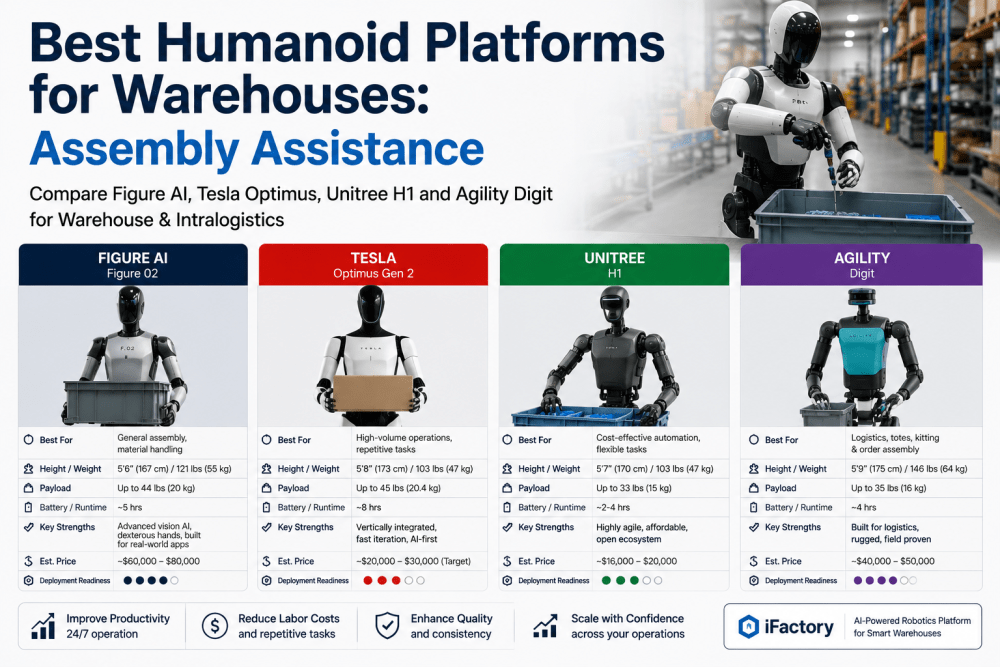
Pharmaceutical manufacturing requires precision, repeatability, and strict regulatory compliance across every assembly operation — from vial filling and syringe assembly to blister packaging and device kitting. Humanoid robots — Figure AI, Tesla Optimus, Unitree H1, and Agility Digit — are entering pharmaceutical production environments to support assembly tasks that combine the dexterity of human operators with the consistency and endurance of automated systems. These platforms perform pick-and-place operations, collaborative assembly tasks, material transport, and visual quality inspection — reducing repetitive manual labor, improving throughput consistency, and enabling pharmaceutical manufacturers to scale production without proportional headcount increases. iFactory's Robotics integration platform connects humanoid robot data directly to your MES, CMMS and quality systems — enabling assembly assistance workflows that are compliant, traceable, and production-ready without requiring changes to your existing pharmaceutical manufacturing infrastructure.
01 / The Assembly Challenge in Pharmaceutical Manufacturing
Pharmaceutical assembly operations involve hundreds of discrete manual tasks performed under strict cGMP conditions — vial filling, syringe assembly, label application, device kitting, blister packaging, and visual inspection. These tasks require fine motor dexterity, sustained attention to detail, and the ability to adapt to product variations. Human operators excel at the adaptability but face inherent limitations in speed consistency, fatigue management, and throughput scalability. As pharmaceutical manufacturers face increasing demand for personalized medicine, combination products, and faster time-to-market, the assembly line must achieve both higher throughput and zero-defect quality — a combination that is increasingly difficult with manual assembly alone. Book a Demo to discuss how humanoid robot assembly assistance addresses these pharmaceutical manufacturing challenges.
| Assembly Challenge | Impact on Operations | Humanoid Robot Solution |
|---|---|---|
| Repetitive Manual Tasks | Operators perform thousands of repetitive pick-place-verify cycles per shift — leading to fatigue-induced errors and throughput variability across shifts | Humanoid robots handle repetitive pick-and-place and transfer operations with consistent cycle times — reducing operator fatigue and throughput variation by 40-60% |
| Skilled Labor Availability | Pharmaceutical assembly requires trained operators who understand cGMP requirements — recruitment and training cycles take 4-8 weeks per operator | Pre-programmed assembly workflows replicate trained operator movements without training lag — new product lines deploy in days instead of weeks |
| Quality Documentation | Manual assembly requires documented operator verification at each step — paper-based or digital records that add cycle time without adding value | Automated data capture from every assembly cycle — sensor-verified completion, time-stamped, and directly recorded in the MES for full traceability |
| Scalability Constraints | Scaling manual assembly requires hiring, training, and qualifying additional operators — capacity increases are delayed by 8-12 weeks | Additional robot units replicate proven assembly workflows instantly — capacity scales with hardware deployment, not recruitment cycles |
| Ergonomic Risk | Repetitive assembly tasks cause upper extremity strain injuries — pharmaceutical manufacturers report 15-25% annual ergonomic incident rates in assembly areas | Robots perform high-repetition tasks, eliminating ergonomic risk exposure for human operators — who are redeployed to oversight and exception-handling roles |
02 / How Humanoid Robots Enable Assembly Assistance in Pharmaceutical Manufacturing
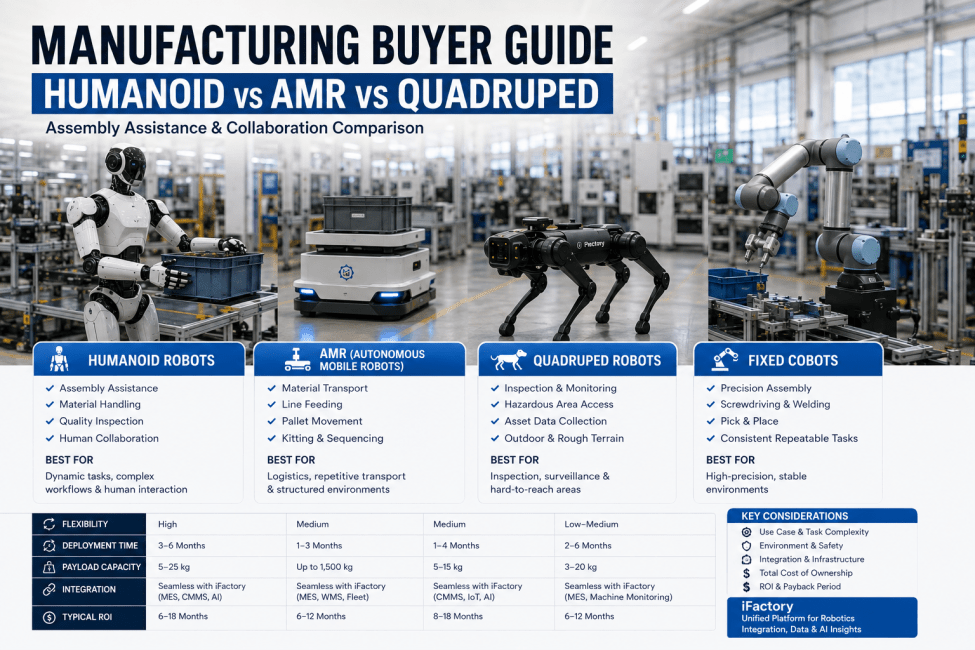
Humanoid robots deployed for pharmaceutical assembly assistance perform collaborative tasks alongside human operators — handling material transfer, component placement, visual inspection, and packaging operations while maintaining the flexibility to adapt to product changeovers and line reconfigurations. Unlike fixed automation systems that require dedicated floor space and long changeover times, humanoid robots operate within existing production layouts, use the same tools and fixtures as human operators, and can be reassigned between assembly stations based on production demand. Book a Demo to explore the assembly assistance workflow for your pharmaceutical manufacturing environment.
Component Handling: Humanoid robots perform pick-and-place operations for pharmaceutical assembly components — vials, syringes, cartridges, needles, plungers, and packaging inserts. The robot's dexterous manipulators handle components with the precision required for pharmaceutical assembly, including delicate glass vials and sterile syringe components that cannot tolerate surface contact or impact.
Vision-Guided Placement: Integrated vision systems verify component orientation, presence, and correct placement before each assembly step is completed. The vision data is recorded in the MES as a quality attribute — providing documented evidence of correct assembly for each unit produced. When the vision system detects a component defect or misplacement, the robot automatically segregates the affected unit and alerts the operator for review.
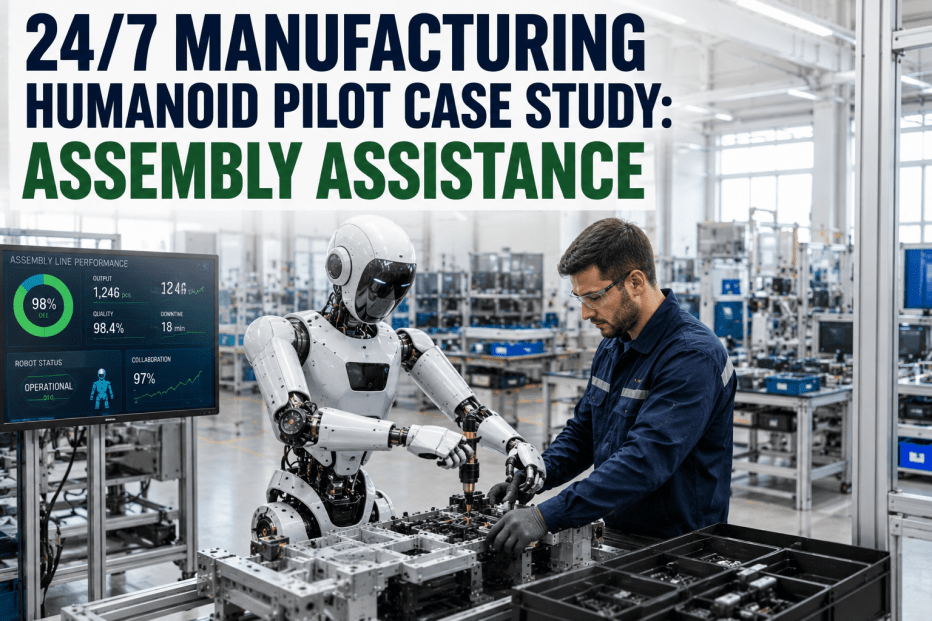
Collaborative Workcells: Humanoid robots operate in shared workspaces with human operators, handling the repetitive transfer and placement tasks while operators focus on exception handling, quality verification, and process monitoring. The robot's sensors detect operator presence and adjust movement speed and force to ensure safe collaboration without requiring physical barriers or safety cages.
Adaptive Task Allocation: When production demand shifts or operator availability changes, assembly tasks are dynamically reallocated between human and robot team members. During peak production periods, the robot handles additional assembly steps to maintain throughput. During product changeovers, the robot adapts to new component geometries and assembly sequences through software reconfiguration rather than tooling changes — reducing changeover time from hours to minutes.
Automated Batch Records: Every assembly cycle performed by the humanoid robot generates a structured data record — component identifiers, cycle timestamps, vision inspection results, and task completion confirmation. This data feeds directly into the electronic batch record system, eliminating the need for manual documentation and reducing data entry errors. The automated batch record provides auditors with complete, time-stamped evidence of every assembly operation.
cGMP Compliance: Humanoid robot assembly workflows are designed to comply with 21 CFR Part 11 requirements for electronic records and signatures. Validation documentation is generated during deployment, and the platform supports revalidation after software updates or workflow changes. The robot's clean room compatible design — sealed joints, smooth surfaces, and HEPA-filtered internal airflow — enables operation in ISO 7 and ISO 8 classified environments without introducing particulate contamination.
03 / Key Capabilities and Measured Impact — Assembly Assistance in Pharma
Pharmaceutical manufacturers evaluating humanoid robot assembly assistance need a clear understanding of the platform capabilities that directly enable productivity improvement, quality compliance, and operational flexibility. The following capabilities and metrics distinguish production-grade humanoid robot integration from pilot-stage automation trials.
| Capability | Description | Impact on Pharmaceutical Operations |
|---|---|---|
| Vision-Guided Assembly | Integrated RGB-D cameras and AI-based object detection verify component orientation, presence, and correct placement before each assembly step | Zero-defect assembly verification — each unit is inspected at every assembly step with documented evidence for batch records |
| Force-Controlled Manipulation | Force-torque sensors in the robot's end effectors enable delicate handling of glass vials, syringes, and sterile components without damage | Component damage rates reduced to near zero — glass breakage, surface scratches, and component deformation eliminated |
| Clean Room Certification | Sealed joint design, smooth external surfaces, and HEPA-filtered internal airflow enable operation in ISO 7 and ISO 8 classified environments | Direct deployment in classified production areas without additional enclosures or room modifications |
| MES / CMMS Integration | Real-time data feed from every assembly cycle to MES, CMMS, and electronic batch record systems — no manual data entry required | Complete traceability with zero documentation overhead — audit-ready data for every batch produced |
| Rapid Changeover | Software-based workflow reconfiguration for product changeovers — no mechanical tooling changes required for component geometry variations | Changeover time reduced from 2-4 hours to 15-30 minutes — enabling smaller batch sizes and faster product transitions |
04 / Implementation Roadmap — Deploying Humanoid Robot Assembly Assistance in Pharma
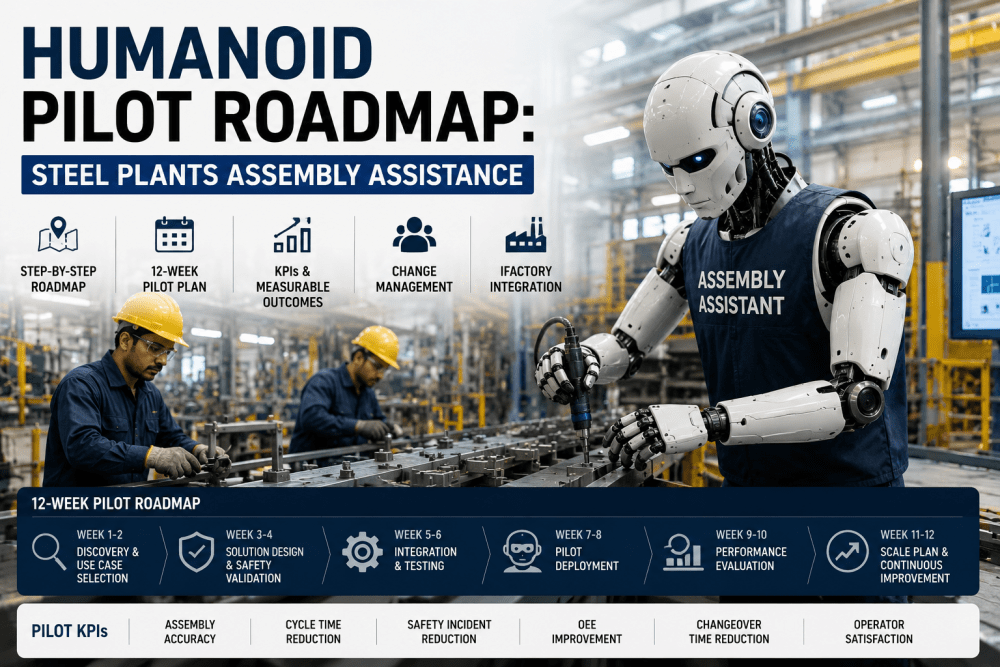
Deploying humanoid robot assembly assistance in pharmaceutical manufacturing follows a phased implementation roadmap designed to deliver measurable productivity improvements while maintaining full cGMP compliance throughout the deployment process. The approach prioritizes rapid value demonstration in a defined pilot area before scaling across the manufacturing facility.
- Review current assembly workflows and task taxonomy
- Identify high-value tasks for robot assistance
- Define productivity and quality KPIs
- Select humanoid platform based on task requirements
- Clean room compatibility testing
- MES/CMMS integration configuration
- Install robot in pilot assembly workcell
- Process performance qualification (PQ)
- Operator training and workflow integration
- Deploy additional robots to adjacent workcells
- Cross-line workflow standardization
- Continuous productivity KPI monitoring
05 / Measured Outcomes — Assembly Assistance Impact in Pharmaceutical Manufacturing
Humanoid robot assembly assistance deployments across pharmaceutical manufacturing environments have demonstrated consistent improvements in throughput consistency, quality compliance, and operator productivity. The following outcomes reflect documented results from collaborative humanoid implementations in cGMP-regulated production environments.
| Performance Metric | Baseline (Manual Assembly) | Humanoid Robot Assistance Target | Projected Improvement |
|---|---|---|---|
| Throughput Consistency | 15-25% cycle time variation across shifts — operator fatigue and experience level drive variability | 2-5% cycle time variation — consistent performance regardless of shift, duration, or operator assignment | 40-60% reduction in throughput variation — predictable output per shift for production planning |
| Quality Defect Rate | 0.5-2.0% defect rate on repetitive assembly tasks — component misplacement, orientation errors, surface damage | 0.1-0.3% defect rate — vision-verified assembly with force-controlled component handling | 70-85% reduction in assembly-related quality defects |
| Ergonomic Incident Rate | 15-25% annual ergonomic incident rate in assembly areas — repetitive strain injuries from pick-place-verify cycles | Near-zero ergonomic incidents — robot handles high-repetition tasks; operators perform oversight and exception handling | 80-95% reduction in ergonomic strain injuries in assembly operations |
| Changeover Time | 2-4 hours per product changeover — tooling changes, operator retraining, line clearance, and first-off inspection | 15-30 minutes — software-based workflow reconfiguration with no mechanical tooling changes required | 85-90% reduction in changeover time — enabling smaller batch sizes and faster product transitions |
| New Line Ramp-Up Time | 8-12 weeks from line install to full production — operator training, qualification, and throughput optimization | 2-4 weeks — pre-programmed workflows replicate proven assembly sequences with minimal on-site tuning | 60-75% reduction in new line ramp-up time |
Expert Review — A Pharmaceutical Manufacturing Leader's Perspective on Humanoid Robot Assembly Assistance
Over 17 years leading pharmaceutical manufacturing operations across solid dose, injectable, and combination product lines, I have observed that the assembly area is consistently the most labor-intensive and quality-critical part of the production process. Our manual assembly lines achieve acceptable quality but at the cost of high operator training overhead, significant throughput variability between shifts, and persistent ergonomic challenges that drive turnover and workers compensation costs. When we evaluated humanoid robots for assembly assistance, I was skeptical that they could match the dexterity and adaptability of trained operators for pharmaceutical components. After a 90-day pilot deployment on a syringe assembly line, the results changed my perspective. The robot handled component transfer, needle shield placement, and visual inspection with cycle time variation below 5% — compared to our manual line variation of 22%. The vision verification at each assembly step provided documented quality evidence that simplified our batch record review process. Our operators were redeployed from repetitive pick-place tasks to oversight and exception-handling roles that they found more engaging and less physically demanding. For pharmaceutical manufacturing leaders evaluating humanoid robot assembly assistance, the technology is ready for cGMP production — the key is selecting the right tasks for robot assistance and integrating the data flow into your existing quality systems.
Conclusion — Humanoid Robot Assembly Assistance Delivers Measurable Productivity and Quality Improvements for Pharmaceutical Manufacturing
Pharmaceutical manufacturing leaders responsible for assembly operations face increasing pressure to improve throughput, maintain zero-defect quality, and manage labor costs — all within the constraints of cGMP regulatory requirements. Humanoid robot assembly assistance addresses these competing demands by handling repetitive, high-precision assembly tasks with consistent cycle times, vision-verified quality, and automated batch record documentation. The documented outcomes from pharmaceutical deployments demonstrate 40-60% improvements in throughput consistency, 70-85% reductions in assembly-related defects, and 85-90% faster product changeovers. The iFactory Robotics integration platform connects any humanoid robot platform to your existing MES, CMMS, and quality systems — enabling assembly assistance workflows that are compliant, traceable, and production-ready without requiring changes to your pharmaceutical manufacturing infrastructure. Book a Demo to schedule a pharmaceutical automation assessment and discover how humanoid robot assembly assistance can improve productivity and quality in your manufacturing operations.
Frequently Asked Questions — Humanoid Robots for Pharmaceutical Assembly Assistance
Current-generation humanoid robots from Figure AI, Agility Digit, and Tesla Optimus are designed with sealed joints, smooth external surfaces, and internal cooling systems that minimize particulate generation. For ISO 7 and ISO 8 classified environments (Class 10,000 and Class 100,000), these platforms can operate directly in the production area after appropriate cleaning and gowning protocols. For ISO 5 environments (Class 100) required for aseptic filling operations, additional enclosure or integration with existing isolator technology may be required. iFactory's deployment team conducts a clean room compatibility assessment during the platform selection phase to ensure the chosen robot meets your specific classified area requirements. The assessment includes particulate emission testing, surface material compatibility review, and cleaning protocol validation to support regulatory filing.
The iFactory integration platform connects humanoid robot assembly data directly to your existing MES, electronic batch record, and CMMS systems through pre-built connectors supporting REST API, OPC-UA, and SQL database interfaces. Every assembly cycle generates a structured data record — component identifiers, cycle timestamps, vision inspection results, force-torque measurements, and task completion status — that is written directly to the MES in real time. This eliminates manual data entry and ensures that the electronic batch record contains complete, time-stamped evidence of every assembly operation. The data integration layer supports 21 CFR Part 11 compliance requirements for electronic records, including audit trails, secure data storage, and electronic signature capabilities. Integration is typically completed during Phase 2 of deployment without modifications to existing MES software.
Humanoid robots are best suited for assembly tasks that combine repetitive motion with precision placement and visual verification — exactly the type of work that causes operator fatigue and ergonomic strain in manual assembly. High-value tasks for robot assistance include vial and syringe pick-and-place operations, needle shield placement and removal, label application and verification, component transfer between assembly stations, blister card loading and inspection, and device kitting operations for combination products. Tasks requiring complex decision-making, unusual component geometries, or direct patient-contact assembly steps are typically retained by human operators with robot assistance for material handling and preparation. iFactory's assessment methodology includes a task taxonomy review that identifies the optimal balance between robot-assisted and manual operations for each assembly line.
The validation timeline for humanoid robot assembly assistance follows standard pharmaceutical equipment qualification protocols — installation qualification (IQ), operational qualification (OQ), and performance qualification (PQ). The typical timeline from deployment start to validated production status is 8-12 weeks. IQ is completed during Phase 2 (weeks 3-4) and verifies that the robot is installed correctly, all sensors are calibrated, and data integration with MES and quality systems is functioning. OQ spans Phase 3 (weeks 5-6) and demonstrates that the robot performs each assembly step within defined parameters across the full range of operating conditions. PQ runs through the pilot deployment period (weeks 7-10) and verifies consistent performance at production volumes. The validation documentation package includes the robot configuration specification, calibration certificates, software version records, integration test results, and performance data — providing regulators with complete evidence of the robot's fitness for its intended use in pharmaceutical assembly.
Humanoid robot assembly assistance is designed to augment — not replace — the pharmaceutical assembly workforce. The robot handles the repetitive, high-volume pick-and-place and transfer tasks that cause operator fatigue, ergonomic strain, and quality variability. Assembly operators are redeployed from performing these repetitive tasks to overseeing robot operation, handling exceptions (component defects, equipment jams, product variations), performing visual verification of completed assemblies, and managing changeover and line clearance procedures. This role evolution typically increases operator job satisfaction by reducing physical strain and providing more engaging, problem-solving work. Most pharmaceutical manufacturers that deploy humanoid robot assembly assistance report that affected operators prefer the redeployed role, which leverages their cGMP knowledge and quality focus while eliminating the physical demands of repetitive manual assembly. The transition is supported by a structured training program that covers robot monitoring, exception handling, and basic troubleshooting.