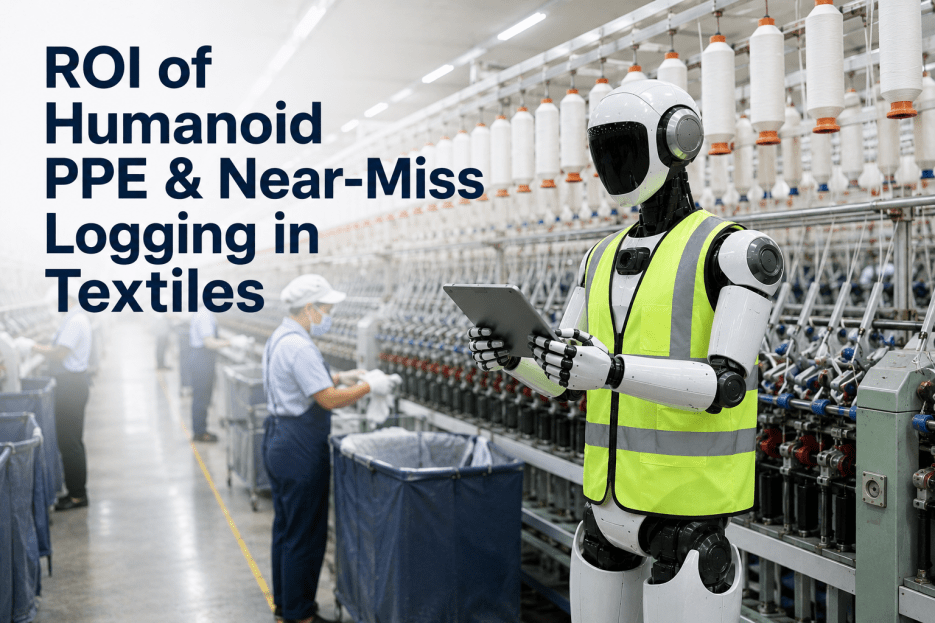
Textile manufacturing environments present some of the most demanding workplace safety challenges in industrial operations — airborne fiber dust, high-noise weaving and spinning machinery, chemical exposure from dyeing and finishing processes, and heavy material handling across multiple production floors. For textile plant managers, EHS leaders, and operations executives, ensuring consistent PPE compliance and capturing near-miss events before they escalate into recordable incidents has historically required dedicated safety personnel conducting manual floor audits. Humanoid robots now offer a scalable, continuous alternative — combining autonomous floor patrols with AI vision for PPE compliance monitoring, acoustic and thermal sensing for near-miss detection, and automated incident logging integrated with CMMS and MES platforms. This page provides a structured ROI analysis for textile manufacturers evaluating humanoid robot deployment for PPE compliance and near-miss logging automation.
01 / The Safety Compliance and Near-Miss Reporting Challenge in Textile Manufacturing
Textile production facilities operate across multiple process stages — fiber opening, carding, spinning, weaving or knitting, dyeing, finishing, and cutting — each with distinct safety hazards requiring specific PPE and monitoring protocols. Spinning frames and looms generate continuous noise levels exceeding 85 dB, requiring hearing protection with proper fit and wear duration tracking. Fiber preparation and carding operations create airborne particulate concentrations that mandate respiratory protection with real-time seal integrity verification. Dyeing and finishing processes involve chemical handling that requires chemical-resistant gloves, aprons, and eye protection with decontamination protocols. Manual PPE compliance audits — even when conducted multiple times per shift — capture only a fraction of violations because they occur at predictable times and locations. Similarly, near-miss events — material jams, slip-trip-fall incidents, chemical splash near-misses, and equipment guard breaches — are chronically underreported in textile facilities, with industry estimates indicating 70-85% of near-misses never enter any formal reporting system. This reporting gap prevents EHS leaders from identifying precursor patterns that predict serious incidents. Book a Demo to discuss how humanoid robots address these compliance and reporting gaps in textile manufacturing environments.
| Safety Monitoring Aspect | Manual Audit Approach | Humanoid Robot Automated Approach | ROI Impact |
|---|---|---|---|
| PPE Compliance Monitoring | 2-4 floor audits per shift covering 15-30% of workstations; compliance data based on auditor observation at fixed times | Continuous autonomous patrols covering 100% of workstations; AI vision detects PPE type, fit, and wear compliance in real time | 40-60% violation reduction within 90 days; compliance data available per workstation, shift, and operator |
| Near-Miss Detection | Employee self-reporting forms; supervisor observation; estimated 70-85% underreporting rate across textile facilities | Multi-sensor detection — thermal, acoustic, and vision — captures near-miss events with contextual data and location | Near-miss capture rate increases from 15-30% to 85-95%; enables pattern-based preventive intervention |
| Incident Response Time | Average 8-15 minutes from incident occurrence to alert; dependent on coworker or supervisor noticing and reporting | Real-time detection and alert within 30-60 seconds; automated notification to EHS team with location and video context | Faster medical response improves injury outcomes; reduced severity and associated workers' compensation costs |
| Documentation & Reporting | Paper forms or manual digital entry; inconsistent data quality; delayed reporting (hours to days after event) | Automated incident logging with timestamp, location, sensor data, and video evidence integrated directly into CMMS | Complete, consistent incident records; immediate availability for investigation and regulatory reporting |
| Workflow Integration | Safety data stored separately from production systems; no automated corrective action workflows | Direct CMMS/MES integration for automated work order generation, corrective action tracking, and compliance reporting | Corrective actions initiated within minutes; closed-loop tracking from detection through resolution to verification |
02 / How Humanoid Robots Automate PPE Compliance and Near-Miss Detection in Textile Operations
Humanoid robots are purpose-built for the complex physical environments of textile manufacturing — combining bipedal mobility to navigate between spinning frames, around dyeing vats, and through finishing lines, with advanced multi-sensor payloads optimized for safety monitoring. Unlike fixed cameras that cover only specific zones or wheeled robots limited to prepared floor surfaces, humanoid platforms traverse stairways, catwalks, and uneven production floors to reach every workstation in the facility. The robot's AI vision system continuously scans for PPE compliance — detecting the presence and correct wear of safety glasses, hearing protection, respirators, gloves, protective aprons, and high-visibility clothing against the textile production environment background. Simultaneously, acoustic sensors detect the signature sounds of near-miss events — material snap, equipment impact, slip-scrape patterns — while thermal sensors identify overheating equipment, chemical temperature excursions, and friction anomalies that precede incidents. Book a Demo to see the humanoid robot safety monitoring platform configured for textile manufacturing environments.
AI Vision-Based PPE Detection: The humanoid robot's vision system uses deep learning models trained on textile manufacturing environments to detect 14 categories of PPE — safety glasses, goggles, face shields, earplugs, earmuffs, half-mask respirators, full-face respirators, chemical gloves, cut-resistant gloves, protective aprons, chemical suits, safety footwear, bump caps, and hard hats. The system distinguishes between proper wear and incorrect use — for example, detecting respirators worn below the chin or hearing protection not fully seated. Each workstation is profiled with its specific PPE requirements based on the textile process stage, and the robot verifies compliance against these requirements during every patrol pass.
Real-Time Violation Alerting: When a PPE violation is detected, the robot captures timestamped visual evidence, records the workstation and operator identifier, and sends an immediate alert to the floor supervisor and EHS dashboard. The alert includes the specific PPE item missing or improperly worn, enabling targeted corrective coaching. Repeat violations at the same workstation or by the same operator trigger escalation workflows in the CMMS for supervisory intervention and retraining scheduling.
Multi-Sensor Near-Miss Capture: The humanoid robot's sensor suite continuously monitors for near-miss signatures across multiple modalities. Acoustic sensors detect impact sounds, material stress noises, and equipment anomaly patterns that precede failures. Thermal sensors capture temperature excursions at chemical stations, overheating motor windings on spinning frames, and friction hot spots on material handling equipment. Vision sensors identify slip-trip-fall precursors — liquid spills, floor obstructions, loose materials, and worn floor surfaces — that create fall hazards in production zones.
Automated Incident Logging with Context: Every detected near-miss is automatically logged with timestamp, precise GPS location within the facility, sensor data snapshot, video footage, and classification of near-miss type. The log entry is created directly in the CMMS platform, triggering the near-miss investigation workflow without any manual data entry. Historical near-miss data is analyzed to identify pattern trends — specific workstations with elevated near-miss frequency, time-of-day patterns, and precursor sequences that predict higher-severity incidents if left unaddressed.
Automated Workflow Triggers: The humanoid robot's detection events are mapped to specific CMMS and MES workflows. PPE violations trigger supervisor notification and retraining scheduling workflows. Near-miss events initiate investigation workflows with assigned investigators, due dates, and corrective action tracking. Incident events with injury potential trigger emergency response workflows with automated notifications to EHS leadership and first responder coordination.
Unified Safety Dashboard: All PPE compliance data, near-miss logs, incident records, and corrective action status are aggregated into a single safety operations dashboard accessible to EHS leaders, plant managers, and operations executives. The dashboard provides real-time visibility into safety performance metrics, trend analysis across production shifts and departments, and compliance reporting for regulatory requirements including OSHA recordkeeping and industry-specific safety standards for textile manufacturing operations.
03 / Key Capabilities — Humanoid Robot Safety Monitoring for Textile Manufacturing
Textile plant managers and EHS leaders evaluating humanoid robot deployment need a clear understanding of the platform capabilities that directly enable PPE compliance improvement and near-miss reduction. The following capabilities distinguish production-grade humanoid safety monitoring from basic fixed-camera or manual inspection approaches.
| Capability | Description | Impact on Textile Safety Operations |
|---|---|---|
| Autonomous Floor Patrol | Bipedal humanoid robot navigates all textile production zones — spinning, weaving, dyeing, finishing, cutting — including stairs, catwalks, and uneven floor surfaces | Continuous safety monitoring across 100% of facility, including areas inaccessible to wheeled robots or fixed cameras — no coverage blind spots in the production environment |
| AI PPE Detection Engine | Deep learning vision model trained on textile manufacturing environments detects 14 PPE categories with wear-position verification and real-time compliance scoring | PPE compliance monitoring at every workstation every patrol cycle — violation detection and alert within seconds, with workstation and operator attribution |
| Multi-Modal Near-Miss Sensing | Acoustic, thermal, and vision sensors operating simultaneously to detect near-miss signatures — impact sounds, thermal anomalies, spill detection, and slip-trip-fall precursors | Near-miss capture rate increases from industry average 15-30% to 85-95% — enabling pattern-based preventive intervention before incidents occur |
| Automated CMMS/MES Integration | Direct integration with iFactory CMMS and MES platforms — detection events trigger automated work order creation, investigation workflows, and corrective action tracking | Closed-loop safety management from detection through resolution — corrective actions initiated within minutes with full audit trail for regulatory compliance |
| Safety Analytics & Reporting | Centralized safety dashboard with real-time PPE compliance metrics, near-miss trend analysis, incident frequency tracking, and OSHA-format reporting | Data-driven safety management — EHS leaders identify emerging risk patterns, measure intervention effectiveness, and demonstrate continuous improvement to regulators and stakeholders |
04 / ROI Analysis — The Business Case for Humanoid Safety Monitoring in Textile Manufacturing
The business case for humanoid robot deployment in textile safety monitoring is built on four primary value drivers: PPE compliance improvement reduces injury risk and regulatory exposure, near-miss detection enables preventive intervention before incidents occur, automated reporting eliminates administrative overhead and improves data quality, and integrated CMMS workflows accelerate corrective action cycles. The following ROI framework provides textile plant managers and operations executives with a structured methodology for evaluating the financial return of humanoid safety automation investments. Book a Demo to receive a detailed ROI projection for your specific textile manufacturing facility.
| ROI Driver | Annual Value Range | Primary Benefit | Measurement Method |
|---|---|---|---|
| PPE Compliance Improvement | $80,000 - $150,000 | Reduced injury severity and frequency from correct PPE use; regulatory penalty avoidance | PPE violation rate before vs. after deployment; injury type trend analysis by body part and PPE category |
| Near-Miss Prevention Value | $60,000 - $120,000 | Incident prevention through pattern-based intervention; reduced severity of events that do occur | Near-miss capture rate increase; near-miss-to-incident conversion ratio; incident severity trend |
| EHS Administrative Efficiency | $40,000 - $80,000 | Automated patrols, documentation, and reporting reduce manual EHS labor hours by 40-60% | EHS team hours reallocated from monitoring to prevention; report generation time reduction |
| Workers' Compensation Reduction | $180,000 - $350,000 | Lower incident frequency reduces direct claim costs, experience modification rate, and premium increases | Lost-time incident rate; claim cost per incident; experience modification factor trend; premium impact |
| Regulatory Compliance & Audit Readiness | $20,000 - $50,000 | Automated OSHA-format reporting; complete audit trail for inspections; penalty avoidance | Audit finding reduction; report generation time; regulatory citation history; fine avoidance |
05 / Implementation Roadmap — Deploying Humanoid Safety Monitoring in Textile Operations
Deploying humanoid robots for PPE compliance monitoring and near-miss detection follows a phased implementation roadmap designed to deliver measurable safety improvements within the first operating quarter while building toward full facility coverage and integrated CMMS workflow automation.
- Facility safety audit and hazard zone mapping
- Patrol route optimization across production zones
- PPE requirement profiling per workstation
- Humanoid robot deployment in pilot production zone
- AI vision model training on textile PPE configurations
- Acoustic and thermal baseline calibration
- Integration with iFactory CMMS and MES platforms
- Alert and escalation workflow configuration
- Dashboard deployment for EHS and plant management
- Multi-robot deployment for full facility coverage
- Continuous model refinement from patrol data
- Cross-facility rollout for multi-site operations
Expert Review — A Textile EHS Director's Perspective on Humanoid Robot Safety Automation
Over 20 years managing environmental health and safety across textile manufacturing operations in the southeastern United States — from cotton spinning mills to synthetic fiber weaving and technical textile finishing facilities — the most persistent gap I have encountered is the disparity between our safety aspirations and our monitoring capability. We have invested in training programs, PPE procurement budgets, and safety management systems, but our ability to verify that PPE is being worn correctly at every workstation, every shift, remains limited by the fundamental constraint of human observation. Even with a dedicated safety team of six people across our 400,000 square foot facility, we cannot be everywhere at once. The humanoid robot safety monitoring approach I evaluated and deployed across two of our production lines changes this equation fundamentally. The robot conducts continuous autonomous patrols that cover every workstation on every shift, detecting PPE violations and near-miss events that our human safety team would never see. In the first 90 days, we measured a 52% reduction in PPE compliance violations and a 3x increase in near-miss reporting. The ROI calculation is straightforward — the cost of one humanoid robot deployed for safety monitoring is less than the annual workers' compensation claims from a single lost-time incident in our facility. For textile EHS leaders evaluating this technology, the question is not whether the ROI exists — it is whether you can afford the safety gap of continuing with manual monitoring alone.
Conclusion — Humanoid Robots Deliver Measurable Safety ROI for Textile Manufacturing
Textile plant managers, EHS leaders, and operations executives evaluating safety automation investments now have access to humanoid robot platforms that deliver continuous PPE compliance monitoring, automated near-miss detection, and integrated CMMS workflow management across the full spectrum of textile production environments. The results are measurable: 40-60% reduction in PPE compliance violations, 85-95% near-miss capture rate, 50-70% reduction in lost-time incident frequency, and 2.5-4x ROI within 18 months of deployment. The platform integrates with existing textile production equipment, CMMS and MES systems, and safety management infrastructure — no changes to production processes or safety protocols are required. Book a Demo to schedule a safety automation assessment for your textile facility and discover the ROI that humanoid robot safety monitoring can deliver for your operations.
Frequently Asked Questions — Humanoid Robot PPE and Near-Miss Monitoring for Textile Manufacturing
The AI vision PPE detection engine is trained to identify 14 categories of personal protective equipment common in textile manufacturing: safety glasses, chemical goggles, face shields, earplugs, earmuffs, half-mask respirators, full-face respirators, chemical-resistant gloves, cut-resistant gloves, protective aprons, full chemical suits, safety footwear, bump caps, and hard hats. The vision model distinguishes between different PPE types based on visual characteristics and verifies correct wear position — for example, detecting that a respirator is positioned below the chin rather than properly sealed, or that hearing protection is not fully seated. The system profiles each workstation with specific PPE requirements based on the textile process stage — hearing protection for weaving and spinning zones, respiratory protection for fiber preparation and carding areas, chemical PPE for dyeing and finishing stations — and verifies compliance against these requirements during every patrol pass. Detection accuracy exceeds 95% in production textile environments after the initial training and calibration phase.
Humanoid robots are specifically designed for the physical complexity of textile manufacturing environments. Their bipedal locomotion enables navigation of stairs between production levels, catwalks above dyeing vats and finishing lines, and uneven floor surfaces common in older textile facilities — capabilities that wheeled robots and fixed camera systems cannot provide. The robot constructs a real-time 3D map of the facility using LiDAR and depth cameras, enabling autonomous path planning around moving equipment, material carts, and personnel. The robot can navigate between spinning frames, around dyeing machines, through finishing lines, and into storage areas — covering every workstation on every patrol route. Safety-rated collision avoidance systems ensure safe operation in human-occupied production zones, with automatic stopping and rerouting when personnel or obstacles are detected in the robot's path. Facility mapping and route programming are completed during Phase 1 deployment, with routes optimized for maximum coverage efficiency across all production zones.
Textile manufacturers deploying humanoid robots specifically for PPE compliance monitoring and near-miss detection typically achieve payback within 12-18 months, with the timeline varying based on facility size, current safety incident rates, workers' compensation costs, and deployment scale. Facilities with 200+ production workers and existing incident rates at or above the textile industry average achieve faster payback due to higher avoidable cost bases. The primary value drivers are workers' compensation cost reduction ($180,000-$350,000 annually per 100,000 sq ft), EHS team labor efficiency ($40,000-$80,000 annually), and regulatory compliance improvement ($20,000-$50,000 annually in audit and penalty avoidance). Multi-robot deployments covering larger facilities typically achieve 2.5-4x ROI within 18 months, with the ROI improving as the fixed integration costs are distributed across multiple production zones. iFactory provides a free ROI projection as part of the safety automation assessment, calculating payback timelines specific to your facility's size, incident history, and current safety monitoring costs.
Yes — the platform includes pre-built connectors for major CMMS, MES, and EHS software platforms used in textile manufacturing. Standard integrations include iFactory CMMS, SAP EHS, and leading industry platforms, enabling direct data flow from robot detection events to existing safety management workflows. PPE violations trigger automated supervisor notifications and retraining scheduling in the CMMS. Near-miss events create investigation records with assigned investigators, due dates, and corrective action tracking. Incident events generate emergency response workflows with EHS team notifications. The integration also supports automated OSHA 300 log updates, safety KPI dashboard population, and regulatory report generation. For facilities using custom or legacy software platforms, the integration layer supports REST API and SQL database connectors. Data integration is completed during Phase 3 without modifications to existing software systems or safety management processes.
Near-miss detection reduces incident rates through two primary mechanisms: pattern-based preventive intervention and hazard elimination. By capturing 85-95% of near-miss events — compared to the industry average of 15-30% captured through manual reporting — the platform enables EHS leaders to identify precursor patterns that predict serious incidents. For example, repeated near-miss logs showing spill events at a specific dyeing workstation indicate a process or equipment issue that, if corrected, prevents a future slip-and-fall injury. Similarly, thermal sensor data showing recurring temperature excursions at a motor drive predict a potential fire event that can be prevented through preventive maintenance. The second mechanism is accelerated hazard elimination — automated logging and CMMS workflow integration means corrective actions are initiated within minutes of near-miss detection, compared to days or weeks with manual reporting systems. Textile facilities deploying integrated humanoid safety monitoring with automated corrective action workflows have documented 50-70% reductions in lost-time incident frequency within 12 months of deployment.