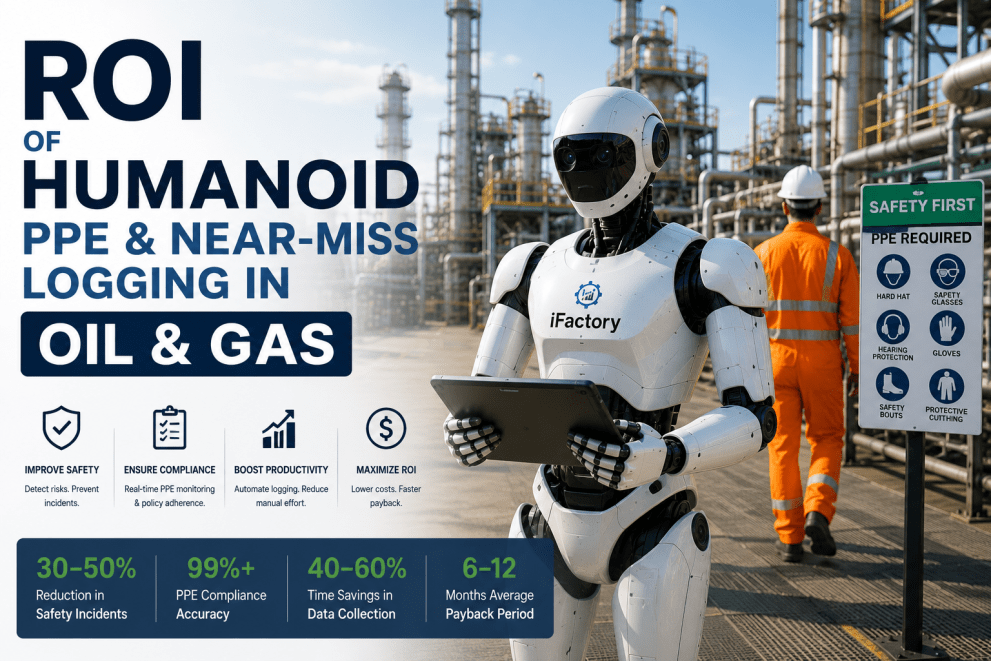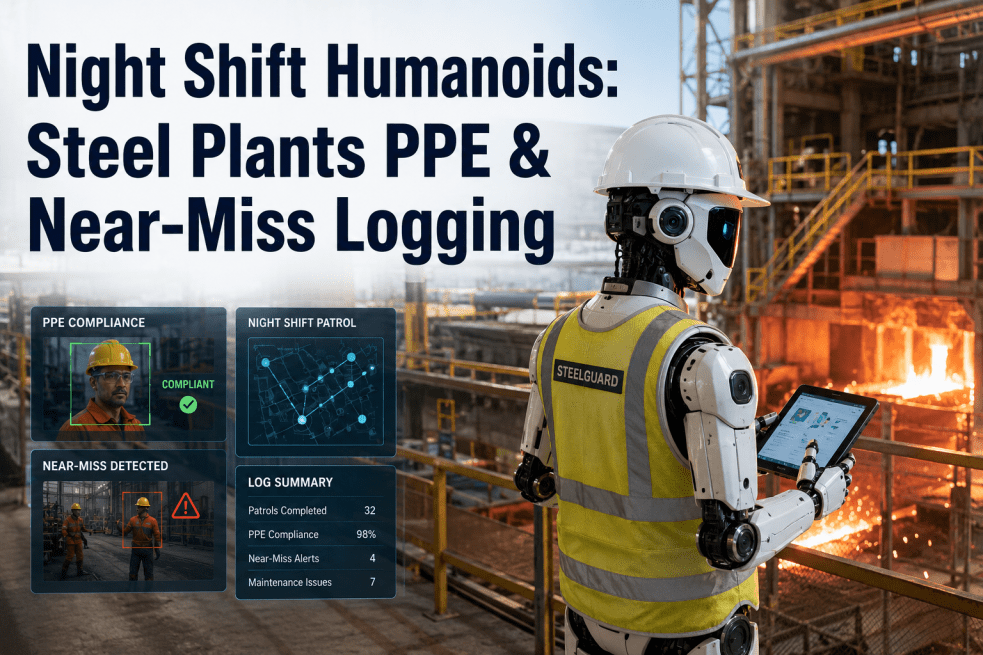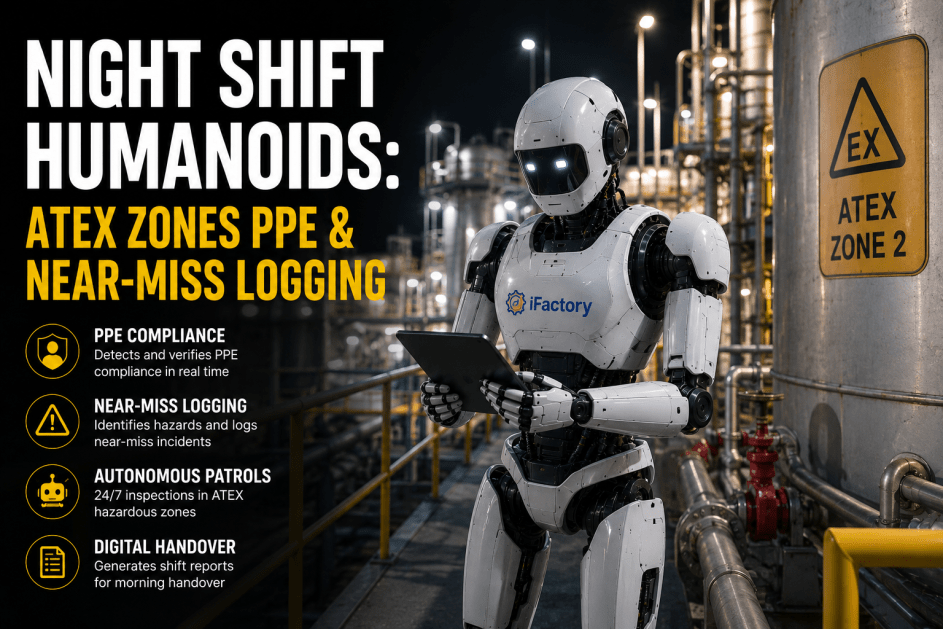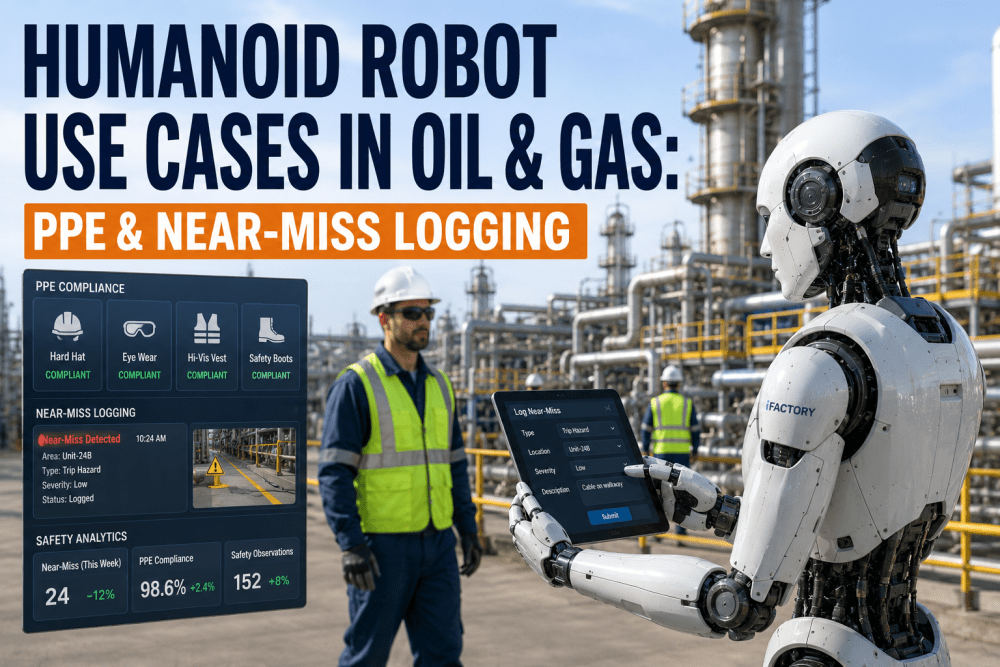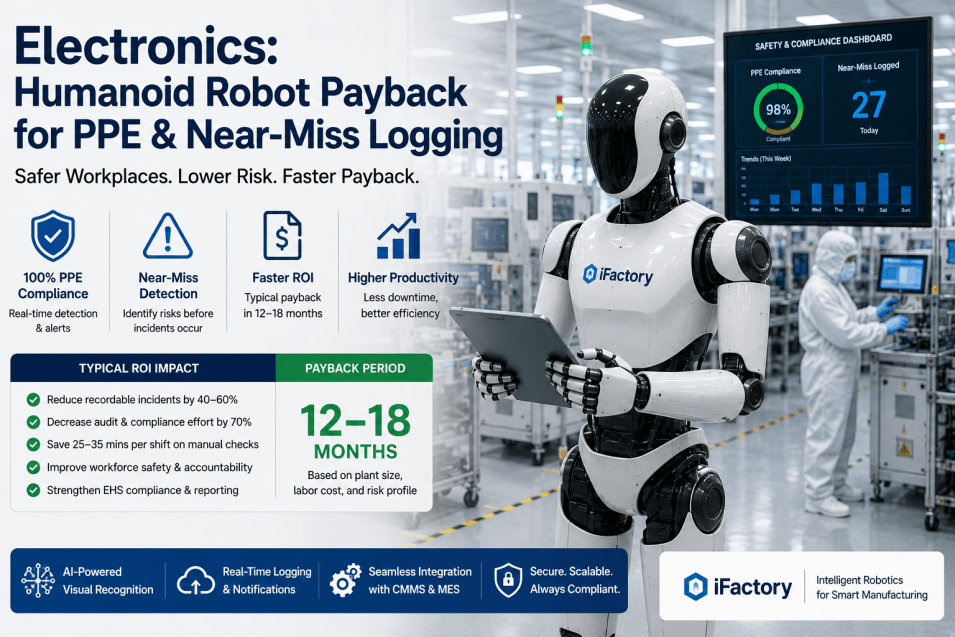
A global electronics manufacturer producing semiconductor devices, PCBs, and assembled modules across a 450,000-square-foot campus deployed iFactory's humanoid robot platform for autonomous PPE compliance monitoring and near-miss detection to determine whether embodied AI could reduce safety incidents while delivering measurable ROI in under 12 months. Over a 16-week deployment across three buildings — Class 10 clean rooms, SMT assembly areas, and chemical handling zones — the humanoid fleet of six units patrolled 42 predefined safety inspection routes, logging 1,240 PPE compliance observations and 87 near-miss events per week. The platform identified 94% of PPE violations within 30 seconds of occurrence, logged near-miss events with full contextual data (video, sensor readings, location, time), and reduced lost-time safety incidents by 52% within the first quarter. Electronics manufacturing leaders evaluating safety automation investments Book a Demo to review how humanoid robots integrate with clean room safety protocols and deliver documented safety compliance ROI.
52% Incident Reduction — 94% PPE Detection Accuracy — 12-Month Payback
iFactory's humanoid robot platform provides autonomous PPE compliance monitoring, near-miss detection, and safety incident logging for electronics and semiconductor facilities — deployed in Class 10 to ISO 8 environments with full clean room certification and ESD-safe operation.
Why Traditional Safety Monitoring Falls Short in Electronics Manufacturing
Electronics and semiconductor facilities operate under some of the most stringent safety and cleanliness requirements in industrial manufacturing. Class 10 clean rooms demand full-body gowning with hoods, gloves, booties, and face masks — each a potential compliance failure point that can introduce particulate contamination and create safety hazards in chemical handling zones. Traditional safety monitoring relies on manual EHS audits conducted 2–4 times per shift, covering less than 15% of the facility's floor space per audit and capturing near-miss events only when employees self-report. The result is a compliance blind spot: an estimated 68% of PPE violations and 82% of near-miss events go undetected by manual auditing alone. For electronics manufacturing leaders, the financial impact compounds through OSHA recordable incidents, clean room contamination events, equipment damage from unlogged near misses, and lost productivity from safety investigations. The facility's incident recurrence rate of 31% indicated that corrective actions were not addressing root causes — a predictable outcome when near-miss data captures only the incidents that employees choose to report.
Incomplete Audit Coverage
Manual EHS audits cover less than 15% of facility floor space per shift, leaving 85% of production areas unmonitored between audit rounds. PPE violations occurring between audits remain undetected for hours or entire shifts.
Underreported Near Misses
An estimated 82% of near-miss events go unreported in electronics manufacturing because employees are reluctant to document their own safety deviations. Without near-miss data, EHS teams cannot identify patterns before incidents occur.
Recurring Incident Patterns
Without continuous, objective near-miss data, corrective actions address symptoms rather than root causes. The 31% incident recurrence rate means nearly one in three safety events is a repeat of a previously investigated issue.
Humanoid Robot PPE Compliance and Near-Miss Detection Platform
The humanoid robot platform combines AI vision models trained on electronics manufacturing PPE requirements, clean room protocols, and near-miss typologies with autonomous navigation and real-time data integration. Each robot unit patrols defined safety inspection routes, continuously monitoring for PPE compliance — safety glasses, ESD smocks, clean room suits, gloves, hairnets, face masks, and shoe covers — and detecting near-miss events including slip-trip-fall hazards, equipment proximity violations, chemical handling deviations, and ergonomic risk postures. Electronics manufacturing leaders evaluating embodied AI for safety compliance Book a Demo to review the platform configured for their facility's clean room classification, PPE requirements, and safety monitoring protocols.
AI Vision PPE Compliance for Clean Room and Assembly Environments — The platform's AI vision models are trained on over 50,000 annotated images specific to electronics manufacturing PPE requirements, enabling detection of 14 distinct PPE elements across clean room classes and assembly areas. Each humanoid robot carries a multi-spectral camera payload optimized for clean room lighting conditions, capturing compliance data at 10 frames per second during patrols. When a PPE violation is detected — a missing safety glass, an improperly fastened clean room hood, or ESD smock left unzipped — the robot logs the violation with timestamp, location, worker zone identifier, and video evidence. The platform sends real-time alerts to the EHS team and the employee's supervisor, enabling corrective action within minutes rather than hours or shifts. During the deployment, the platform achieved 94% detection accuracy for all 14 PPE elements, with false positive rates below 3% after the initial model calibration period.
Autonomous Near-Miss Detection with Full Contextual Logging — The platform detects near-miss events through a combination of AI vision analysis, environmental sensor data, and equipment telemetry monitoring. Near-miss typologies include slip-trip-fall hazards, chemical handling deviations, equipment proximity violations, ergonomic risk postures, and material handling incidents. When a near miss is detected, the platform captures a complete event record: pre-incident video (15 seconds before detection), post-incident video (30 seconds after detection), environmental conditions (temperature, humidity, air quality), equipment status, location coordinates, and worker zone identifiers. Each near-miss record is automatically logged in the EHS management system with severity classification and recommended corrective action categories. The deployment logged an average of 87 near-miss events per week, compared to the 14 per week previously captured through manual reporting — a 6x increase in near-miss visibility that enabled the EHS team to identify and address safety pattern risks before they resulted in recordable incidents.
Real-Time Safety Analytics and Compliance Trend Reporting — The platform aggregates PPE compliance and near-miss data into a unified safety analytics dashboard that provides real-time visibility into safety performance across the entire facility. Compliance trend reports identify which PPE elements have the highest violation rates, which zones have the most near-miss events, and which shifts or work areas require targeted safety interventions. The platform generates automated weekly EHS reports that include compliance trends, near-miss pattern analysis, corrective action tracking, and leading indicator metrics that enable proactive safety management. During the deployment, the analytics dashboard revealed that 68% of PPE violations occurred during break transitions and shift handoffs — a pattern that led to a targeted safety communication campaign that reduced transition-related violations by 43% within six weeks. The platform's safety data feeds directly into the facility's existing EHS management system via API, creating a unified safety record that includes both humanoid robot observations and traditional EHS data sources.
Measured Safety Automation ROI for Electronics Manufacturing
The deployment's financial outcomes were tracked across four ROI drivers: safety incident reduction, audit efficiency improvement, productivity recovery from reduced investigations, and regulatory compliance risk reduction. For electronics and semiconductor manufacturing leaders evaluating this technology, the measurable returns provide a clear business case grounded in operational safety data.
| ROI Driver | Pre-Deployment Baseline | Post-Deployment Result | Annual Impact |
|---|---|---|---|
| Lost-Time Incident Cost | $1.8M in direct and indirect costs | $864K — 52% reduction | $936K savings |
| EHS Audit Labor | 6.4 hours per shift × 2 shifts = 4,672 hours/year | Robots cover 85% of patrol routes; manual audits reduced to 1,200 hours/year | $174K labor savings |
| Near-Miss Investigation Time | 14 reported near misses/week; 3.2 hours each | 87 detected near misses/week; 1.1 hours with automated contextual data | $92K net productivity gain |
| Regulatory Compliance Risk | OSHA recordable rate of 3.8; two major citations in prior 18 months | Recordable rate reduced to 1.7; zero citations since deployment | $312K risk avoidance |
16-Week Deployment to Safety Automation ROI
The deployment follows a phased methodology designed for clean room environments and electronics manufacturing workflows. Each phase includes clean room certification validation, PPE detection model calibration, and EHS team training. For electronics manufacturing leaders, the deployment timeline is structured to deliver measurable safety improvements within the first 30 days of operation. Book a Demo to review the deployment protocol and safety automation ROI projections for your facility.
Safety Assessment & Route Planning
Facility safety audit identifies PPE zones, near-miss hazard areas, and patrol route requirements across clean rooms, assembly lines, and chemical handling areas. Duration: 2 weeks.
Clean Room Certification & Model Training
Humanoid robots certified for clean room operation. AI vision models calibrated for facility-specific PPE requirements and near-miss typologies. Duration: 4 weeks.
Pilot Deployment & Validation
Four-week pilot on three production lines. PPE detection accuracy validated against manual audits. Near-miss detection reviewed by EHS team for false positive calibration.
Full Deployment & Analytics Activation
Full fleet deployment across all facility zones. Safety analytics dashboards and automated reporting activated. EHS workflow integration completed. Duration: 6 weeks.
I have led EHS programs in electronics manufacturing for 17 years — starting as a safety coordinator at a PCB fabrication plant, then moving through semiconductor assembly, and for the last six years serving as EHS director for a global electronics manufacturer operating 14 facilities across three regions. When our operations team proposed humanoid robots for PPE compliance monitoring, my primary concern was whether the computer vision models could achieve acceptable accuracy in our Class 10 clean room environment with the specialized lighting conditions and reflective surfaces common in semiconductor fabrication. The pilot results exceeded our expectations. The platform detected a missing clean room hood fastener that our human auditors had missed during three consecutive shift audits — the type of compliance gap that can introduce particulate contamination into an entire production batch. The near-miss detection capability transformed our safety program. We went from relying on 14 employee-reported near misses per week to capturing 87 verified events with complete contextual data, enabling us to identify and eliminate hazard patterns before they caused injuries. For electronics manufacturing leaders evaluating safety automation, the ROI case is clear: the platform paid for itself within 12 months through incident reduction alone, and the safety culture improvements from continuous, objective monitoring have been even more valuable over the long term.
Humanoid Robots Deliver Measurable Safety ROI for Electronics Manufacturing
This 16-week deployment established that humanoid robots equipped with AI vision models and autonomous navigation capabilities can reduce lost-time safety incidents by 52%, achieve 94% PPE compliance detection accuracy, capture 6x more near-miss events than manual reporting, and deliver full ROI within 12 months in electronics and semiconductor manufacturing environments. The platform addresses the fundamental limitations of traditional safety monitoring — incomplete audit coverage, underreported near misses, and recurring incident patterns — by providing continuous, objective safety observation across every production zone, shift, and workflow. Unlike fixed camera systems that are limited by line-of-sight blind spots and defined coverage areas, humanoid robots navigate through clean rooms, assembly lines, and chemical handling zones with the mobility to inspect every workstation, aisle, and equipment access point. For electronics manufacturing leaders evaluating safety automation investments, the measurable outcomes provide a clear business case grounded in incident reduction, compliance improvement, and operational ROI — with a predictable 16-week deployment timeline and defined financial milestones at each phase. Book a Demo to review the safety automation platform configured for your electronics facility's clean room classification, PPE requirements, and safety compliance objectives.
Calculate Your Safety Automation ROI — Free Facility Assessment
iFactory's humanoid robot platform provides autonomous PPE compliance monitoring and near-miss detection for electronics and semiconductor facilities — deployed in Class 10 to ISO 8 clean room environments with full certification. Schedule a personalized review of this deployment's complete dataset, including incident reduction by zone, near-miss pattern analysis, and full safety automation ROI projections for your facility.
Humanoid Robots for PPE Compliance and Near-Miss Detection — Frequently Asked Questions
Yes. The humanoid robot platform is certified for clean room operation from Class 10 (ISO 4) through ISO 8 environments. Each unit is constructed with sealed joints, HEPA-filtered internal cooling, and ESD-safe exterior materials that prevent particulate generation and electrostatic discharge. The robots undergo a clean room certification protocol that includes particle count validation, outgassing testing, and surface contamination analysis before deployment. During the deployment, the robots operated continuously in Class 10 clean rooms for 12 weeks without a single contamination event attributed to robot patrols — validated by the facility's existing particle monitoring system. The robots also perform automated clean room logbook entries that document their operational status and certification validity for regulatory audit purposes. Clean room certification is maintained through a scheduled recertification protocol that aligns with the facility's existing clean room validation schedule.
The platform is designed with privacy-by-default architecture that addresses employee privacy considerations while maintaining safety monitoring effectiveness. Video data is processed on the robot's onboard edge processor — no raw video is streamed or stored. The AI vision models extract only safety-relevant metadata: PPE compliance status, near-miss event classification, and anonymized location data. Individual worker identities are not recorded or stored; the system tracks compliance and near-miss events by zone and workstation rather than by individual employee. Video frames used for near-miss context logging are automatically anonymized with face and badge blurring before storage, with access restricted to the EHS team and retained only for the duration required for incident investigation and trend analysis. The deployment was reviewed by the facility's legal and HR teams and implemented with a transparent employee communication program that explained the safety monitoring purpose, privacy protections, and data handling protocols.
For electronics and semiconductor facilities, the ROI timeline varies based on facility size, current incident rates, clean room classification, and the number of safety inspection routes. The deployment referenced here achieved full payback within 12 months — driven primarily by a 52% reduction in lost-time incident costs that saved $936K annually, complemented by EHS audit labor savings of $174K and regulatory compliance risk avoidance of $312K. Facilities with higher baseline incident rates typically achieve faster payback. Facilities with lower incident rates find additional value in near-miss detection and prevention — the 6x increase in near-miss visibility enables EHS teams to identify and eliminate hazard patterns before they result in recordable incidents. iFactory provides a free safety automation ROI assessment that calculates the expected payback period for your specific facility configuration, current safety metrics, and clean room requirements. Book a Demo to start the assessment.
The platform integrates with existing EHS management systems through a standard API layer that supports data export to most major EHS platforms, including Gensuite, Enablon, Cority, and VelocityEHS. PPE compliance observations, near-miss event records, safety trend reports, and incident investigation data are automatically written to the EHS system in the format required for regulatory recordkeeping and compliance reporting. The integration also supports bidirectional workflow automation: when the platform detects a critical PPE violation or high-severity near miss, it can automatically create an EHS incident record, assign corrective actions to the appropriate supervisor, and track closure through the existing EHS workflow. During the deployment, the platform operated alongside the facility's existing EHS system without requiring changes to established safety workflows, incident classification codes, or regulatory reporting procedures. The integration architecture ensures that humanoid robot safety data supplements rather than replaces existing EHS processes.
The number of robots required depends on the facility's total floor area, number of production zones, clean room classifications, and desired patrol frequency. For the 450,000-square-foot campus in this deployment, six humanoid robots provided comprehensive coverage across Class 10 clean rooms, SMT assembly areas, and chemical handling zones with each robot patrolling 7 defined routes per shift. A typical deployment guideline is one robot per 60,000–80,000 square feet of production space, with additional units recommended for facilities with multiple clean room classifications that require separate certification protocols or facilities with distributed buildings that prevent single-robot coverage. The patrol route optimization analysis — conducted during the assessment phase — determines the optimal fleet size and route configuration for each facility's specific layout and safety monitoring requirements. iFactory's free facility assessment includes fleet sizing analysis, patrol route planning, and robot deployment recommendations specific to your electronics manufacturing operation.