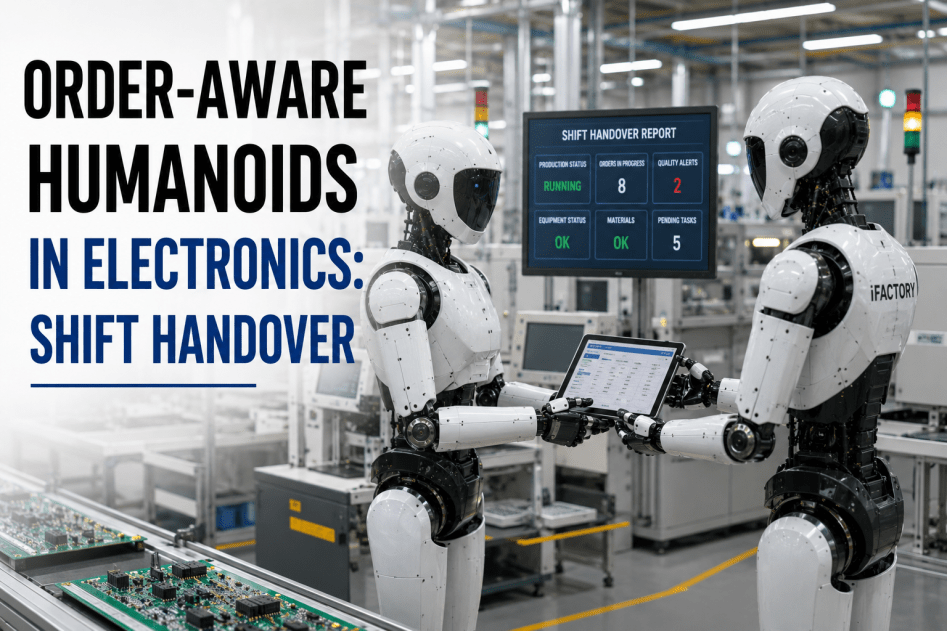
In electronics and semiconductor manufacturing, the margin between a profitable shift and a costly disruption is measured in microns and milliseconds. Furnace temperatures exceeding 1,000°C, cleanroom particle counts below Class 100 and SMT placement accuracy within 50 microns define the operating envelope. Humanoid robots purpose-built for these environments are now performing molten metal patrols, cleanroom material handling, automated line inspections, and predictive tool health monitoring, reducing unplanned downtime by up to 40% while freeing skilled technicians for higher-value work. Here is how leading fabs are deploying embodied AI to protect their most expensive assets and most critical processes.
Humanoid Robot Use Cases in Electronics: Molten Metal Patrols
4 Key Humanoid Robot Use Cases in Electronics & Semiconductor Manufacturing
Humanoid robots bring a combination of mobility, dexterity, and sensor payload that stationary automation cannot match. In electronics manufacturing, they navigate tight cleanroom aisles, operate in high-temperature zones where humans require full PPE, and execute inspection routines with repeatable precision. The following four use cases represent the highest-value deployment opportunities identified by early adopters across semiconductor fabrication, PCB assembly, and electronics component manufacturing.
Furnace & Molten Metal Patrol
Diffusion furnaces, annealers, and reflow ovens operate at temperatures that make continuous human presence impractical and dangerous. Humanoid robots equipped with thermal imaging, gas detection, and acoustic sensors patrol these zones autonomously, reading gauge panels, logging temperature profiles, and detecting early signs of refractory degradation or gas leakage. iFactory AI's integration layer pipes every patrol reading into the CMMS, triggering work orders when parameters drift outside recipe specification. Fabs running humanoid furnace patrols report a 50% faster anomaly detection rate and zero heat-exposure incidents since deployment.
Cleanroom Wafer & Material Handling
Class 10 and Class 100 cleanrooms demand strict particle control, gowning protocols, and minimized human traffic. Humanoid robots wearing cleanroom-rated exosuits transport wafer carriers, retrieve chemical containers, and load/unload process tools without introducing contamination. Their precision manipulation enables safe handling of 300 mm wafers and fragile substrates. Paired with iFactory AI's MES integration, each material movement is logged in real time, creating a complete digital trace from stocker to process chamber. Early adopters report a 30% reduction in cycle time for interbay material transport and a measurable decrease in particle-related yield loss.
SMT Line Automated Inspection
Surface-mount technology lines run at speeds where human visual inspection becomes the bottleneck. Humanoid robots positioned at critical inspection stations use high-resolution cameras and AI vision models to check solder paste deposition, component alignment, and reflow quality at line speed. Unlike fixed machine vision systems, humanoid robots reposition dynamically across stations, flexing between inspection points as product changeovers occur. The iFactory AI platform aggregates inspection results with upstream reflow profiles and downstream test data, enabling closed-loop process adjustment within minutes rather than shifts.
Predictive Tool Health Monitoring
Semiconductor processing tools from etchers to deposition chambers represent capital investments of $2M to $10M per unit. Unplanned failure of any single tool can halt an entire production line. Humanoid robots equipped with vibration, thermal, and acoustic sensors perform daily health rounds on these tools, capturing data that stationary sensors miss: panel temperature gradients, door seal integrity, cooling line vibration, and exhaust flow acoustics. The data streams into iFactory AI's predictive analytics engine, which identifies pre-failure signatures and schedules maintenance during planned downtime windows. Fabs using humanoid tool health monitoring report 35% longer mean time between failures and an 18% improvement in overall equipment effectiveness.
ROI Benchmarks by Use Case
The following table summarizes early-adopter results across four deployment scenarios in electronics and semiconductor manufacturing. All figures are based on a typical 200 mm or 300 mm fab with 25,000+ wafer starts per month. Individual results vary by facility scale, tool mix, and existing automation baseline.
| Use Case | Avg Annual Savings | Payback Period | Uptime Improvement | Labor Reallocation |
|---|---|---|---|---|
| Furnace & Molten Metal Patrol | $480K | 8 months | +12% | 3 FTE redeployed |
| Cleanroom Material Handling | $320K | 10 months | +8% | 2 FTE redeployed |
| SMT Line Inspection | $280K | 6 months | +15% | 4 FTE redeployed |
| Predictive Tool Health | $540K | 7 months | +18% | 2 FTE redeployed |
Calculate Your ROI with a Free Assessment
Implementation Workflow
Deploying humanoid robots in an electronics manufacturing environment follows a repeatable four-phase sequence. The iFactory AI platform supports each phase with pre-built integration connectors, template inspection routines, and analytics dashboards that accelerate time to value.
iFactory AI pre-integrates with leading humanoid robot platforms via MQTT, OPC UA, and ROS2. Book a 30-minute integration assessment and we will map your fab's asset hierarchy to a complete digital inspection and patrol program.
Expert Review: Humanoid Robots in Electronics Manufacturing
Chen's observation highlights a principle that holds across every semiconductor fab where humanoid robots have been deployed: the inspection data is only as valuable as the action it triggers. The most effective programs combine three disciplines—standardized patrol routes, digital sensor data capture, and closed-loop work order generation—into a single workflow. iFactory AI was built to deliver exactly that integration depth, from robot sensor to CMMS work order in under one minute.
Deployment Roadmap for Humanoid Robots in Electronics Manufacturing
A successful humanoid robot deployment in electronics manufacturing follows a structured five-phase roadmap that balances speed with risk management. Each phase includes clear milestones and go-no-go decision points.
Conclusion
Humanoid robots are no longer a laboratory curiosity in electronics and semiconductor manufacturing. They are patrolling furnace decks, transporting wafers, inspecting SMT lines, and monitoring critical tool health with measurable results that deliver payback in under 12 months. The technology works best when tightly integrated with a platform like iFactory AI that connects robot-collected data directly to work order generation, predictive analytics, and continuous improvement workflows. For fab managers evaluating their first deployment, the recommendation is clear: start with the highest-temperature, highest-consequence zone in your facility and let the data build the business case for expansion. Book a Demo to see how iFactory AI integrates with leading humanoid robot platforms and existing fab systems.