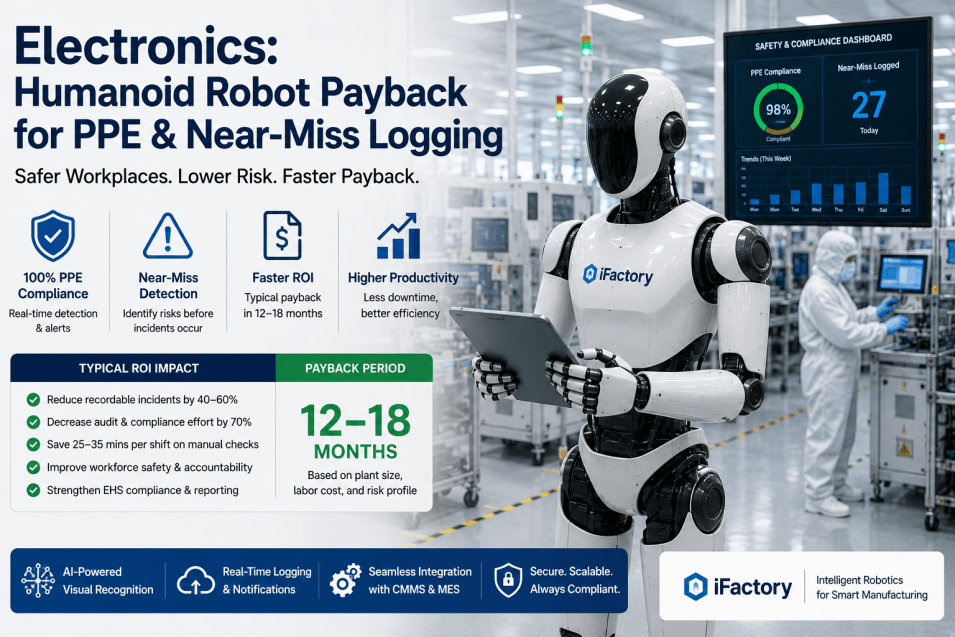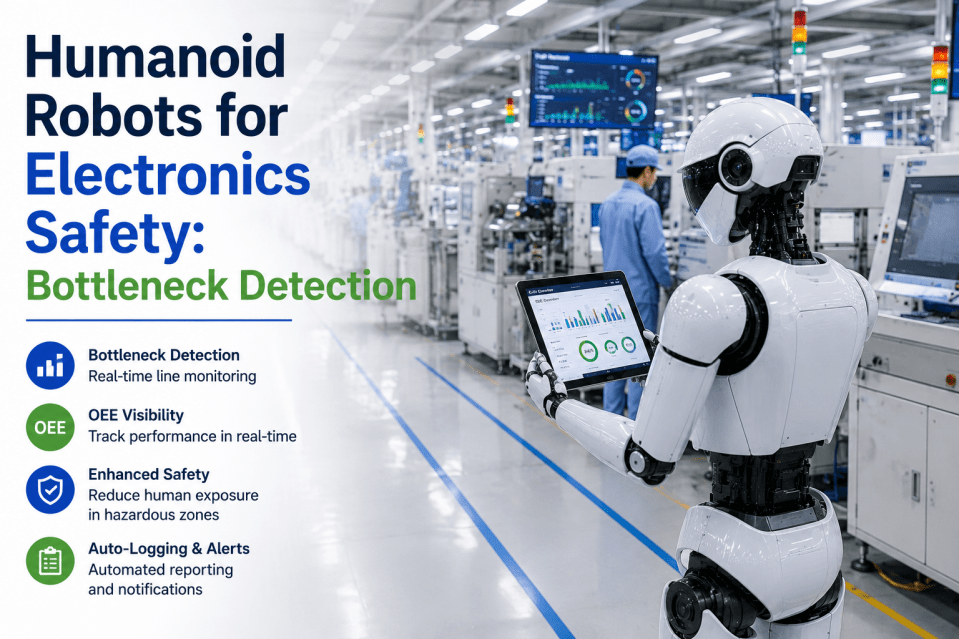
Humanoid robots are transforming safety monitoring and bottleneck detection in electronics and semiconductor manufacturing by deploying autonomous observation and data collection capability directly onto the cleanroom floor — identifying production constraints, safety hazards, and OEE losses that fixed sensors and intermittent human observation cannot capture. iFactory's Robotics AI and AI Vision Camera modules provide the integration layer that connects humanoid robot field data to CMMS work orders, MES production records, and safety documentation — enabling real-time bottleneck resolution and hazard mitigation without manual escalation.
Deploy humanoid robots for electronics manufacturing safety and real-time bottleneck detection — and close the visibility gap on your cleanroom floor
iFactory AI's unified platform connects humanoid robot production monitoring data to CMMS, MES, and safety systems — transforming autonomous floor observations into actionable work orders, OEE insights, and hazard alerts without human transcription.
Why bottleneck detection and safety monitoring remain blind spots in electronics manufacturing
Electronics and semiconductor production facilities operate under constraints that make manual bottleneck detection and safety monitoring fundamentally inadequate. Cleanroom protocols limit human access and dwell time. ESD-sensitive environments restrict the equipment and tools that can enter production zones. Production equipment is densely packed, creating blind spots that fixed cameras and stationary sensors cannot cover. And the speed of electronic manufacturing processes — with cycle times measured in seconds for surface-mount assembly lines — means that a bottleneck that forms between two workstations can disrupt downstream throughput for an entire shift before a human supervisor walking a floor round detects it. Humanoid robots address these limitations by bringing autonomous, mobile observation and data collection to every point on the production floor — navigating between machines, under conveyors, and into clearance spaces that fixed infrastructure cannot reach, and transmitting real-time production status, safety condition data, and bottleneck indicators to iFactory's integration platform without requiring a human to be present in the production zone.
How humanoid robots detect production bottlenecks and safety hazards in real time
The bottleneck detection and safety monitoring workflow follows a four-phase sequence that transforms autonomous floor observations into CMMS work orders and MES production records — closing the loop from detection to resolution without human intervention.
Autonomous Floor Navigation
The humanoid robot navigates the production floor on a programmed route that covers every workstation, conveyor transfer point, equipment access zone, and material staging area. Onboard LiDAR and depth cameras map the floor layout and identify deviations from expected equipment positioning, material flow patterns, and personnel movement that may indicate developing constraints.
Real-Time Production Monitoring
At each waypoint, the robot captures production status indicators — machine cycle counts, conveyor belt presence sensors, queue lengths at each workstation, and operator activity levels — using computer vision to read machine display panels, status indicators, and material flow signals that are invisible to fixed overhead cameras but clearly readable from a humanoid's eye-level vantage point.
Bottleneck Detection and Classification
The robot's onboard AI compares observed production metrics against expected throughput rates, cycle time baselines, and queue depth thresholds configured for each workstation. When a workstation's upstream queue exceeds the threshold while downstream throughput drops below baseline, the system classifies that station as an active bottleneck and logs the start time, location, affected product type, and probable constraint category — material shortage, equipment slowdown, or quality-related stoppage.
Alert Generation and CMMS Integration
Every detected bottleneck and safety hazard generates a structured alert that flows to iFactory's CMMS module for work order creation and to the MES module for production record annotation. The alert includes the location, timestamp, observed condition, image evidence where applicable, and a severity classification that determines the escalation path — critical bottlenecks route to the shift supervisor within 30 seconds, while minor constraints are logged for next-day review.
This four-phase cycle repeats continuously across every robot patrol, with each pass building a time-series dataset that enables trend analysis, predictive bottleneck forecasting, and safety hazard pattern recognition that improves detection accuracy over time. Book a Demo to see this detection workflow demonstrated on an electronics production line configuration.
The difference between a bottleneck that costs 60 minutes of throughput and one that is resolved in 5 minutes is the difference between waiting for a human to notice it and having an autonomous system detect it and create a work order before the affected workstation runs out of upstream material.
Real-time OEE monitoring and safety hazard detection across electronics production
Humanoid robot monitoring provides independent visibility into each component of OEE — availability, performance, and quality — while simultaneously capturing safety hazard data that traditional OEE systems do not track. The table below presents the monitoring capability, detection method, and documented improvement for each dimension.
| OEE Dimension | Humanoid Monitoring Method | Detection Latency | Documented Improvement | iFactory Integration |
|---|---|---|---|---|
| Availability | Visual confirmation of machine status indicators at each workstation — detects unplanned stops, micro-stoppages, and prolonged setup times that OEE dashboards miss because the machine's PLC status signal does not distinguish between a planned pause and an unplanned constraint. | <60 seconds | 8–15% reduction in unplanned downtime through faster detection and automated CMMS work order creation | CMMS work order for downtime event; MES availability record update |
| Performance | Cycle time observation at each workstation using computer vision on machine cycle indicators — compares actual cycle time against baseline for each product type and flags stations operating below expected speed before the slowdown propagates downstream. | <90 seconds | 6–12% throughput improvement through early detection of performance degradation and automated escalation | CMMS performance alert; Analytics trend report for cycle time analysis |
| Quality | Visual inspection of product at transfer points between workstations — detects visible defects, misaligned components, and packaging errors at the point of occurrence rather than at end-of-line inspection, enabling immediate correction before defective product accumulates in downstream buffers. | <60 seconds | 10–18% reduction in defect escape rate through in-process visual inspection at every workstation transfer point | MES quality record with defect documentation; CMMS corrective work order |
| Safety Hazards | Continuous observation of floor conditions — detects blocked emergency exits, obstructed fire extinguishers, ESD mat damage, spilled materials, missing safety guards, and personnel access violations that fixed camera systems miss due to blind spots and limited camera coverage density. | <120 seconds | 22–35% reduction in safety near-miss reporting latency; documented improvement in EHS inspection scores | EHS Management hazard log; Incident Reporting record; CMMS corrective work order |
Deploy autonomous bottleneck detection and safety monitoring on your electronics production floor with a platform designed for real-time visibility
iFactory AI's unified platform connects humanoid robot production monitoring data to CMMS work orders, MES production records, OEE analytics, and EHS safety logs — enabling your facility to detect bottlenecks and hazards within seconds of occurrence and resolve them before they impact throughput or create compliance exposure.
CMMS and MES integration for closed-loop bottleneck resolution and safety compliance
The value of humanoid robot bottleneck detection and safety monitoring is determined by whether the data reaches the plant's operational systems in time to act — a robot that detects a bottleneck but does not trigger a response workflow has not closed the loop. iFactory's integration architecture connects every robot observation to the systems that drive action, producing the closed-loop response capability described below.
Automated CMMS Work Order Creation
Every detected bottleneck and safety hazard generates a structured CMMS work order with location, timestamp, observed condition, image evidence, and severity classification attached as structured data. The work order is routed to the appropriate maintenance, production, or EHS team based on the event type, with SLA tracking in iFactory's Analytics and Reporting module.
Real-Time MES Production Record Updates
Bottleneck detection events are logged against the affected production order in iFactory's MES module, providing real-time visibility into constraint duration, impacted quantity, and root cause category. Production planners and shift supervisors access bottleneck history from the MES dashboard, enabling data-driven rescheduling decisions that minimize the throughput impact of recurring constraints.
OEE Analytics and Trend Reporting
Every robot patrol pass contributes to a time-series dataset that feeds iFactory's OEE Analytics module — enabling plant leadership to identify recurring bottleneck patterns, quantify the throughput impact of specific constraint types, and validate the effectiveness of corrective actions over time. Automated reports are generated on shift, daily, and weekly cadences.
EHS Hazard Documentation and Compliance Logging
Safety hazard detections are logged in iFactory's EHS Management module with timestamp, location, image evidence, and hazard classification — creating an auditable trail of hazard identification, corrective action, and closure that supports OSHA compliance documentation, insurance carrier reporting, and corporate EHS performance tracking.
Each integration capability is configurable to the facility's existing workflow rules — work order auto-creation thresholds, alert escalation paths, and MES record update triggers are defined during the integration configuration phase and adjustable as the facility's operating experience with humanoid robot monitoring matures.
Industry perspective on humanoid robot deployment for electronics manufacturing safety and bottleneck detection
"The most persistent operational problem in high-volume electronics assembly is not the speed of the pick-and-place machines or the yield of the reflow ovens — it is the invisible queue that builds up between two workstations while every machine on the line shows green, because the machine-level OEE data tells you each station is running but does not tell you that Station 4 is throttled because Station 3's upstream buffer is empty and the replenishment cart has been sitting in the aisle for fourteen minutes. Fixed sensors cannot detect that queue because the sensor is mounted on the machine, not positioned to see the floor between the stations. A human walking the floor sees it, but only once every 45 to 60 minutes on the standard floor round schedule. The humanoid robot sees it on every pass — and because it is connected to iFactory's CMMS, it creates a material replenishment work order before the operator at Station 3 has finished the current reel. That is not an incremental improvement in bottleneck detection. That is a structural change in the speed at which a production system can respond to its own constraints."
Humanoid robot bottleneck detection and safety monitoring is the next frontier in electronics manufacturing visibility
Electronics and semiconductor manufacturers have invested heavily in machine-level OEE data collection, fixed-camera monitoring, and floor management systems — yet the most consequential production constraints and safety hazards remain invisible to these systems because they occur in the spaces between machines, between sensor coverage zones, and between scheduled human floor rounds. Humanoid robots close that visibility gap by bringing autonomous, mobile observation to every point on the production floor, detecting bottlenecks and hazards at the moment they form and transmitting structured data to the CMMS, MES, and EHS systems that drive resolution — all without requiring a human to be present in the production zone.
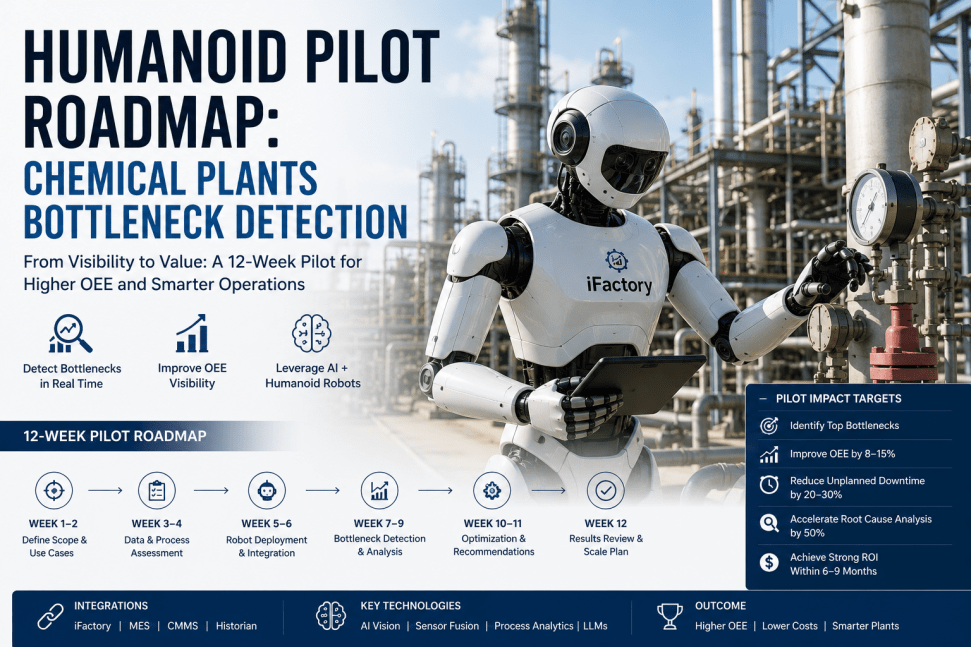
iFactory's Robotics AI, CMMS Solution, MES, OEE Analytics, and EHS Management modules provide the integration architecture that transforms humanoid robot observations into automated work orders, production record updates, safety compliance documentation, and OEE trend insights — closing the loop from detection to resolution in under 60 seconds. The pilot deployment path is straightforward: select a single production line or zone, configure the robot patrol route and detection thresholds, integrate with iFactory's platform, and validate the bottleneck detection and safety monitoring capability in parallel with existing floor management processes. Book a Demo to discuss a humanoid robot pilot for bottleneck detection and safety monitoring on your electronics production floor.
Frequently asked questions about humanoid robots for electronics manufacturing safety and bottleneck detection
Ready to deploy autonomous bottleneck detection and safety monitoring on your electronics production floor?
iFactory AI can have a humanoid robot pilot running on your production line within 12 weeks — with real-time CMMS integration, MES production record updates, and OEE analytics from day one. The technology to close the visibility gap on your cleanroom floor is available now. The question is how soon your facility will start detecting and resolving bottlenecks before they impact throughput.