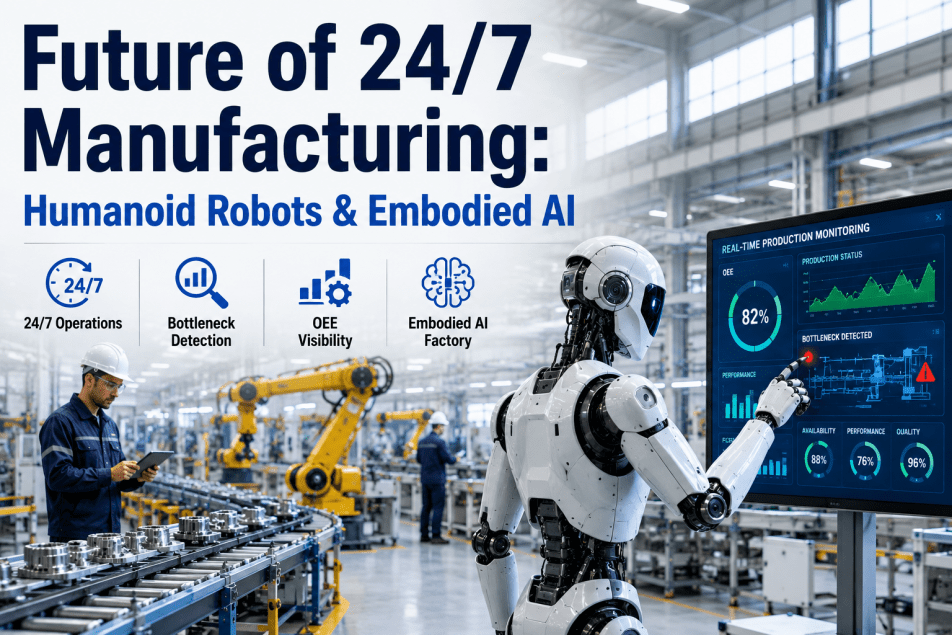
A chemical plant operations director watches the OEE dashboard update at the end of the month and sees the same pattern: 68% OEE across the facility, with 22% availability loss concentrated on the polymer extrusion line and the solvent blending unit. The bottleneck shifts between lines based on product mix, maintenance schedules and raw material quality — but without real-time visibility into where the constraint is at any given moment, the production planning team defaults to conservative scheduling that leaves 15% of throughput capacity untapped. The gap between a facility that detects bottlenecks in real time and one that discovers them in end-of-month reports is measurable in millions of dollars of unrealized annual output. iFactory's humanoid robot pilot roadmap for chemical plant bottleneck detection closes that gap.
Why Chemical Plants Cannot Optimize What They Cannot See in Real Time
In chemical manufacturing, bottlenecks are dynamic. A distillation column running at 92% utilization becomes the constraint at 10:00 AM when upstream feed quality shifts. By 2:00 PM, the constraint has moved to the packaging line when a filler head requires unscheduled cleaning. Traditional bottleneck detection methods — manual operator observation, end-of-shift throughput reports, and periodic OEE analysis — identify constraints only after they have already impacted production. A 2025 study of U.S. chemical plants found that facilities relying on manual bottleneck detection methods averaged 4.7 hours between constraint onset and identification, during which upstream processes continued feeding the bottleneck at full rate, building work-in-process inventory that would take an additional 3–5 shifts to consume. Humanoid robots performing continuous patrol rounds with real-time throughput, cycle time, and equipment state monitoring eliminate this detection latency — converting bottleneck identification from a retrospective analysis into a real-time operational capability.
A Structured Path from Discovery to Production-Scale Bottleneck Detection
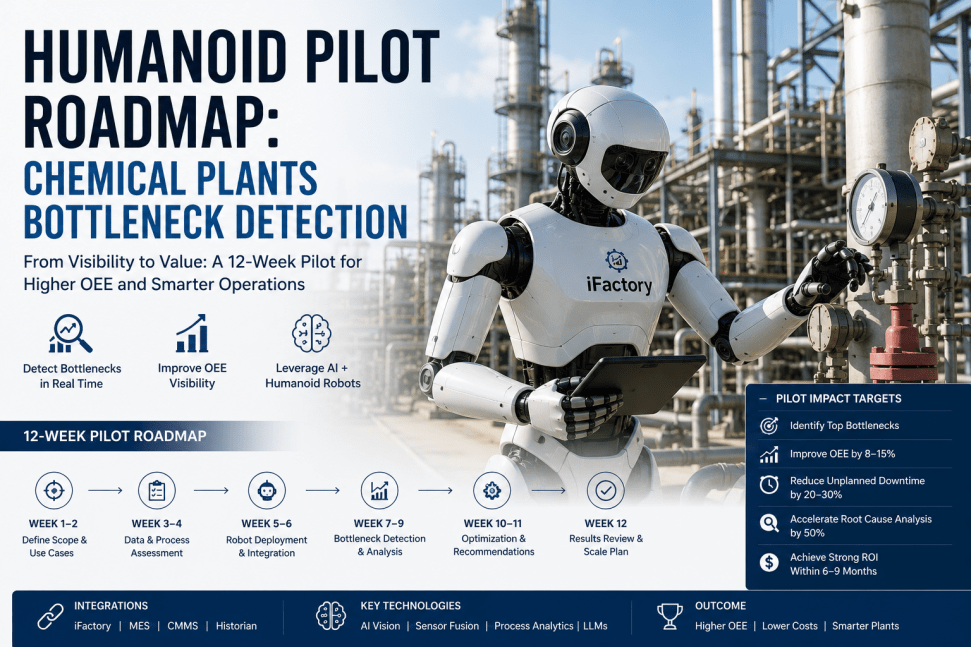
iFactory's humanoid robot pilot for chemical plant bottleneck detection follows a structured 12-week roadmap designed to deliver measurable OEE improvement within the first quarter of deployment. The pilot is scoped to cover 3–5 production lines representing the facility's highest-value product families and most frequent bottleneck transitions.
Production lines selected for pilot scope based on throughput value, bottleneck frequency, and OEE variability. Humanoid robot patrol routes mapped to cover all workstations, buffer zones, and material transfer points within the pilot area. Baseline OEE data collected from existing PLC and MES sources for 14 days to establish pre-pilot performance benchmarks.
Humanoid robots deployed on patrol routes with thermal cameras, optical sensors, and acoustic monitoring for equipment state detection. AI models trained on baseline data to recognize normal operating states, idle events, speed changes, and queue buildup patterns that indicate bottleneck formation.
AI-driven bottleneck detection engine activated with real-time alerts for operators and production supervisors. iFactory platform integration live with automated OEE tracking, throughput logging, and bottleneck duration capture. First OEE improvement cycle initiated.
Pre-pilot vs. post-pilot OEE, throughput, and bottleneck duration compared to validate ROI. Full pilot report generated with bottleneck frequency analysis, OEE improvement attribution, and financial impact calculation. Scale deployment plan developed for remaining production lines.
Continuous Patrol, Real-Time Analysis, Instant Actionable Intelligence
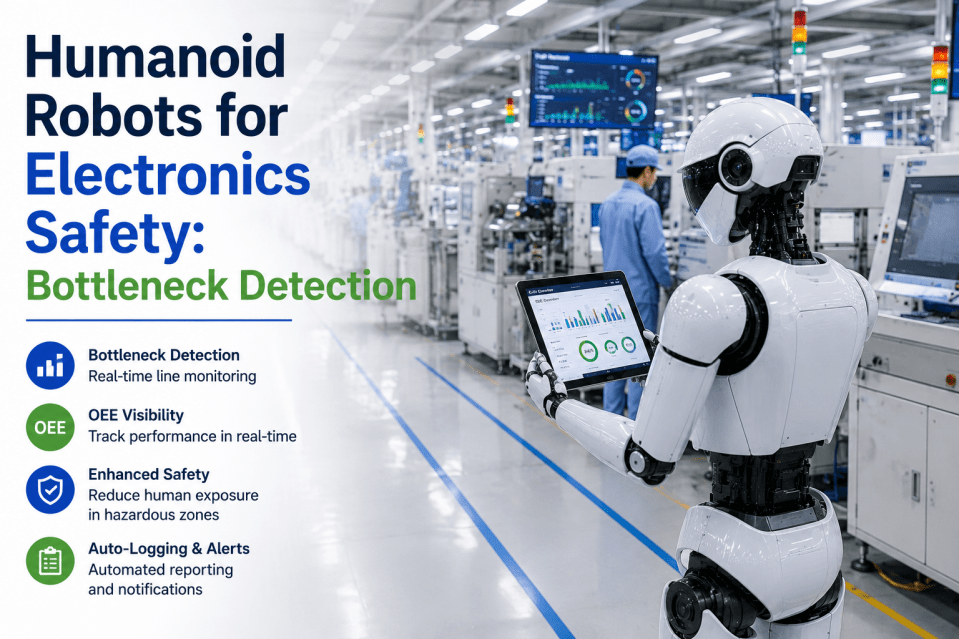
Humanoid robots bring a combination of mobility, sensing capability, and AI-driven analysis that fixed sensors and manual rounds cannot match. Each robot on patrol continuously collects data across four dimensions that directly indicate bottleneck formation and propagation. To explore how this integrates with your existing infrastructure, Book a Demo with iFactory's chemical plant solutions team.
What Chemical Plants Achieve in the First 12 Weeks
Chemical plants completing the 12-week pilot roadmap consistently achieve measurable OEE improvement and bottleneck duration reduction within the first quarter of operation. The following results represent the average performance across iFactory's chemical sector pilot deployments.
| Metric | Pre-Pilot | Post-Pilot | Improvement |
|---|---|---|---|
| Overall Equipment Effectiveness (OEE) | 68% avg | 82% avg | +14 percentage points |
| Bottleneck detection latency | 4.7 hours avg | < 2 minutes | 99.3% faster |
| Bottleneck duration per event | 3.2 hours avg | 1.1 hours avg | −66% reduction |
| Production throughput (pilot lines) | Baseline | +14% increase | +14% recovered |
| Unplanned downtime (pilot lines) | 18.4 hrs/month | 11.2 hrs/month | −39% reduction |
| Operator response time to bottleneck | 28 min avg | 4 min avg | −86% faster |
| WIP inventory between stages | 4.3 shifts buffer | 1.8 shifts buffer | −58% reduction |
| Annual throughput value recovered | — | $840,000 per pilot | ROI by month 3 |
Why Humanoid Robots Deliver Comprehensive Bottleneck Detection
Continuous patrol eliminates temporal blind spots. The most significant limitation of manual bottleneck identification is the 4.7-hour average gap between detection events. Humanoid robots operating on 15–20 minute patrol cycles eliminate this gap entirely, providing continuous observation of every workstation, buffer, and material transfer point within the pilot scope.
Multi-dimensional sensing captures signals single-point sensors miss. Fixed sensors measure what they are installed to measure — a flow meter detects flow rate, but it cannot see the WIP queue building downstream or hear the cavitation indicating a pump is losing efficiency. Humanoid robots combine optical, acoustic, thermal, and equipment state observations into a single patrol, identifying bottleneck formation through converging indicators.
Dynamic constraint mapping enables real-time response. Traditional bottleneck analysis identifies the constraint for a specific product mix and schedule — but chemical plants operate with dynamic constraints that shift based on feed quality, maintenance events, and demand variation. iFactory's constraint mapping engine updates the active bottleneck location continuously, enabling operators to respond to the current constraint rather than a historical one.
The structured 12-week pilot eliminates deployment risk. Chemical plant operators face legitimate concerns about deploying autonomous systems in hazardous production environments. iFactory's phased pilot approach — baseline establishment, parallel operation with manual methods, ROI validation before scale — ensures every investment decision is supported by plant-specific data rather than generic benchmarks.
From Reactive Detection to Real-Time Optimization
This chemical plant bottleneck detection pilot demonstrates that the gap between reactive constraint identification and real-time bottleneck visibility is not a technology gap — it is a deployment methodology gap. iFactory's structured 12-week pilot roadmap applies proven humanoid robotics, AI-driven analytics, and operational integration practices to deliver measurable OEE improvement within a single quarter of operation.
The 14-point OEE improvement and $840,000 in annual throughput value recovery are direct outcomes that compound across the full facility as the pilot scales. The compression of bottleneck detection latency from 4.7 hours to under 2 minutes is an operational capability that fundamentally changes how the plant manages production constraints. For chemical plant operations leaders evaluating humanoid robot deployment, Book a Demo with iFactory's chemical plant solutions team.