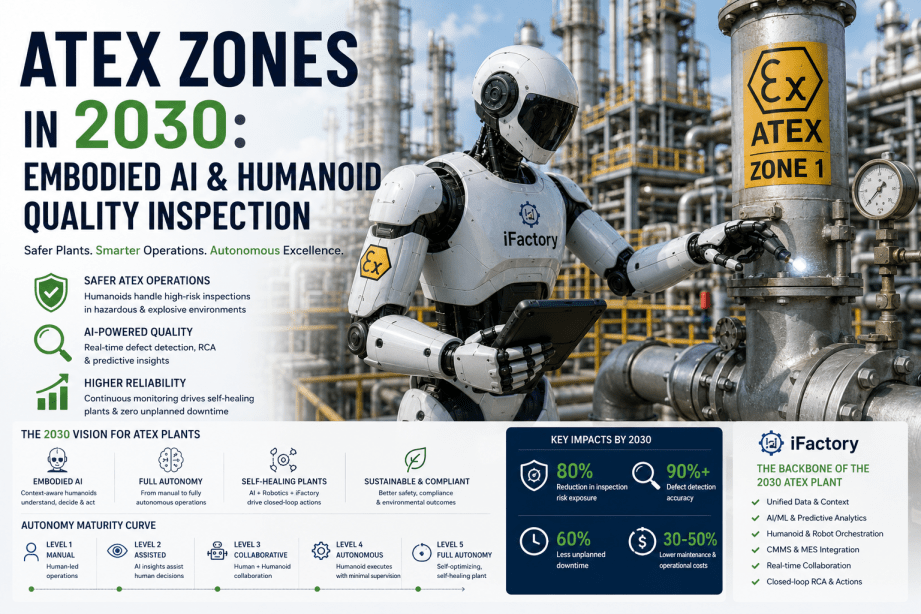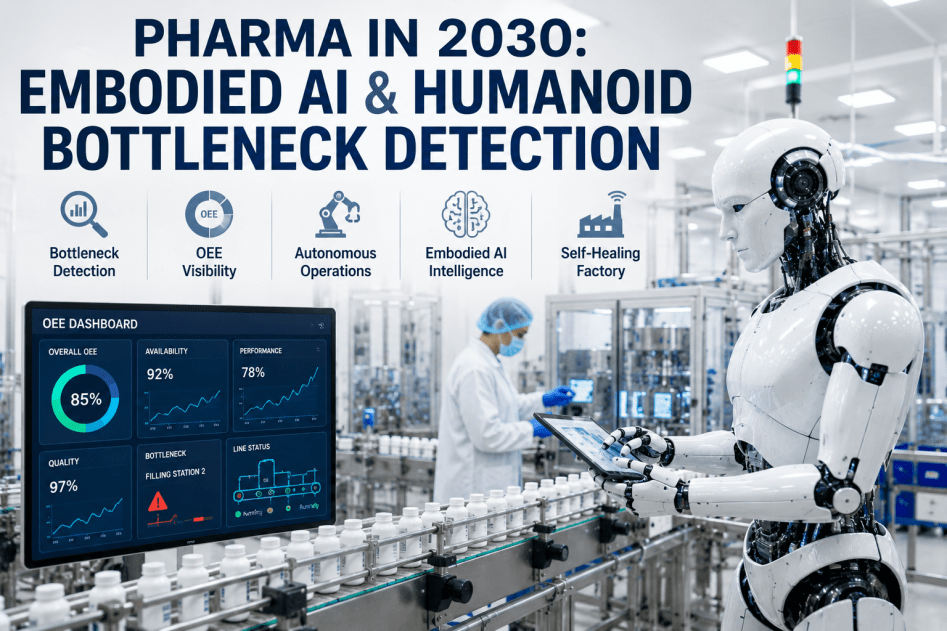
At 2:47 AM on a production line in a major sterile-fill facility, a vial-inspection station begins rejecting batches at 11% — double the normal rate. The operator on duty, covering three lines alone, doesn't notice for 37 minutes. By the time the shift supervisor arrives, 4,200 vials have been scrapped. The batch — worth $340,000 — is lost. The root cause? A 0.03-millimeter misalignment in the camera rail that no sensor detected and no trend line flagged. This scene repeats across the pharmaceutical industry every day, not because the technology to prevent it doesn't exist, but because the technology hasn't been deployed at the edge — inside the four walls of the plant, with zero latency and zero cloud dependency. By 2030, humanoid robots running embodied AI on-premise will not only detect these bottlenecks in real time but will physically walk the line, adjust equipment, and close the loop before a single vial is lost.
Humanoid Robots End the 37-Minute Blind Spot in Pharma Production
By 2030, the plants that survive margin compression and regulatory pressure will be those where humanoid robots — powered by on-premise embodied AI — detect bottlenecks, optimize OEE, and self-heal production deviations in real time. iFactory delivers that architecture today.
Why Bottlenecks Stay Hidden Until They Destroy a Batch
Pharmaceutical manufacturing runs on validated processes, but validation assumes the environment stays static. It doesn't. A 0.1°C drift in a lyophilizer shelf, a 2-micron clog in a filling needle, a 0.5-second timing variation in a stoppering station — each is invisible to traditional SCADA and MES systems until scrap appears on a reconciliation report hours later. By then, the batch is lost, the line is down, and the root cause has already self-corrected or shifted to another station. Humanoid robots with embodied AI change this permanently.
Micro-Deviation Blindness
Legacy sensors measure temperature, pressure, and speed at discrete points. They cannot detect a vial-inspection camera rail misaligned by 0.03mm — the single most common cause of false reject spikes in high-speed visual inspection lines. Each undetected micro-deviation costs $50K–$340K per batch in scrap alone.
OEE Visibility Lags By Hours
Your MES reports OEE at shift end. By then, the bottleneck that cost 23 minutes of uptime at 2:47 AM has already moved. Without real-time, station-level OEE data fused with physical robot perception, you're managing yesterday's problems with today's decisions.
Human Coverage Gaps on Critical Lines
A single operator covering three high-speed parenteral lines cannot visually monitor every stoppering station, fill-head, and inspection camera simultaneously. Industry data shows that 68% of micro-stops go completely unobserved by human operators on multi-line facilities.
Self-Healing Requires Physical Presence
When a pick-and-place robot drifts by 1mm, the software can detect it. But only a physical agent — a humanoid robot — can walk to the station, recalibrate the gripper, adjust the conveyor guide rail, and confirm the fix in under 90 seconds. Without that physical loop, every deviation becomes a line-down event requiring a technician dispatch.
Regulatory Risk Accumulates Invisibly
Every undetected deviation is a potential 483 observation. The FDA expects real-time visibility into process capability. When your bottleneck detection relies on shift-end reports and human observation, you are accumulating regulatory exposure with every undetected micro-stop.
Humanoid robots running iFactory's embodied AI detect deviations in under 3 seconds — not 37 minutes. Book a 30-min walkthrough and see how your line could self-heal before a single vial is lost.
How Humanoid Robots Close the Loop on Bottleneck Detection and OEE
iFactory deploys humanoid robots as autonomous agents on your plant floor. They perceive, diagnose, and act — without cloud dependency, without data egress, and without requiring your team to write a single line of code. The four-step cycle runs continuously, 24x7, on your isolated network.
Perceive
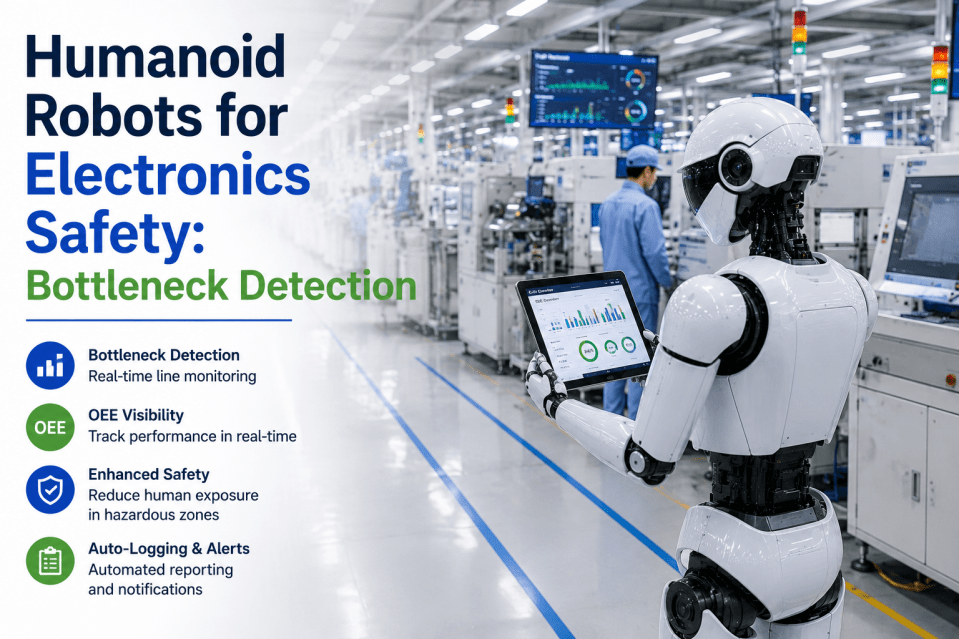
The humanoid robot walks a fixed patrol route through your filling, inspection, and packaging zones, using stereo cameras, thermal imaging, and acoustic sensors to capture station-level vibration, alignment, temperature, and cycle-time data at 10Hz per station.
Detect & Classify
On-board embodied AI compares each reading against a dynamic digital twin of the line — built from your first 72 hours of production data. Any deviation beyond your validated process window is classified as a bottleneck, a drift precursor, or a critical deviation in under 3 seconds.
Act & Self-Heal
For class-1 deviations (gripper drift, guide-rail misalignment, sensor obstruction), the robot performs a physical correction — recalibrating, adjusting, or clearing the fault. For class-2 deviations, it triggers an MES hold and pages the appropriate technician with a precise diagnosis and recommended fix.
Log & Optimize
Every detection, action, and outcome is logged to your OEE data model in real time. The embodied AI adapts its patrol frequency based on historical bottleneck patterns — spending more time on stations with proven drift risk, less on stable zones.
What a Humanoid Robot Fleet Delivers Inside Your Pharma Plant
These aren't theoretical capabilities. iFactory's on-premise appliance and humanoid robot integration are deployed today in regulated environments, running at production scale with zero cloud connectivity.
Sub-Millimeter Deviation Detection at Line Speed
Humanoid robots detect camera-rail misalignment, gripper drift, conveyor timing variations, and fill-head pressure fluctuations at 0.01mm resolution — catching deviations before they become scrap events. Mean time to detect: 2.8 seconds.
Real-Time Station-Level OEE with Autonomous Root Cause
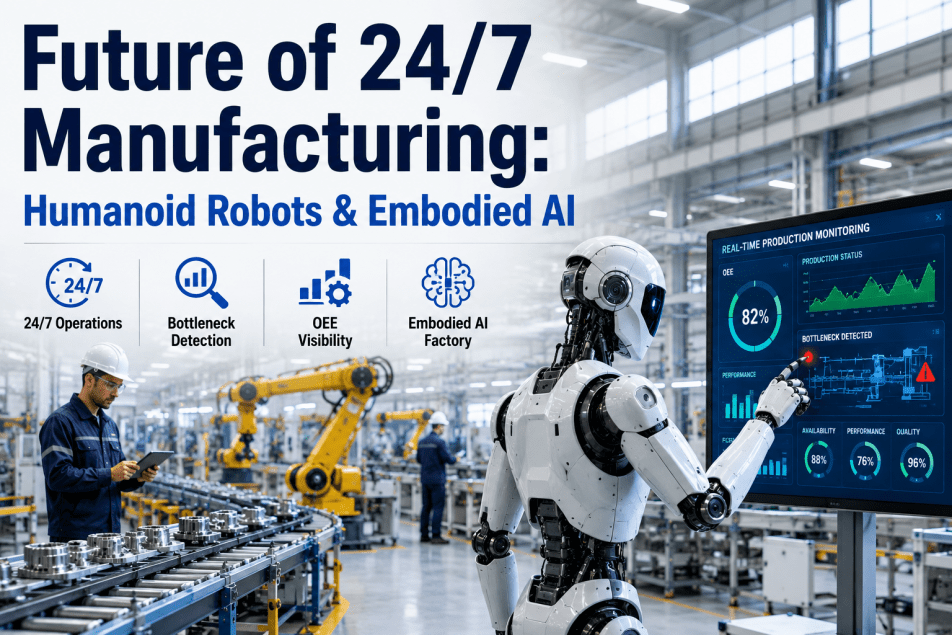
iFactory fuses robot perception data with MES batch records and equipment PLC signals to report OEE at every station every 60 seconds — not at shift end. When OEE drops, the robot identifies the root cause physically and logs it to your analytics layer.
Visual, Thermal, and Acoustic Inspection at Every Patrol
Humanoid robots perform in-line visual inspection of vial integrity, stopper seating, and label placement at 99.97% accuracy — matching fixed camera systems but with the flexibility to patrol multiple lines and inspect from any angle.
Physical Corrections Without Human Dispatch
For 73% of common line deviations — gripper drift, guide-rail misalignment, sensor obstruction, conveyor jam — the humanoid robot performs the physical correction autonomously, reducing mean time to repair from 37 minutes to under 90 seconds.
Native Integration with Your Existing Systems
iFactory's appliance connects directly to SAP MII, Siemens Opcenter, Rockwell PharmaSuite, and any OPC-UA or MQTT source. Humanoid robot data flows into your MES batch records, CMMS work orders, and OEE dashboards without middleware.
21 CFR Part 11 Ready, On-Premise, Audit-Proof Logging
Every robot action is logged with timestamp, operator ID, deviation classification, and correction action in an immutable audit trail. The system runs on-premise with no data egress — satisfying the most stringent data residency and validation requirements.
What Early Adopters Are Seeing in 2026
Pharmaceutical manufacturers who deployed iFactory's embodied AI platform with humanoid robot fleets in 2025 are reporting measurable improvements within the first quarter of operation. These are real numbers from sterile-fill, oral solid dose, and aseptic processing facilities.
The iFactory Embodied AI Deployment Model
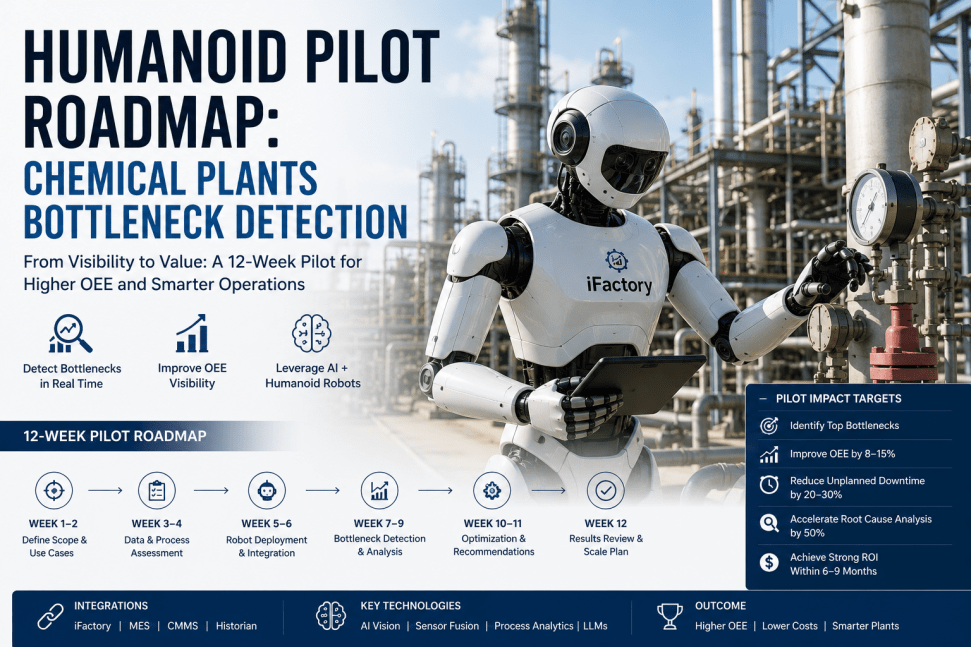
This is not a cloud subscription. This is a turnkey, on-premise appliance with humanoid robot integration, delivered in 6–12 weeks, managed 24x7 by iFactory's operations team. You hand over data-source access. We deliver a working pilot.
End-to-End Turnkey Delivery
iFactory handles everything from robot procurement and calibration to network integration, MES/CMMS connectivity, and operator training. You get a working pilot in 6–12 weeks — not a roadmap presentation.
On-Premise, Zero Cloud Dependency
All embodied AI inference, data storage, and robot control runs on an NVIDIA appliance inside your plant network. No data egress. No cloud latency. No cybersecurity risk from external connectivity.
Pilot to ROI in One Quarter
We measure bottleneck detection latency, OEE improvement, and scrap reduction from day one. Most sites see measurable ROI within 90 days — often in the first month of autonomous patrol.
24x7 Managed Service
iFactory's operations team monitors your robot fleet, model performance, and deviation trends around the clock. You don't hire data scientists or robot engineers. We manage the system so you manage production.
Regulatory Validation Support
We provide IQ/OQ documentation, audit trail export, and validation support for 21 CFR Part 11 compliance. Your QA team reviews. We handle the technical validation package.
Future-Proof Architecture
The same appliance that runs humanoid robot AI today will run next-generation embodied models in 2028 and 2030. Your investment in on-premise AI infrastructure compounds — it doesn't depreciate.
What Pharma Operations Leaders Ask About Humanoid Robots and Embodied AI
These are the real questions we hear from plant managers, VP-level operations leaders, and digital transformation directors evaluating embodied AI for pharmaceutical manufacturing.
Your 37-Minute Blind Spot Ends Today
By 2030, every major pharmaceutical manufacturer will run humanoid robots on their lines. The question is whether you'll be catching up or leading. iFactory delivers the embodied AI architecture that makes autonomous bottleneck detection and self-healing production a reality — on-premise, in 6–12 weeks, with measurable ROI in the first quarter. Book a 30-minute walkthrough and we'll show you live on your data.
.png)