ATEX Zones in 2030: Embodied AI & Humanoid Quality Inspection
By Hannah Baker on June 10, 2026
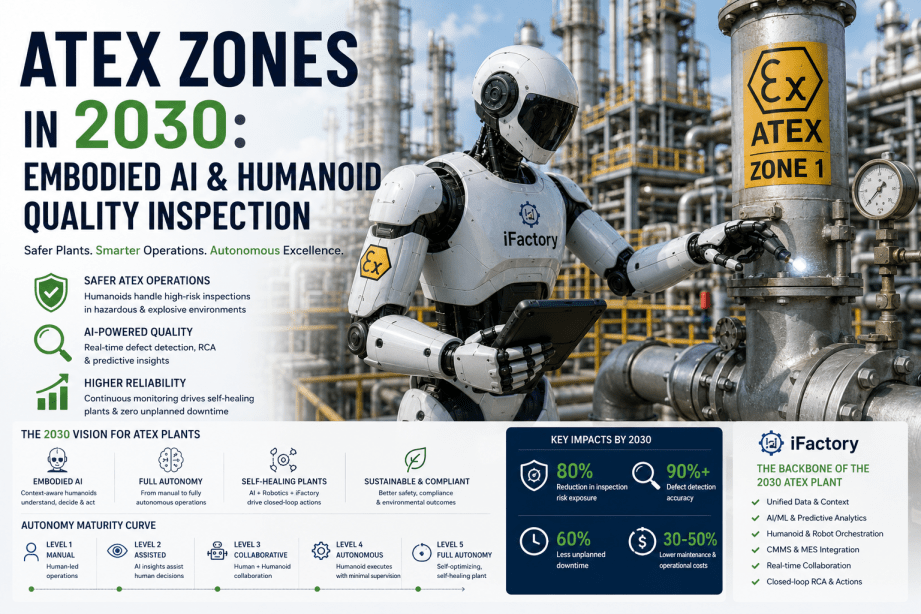
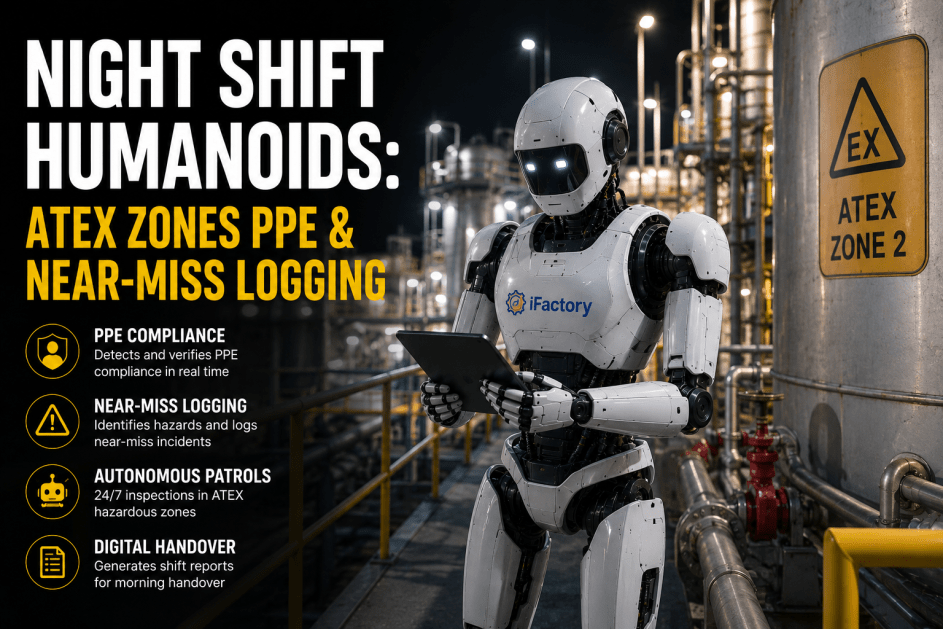
ATEX-classified hazardous zones — areas where flammable gases, vapors, or combustible dusts create explosion risk — have historically been among the most labor-intensive and inspection-dependent environments in industrial manufacturing. Human technicians rotating through these zones carry clipboards, gas detectors, and thermal cameras to document equipment condition, product quality, and environmental parameters. By 2030, embodied AI platforms powered by autonomous humanoid robots will fundamentally restructure this model. Deployed across ATEX Zones 1 and 2, these humanoids will perform continuous quality inspection, real-time defect root-cause analysis, and self-healing operational interventions without requiring human entry into hazardous areas. This article examines the trajectory from today's manual inspection protocols to the 2030 embodied AI humanoid factory — and how platforms like iFactory's Humanoid Robot Integration layer serve as the connective digital backbone for this transformation.
EMBODIED AI · HUMANOID ROBOTS · ATEX HAZARDOUS ZONES
2030 Vision: Autonomous Quality Inspection in ATEX Zones — Zero Human Entry Required
iFactory's Humanoid Robot Integration Platform connects autonomous humanoid robots to your CMMS, MES, and quality systems — enabling continuous inspection, real-time defect RCA, and predictive maintenance in hazardous environments without human exposure.
Autonomous Inspection Coverage in ATEX Zones by 2030
87%
Reduction in Human Hazardous-Zone Entry Events
4.2s
Average Defect Detection-to-RCA Cycle Time (vs. 48 hrs Manual)
3x
Equipment Life Extension via Self-Healing Intervention
ATEX Hazard Context
Why Humanoid Robotics Is Uniquely Suited for ATEX Quality Inspection
ATEX-classified environments impose constraints that traditional fixed automation and wheeled robots cannot fully address. Zone 1 areas — where explosive atmospheres are likely to occur during normal operation — and Zone 2 areas — where explosive atmospheres are unlikely but possible — require inspection equipment that is both intrinsically safe and capable of navigating complex, irregular terrain with ladders, platforms, and narrow walkways. Humanoid robots, designed with bipedal locomotion, articulated manipulators, and multi-spectral sensor arrays, offer a structural advantage over every existing automation form factor for this environment class.
BIPEDAL ACCESS
Full Terrain Navigation Without Facility Modification
Humanoid robots ascend stairs, cross grating platforms, and position themselves at elevated inspection points without requiring ramp installation, stairway modification, or facility redesign — eliminating the capital cost barrier that prevents fixed automation deployment in existing ATEX facilities.
Zero Facility Retrofit Required
ATEX CERTIFIED
Intrinsically Safe Design for Zone 1 and Zone 2
By 2030, ATEX-certified humanoid platforms will operate with intrinsically safe electrical systems, sealed enclosures, and temperature-limited surface contacts — enabling continuous patrol in hazardous areas where human entry requires permit-to-work, gas testing, and full PPE protocol.
IECEx / ATEX Zone 1 Certified
MULTI-SPECTRAL
Beyond-Visible Inspection Capability
Integrated thermal imaging, ultrasonic acoustic detection, and hyperspectral sensors enable humanoid platforms to detect incipient equipment faults, fugitive emissions, and product quality deviations that are invisible to human visual inspection — identifying defects before they become quality excursions.
Thermal + Acoustic + Hyperspectral
DEXTEROUS
Manipulation for Sample Collection and Intervention
Articulated hands with tactile feedback enable humanoid platforms to open inspection hatches, collect product samples, operate valves during testing sequences, and perform minor corrective interventions — extending capability from detect-and-report to detect-and-respond.
Full Manipulation Capability
Inspection Modality
Human Technician
Fixed Sensor Network
Wheeled AGV
Humanoid Robot (2030)
Stair / Platform Access
Yes
N/A
No
Yes
Visual Surface Inspection
Manual
Fixed-point only
Limited FOV
360° adaptive
Thermal Imaging Patrol
Handheld camera
Fixed-point only
Available
Continuous
Valve / Hatch Manipulation
Yes
No
No
Yes
Sample Collection
Manual
No
No
Yes
24/7 Autonomous Patrol
Shift-dependent
Continuous
Continuous
Continuous
Defect RCA within Minutes
Hours-days
Not possible
Not possible
Yes
Embodied AI Framework
From Detect-and-Report to Detect-Analyze-Respond: The Embodied AI Quality Loop
The defining shift between today's automated inspection and the 2030 embodied AI model is not sensor resolution or battery life — it is the closed-loop autonomy that connects detection to root-cause analysis to corrective action without human intermediation. Humanoid platforms operating within iFactory's integration layer execute a continuous four-stage quality loop that compresses the traditional defect resolution timeline from days to minutes.
1
Continuous Multi-Modal Sensing
Humanoid platforms patrol ATEX zones on programmed routes augmented by real-time anomaly detection. Visual, thermal, acoustic, and gas-sensing data streams are continuously compared against baseline models stored in the iFactory platform. Any deviation exceeding configurable thresholds triggers autonomous escalation to the analysis stage.
Stage 1 — Continuous
2
AI Root-Cause Analysis at Point of Detection
Embodied AI models running on the humanoid's edge processor classify the anomaly against a library of known defect signatures — equipment degradation, process parameter drift, material quality deviation, environmental change. The platform cross-references the finding with CMMS history, batch records, and sensor trends to identify root cause within seconds.
Stage 2 — < 10 Seconds
3
Autonomous Corrective Intervention
For defects within the humanoid's manipulation capability — valve position adjustment, sample collection, filter cleaning — the platform executes the correction immediately. For complex interventions requiring maintenance dispatch, the system generates a structured work order in the iFactory CMMS with attached evidence, RCA summary, and recommended action.
Stage 3 — Immediate / Automated
4
Self-Healing Feedback to Platform Model
Every intervention outcome — successful correction, partial resolution, or escalation — is fed back into the iFactory AI model. The platform continuously improves its defect classification accuracy, predictive maintenance timing, and autonomous intervention protocol selection — creating a self-healing operational model that becomes more effective with each cycle.
Stage 4 — Continuous Learning
2030 Technology Stack
The Humanoid-Integrated Digital Stack: iFactory as the Orchestration Layer
Humanoid robots operating in ATEX environments do not function as standalone inspection devices. They operate within a digital ecosystem that connects their sensing and manipulation capabilities to the plant's broader operational systems — CMMS, MES, quality management, and process control. iFactory's Humanoid Robot Integration Platform provides the middleware layer that enables this connectivity without custom integration development for each deployment.
SYSTEM LAYER
FUNCTION
iFACTORY INTEGRATION MODE
2030 CAPABILITY
Humanoid Control OS
Navigation, manipulation, sensing
REST API / MQTT Bridge
Bidirectional command and data streaming
iFactory CMMS
Work order, asset history, PM scheduling
Auto WO generation from defect events
Zero-lag work order creation with RCA data attached
iFactory MES
Production tracking, batch records, OEE
Real-time quality data injection
Continuous batch quality visibility from ATEX zones
Quality Management
Defect tracking, RCA, CAPA, trending
AI-classified defect records with auto-RCA
4.2-second detection-to-RCA cycle time
Process Control / DCS
Process parameter monitoring and control
OPC-UA / API bidirectional bridge
Humanoid sensor data enriches DCS model
Quality Inspection Evolution
From Scheduled Rounds to Predictive Self-Healing: The Quality Inspection Maturity Model
The transformation of quality inspection in ATEX zones follows a predictable maturity curve. Understanding this trajectory helps plant operations and quality leaders assess their current position against the 2030 embodied AI benchmark and identify the infrastructure investments — data integration, platform connectivity, robotic interface standardization — required to progress to the next maturity level.
LEVEL 1
Manual Paper-Based Inspection
Human technicians enter ATEX zones with paper checklists, handheld thermal cameras, and gas detectors. Inspection data recorded on clipboards is transcribed to digital systems after the shift. Defect detection-to-RCA cycle: 48–72 hours. Quality data is retrospective and disconnected from real-time operations.
Current Baseline — Most Facilities
LEVEL 2
Digital Checklist + Fixed Sensors
Tablet-based digital checklists replace paper. Fixed-point thermal and gas sensors provide continuous monitoring at critical equipment locations. Defect detection improves but RCA remains manual. Quality data is siloed in the inspection system and not integrated with CMMS or MES.
Transitional — 2024–2026
LEVEL 3
Mobile Robot Patrol with AI Analysis
Wheeled or tracked robots patrol ATEX zones on fixed routes. Multi-spectral sensor data is uploaded to cloud AI for defect classification. RCA is semi-automated. Integration with CMMS enables auto-generated work orders. Defect detection-to-RCA: 2–4 hours.
Emerging — 2026–2028
LEVEL 4
Autonomous Humanoid + Embodied AI
Humanoid robots with full terrain navigation, dexterous manipulation, and edge AI operate continuously in ATEX zones. Detection, RCA, and corrective intervention execute within minutes. Self-healing feedback loop continuously improves detection models. Human entry for routine inspection eliminated.
2030 Target State
Edge AI Inference — Real-Time Defect Classification Without Cloud Dependency
Humanoid platforms operating in ATEX zones must execute defect classification at the edge — network latency to cloud inference engines introduces unacceptable delay for real-time intervention decisions. Edge AI models trained on plant-specific defect libraries and deployed on the humanoid's onboard processor enable sub-second classification of thermal anomalies, surface defects, acoustic emissions, and gas detection events without external connectivity.
On-device neural network inference with < 500ms classification latency
Plant-specific defect library trained on historical quality and maintenance records
Continuous model update via delta sync when humanoid returns to charging station
Confidence scoring with automatic re-inspection for below-threshold classifications
Multi-modal sensor fusion — visual, thermal, acoustic, gas — for compound defect detection
ATEX Certification Path — From Lab Validation to Zone 1 Deployment
ATEX certification for humanoid robots follows a structured validation pathway that addresses ignition source elimination, electrostatic discharge, surface temperature limits, and battery safety in explosive atmospheres. By 2030, major humanoid OEMs will offer ATEX Zone 1 and Zone 2 certified variants as standard product options rather than custom engineering projects.
Intrinsically safe electrical architecture with energy-limited circuits
Temperature classification T3/T4 surface limits for Zone 1 operation
Sealed enclosure with positive pressure purge for internal component protection
ESD-safe materials and grounding path design for all external surfaces
Battery system with thermal runaway containment and gas monitoring
Fleet Orchestration — Multi-Humanoid Coordination in Large ATEX Facilities
Large chemical, petrochemical, and pharmaceutical facilities may require multiple humanoid platforms to cover all ATEX zones within inspection frequency requirements. iFactory's fleet orchestration module manages patrol route assignment, charging cycle coordination, task prioritization, and data aggregation across the humanoid fleet — ensuring complete zone coverage without overlap or missed inspection points.
Dynamic patrol route optimization based on equipment criticality and inspection history
Automatic re-routing when one platform is unavailable for charging or maintenance
Centralized data lake aggregating all inspection findings across fleet
Task prioritization engine — defect response over routine patrol
Humanoid-to-humanoid handoff for extended patrol sequences exceeding single battery range
Self-Healing Protocol — Closing the Loop from Detection to Correction
The self-healing protocol represents the highest maturity level of embodied AI quality inspection. When a humanoid platform detects a defect within its correction capability — valve stem leak requiring minor adjustment, filter blockage requiring cleaning, product sample requiring collection — the platform executes the intervention autonomously and verifies resolution before continuing its patrol. The complete detection-correction-verification cycle completes within minutes.
Autonomous valve position adjustment with torque-limited manipulation
Filter cleaning via integrated air pulse or mechanical agitation tool
Product sample collection with container seal and barcode labeling
Visual and thermal verification of correction effectiveness
Documentation of intervention in iFactory CMMS with pre/post evidence
HUMANOID INTEGRATION · ATEX ZONE AUTOMATION · 2030 ROADMAP
Your ATEX Facility's 2030 Roadmap Starts with Platform Connectivity Today
iFactory's Humanoid Robot Integration Platform provides the digital infrastructure your plant needs to connect autonomous humanoid robots to your CMMS, MES, and quality systems — enabling continuous inspection, real-time defect RCA, and self-healing operations in hazardous environments.
Dr. S. Vann, Director of Automation Strategy — Global Chemical Manufacturer, 28 Years
Past Chair, ISA-88 Batch Control Standards Committee
"I have spent 28 years in chemical manufacturing automation, and the single most persistent operational gap across every facility I have worked with is the inability to inspect ATEX-zoned equipment with the same frequency and fidelity as non-classified areas. We have instrumented the non-hazardous parts of our plants with continuous monitoring, but the hazardous zones — where the most critical process equipment lives — are still served by human technicians on 4-hour or 8-hour patrol cycles. The embodied AI humanoid model addresses this gap not by replacing human technicians but by extending inspection capability into areas where human entry is inherently limited by safety constraints. What excites me about the 2030 trajectory is the convergence of three enabling technologies — ATEX-certified humanoid form factors, edge AI inference capable of real-time defect classification, and platform middleware like iFactory that connects robotic sensing to CMMS and MES without custom integration. The facilities that invest in this digital infrastructure today will be the ones operating with zero routine human entry into hazardous zones by 2030."
Dr. S. Vann, Director of Automation StrategyGlobal Chemical Manufacturer — 28 Years, Past Chair ISA-88 Batch Control Committee
Conclusion
2030 Is Eight Years Away — The Infrastructure Decisions You Make Today Determine Whether You Lead or Follow
The embodied AI humanoid factory is not a speculative concept. Every enabling technology — ATEX-certified bipedal platforms, edge AI inference engines, multi-modal sensor arrays, and industrial integration middleware — is in active development or early commercialization today. The gap between today's manual-inspection ATEX facilities and the 2030 autonomous-inspection model is not a technology gap. It is an integration gap and a data infrastructure gap. Facilities that have already digitized their CMMS, MES, and quality management workflows on a unified platform like iFactory will be able to connect humanoid robot data streams as soon as ATEX-certified platforms become commercially available. Facilities operating on disconnected legacy systems will face a multi-year integration effort while their competitors are already running autonomous patrols.
The 87% reduction in human hazardous-zone entry events, the 4.2-second defect-to-RCA cycle, and the 3x equipment life extension projected for the 2030 humanoid model are not hypothetical benefits — they are the measurable outcomes of a digital infrastructure that connects robotic sensing to operational decision-making. iFactory's Humanoid Robot Integration Platform provides the middleware layer that makes this connectivity possible, enabling plants to build the data foundation for 2030 autonomous operations while delivering immediate value from today's CMMS, MES, and quality management capabilities. Book a Demo to see how your facility can begin building the 2030 digital infrastructure today.
87%
Human Hazardous-Zone Entry Reduction
4.2s
Detection-to-RCA Cycle Time
3x
Equipment Life Extension via Self-Healing
24/7
Continuous ATEX Zone Inspection Coverage
FAQ
Humanoid Robots in ATEX Zones — Frequently Asked Questions
Humanoid robots for hazardous environments are being developed for ATEX Zone 2 (explosive atmosphere unlikely during normal operation) and Zone 1 (explosive atmosphere likely during normal operation) classification. The certification pathway requires intrinsically safe electrical architecture with energy-limited circuits, temperature classification T3/T4 surface limits, sealed enclosure with positive pressure purge, ESD-safe external materials, and battery systems with thermal runaway containment. Zone 0 certification — where explosive atmospheres are continuously present — remains outside the expected capability envelope for humanoid platforms through 2030, as the ignition source elimination requirements exceed current battery and actuation system capabilities. Most industrial deployments will target Zone 1 and Zone 2 areas, which cover the majority of chemical, petrochemical, and pharmaceutical facility hazardous zones.
iFactory's Humanoid Robot Integration Platform provides REST API and MQTT bridge connectivity between humanoid robot control systems and existing plant systems — CMMS, MES, quality management, and process control. When a humanoid platform detects a defect during ATEX zone patrol, the platform automatically generates a structured work order in the CMMS with attached inspection evidence, AI-classified defect type, and root-cause analysis summary. Quality deviations are recorded in the quality management module with full traceability to specific equipment, location, and patrol timestamp. The integration requires no custom development — the platform's middleware layer handles protocol translation, data normalization, and system routing. The connection is bidirectional: the humanoid platform can query equipment history, maintenance schedules, and quality specifications from connected systems during patrol to inform its inspection and intervention decisions.
ROI analysis for humanoid deployment in ATEX zones considers three primary value streams: labor cost reduction from reduced human entry for routine inspection, productivity improvement from continuous defect detection versus scheduled patrol cycles, and equipment life extension from early intervention on incipient faults. Early adopter projections from humanoid OEMs and integration platform providers indicate a 2–3 year payback period for facilities with 10+ ATEX-classified equipment locations requiring daily inspection. The ROI accelerates significantly when the humanoid platform is integrated with existing CMMS and quality systems — the auto-generation of structured work orders and quality records eliminates the administrative overhead that consumes approximately 35% of the total inspection cycle cost in manual operations. Book a Demo to review the ROI model for your specific facility configuration.
Bipedal locomotion is the defining structural advantage of humanoid robots over wheeled or tracked platforms for ATEX facility inspection. Humanoids ascend stairs at standard industrial pitch, traverse grated platforms and catwalks, and navigate narrow walkways with step-over clearance for raised obstacles — all without facility modification. Simultaneous localization and mapping (SLAM) algorithms operating on the humanoid's edge processor build and maintain a 3D model of the facility that includes stair geometry, platform elevation changes, and walkway width constraints. The platform adapts its gait and foot placement strategy based on surface type — solid flooring, grating, anti-slip tread — detected through visual and force-feedback sensing. This terrain-adaptive capability is the key differentiator from wheeled AGVs, which require ramp installation, elevator integration, or facility reconfiguration to access multi-level ATEX zones.
When a humanoid platform encounters an anomaly outside its autonomous correction capability — complex equipment failure requiring parts replacement, process condition requiring engineering evaluation, safety condition requiring human verification — the platform executes a structured escalation protocol within the iFactory platform. The anomaly is classified by severity and type, all sensor evidence is attached to the escalation record, the platform's AI model generates a recommended course of action based on similar historical events, and a work order or notification is routed to the appropriate human responder — maintenance supervisor, process engineer, or EHS specialist. The humanoid platform continues its patrol while the escalated item is managed through the iFactory CMMS workflow. The defect data collected during detection remains in the platform's continuous learning model, improving future autonomous intervention capabilities. This human-supervised autonomy model ensures that escalation to human decision-makers occurs only for events requiring judgment or intervention beyond the platform's certified capability envelope.
Build Your 2030 ATEX Zone Inspection Infrastructure on iFactory's Humanoid Integration Platform
iFactory provides the digital middleware layer that connects autonomous humanoid robots to your CMMS, MES, and quality systems — enabling continuous inspection, real-time defect RCA, and self-healing interventions in hazardous ATEX environments. Start building your integration foundation today.