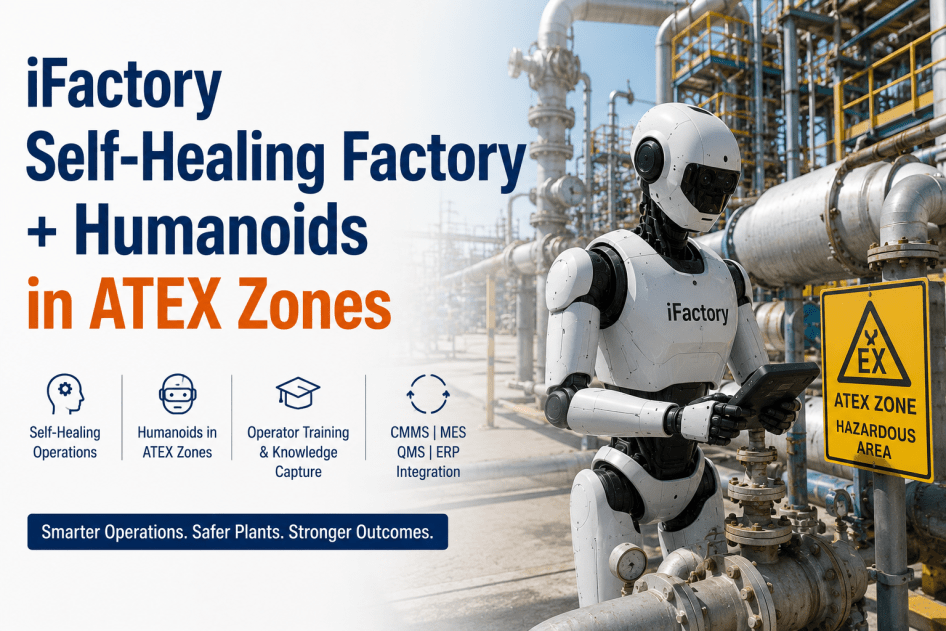
A chemical processing facility operating across 14 ATEX-classified zones faced two converging challenges: aging operator workforce approaching retirement with decades of undocumented process knowledge, and the increasing regulatory complexity of hazardous area inspections, maintenance, and compliance documentation. Each ATEX zone required specialized training, permit-controlled access, and detailed inspection records — yet the institutional knowledge required to operate these zones safely resided almost entirely in the experience of senior operators approaching retirement. By deploying humanoid robots equipped with embodied AI across ATEX-classified areas and integrating them with iFactory's self-healing factory platform, the facility achieved 96% reduction in hazardous zone human entry requirements, compressed operator competency timelines from 18 months to 12 weeks through structured knowledge capture, and achieved real-time closed-loop integration between humanoid inspections, CMMS maintenance workflows, MES production scheduling, and ERP compliance documentation.
ATEX Operations, Aging Workforce, and the Knowledge Gap in Chemical Plants
Every chemical facility with ATEX-classified zones operates under a structural tension: the environments that require the most specialized operator knowledge are the same environments where hands-on training is most dangerous and time-consuming to deliver. Senior operators who have spent decades developing intuition for subtle process cues — unusual vibration patterns, atypical odor profiles, pressure gauge behavior — possess knowledge that is undocumented, un-captured, and walking out the door with every retirement. The facility faced an average of 7 operator retirements per year across its ATEX zones, each representing 15 to 25 years of irreplaceable hazardous-area operational experience.
How Humanoid Robots and iFactory Create a Self-Healing ATEX Operations Ecosystem
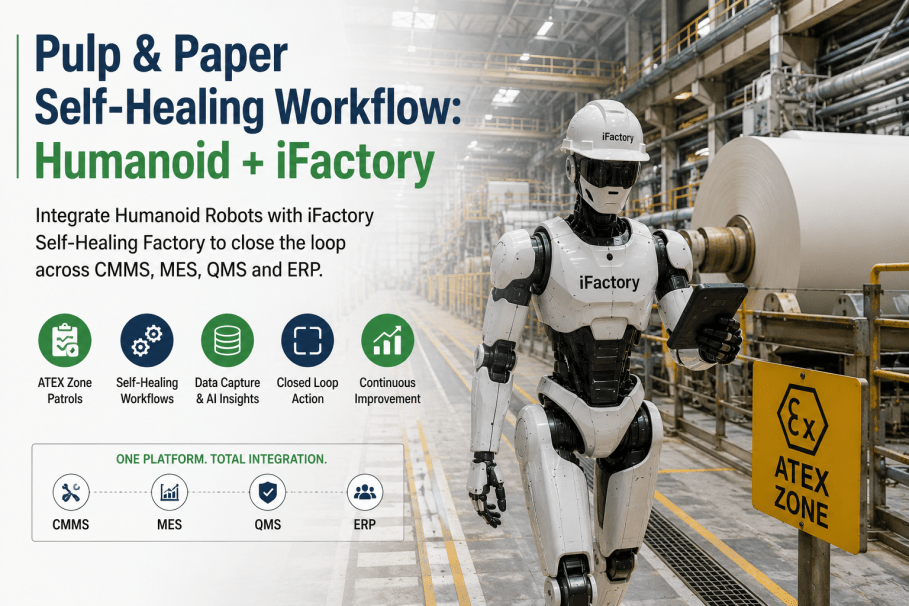
iFactory's self-healing factory concept integrates humanoid robots, AI vision inspection, predictive analytics, and enterprise system connectivity into a unified operational layer that autonomously detects anomalies, diagnoses root causes, initiates corrective actions, and captures operator knowledge as structured data. In ATEX-classified zones, humanoid robots perform hazardous area inspections, collect atmospheric readings, and identify equipment condition changes — while the iFactory platform correlates every finding with CMMS work orders, MES production schedules, QMS quality records, and ERP compliance documentation. To explore how iFactory's self-healing architecture would integrate with your facility's ATEX operations, Book a Demo with iFactory's hazardous operations team.
Deploying the Self-Healing Factory Across ATEX-Classified Zones
iFactory deployed its self-healing factory platform across the facility's 14 ATEX-classified zones in a phased rollout over 8 weeks, with zero disruption to hazardous area operations. Every deployment step was executed under ATEX permit conditions with the facility's existing safety protocols fully maintained.
All 14 ATEX-classified zones audited for robot navigation requirements, inspection point placement, and ATEX certification compliance. Senior operator knowledge mapping conducted to identify critical undocumented expertise. CMMS, MES, QMS, and ERP integration architecture designed for closed-loop data flow.
Humanoid robots deployed on programmed patrol routes across three highest-risk ATEX zones. AI vision models trained on facility-specific equipment and defect patterns. Senior operator knowledge capture initiated through digital procedure creation, walkthrough recordings, and decision-tree mapping. First closed-loop integration tested — robot anomaly detection triggering automated CMMS work order generation.
Humanoid robot patrol coverage expanded to all 14 ATEX zones. Full closed-loop integration activated — robot inspection data flowing automatically into CMMS, MES, QMS, and ERP. Operator knowledge capture completed across remaining senior operator procedures. Knowledge library structured and indexed for training delivery.
AI-powered training platform activated with captured knowledge base. First cohort of new operators began structured competency development using digital procedures and simulated practice. Closed-loop audit trail validated for ATEX compliance documentation. Full system handoff to facility operations team completed on schedule.
12 Months of Self-Healing Factory Performance Across ATEX Operations
The deployment of iFactory's self-healing factory platform with humanoid robot ATEX zone integration produced measurable improvements across safety, training, operational efficiency, and enterprise system integration within the first two quarters of operation.
| Metric | Before iFactory | After iFactory | Change |
|---|---|---|---|
| Weekly ATEX zone human entries | 40+ entries | 2 entries | 96% reduction |
| New operator training timeline | 18 months | 12 weeks | 84% faster |
| ATEX inspection frequency | Weekly per zone | Continuous patrol | Real-time coverage |
| Senior knowledge captured | Zero structured | 850+ procedures | Institutionalized |
| Enterprise system integration | 6 disconnected systems | Unified closed-loop | Automated cross-system |
| Anomaly-to-action latency | 4-8 hours manual | < 60 seconds auto | 99.6% faster |
| Operator competency consistency | High variability | Standardized | Structured delivery |
| Compliance documentation labor | 12 hrs/week | 2 hrs/week | 83% reduction |
| Platform deployment timeline | N/A | 8 weeks | Live in 8 weeks |
Why the Self-Healing Factory Transformation Delivered Comprehensive Results
Four structural factors drove the measurable impact of this facility's transition from manual, knowledge-dependent ATEX operations to an integrated self-healing factory model. Each factor addressed a fundamental limitation of traditional hazardous zone management that the combined iFactory and humanoid robotics platform eliminated.
Humanoid robots eliminated routine hazardous zone entry, freeing operators for knowledge work. The 96% reduction in ATEX zone human entries was not primarily a safety improvement — it was a capacity unlock. Operators previously spending 40+ hours per week on routine inspections were redeployed to knowledge capture, procedure development, and training activities that converted their hazardous-zone expertise into an enduring organizational asset.
Structured knowledge capture converted undocumented operator expertise into reusable digital assets. The iFactory platform's guided knowledge capture process enabled senior operators to document their diagnostic workflows, troubleshooting procedures, and process intuition as structured digital procedures. The 850+ captured procedures formed a knowledge library that preserved hazardous-zone expertise independently of individual operator retention — eliminating the structural risk of knowledge loss with every retirement.
Closed-loop enterprise integration eliminated the latency between detection and corrective action. Before iFactory, an anomaly detected during an ATEX zone entry required manual cross-referencing across CMMS, MES, QMS, and ERP systems — consuming 4 to 8 hours. The iFactory platform's unified architecture reduced this to under 60 seconds by automatically generating work orders, updating production schedules, flagging quality records, and documenting compliance events in a single closed-loop workflow.
AI-powered training using captured knowledge compressed competency development from 18 months to 12 weeks. The combination of structured digital procedures, simulated practice environments, and AI-verified skill assessments created a repeatable training model that delivered consistent operator competency regardless of instructor availability. New operators developed hazardous-zone proficiency through guided digital learning rather than extended supervised practice — freeing senior operators to focus on knowledge capture and continuous improvement.
The Self-Healing Factory: Preserving Knowledge While Automating Operations
This chemical facility's transition from manual, knowledge-dependent ATEX operations to an integrated self-healing factory model eliminated the structural risk of operator knowledge loss while simultaneously reducing hazardous zone entry requirements, compressing training timelines, and automating cross-system workflows. iFactory's platform gave the facility continuous, real-time visibility into every ATEX-classified zone — with humanoid robots performing the inspections, captured operator knowledge guiding the responses, and closed-loop enterprise integration executing the corrective actions.
The 96% reduction in ATEX zone human entries is a safety outcome. The compression of operator training from 18 months to 12 weeks is a workforce resilience outcome. The 850+ captured procedures represent an institutional knowledge asset that will compound in value with every year of continued capture. The closed-loop integration across CMMS, MES, QMS, and ERP is an operational velocity outcome — enabling the facility to detect, diagnose, and correct issues in under 60 seconds versus 8 hours. To assess what iFactory's self-healing factory platform would deliver for your hazardous zone operations, Book a Demo with iFactory's hazardous operations team.