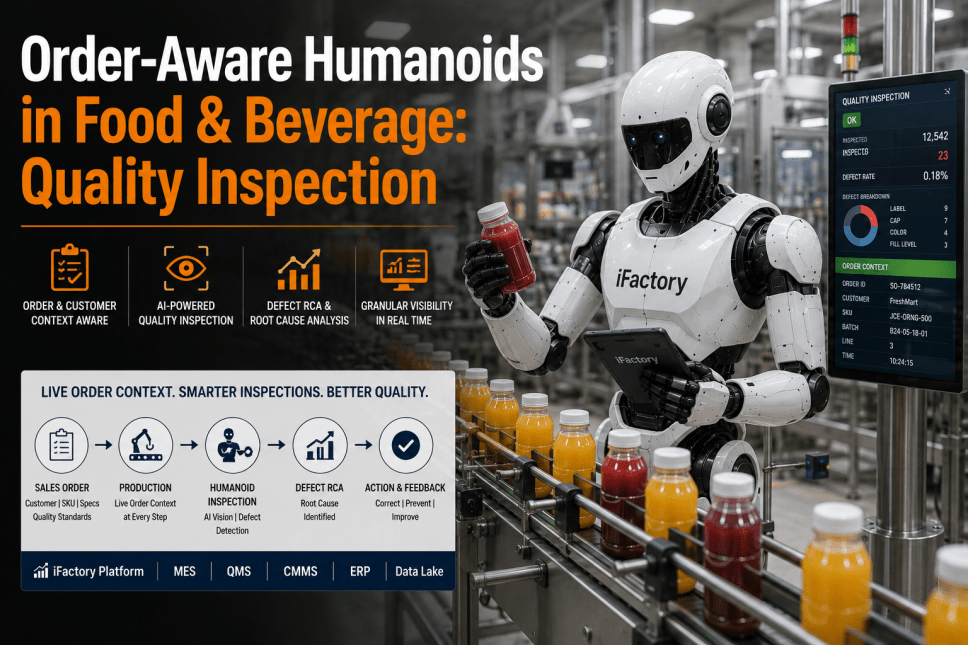
A top-10 North American beverage manufacturer producing 200 million cases annually across four high-speed lines faced a quality visibility problem that no single camera system could solve: each production line ran multiple SKUs per shift, customer specifications varied by retailer, and defects discovered at the warehouse or retailer dock triggered chargebacks averaging $340,000 per incident. Traditional fixed-camera inspection systems covered individual checkpoints but could not adapt to product changeovers, could not correlate defects with upstream process conditions, and had no awareness of which customer would receive each unit. By deploying order-aware humanoid robots integrated with iFactory's AI vision platform, the manufacturer achieved 99.7% defect detection accuracy, reduced customer quality complaints by 68% and eliminated $2.8 million in annual retailer chargebacks — with root cause analysis delivered within minutes of defect detection rather than days. Quality and operations leaders regularly Book a Demo to see how order-aware humanoid quality inspection integrates with their existing line infrastructure and quality management systems.
The Order-Aware Quality Visibility Challenge
When a food or beverage plant runs multiple SKUs per shift — each bound for a different retailer with its own label specifications, packaging requirements, and quality thresholds — the quality inspection system must know which customer is receiving each unit to determine whether a given characteristic constitutes a defect. Traditional vision systems inspect every unit against a single pass-fail standard, but in modern food manufacturing, the standard depends on the order. A label positioned 2 mm left of nominal may be acceptable for a regional discount retailer but trigger a rejection from a national grocery chain with strict branding guidelines. The manufacturer discovered that 43% of its retailer chargebacks originated from orders where the product met general quality standards but failed customer-specific requirements — defects that traditional inspection systems could not detect because they did not have access to order context. Manufacturing leaders seeking to assess their quality visibility can review iFactory's order-aware quality framework during a platform demonstration.
SKU-Specific Quality Variance
Each product SKU has unique quality parameters — fill level tolerance, label placement, cap torque range, case pack pattern — yet traditional fixed-camera systems apply uniform inspection criteria across all SKUs, generating false rejects on some products while missing defects on others. Order-aware humanoids load SKU-specific inspection profiles at each changeover.
Customer-Specific Requirements
Retailers and food service customers enforce distinct quality specifications — case labeling, pallet configuration, date code format, packaging material — that cannot be verified by line-mounted cameras. Humanoid robots access the production order in real time and inspect each unit against the receiving customer's quality requirements before shipment.
Delayed Root Cause Analysis
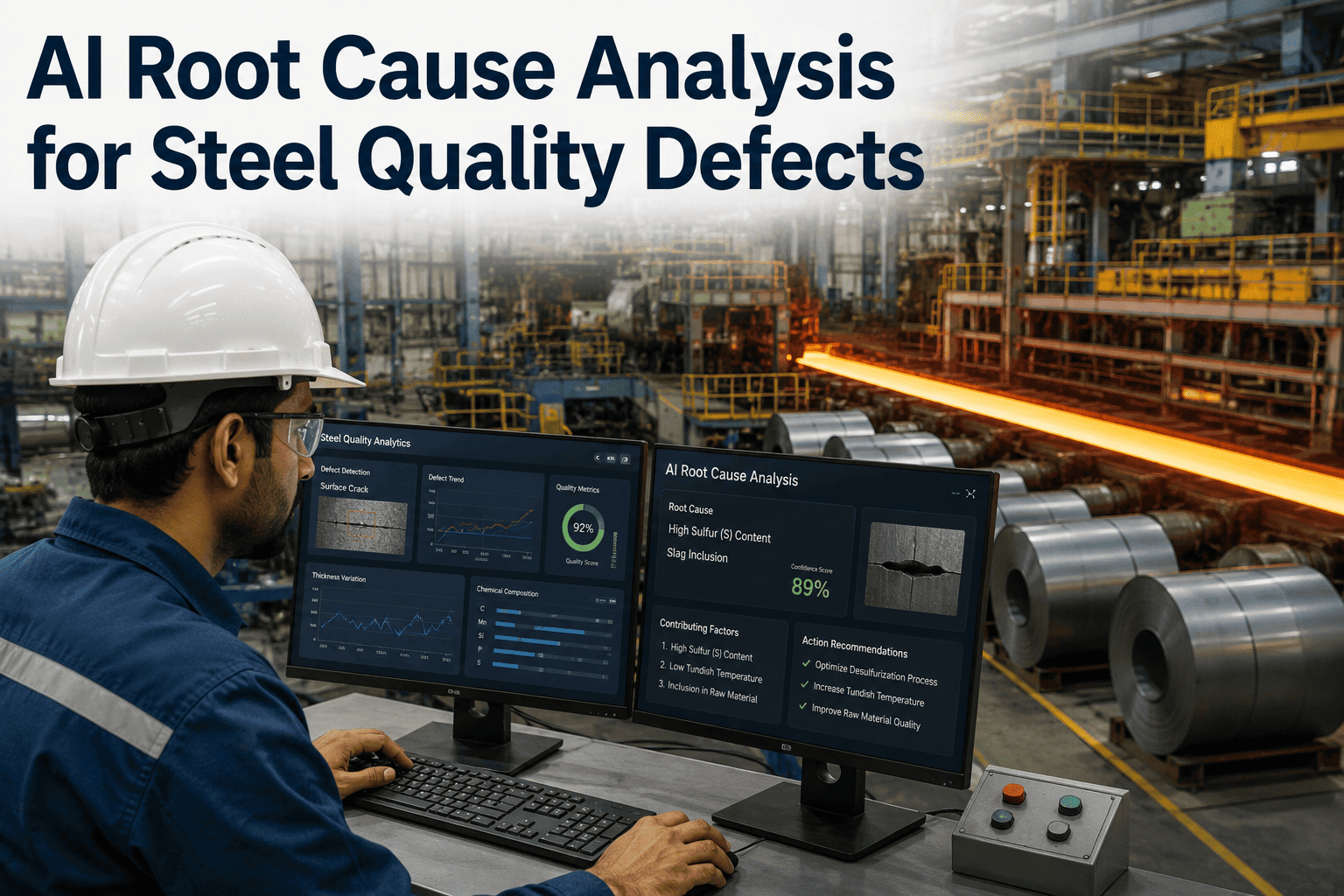
When a defect is detected at the retail level, the quality team spends days tracing the affected lot back through production records to identify root cause — by which time the same defect may have affected thousands of additional units. Humanoid robots execute RCA in minutes by correlating defect data with upstream process parameters at the moment of detection.
Order-Aware Quality Inspection Approach
iFactory deployed order-aware humanoid robots across all four production lines, integrating real-time order data from the MES with AI vision inspection parameters specific to each SKU-customer combination. The platform allows each production line to run at full speed while the humanoid fleet dynamically adjusts inspection criteria based on the active order — enabling customer-specific quality verification without slowing production. Book a Demo to explore how iFactory's order-aware quality framework integrates MES order data with humanoid robot inspection parameters for customer-specific defect detection.
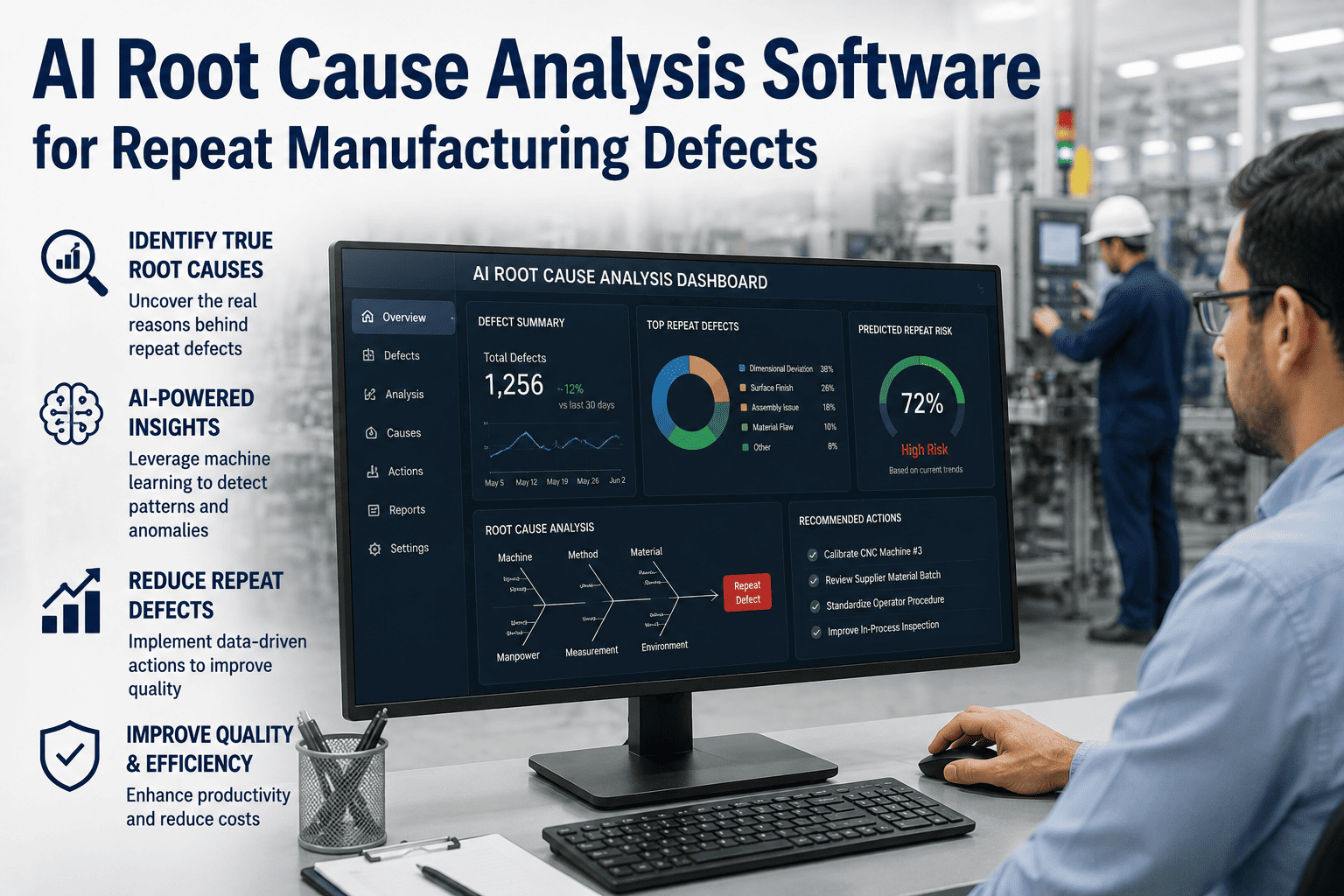
Real-Time Quality Dashboard — The quality management team accesses a live dashboard showing defect detection rates, root cause assignments, and customer-specific quality performance across all four lines. Each defect event is tagged with the production order, SKU, target customer, and upstream process conditions at the moment of detection. The system automatically generates CAPA records for emerging defect patterns and routes them to the appropriate process owner. Trending analytics identify recurring defect families and correlate them with specific production conditions — filler temperature excursions, label reel changes, capper torque drift — enabling proactive correction before the defect threshold is exceeded.
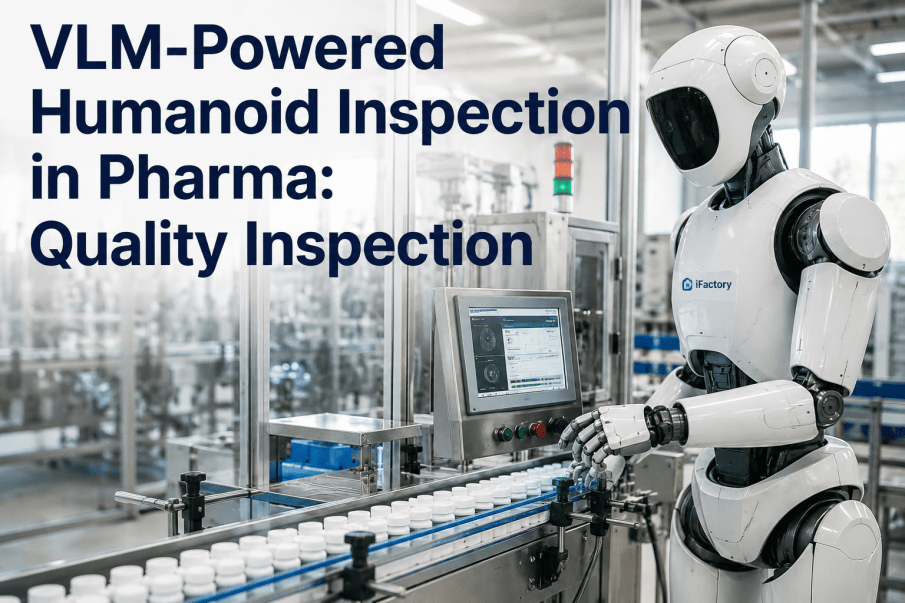
Line-Side Performance Management — Each production line operates with a dedicated humanoid robot fleet that executes continuous inspection routes, covering fill level verification, label placement, cap torque, seal integrity, case pack accuracy, and pallet configuration. The humanoid robots access the line's production schedule and load SKU-specific inspection profiles automatically at each changeover — no operator intervention required. Real-time defect alerts are displayed on line-side monitors, and the humanoid fleet executes corrective actions — diverting defective units, adjusting downstream reject gates, and updating the quality record — within seconds of detection.
Order-Aware Quality Verification — The humanoid inspection system receives the active production order from the MES, including the target customer, ship-to location, and applicable quality specifications. Each inspected unit is evaluated against the customer-specific requirements: a unit destined for a national grocery chain is inspected to that chain's label placement tolerance, date code format, and case pack pattern, while a unit destined for a food service distributor is inspected against that distributor's pallet configuration and packaging specifications. The system maintains a customer-specific quality score for each order and flags deviations before the unit reaches the pallet.
Deploy Order-Aware Humanoid Quality Inspection Across Your Production Lines
iFactory's platform integrates MES order data with humanoid robot AI vision inspection — enabling customer-specific quality verification, real-time defect RCA, and automated CAPA generation across unlimited SKUs and retailer specifications.
Quality Inspection Performance and Business Impact
Within 12 months of deployment, the manufacturer documented verified quality improvements across all four production lines. The order-aware inspection framework enabled the quality team to intercept customer-specific defects before shipment, identify upstream process root causes in minutes rather than days, and eliminate the chargeback exposure that had cost millions annually.
| Defect Category | Pre-Deployment Detection | Post-Deployment Detection | Enterprise Impact |
|---|---|---|---|
| Label Placement and Alignment | 82% — fixed camera missed SKU-specific tolerance variation | 99.5% — order-aware humanoids apply customer-specific label tolerances | $1.1M annual chargeback reduction from mislabeled pallets rejected at retail |
| Fill Level Accuracy | 91% — single threshold triggered excessive false rejects on underweight SKUs | 99.8% — SKU-specific fill tolerance with customer weight compliance verification | 37% reduction in giveaway costs through precision fill adjustment per customer spec |
| Seal and Closure Integrity | 93% — fixed cameras at capper exit; downstream leakers undetected | 99.6% — mobile humanoid inspection covers every unit at multiple angles | 52% reduction in retailer-reported leaker complaints and spoilage claims |
| Case Pack and Pallet Configuration | Manual inspection at palletizier — 78% accuracy during shift change | 99.9% — automated case count, layer pattern, and pallet wrap verification per customer order | $640K annual savings from eliminated restocking fees and reshipment costs |
| Date Code and Lot Marking | 85% — OCR camera missed rotated or misprinted codes on curved surfaces | 99.7% — multi-angle humanoid vision with order-specific date format verification | Zero retail rejections for date code format mismatch in 12 months post-deployment |
Phased Humanoid Quality Inspection Rollout
iFactory's deployment team followed a structured four-phase methodology designed to deliver measurable quality improvements within 12 weeks while building toward enterprise-wide order-aware inspection coverage. Each phase included SKU profiling, customer specification integration, and operator training to ensure consistent adoption across shifts and product categories. Book a Demo to see the phased deployment roadmap configured for your production lines and customer portfolio.
Defect Library and SKU Profiling
iFactory's quality engineering team worked with the manufacturer's quality and operations teams to curate a defect image library from 24 months of production records, containing 180,000+ labeled images across 14 defect categories. Each SKU was profiled with its unique quality parameters — fill tolerance, label position, cap torque, case configuration — and cross-referenced against customer-specific requirements extracted from retailer specification documents. Timeline: 4 weeks.
Humanoid Deployment and SKU Validation
Humanoid robot platforms were deployed on the first production line with the defect library and SKU inspection profiles loaded. The validation phase confirmed that each humanoid could execute inspection routes at full line speed, detect all 14 defect categories at the accuracy target, and correctly apply SKU-specific inspection criteria during product changeovers — without operator intervention. Timeline: 4 weeks.
MES Integration and Order-Aware Configuration
Each humanoid robot was connected to the plant's MES to receive real-time production order data — SKU, target customer, ship-to location, and applicable quality specifications — at each changeover. The order-aware inspection engine was configured to apply customer-specific quality criteria at the unit level, and the defect RCA engine was connected to upstream process data sources for automated root cause correlation. Timeline: 2 weeks.
Line Expansion and Continuous Learning
Following successful validation on the first line, humanoid robot deployment was expanded to the remaining three production lines, with SKU libraries and customer specifications replicated and validated per line. The active learning loop was activated, enabling the defect detection models to improve continuously as new defect variants were encountered and reviewed. Timeline: 2 weeks.
Before iFactory's order-aware humanoid deployment, our quality team spent 60% of their time investigating customer complaints that turned out to be specification mismatches — a label that would have passed our internal standard but failed a customer's specific requirement. Traditional vision systems cannot distinguish between a quality defect and a customer specification variance because they do not know who the customer is. The order-aware humanoid framework changed that fundamentally. Today, every unit is inspected against the receiving customer's quality requirements, root cause analysis is delivered in minutes instead of days, and our retailer chargeback exposure has effectively been eliminated. The technology investment paid for itself in reduced chargebacks alone within the first two quarters of operation.
The Path to Order-Aware Quality Inspection
This deployment demonstrates that order-aware humanoid quality inspection is achievable without replacing existing line infrastructure or disrupting production throughput. iFactory's platform integrates MES order data with humanoid robot AI vision inspection — enabling customer-specific quality verification, real-time defect RCA, and automated CAPA generation across unlimited SKUs and retailer specifications. The manufacturer achieved 99.7% defect detection accuracy, reduced customer quality complaints by 68%, and eliminated $2.8 million in annual retailer chargebacks through inspection that knows which customer will receive each unit. Quality and operations leaders evaluating their food and beverage quality strategy regularly Book a Demo to explore how iFactory's order-aware humanoid framework can customer-specific quality protection across their production network.
Order-Aware Quality Inspection — Frequently Asked Questions
The humanoid quality inspection system connects to the plant's MES via iFactory's integration API, receiving the active production order at each changeover — including SKU, target customer, ship-to location, and applicable quality specifications. Each customer's quality requirements are maintained in a centralized specification library within the iFactory platform, indexed by customer ID and SKU combination. When a new order is started, the humanoid fleet automatically loads the corresponding inspection profile — fill tolerance, label placement parameters, date code format, case configuration, and pallet pattern — without operator intervention. Customer specifications can be updated centrally and propagate to all affected inspection profiles within minutes.
Product changeovers are detected automatically via the MES integration — when the line controller signals a new order start, the humanoid fleet receives the updated order data and loads the corresponding SKU-specific inspection profile within seconds. The humanoid robots stationed at the changeover point verify that the first units of the new order meet the customer's requirements before full production resumes, providing real-time changeover quality verification. SKU libraries and customer specification profiles are pre-loaded and validated during the deployment phase, so no operator configuration is required at changeover time.
When a defect is detected, the RCA engine automatically queries upstream process data from the line's PLC network, SCADA system, and iFactory's CMMS — including filler temperature, filler pressure, conveyor speed, capper torque, label reel tension, and date coder temperature at the moment of production. The engine correlates defect patterns with process parameter excursions using statistical pattern matching and presents the root cause hypothesis with supporting data within seconds. For recurring defect families, the engine learns the correlation patterns over time and generates predictive alerts when pre-defect process conditions are detected — enabling proactive correction before the defect occurs.
In this deployment, the order-aware humanoid quality inspection system paid for itself within the first two quarters of full operation through eliminated retailer chargebacks alone. Most food and beverage manufacturers achieve full ROI within 6 to 9 months, with payback coming from three primary sources: eliminated retailer chargebacks and customer penalties (40–50% of total savings), reduced giveaway and rework costs through precision SKU-specific inspection (25–30%), and avoided recall costs through improved defect detection coverage (15–20%). iFactory provides a free ROI assessment that quantifies the expected payback for your specific production lines within two weeks, based on your historical quality data and customer chargeback records. Book a Demo to start the assessment.
Yes. iFactory's integration platform supports connectivity with a wide range of industrial camera brands, X-ray systems, metal detectors, checkweighers, and existing vision inspection hardware through standard interfaces. In cases where existing camera systems meet the resolution and speed requirements, iFactory provides the integration software layer that connects the existing inspection data to the order-aware quality framework — enabling manufacturers to retain their existing inspection investment while adding order-context intelligence and mobile humanoid inspection coverage. The humanoid fleet provides mobile inspection routes that cover inspection points beyond the reach of fixed cameras, creating a comprehensive quality verification network.
Deploy Order-Aware Humanoid Quality Inspection on Your Production Lines
iFactory's integrated platform connects MES order data with humanoid robot AI vision inspection — enabling customer-specific quality verification, real-time defect root cause analysis, and automated CAPA generation that eliminates retailer chargebacks and protects brand reputation.