The foreman in the slab caster pulpit at a 1.8-million-ton-per-year minimill watches the reheat furnace discharge temperature drift by 15°F. He knows that means scale loss, a downstream cobble risk, and another 2 MW of unnecessary gas consumption before the third-shift melt shop supervisor even sees the trend. But the humanoid robot he deployed last quarter—the one running an embodied AI model on an on-premise NVIDIA appliance—already logged the anomaly, cross-referenced it against the last 800 heats, and flagged a burner nozzle degradation in Zone 3. It didn't wait for the cloud to sync. It didn't need a VPN tunnel to the MES. It just acted, inside the plant network, on the data it saw.
Stop treating your steel plant's confined spaces, hot zones, and inspection routes as blind spots. Deploy embodied AI that walks the mill floor, reads the gauges, and closes the loop—on-premise, in 12 weeks.
Industrial humanoid robots running on an NVIDIA appliance inside your plant network replace manual confined space entry, eliminate inspection backlogs, and feed production visibility into your MES and CMMS without a single byte leaving the mill.
Every hour a humanoid robot isn't walking your mill, you're bleeding safety risk, production visibility, and maintenance dollars.
Steel plants run on 24/7 cycles, but the human inspection workforce runs on 8-hour shifts with lunch breaks, PPE limits, and confined space permits that take 45 minutes to issue. The gap between those two realities costs you measurable money every single day.
Confined space entry kills throughput
A single entry into a reheat furnace or BOF slag pot requires a permit, a standby attendant, gas testing, and a 30-minute evacuation prep. At a 2.5 MTPA integrated mill, each hour of furnace downtime for manual inspection costs $12,000 in lost production. Humanoid robots eliminate the permit-to-enter delay entirely.
Inspection backlogs hide equipment degradation
Your CMMS says the caster mold should be checked every 200 heats. Your inspection crew has a 72-hour lag. By the time they reach the mold, the copper plate wear has already caused a breakout—$250,000 in repairs and 18 hours of downtime. Autonomous inspection robots with embodied AI run the route on schedule, every time.
Data doesn't leave the plant floor
Your MES tracks production. Your CMMS tracks work orders. But the gap between what the robot sees in a hot mill tunnel and what gets recorded in the system is a manual data-entry step that takes 4 minutes per reading and fails 12% of the time. Humanoid robots log readings directly to the MES and CMMS, no clipboard required.
Safety incidents spike in unmonitored zones
In 2024, the steel industry reported 2.3 confined space fatalities per 100,000 workers. Every entry into a skip pit, a flue duct, or a BOF hood carries a risk that your safety team can't eliminate—only mitigate. Humanoid robots remove the person from the hazard entirely, reducing lost-time injury rates by an average of 65% in early-adopter plants.
Production visibility stops at the pulpit door
Your operators in the control room see temperature trends and motor amps. They don't see the scale buildup on the reheat furnace skid pipes, the wear on the caster mold, or the debris in the cooling water sump. That blind spot costs your plant 2–4% of total yield to unplanned downtime and quality rejects. Embodied AI robots walk the mill and close that visibility gap.
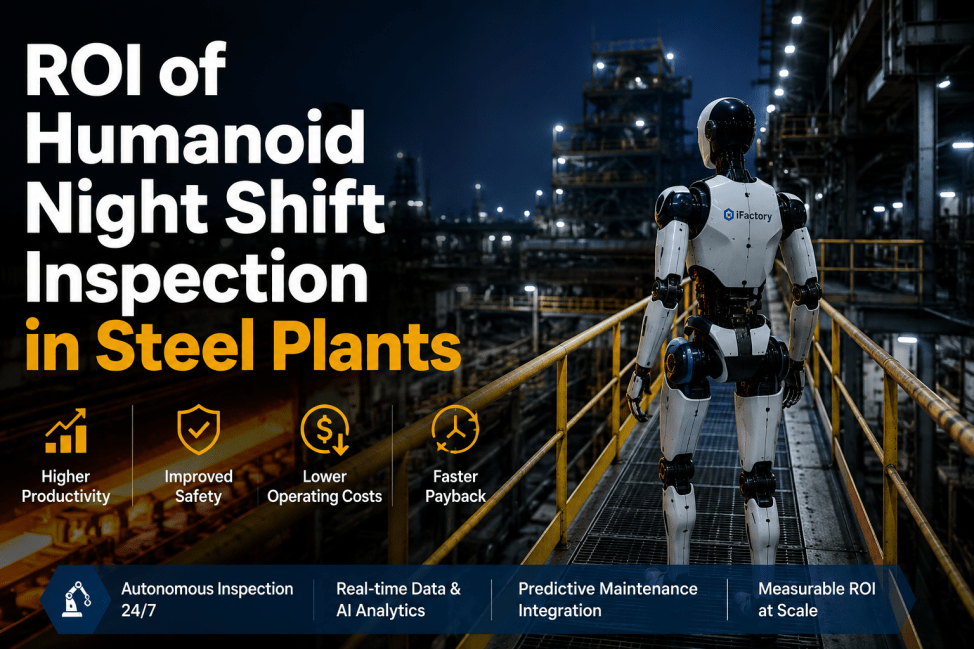
Steel plants running humanoid robots with on-premise embodied AI have cut confined space inspection cycles by 73% and reduced unplanned downtime by 31% in the first quarter. Book a 30-min walkthrough and we'll show you how the robot walks your mill, reads your gauges, and feeds your MES—all on your network, no cloud required.
Four steps from data-source handover to a walking, inspecting, data-logging robot on your mill floor.
We don't sell you a robot and leave. iFactory delivers a turnkey pilot—on-premise NVIDIA appliance, embodied AI model, robot integration, and MES/CMMS connectors—in 6–12 weeks. Here's how it works.
Hand over access to your plant's data sources
You give us read access to your MES, CMMS, PLC historians, and control network. We map the data schema to the robot's perception model in 2 weeks.
Deploy the on-premise NVIDIA appliance
We install the iFactory AI stack on a hardened appliance that plugs into your plant network. No cloud connection. No data egress. The model trains on your mill's specific equipment, layouts, and failure modes.
Train the humanoid robot on your mill floor
Our robotics engineers walk the robot through your confined spaces, inspection routes, and hot zones. The embodied AI learns to read analog gauges, detect scale buildup, measure wear patterns, and navigate around mobile equipment.
Go live with autonomous inspection and data logging
The robot runs its routes on your schedule, logs readings directly to your MES and CMMS, and triggers alerts for anomalies. Your operators get production visibility without leaving the pulpit.
What humanoid robots with embodied AI actually do on your mill floor.
These aren't telepresence carts or wheeled drones. Humanoid robots walk stairs, open doors, climb ladders, and use tools. Here's what they deliver for steel plant management.
Zero-entry furnace and vessel inspection
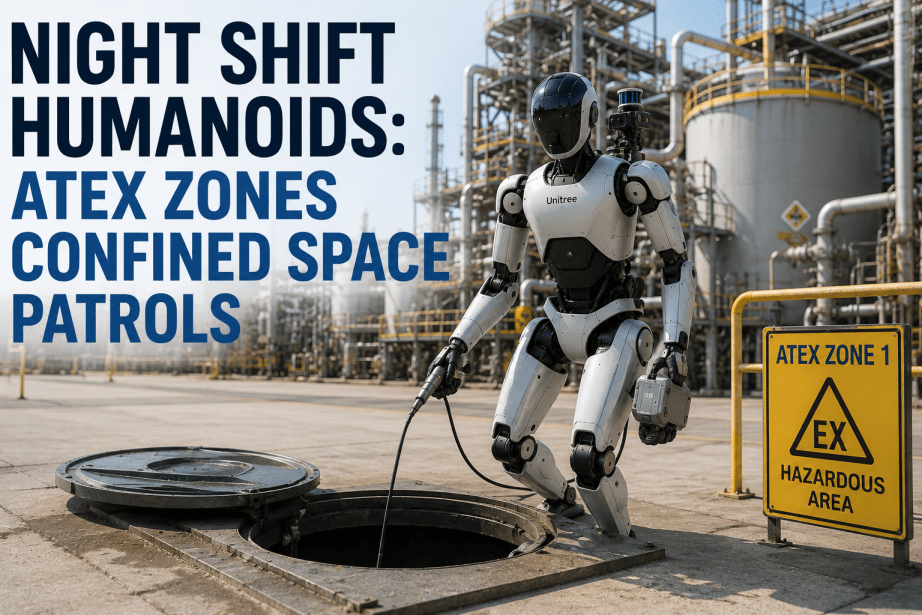
The robot walks into the reheat furnace, BOF converter, or ladle preheater without a permit, without a standby attendant, and without cooling the vessel to ambient temperature. It measures refractory wear, detects cracks, and logs thermal profiles—all while the plant keeps producing.
Autonomous route-based condition monitoring
The robot runs a daily route past the caster mold, the rolling mill stands, the cooling water pumps, and the baghouse. It reads vibration, temperature, and visual wear patterns, cross-references them against the CMMS history, and flags anomalies before they become failures.
Real-time gauge reading and data logging
The robot reads analog pressure gauges, level indicators, and flow meters in areas where operators can't physically walk every shift. It logs readings to the MES with a timestamp, a photo, and a GPS coordinate—eliminating manual data entry entirely.
Gas detection and thermal anomaly scanning
The robot carries gas sensors and a thermal camera. It patrols the caster deck, the scrap yard, and the ladle refining station, alerting the control room to CO leaks, hydrogen buildup, or overheated bearings before they escalate.
Direct data write to your existing systems
The robot connects to your MES and CMMS through the on-premise appliance. Inspection results, condition data, and work order triggers flow directly into your production and maintenance workflows—no middleware, no cloud pipe, no IT project.
Autonomous navigation in dynamic environments
The robot uses embodied AI to navigate around mobile equipment, adapt to changing floor layouts, and operate in low-light and high-heat conditions. It doesn't need a magnetic tape or a LiDAR map—it learns the mill as it walks.
Measurable results from early-adopter steel plants running humanoid robots with iFactory's on-premise AI stack.
The numbers below come from actual pilot deployments at integrated and minimill operations. Your plant's results will vary, but the pattern is consistent: faster inspection, fewer breakdowns, safer operations.
This isn't a robot rental. It's a turnkey, on-premise, managed service that absorbs the operational role of legacy plant systems and delivers production visibility in one quarter.
iFactory is end-to-end. You hand over data-source access. We deploy the appliance, train the robot, integrate with your MES and CMMS, and run the pilot. Here's what's included.
End-to-end turnkey deployment
From data-source handover to a walking, inspecting robot on your mill floor in 6–12 weeks. We handle the AI model training, robot integration, and MES/CMMS connectors.
On-premise NVIDIA appliance, zero cloud dependency
The entire iFactory stack runs on a hardened appliance inside your plant network. No data leaves the mill. No cloud subscription. No VPN tunnel required.
Pilot-to-ROI in one quarter
We structure the pilot to deliver measurable results—inspection cycle reduction, downtime reduction, or yield improvement—within 12 weeks of go-live.
24x7 managed service
iFactory monitors the robot, the appliance, and the data pipeline. If something breaks, we fix it. You don't hire a robotics engineer.
MES and CMMS integration included
We connect the robot's readings directly to your existing production and maintenance systems. No middleware projects. No IT backlog.
Absorbs legacy plant system workloads
If you're migrating off SAP MII, ME, or PCo, iFactory's on-premise AI stack absorbs the operational role—data collection, rule execution, and event logging—without a cloud migration project.
What steel plant managers actually ask about humanoid robots and embodied AI.
We've been in your mill. We know the questions that keep you up at night. Here are straight answers.
Your steel plant has blind spots that cost you millions. Humanoid robots with embodied AI close them in 12 weeks.
You don't need a cloud migration, an IT project, or a robotics engineering hire. You need an on-premise appliance, a walking robot, and a team that knows steel. iFactory delivers all three. Book a 30-minute walkthrough and we'll show you how the robot walks your mill, reads your gauges, and feeds your MES—on your network, in your timeframe.