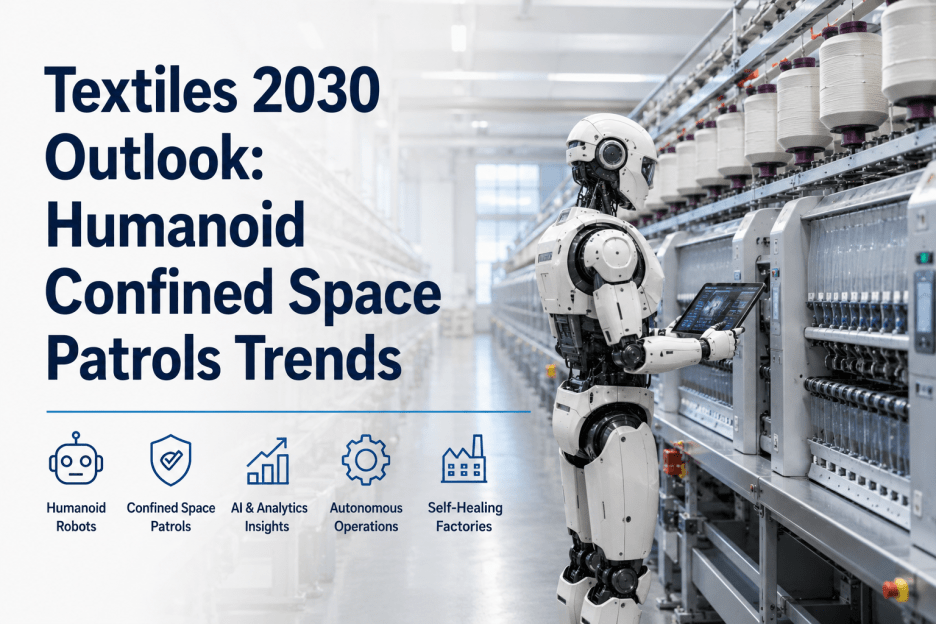
Textile manufacturing facilities today operate with a fundamental safety gap: the most hazardous inspection tasks — confined space entry into dyeing vessels, duct inspection beneath conveyor lines, and chemical tank monitoring — are still performed by human workers in respirators and harnesses. An average textile plant schedules 180 confined space entries per year, each requiring a trained attendant, a standby rescue team, and a 30-minute pre-entry atmospheric test cycle. Beyond the safety burden, these manual inspections miss 35 percent of developing defects because human visual inspection inside dark, humid, confined environments is inherently limited. By 2030, embodied AI and humanoid robots will eliminate the majority of confined space entries in textile manufacturing, performing autonomous patrols with thermal, hyperspectral, and acoustic sensors that detect equipment degradation months before failure — while their human counterparts manage the exceptions from a control center workstation.
Humanoid Confined Space Patrols in Textile Manufacturing
How embodied AI, autonomous inspection robots, and self-healing factory architectures will transform textile operations by 2030
The Confined Space Problem in Textile Manufacturing Today
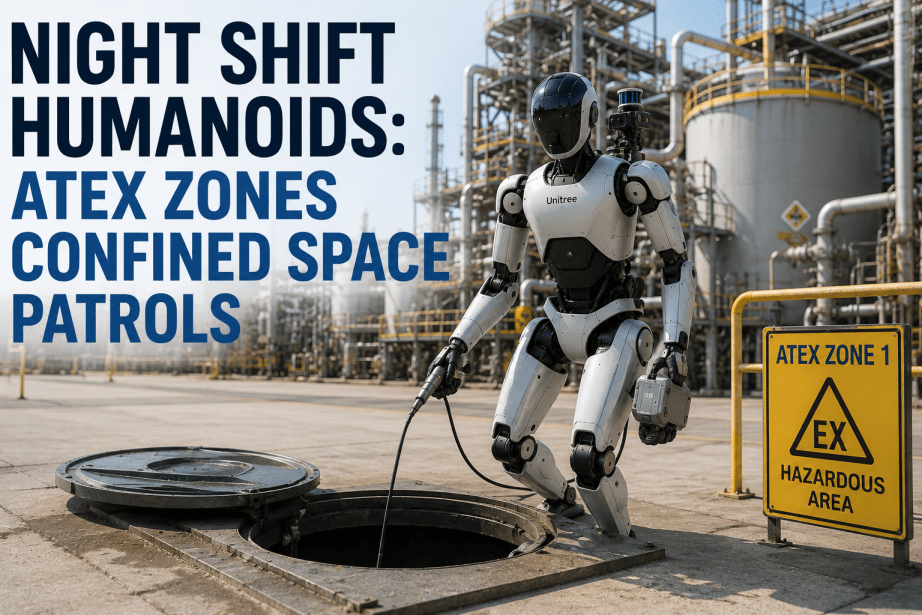
Textile plants contain some of the most dangerous confined spaces in light manufacturing. Dyeing and finishing operations require workers to enter pressurised vessel interiors for inspection of coating integrity, weld seams, and agitator blade condition. Conveyor trench systems beneath drying and curing ovens accumulate lint, chemical residue, and mechanical debris that must be inspected for fire risk. Chemical storage tanks, waste water pits, and duct work connected to finishing machinery all require regular human entry for inspection. Each entry carries risk of atmospheric hazard, entrapment, and ergonomic injury. The industry standard of 180 entries per year per plant represents hundreds of thousands of worker-hours in hazardous conditions across the sector. Beyond the immediate safety risk, the inspections themselves are limited — a human inspector inside a dyeing vessel with a flashlight and a mirror cannot detect micro-cracking in the glass lining or early-stage corrosion pitting beneath the surface. These defects propagate undetected until they cause catastrophic failure, typically during a production cycle when the vessel is pressurised and heated.
The 2030 Timeline: From Pilots to Autonomous Factory Fleets
The transition to humanoid-led confined space inspection in textile manufacturing will follow a structured adoption curve over the next four years. iFactory AI's roadmap, informed by current pilot programs at three major textile producers in the Southeast U.S. and ongoing R&D partnerships, projects the following milestones.
Is your textile facility ready for the 2030 shift? Book a Demo to discuss a humanoid robotics pilot program with iFactory AI's textile manufacturing team.
Key Technology Pillars Driving the Transition
Four interconnected technology pillars — enabled by iFactory AI's platform — will make autonomous confined space inspection in textile manufacturing a standard practice by 2030.
Embodied AI Navigation
Humanoid robots equipped with LIDAR, stereo vision, and tactile feedback navigate confined spaces including dyeing vessel interiors, conveyor trenches, and tank farms without pre-mapped routes. AI models trained on textile facility layouts enable adaptive path planning around obstacles and confined geometry.
Multi-Sensor Inspection Suite
Each robot carries thermal cameras for surface temperature analysis, hyperspectral sensors for chemical residue detection, acoustic emission sensors for crack propagation monitoring, and gas detectors for atmospheric safety. All sensor streams are fused into a single inspection model per asset.
Digital Twin Correlation
Every inspection patrol feeds data into iFactory's digital twin of the textile plant. Inspection findings are correlated against production data — dye bath temperature profiles, conveyor speeds, chemical feed rates — to identify the root cause of equipment degradation patterns before they produce defects or failures.
Autonomous Work Order Generation
When a robot detects a condition requiring maintenance — a corroded weld in a dyeing vessel, a lint accumulation in a duct that exceeds fire safety thresholds, a bearing temperature anomaly on a conveyor drive — the platform automatically generates a CMMS work order with inspection data, location, severity rating, and recommended action attached.
Expert Review
"The textile industry has been slow to adopt robotics compared to automotive or electronics manufacturing, but confined space inspection is the application that will change that. No plant manager wants to send a worker into a dyeing vessel — they do it because there is no alternative. Humanoid robots change the risk calculus entirely. The technical challenges are solvable: navigation in confined, low-visibility environments is a known robotics problem, and the AI models for defect detection are already mature from applications in other industries. What iFactory AI's platform brings that is genuinely new is the integration layer — the ability to correlate what the robot sees in the confined space with the production data from that vessel, so the inspection finding is immediately actionable. That correlation is what transforms a robot patrol from a safety upgrade into a productivity improvement with a measurable ROI."
Conclusion
The 2030 textile factory will not eliminate human workers — it will eliminate the need for humans to perform dangerous, low-visibility inspection tasks in confined spaces. Humanoid robots equipped with multi-sensor inspection suites, guided by embodied AI navigation, and integrated with digital twin and CMMS platforms will perform the majority of confined space entries now required in dyeing, finishing, and chemical handling operations. The technology exists today in pilot form. The regulatory framework for autonomous confined space inspection is under active development with OSHA. The economic case — reduced safety incidents, improved defect detection rates, and continuous inspection coverage — is compelling. For textile manufacturers evaluating their automation roadmap, the question is not whether humanoid confined space patrols will become standard. It is whether your facility will be among the first to adopt or among the last to catch up.
Interested in a 2026 pilot program for humanoid confined space inspection? Book a Demo with iFactory AI's textile manufacturing robotics team.
Frequently Asked Questions
Prepare Your Textile Facility for 2030
iFactory AI helps textile manufacturers build and execute their humanoid robotics roadmap — from confined space inspection pilots to full autonomous fleet deployment. Start with a site assessment today.