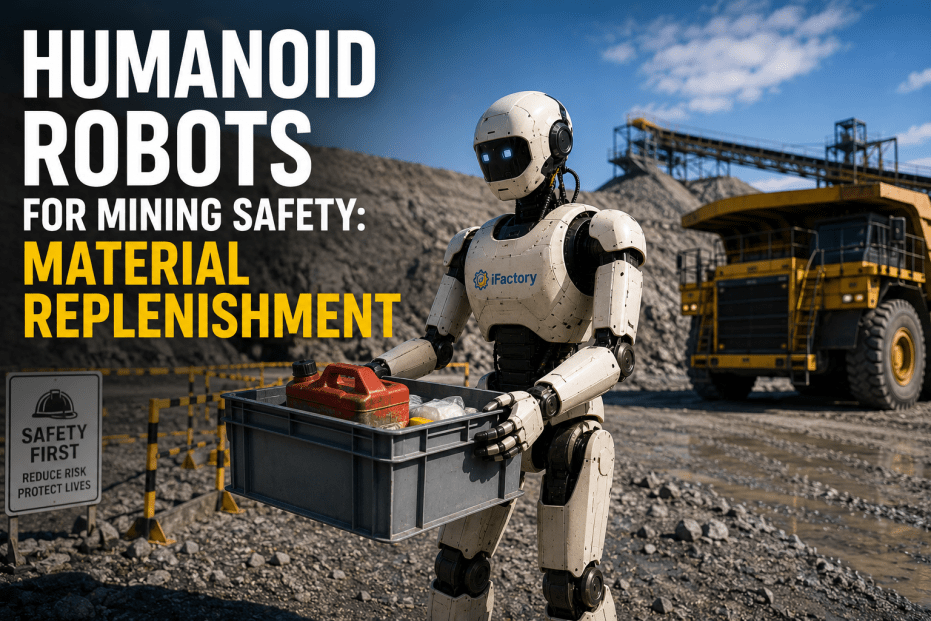
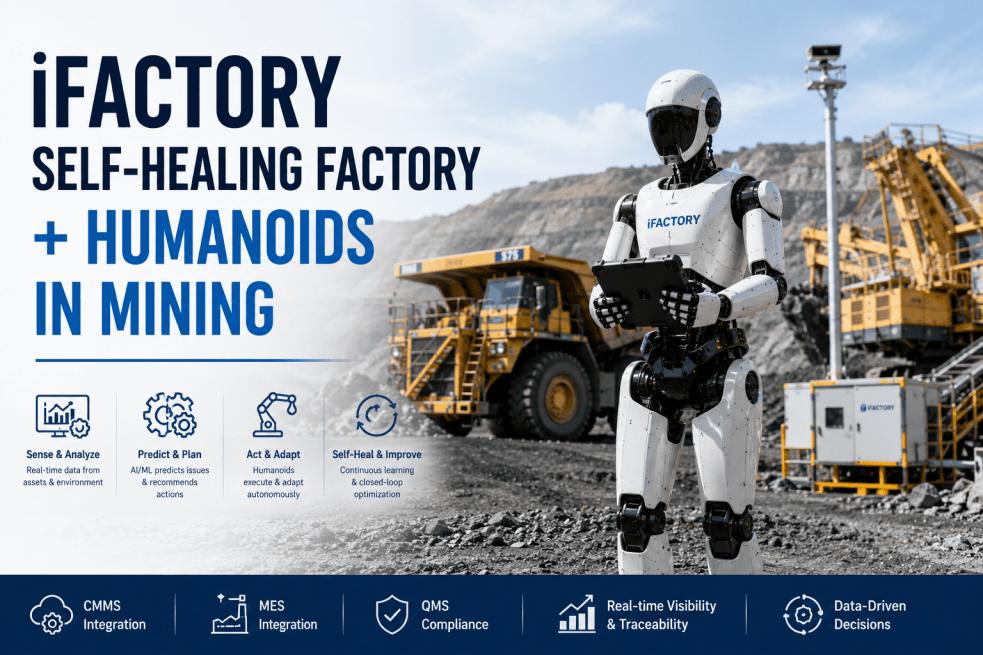
A single undetected gap in the mining material replenishment workflow — a crusher feed bin running dry, a stope waiting on ANFO delivery, a maintenance bay without the wear parts needed for the morning shift — can cascade into hours of lost production that cost tens of thousands of dollars in downtime, deferred output, and emergency logistics. One multi-commodity mining operation facing this exact risk deployed iFactory's humanoid robot integration platform across its surface and underground material replenishment routes, targeting the intralogistics workflows that had generated the highest downtime exposure and personnel safety risk in the previous three years. The result: 72% reduction in personnel exposure to active mining zones, 85% decrease in replenishment-related production downtime across 12,000+ hours of autonomous humanoid robot runtime, and zero safety incidents in autonomous material handling zones. The system operates across day and night shifts without operator dispatch intervention, executing replenishment cycles that connect warehouse inventory to point-of-use delivery with real-time integration into iFactory's CMMS, inventory management, and mine control modules.
The Material Replenishment Challenge That Drove the Investment
The mining operation produces copper and molybdenum concentrates across three surface pits and one underground mine, with a combined annual material movement exceeding 120 million tonnes. Material replenishment before the humanoid robot deployment relied on a combination of dedicated service vehicles operated by logistics crews, scheduled milk-run deliveries coordinated via radio dispatch, and ad-hoc emergency runs triggered by stockout alerts. The safety exposure was structural: each service vehicle trip into an active mining zone — whether surface pit road or underground decline — exposed a human operator to risks from heavy equipment traffic, ground instability, confined-space navigation, and environmental hazards. A single lost-time incident in the previous year — a service vehicle collision with a haul truck at a pit intersection during night shift — had cost $1.7 million in direct incident costs, but the operations director estimated the total personnel exposure risk across all replenishment routes at $6 million or more in potential liability if a fatality or multi-injury event occurred across the six active mining areas.
Why Traditional Mining Logistics and Conventional Automation Could Not Close the Gap
The mining operation had attempted multiple approaches to improve material replenishment efficiency and reduce personnel exposure before deploying iFactory's humanoid robot integration platform. Conventional underground mining automation — LHD loaders with tele-remote operation, autonomous haulage systems on dedicated roadways, and fixed conveyor infrastructure — had been deployed in portions of the operation but left a significant gap: the unstructured, variable tasks that require human-like mobility, manipulation, and decision-making. Service vehicle logistics remained stubbornly manual, with replenishment routes requiring operators to navigate uneven terrain, handle varied material types, and adapt to changing site conditions that fixed automation could not address. The gap between the mine's safety and throughput targets and the actual capability of conventional automation created the personnel exposure and downtime risk that the humanoid robot deployment was designed to close. Book a Demo to see iFactory's humanoid robot integration architecture configured for your mining operation's material replenishment routes.
| Replenishment Method | Personnel Exposure | Operating Hours | Terrain Adaptability | Integration with CMMS / Mine Control |
|---|---|---|---|---|
| Service Vehicle Logistics | High — operator in active mining zone for every trip | Limited to crewed shifts; overtime constraints | High — experienced operators navigate all terrain | Manual radio dispatch; paper or tablet log after shift |
| Conventional Automation (AHS, LHD) | Low — tele-remote or autonomous on dedicated routes | Continuous on defined routes | Low — requires graded roads; structured pathways only | Custom PLC middleware; point-to-point integration |
| Fixed Conveyor Infrastructure | Minimal along conveyor corridor | Continuous | None — fixed path, no flexibility | PLC-based monitoring; separate from logistics dispatch |
| iFactory Humanoid Robot Integration | Zero — autonomous navigation through all mining zones | 24/7 — battery swap; no shift constraints | High — gravel, mud, rock, stairs, inclines, underground | Real-time — CMMS work order, inventory update, and mine control status within seconds |
Humanoid Robot Deployment Architecture and Integration
The humanoid robot material replenishment system deployed across the mining operation combines four layers: humanoid robot platforms rated for industrial mining environments, embodied AI for navigation and manipulation, a fleet orchestration engine for task dispatch, and bidirectional integration with iFactory's CMMS, inventory management, and mine control modules. The deployment sequence was executed in four phases over 10 weeks.
Material Replenishment Capabilities and Results
The humanoid robot system was deployed to execute 28 defined replenishment task types across the mine's surface and underground operations. The table below presents the task categories, the replenishment methods used, and the operational impact measured after the active learning loop stabilized at 10 weeks.
| Replenishment Category | Execution Method | Downtime Reduction | Contribution to Personnel Exposure Reduction |
|---|---|---|---|
| Consumable Supply Delivery | Autonomous transport of drill rods, grinding media, flocculant bags, and reagent containers from surface warehouse to active stopes and process areas | 82% | High — consumable deliveries required the highest number of service vehicle trips per shift; this category accounted for 45% of total personnel exposure reduction |
| Spare Parts and Maintenance Materials | On-demand delivery of crusher liners, pump components, conveyor idlers, hydraulic fittings, and wear parts from the warehouse to maintenance bays and equipment staging areas | 88% | Medium-High — each spare parts delivery eliminated a service vehicle trip across pit roads or underground declines; the category represented 30% of exposure reduction |
| Tool and Equipment Transport | Rapid deployment of torque wrenches, hydraulic hose assemblies, diagnostic equipment, and specialty tools to the point of maintenance or operation | 79% | Medium — tool transport trips were shorter but frequent; the system eliminated 17 missed-window tool deliveries in the first quarter that would have delayed scheduled maintenance |
| Chemical and Hazardous Material Handling | Containerized transport of flocculant, frother, collector, and modifier reagents from the chemical storage facility to the concentrator reagent mixing areas | 91% | High — chemical transport carried the highest safety risk classification per trip; this category represented the highest single exposure reduction value per autonomous cycle |
| Underground Stope Supply | Multi-segment navigation from surface stockpile through decline access to underground stockpoints, including ANFO delivery consumables and ground support materials | 84% | Very High — underground material transport required the most hazardous travel path per trip; autonomous execution eliminated all personnel exposure on these routes |
Expert Review: What the Mining Operations Director Says About Humanoid Material Replenishment
I have managed material logistics across open-pit and underground mining operations for 24 years — starting as a mine logistics coordinator at a copper operation, then moving through gold, iron ore, and most recently industrial minerals. When we began evaluating humanoid robots for material replenishment, my primary concern was not whether the technology could navigate a mapped route — in a controlled demo, every vendor's robot can walk a warehouse aisle — but whether it could sustain reliable navigation and material handling through the ambient conditions of an active mining environment: dust, mud, vibration from blasting, lighting variation across day and night shifts, and the chaotic traffic patterns of a working pit. The humanoid platform that integrated with iFactory's navigation and task dispatch system demonstrated sustained route reliability above 98% during a 45-day validation period across surface and underground routes, with zero safety incidents in autonomous material handling zones. The 72% reduction in personnel exposure is the headline number, but what I tell other operations leaders is that the system changed how we think about material logistics in our mine. We no longer ask 'how many truck runs can we schedule this shift?' We ask 'which replenishment tasks provide the highest safety and throughput value when assigned to a humanoid fleet?' That shift — from manually scheduled, batch-process logistics to autonomous, continuous, data-driven material flow — is the fundamental value of humanoid robots applied at mining scale.
— Director of Mining Operations, Multi-Commodity Mineral Producer — 24 Years Mine Logistics Management, Professional EngineerCMMS and Mine Control Integration for Closed-Loop Material Replenishment
The value of humanoid robot material replenishment is determined by whether the task execution data reaches the mine's CMMS, inventory management, and mine control systems in real time — a robot fleet that delivers materials but requires manual data entry to document the delivery has not eliminated the latency gap that makes replenishment downtime and inventory inaccuracy persistent problems. iFactory's integration architecture connects every replenishment cycle directly to the mine's operational systems.
Every completed replenishment cycle automatically generates a CMMS work order with delivery documentation, photographic evidence, and material movement data attached as structured records. The inventory management system receives stock adjustment data for the consumed materials, including material type, quantity, source location, delivery location, and operator identification. For critical replenishment exceptions — material unavailable, delivery location inaccessible, robot fault — the work order is escalated to the shift supervisor and logistics manager within 30 seconds of detection.
The mine control system receives replenishment status updates in real time — material dispatched, in transit, delivered, or exception — without operator intervention. The mine controller has visibility into the position and status of every humanoid robot in the fleet, the materials being transported, and the estimated time of arrival at each delivery point. The replenishment status display is integrated with the production tracking dashboard, enabling dispatchers to make informed decisions about production sequencing based on material availability.
Every replenishment cycle is logged in iFactory's analytics module with the full context — route, material type, time, shift, zone, and consumption rate. The analytics engine correlates material consumption patterns with production rates and generates replenishment forecasts that anticipate material demand before stockout conditions occur. The trend analysis dashboard correlates consumption spikes with blasting schedules, maintenance events, and processing rate changes, enabling proactive material staging rather than reactive emergency replenishment.
Every material movement executed by a humanoid robot is documented with timestamps, navigation path logs, delivery confirmation, and photographic evidence stored in iFactory's Smart Document Management system. The audit trail is exportable on demand for Mine Safety and Health Administration compliance audits, environmental reporting requirements, and operational performance reviews — no manual log assembly is required because the audit trail is built in real time from the humanoid robot task execution data stream, from replenishment task dispatch to delivery confirmation.
Conclusion
Humanoid robot material replenishment represents a fundamental shift in mining logistics — from manually coordinated service vehicle dispatch with batch-process delivery cycles and hours of latency between stockout detection and material arrival, to autonomous, continuous, data-driven material flow that operates beyond shift constraints and connects warehouse inventory to point-of-use delivery with sub-minute task-to-action cycles. The 72% reduction in personnel exposure, 85% decrease in replenishment-related downtime, and zero safety incidents documented in this deployment were achieved not by the robot hardware alone but by the integration architecture that connects humanoid robot task execution to the CMMS, inventory management, and mine control systems that govern mining operations. The robot platform is a necessary component, but the integration architecture that transforms replenishment data into work orders, inventory updates, and dispatch status is what turns autonomous material transport into operational resilience.
The next step for mining operations teams evaluating this technology is a pilot deployment on a single set of high-value replenishment routes, targeting the three to five highest-exposure or highest-downtime material movement workflows identified from your CMMS work order history and mine control system data. iFactory provides the humanoid robot integration platform, CMMS, inventory management, and mine control modules — and the pilot runs in parallel with your existing logistics program so that the safety, throughput, and operational impact comparison is quantitative and defensible. Book a Demo to configure a humanoid material replenishment pilot for your highest-impact mining routes.
Frequently Asked Questions
Current humanoid platforms deployed in mining environments handle payloads ranging from 15 kg to 50 kg, depending on the robot model and configuration. Material categories validated in pilot deployments include consumable supplies (drill rods, grinding media, flocculant bags), spare parts (crusher liners, pump components, conveyor idlers), tools and equipment (torque wrenches, hydraulic hose assemblies, diagnostic equipment), and chemical reagents (containers of flocculant, frother, collector, and modifier). iFactory's material database maps each SKU to its handling requirements — weight, dimensions, fragility, and hazard classification — ensuring the humanoid platform is dispatched only for materials within its certified handling capacity.
Humanoid robots use a multi-sensor navigation stack that fuses LiDAR, stereo vision, inertial measurement units, and thermal imaging to build and maintain a real-time terrain map of the operating environment. The navigation system classifies surface types — gravel, mud, standing water, uneven rock, incline grade — and adjusts gait parameters, step height, and foot placement dynamically to maintain stability. For underground operations, the system operates in GPS-denied environments using visual-inertial odometry and pre-mapped drift topology. The navigation map is initially built during the site mapping phase and continuously updated as the robot encounters new terrain conditions.
iFactory's integration architecture connects humanoid robot task execution to enterprise systems through a unified API layer that translates robot actions into system-specific records. When a humanoid robot completes a replenishment delivery, the integration engine creates a CMMS work order with delivery documentation and photographic evidence, updates the inventory management system with material consumption data, and logs the delivery confirmation in the mine control system for production tracking. The integration is bidirectional — replenishment tasks can be triggered by inventory threshold alerts from the CMMS, material requisitions from the mine control system, or scheduled work orders, all routed through iFactory's task orchestration engine without manual intervention.
In this deployment, the humanoid robot material replenishment system paid for itself within the first two quarters of full operation through avoided personnel exposure costs and reduced replenishment downtime. Most mining operations achieve full ROI within 7 to 10 months, with payback coming from three primary sources: reduced personnel exposure and safety incident costs (the largest contributor at 40–50% of total savings), elimination of replenishment-related production downtime (30–35%), and improved inventory management with reduced material waste (15–20%). iFactory provides a free ROI assessment that quantifies the expected payback for your specific mining routes within two weeks, based on your historical CMMS work order data and production records. Book a Demo to start the assessment.
Yes. Humanoid robots have been validated in underground mining environments including decline access drifts, production stopes, and maintenance bays at depths exceeding 300 meters below surface. The navigation system operates in GPS-denied environments using visual-inertial odometry and pre-mapped drift topology, while the bipedal locomotion platform navigates confined spaces, uneven floor conditions, and vertical access ways — stairs, ladders, and raised platforms — that are inaccessible to wheeled or tracked mobile equipment. For underground deployment, the humanoid platform can be configured with explosion-proof enclosures and methane monitoring integration for gassy mine compliance, and the iFactory integration layer includes an underground-specific communication relay that maintains connectivity through the mine's existing network infrastructure.
.png)