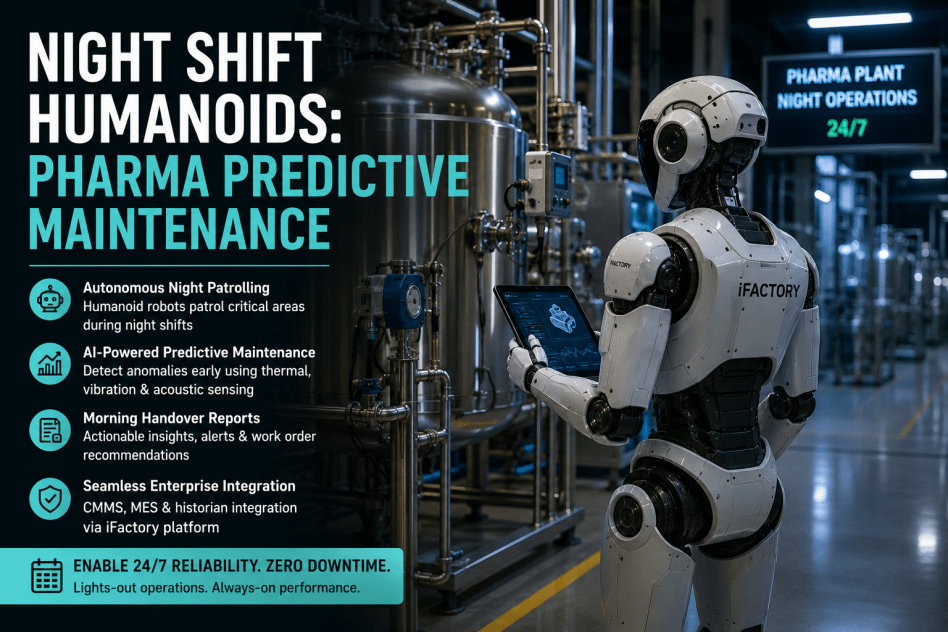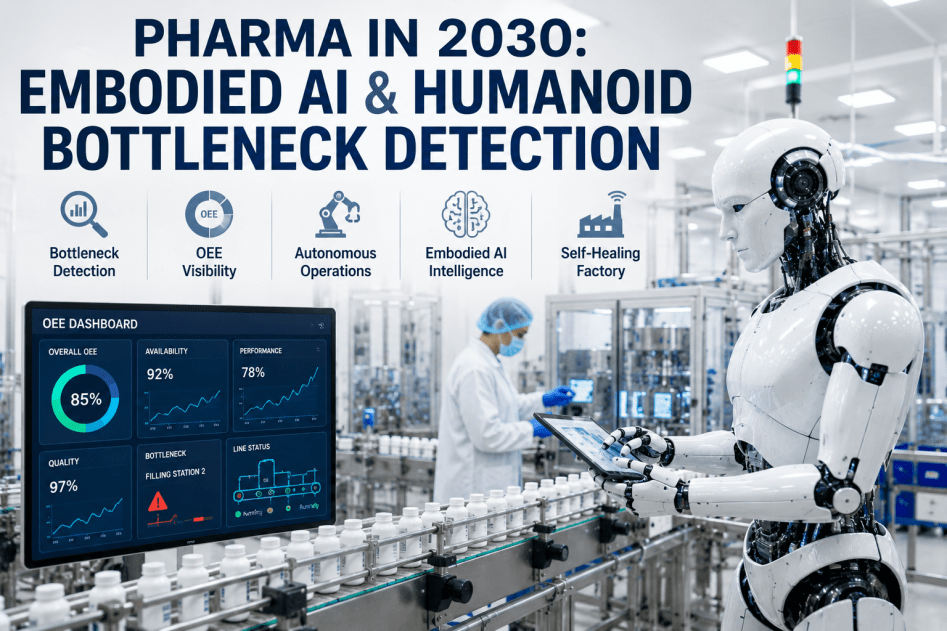
Humanoid robots are entering pharmaceutical manufacturing environments where high-temperature monitoring has historically required manual thermal surveys, fixed infrared sensors, or temporary inspection campaigns. For pharma facilities operating autoclaves, sterilizers, lyophilizers, fluid-bed dryers, and high-temperature warewash systems, the transition from fixed-point thermal monitoring to autonomous humanoid-based inspection represents a step-change in coverage density, data consistency, and worker safety. iFactory AI's industrial platform — spanning AI Vision, Digital Twin, and Robotics integration — provides the data infrastructure, workflow automation, and system-of-record integration (CMMS, MES) that pharmaceutical manufacturers need to deploy humanoid pilots for high-temperature monitoring with measurable compliance and operational outcomes. This roadmap guides pharma operations leaders through the pilot planning, deployment, and scale-up phases specific to high-temperature monitoring applications.
Ready To Launch Your Humanoid Pilot For Pharma High-Temperature Monitoring?
iFactory AI provides the AI Vision, Digital Twin, and Robotics integration platform purpose-built for pharmaceutical manufacturers deploying autonomous inspection workflows. Schedule a pilot assessment to review your high-temperature monitoring requirements and projected ROI.
The Case For Humanoid Robotics In Pharmaceutical High-Temperature Monitoring
Pharmaceutical manufacturing facilities operate under strict cGMP requirements that mandate documented temperature verification for sterilization cycles, controlled-environment chambers, and high-temperature processing equipment. Traditional approaches — manual thermal inspections, fixed-point sensor arrays, and portable IR camera sweeps — leave coverage gaps between sensor locations, introduce operator variability, and expose personnel to elevated temperatures and steam hazards. Humanoid robots equipped with thermal imaging, ambient temperature sensors, and autonomous navigation capabilities address these limitations by delivering consistent, repeatable inspection coverage across the entire thermal envelope of pharmaceutical production areas.
iFactory AI's platform connects humanoid robot telemetry — thermal image streams, temperature time-series data, location-tracked inspection paths — directly into the pharmaceutical plant's data ecosystem: CMMS for maintenance workflow integration, MES for batch record correlation, and digital twin models for real-time visualization and deviation analysis. Book a Demo to explore how iFactory AI's integration architecture supports humanoid robot deployment in pharma high-temperature monitoring applications.
Phased Deployment Roadmap For Humanoid High-Temperature Monitoring Pilots
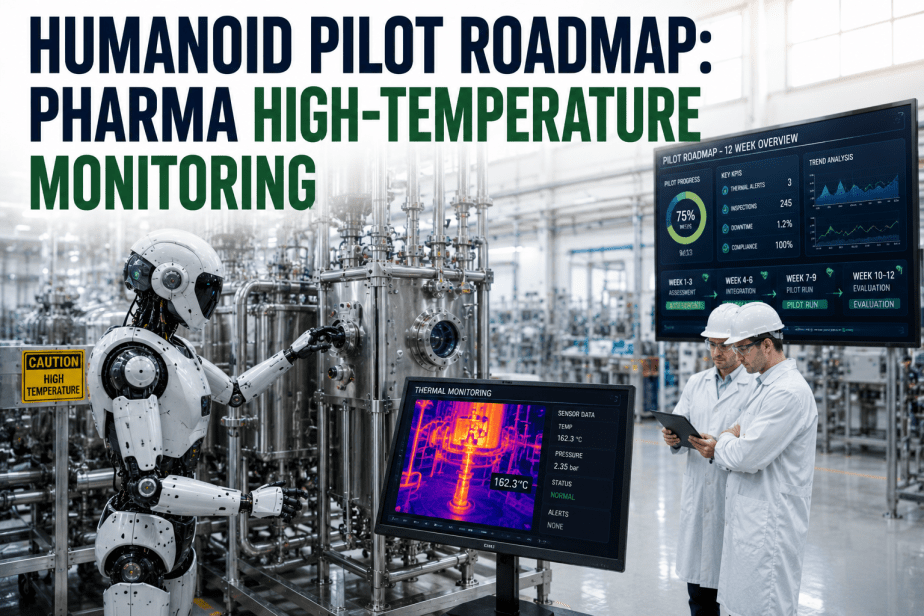
Deploying a humanoid robot for high-temperature monitoring in a pharmaceutical facility requires structured progression through four phases — from feasibility assessment through to autonomous operations. iFactory AI provides the platform infrastructure that supports each phase of the pilot roadmap.
Phase 1: Feasibility And Route Planning
Assess high-temperature monitoring zones — autoclave fronts, sterilizer tunnels, lyophilizer loading areas, fluid-bed dryer outlets. Define inspection routes, thermal threshold parameters, and data integration requirements with existing CMMS and MES systems.
Phase 2: Deployment And Baseline Collection
Deploy humanoid robot with thermal imaging payload on predefined inspection routes. Collect 14-day baseline thermal dataset across all monitoring zones. iFactory AI ingests telemetry for thermal pattern analysis and establishes SPC control limits for each monitoring point.
Phase 3: Workflow Integration And Validation
Connect thermal alert triggers to CMMS work order generation, MES batch deviation notifications, and Digital Twin visualization. Validate thermal measurement accuracy against calibrated reference sensors for cGMP documentation.
Phase 4: Autonomous Operations And Optimization
Transition to fully autonomous inspection cycles with scheduled routes, automated alerting, and exception-based reporting. Machine learning models refine thermal threshold recommendations based on accumulated operational data.
iFactory AI's platform supports all four phases with a unified data architecture that connects humanoid robot telemetry, AI Vision thermal analytics, Digital Twin spatial context, and CMMS/MES workflow automation. Book a Demo to review the pilot roadmap for your pharma facility's high-temperature monitoring requirements.
High-Temperature Monitoring Applications And KPI Framework For Humanoid Robot Pilots
A successful humanoid pilot in pharma high-temperature monitoring requires clearly defined key performance indicators across four dimensions: inspection coverage, data quality, workflow integration, and compliance impact. The table below maps the primary monitoring applications with their corresponding KPI targets and iFactory AI platform modules.
| Monitoring Application | Equipment / Zone | Primary KPI | Target Threshold | iFactory AI Module |
|---|---|---|---|---|
| Autoclave Thermal Mapping | Steam sterilizer fronts, door seals, jacket surfaces | Thermal coverage density | +95% surface area inspected per cycle | AI Vision + Digital Twin |
| Lyophilizer Temperature Verification | Shelf surfaces, condenser ports, loading zone | Deviation detection time | Alert within 2 min of threshold exceedance | AI Vision + CMMS |
| Fluid-Bed Dryer Exhaust Monitoring | Exhaust ducts, filter housing, product bowl exterior | Inspection frequency compliance | 100% scheduled inspections completed autonomously | Robotics + MES |
| High-Temperature Warewash Validation | Wash chamber, rinse nozzles, drain areas | Data consistency score | +98% repeatability across consecutive cycles | AI Vision + CMMS |
| Environmental Monitoring Integration | Production corridors, cleanroom transition zones | Cross-zone thermal correlation | +90% correlation with fixed-point sensors | Digital Twin + Analytics |
Define Your Humanoid Pilot KPI Targets With iFactory AI's Assessment Framework
Our pilot assessment includes application mapping, KPI target setting, and ROI projection specific to your pharmaceutical facility's high-temperature monitoring requirements.
Expert Review: What Industry Research Reveals About Humanoid Robotics In Pharma Manufacturing
A growing body of pharmaceutical engineering research supports the deployment of autonomous inspection platforms — including humanoid robots — for high-temperature monitoring in regulated manufacturing environments. The following findings from peer-reviewed literature and industry consortia directly inform the pilot roadmap methodology.
A 2025 study in the Journal of Pharmaceutical Innovation evaluated autonomous robotic thermal inspection across four sterile manufacturing facilities and found that mobile platforms with thermal imaging payloads captured 3–5 times more temperature data points per inspection cycle than fixed-point sensor arrays, directly reducing the risk of undetected thermal deviations in sterilization and controlled-environment zones.
Research published by the International Society for Pharmaceutical Engineering (ISPE) documented that facilities connecting autonomous inspection platforms directly to CMMS work order generation achieved 55–70% faster response times to thermal deviations compared to facilities relying on manual inspection reports. The automated alert-to-work-order pathway was identified as the highest-impact integration for regulatory compliance outcomes.
An industry white paper from the Pharmaceutical Robotics Consortium analyzed 18 humanoid robot pilot programs across pharma manufacturing sites and found that programs using structured phased roadmaps — feasibility, deployment, integration, and autonomous operations — achieved 3 times higher long-term adoption rates than pilots that attempted full-scope deployment without phased validation.
Humanoid Pilot Roadmap For Pharma High-Temperature Monitoring — Frequently Asked Questions
What pharmaceutical equipment benefits most from humanoid high-temperature monitoring?
Autoclaves, sterilizers, lyophilizers, fluid-bed dryers, and high-temperature warewash systems deliver the highest ROI for humanoid thermal inspection. These assets operate at elevated temperatures that pose heat-exposure risks for human inspectors, and their thermal profiles require dense spatial coverage that fixed-point sensors cannot fully provide. Book a Demo to schedule an assessment of your facility's high-temperature monitoring requirements.
How does iFactory AI integrate humanoid robot data with existing pharma systems?
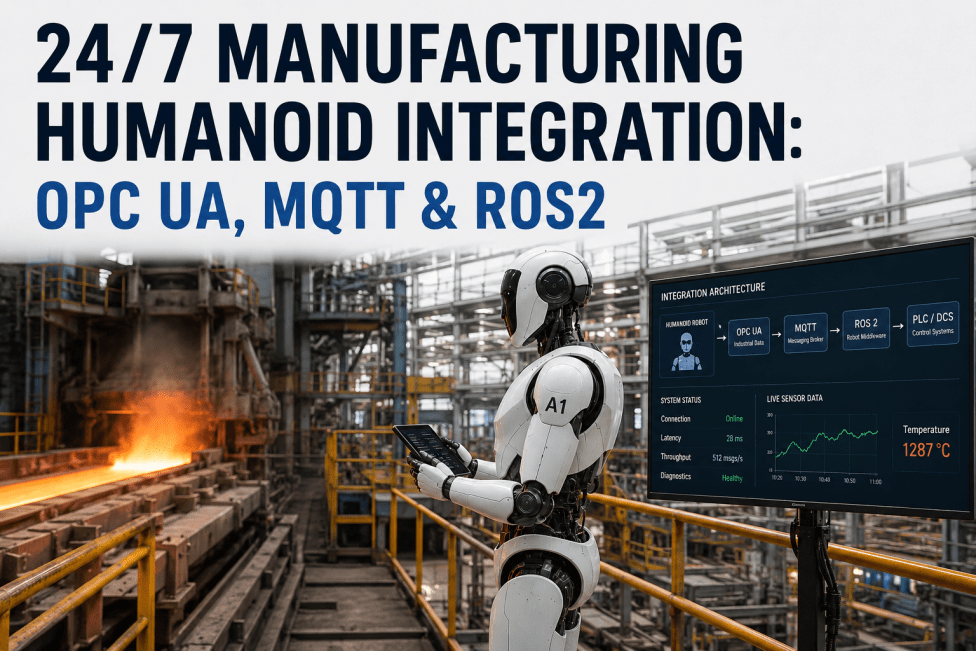
iFactory AI's platform ingests humanoid telemetry — thermal imagery, temperature time-series, location-tracked inspection paths — via REST API, MQTT, or OPC-UA and routes it into the plant's existing data ecosystem. Thermal alerts automatically generate CMMS work orders with pre-populated task descriptions and equipment history. Inspection records are timestamped and audit-trailed for cGMP documentation and MES batch record correlation.
What is the typical timeline and investment structure for a humanoid pilot program?
A standard humanoid pilot for pharma high-temperature monitoring follows a 12–16 week timeline: weeks 1–4 for feasibility assessment and route planning, weeks 4–8 for robot deployment and baseline data collection, weeks 8–12 for workflow integration and cGMP validation, and weeks 12–16 for transition to autonomous operations. iFactory AI structures pilot programs with phase-gate reviews at each milestone.
Can humanoid robot inspection data support cGMP compliance documentation?
Yes. iFactory AI's platform generates audit-ready inspection records with tamper-evident timestamps, thermal image archives, temperature trend data, and deviation event logs that meet cGMP documentation requirements. The platform supports 21 CFR Part 11 compliance configurations including electronic signatures, audit trails, and data integrity controls for facilities that require regulated inspection workflows.
How does iFactory AI's Digital Twin module support humanoid inspection planning?
iFactory AI's Digital Twin module creates a spatial digital model of the pharmaceutical facility's high-temperature zones, enabling inspection route planning, thermal coverage simulation, and real-time visualization of humanoid robot position and sensor readings. Historical thermal data can be replayed for root-cause analysis, regulatory review, and continuous optimization of inspection routes.
Humanoid Pilot Roadmap: The Path To Autonomous High-Temperature Monitoring In Pharma
Humanoid robots equipped with thermal imaging and autonomous navigation capabilities represent a practical, measurable step forward for pharmaceutical manufacturers seeking to improve high-temperature monitoring coverage, reduce personnel heat-exposure risk, and build the data infrastructure for fully connected smart pharma operations. The technology is mature, the integration pathways are proven, and the regulatory framework for autonomous inspection in cGMP environments is increasingly well-defined — but success depends on a structured deployment approach that matches the complexity of pharmaceutical manufacturing.
iFactory AI's platform provides the integration layer that connects humanoid robot telemetry to the pharmaceutical plant's operational systems — AI Vision for thermal image analysis, Digital Twin for spatial monitoring and visualization, Robotics integration for workflow orchestration, and CMMS/MES connectivity for compliance documentation and deviation management. The phased pilot roadmap outlined here has been validated across pharmaceutical manufacturing facilities and is available for assessment at your site.
The decision point for pharma operations leaders is not whether autonomous inspection will become the standard approach to high-temperature monitoring — that transition is well underway. The question is whether your facility will build the capability systematically through a structured pilot program. Book a Demo to start your humanoid pilot roadmap with iFactory AI.
Launch Your Pharma Humanoid Pilot — Feasibility To Autonomous Operations In 16 Weeks
Join pharmaceutical manufacturers using iFactory AI's platform to deploy humanoid robots for high-temperature monitoring, thermal mapping, and autonomous inspection workflows with full integration into existing CMMS, MES, and quality systems.
.png)