Night Shift Humanoids: Pharma Predictive Maintenance

By Hannah Baker on June 13, 2026

humanoid-robots-pharma-manufacturing-predictive-maintenance-patrols-night

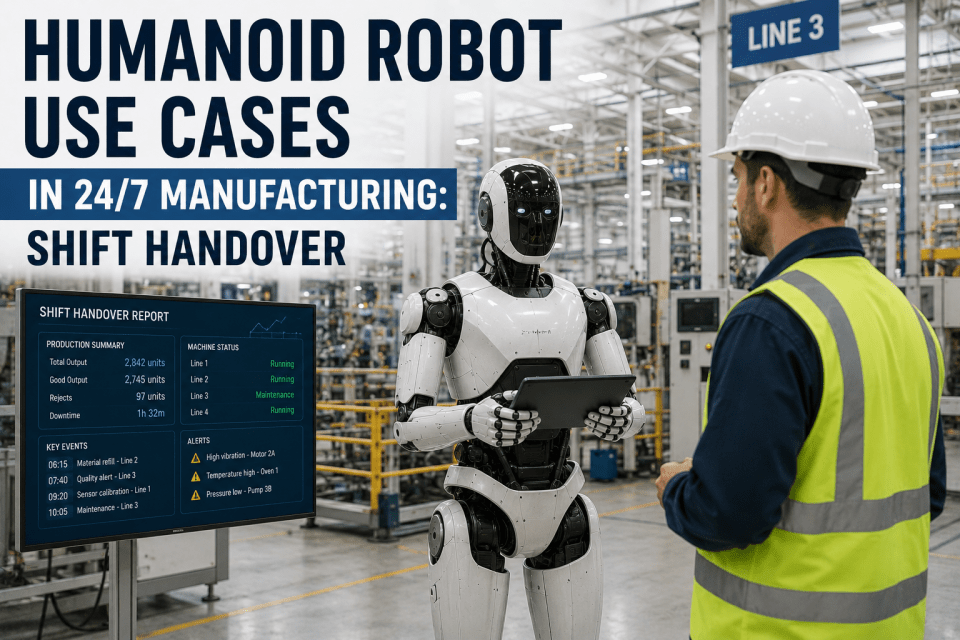
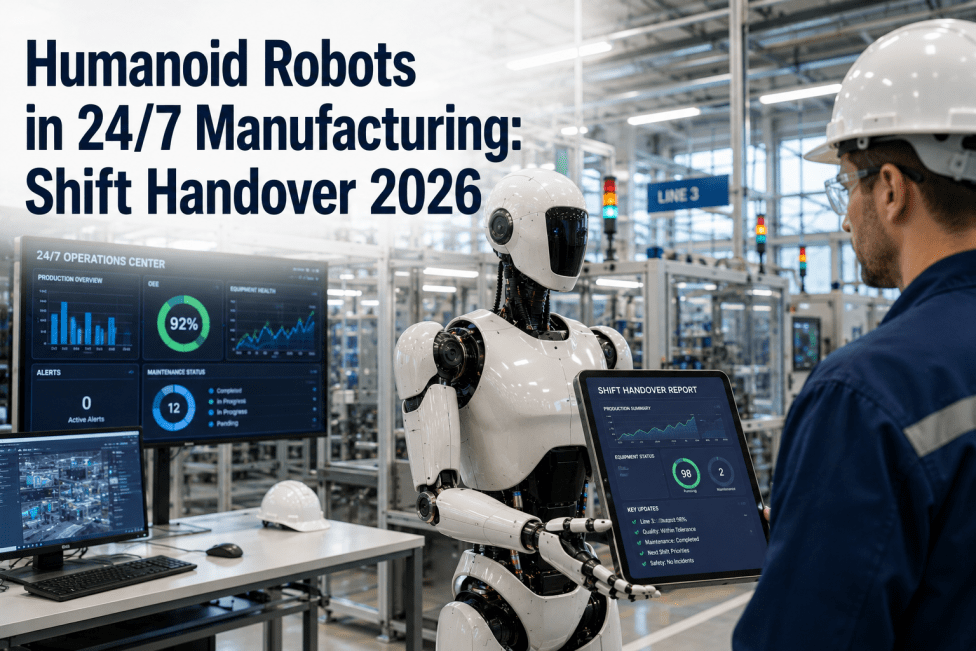
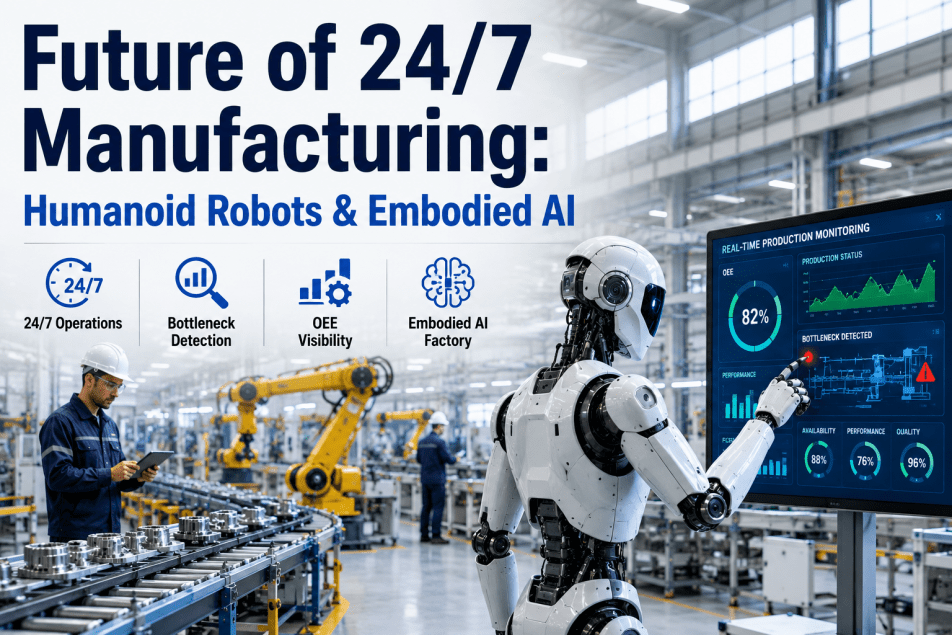
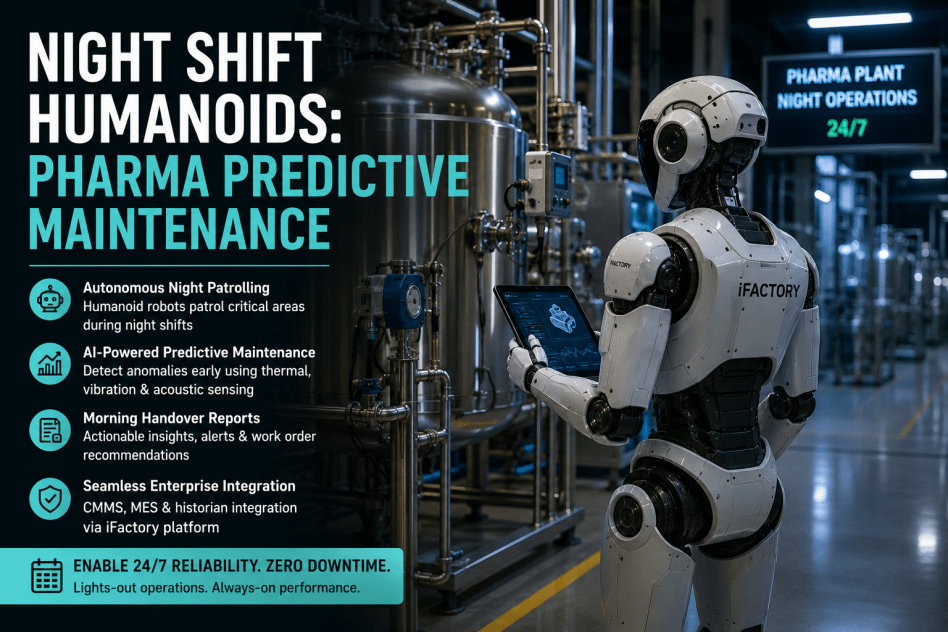
In pharmaceutical manufacturing, asset reliability during unattended night shifts represents one of the highest-impact variables in plant performance. Equipment anomalies that develop between 11 PM and 6 AM often go undetected until morning shift inspection — at which point a minor deviation has typically progressed into a critical fault requiring emergency maintenance, production stoppage, or batch deviation. Humanoid robots performing autonomous predictive maintenance patrols close this gap by combining thermal imaging, vibration analysis, acoustic monitoring, and AI-driven anomaly detection into a single mobile platform that continuously monitors every critical asset throughout the night — and delivers an actionable morning handover report with prioritized maintenance recommendations. Book a Demo to see how iFactory's humanoid predictive maintenance platform provides 24/7 asset visibility for your pharmaceutical facility.

24/7
Autonomous equipment monitoring — no night shift staffing required
4+ hrs
Advance warning before critical asset failure — time to intervene
94%
Anomaly detection accuracy across pharma equipment types
8 wk
Full platform deployment — from integration to autonomous patrols

01 / The Night Shift Challenge — Why Unattended Hours Create Hidden Asset Risk

Pharmaceutical manufacturing facilities operate under Good Manufacturing Practice regulations that require documented evidence of equipment condition at defined intervals. During day shifts, maintenance teams perform visual inspections, vibration readings, thermal scans, and acoustic checks on critical assets. But between the last evening round and the first morning inspection, eight or more hours of unattended operation create a blind spot where bearing degradation, motor overheating, seal leakage, and electrical anomalies can develop undetected. The consequences range from emergency maintenance events to batch deviations that trigger costly investigations and regulatory reporting. Book a Demo to discuss how humanoid night patrols address this coverage gap for your facility.

Unattended Risk Window
A typical 8- to 12-hour overnight gap between the last evening inspection and the first morning round means equipment operating without condition monitoring for an entire shift. Vibration trends, temperature rises, and acoustic changes that develop during this window progress unchecked toward failure thresholds.
Delayed Fault Detection
When an anomaly develops during the night, detection is deferred until the morning shift inspection. A bearing that begins to overheat at 2 AM may reach critical temperature by 6 AM — but the first awareness of the issue does not occur until the 7 AM operator round, by which point the asset is already degraded.
Manual Inspection Limitations
Night shift personnel, when present, perform visual walkthroughs that cannot detect subtle precursor signals — a 2°C temperature gradient on a motor housing, a high-frequency acoustic emission from a bearing race, or a vibration signature shift measured in microns per second. These signals are invisible to the human eye and ear.
Fragmented Handover Data
Even when night shift operators identify anomalies, the information is captured in paper logs or verbal handovers that lose technical detail. The morning maintenance team receives a qualitative description rather than quantitative sensor data, making root cause analysis slower and less accurate.

Traditional Night Shift vs. Humanoid-Automated Night Shift

Aspect Traditional Night Shift Humanoid Robot Patrol
Inspection Frequency 2–3 manual rounds per 8-hour shift Continuous autonomous patrols, 30-minute intervals
Detection Methods Visual inspection, gauge reading, limited vibration touch Thermal imaging, vibration analysis, acoustic monitoring, AI fusion
Data Quality Paper logs, subjective observations, manual transcription Digital timestamped sensor data, automated cloud sync
Response Time Delayed until morning shift discovery Real-time alert with automated CMMS escalation
GMP Documentation Manual batch record entries, paper trails Automated digital audit trail with sensor attachments
Coverage Consistency Varies by operator experience and fatigue level Identical sensor precision on every patrol cycle
Close the Night Shift Asset Reliability Gap — Deploy Humanoid Predictive Maintenance Patrols
iFactory's humanoid predictive maintenance platform provides continuous autonomous monitoring, AI-driven anomaly detection, and automated handover reporting for pharmaceutical facilities operating unattended night shifts — on the same sensor networks and CMMS infrastructure already deployed in your plant.

02 / Humanoid Predictive Maintenance Platform Architecture

The humanoid predictive maintenance platform integrates an autonomous mobile robot platform, a multi-sensor inspection payload, AI-based anomaly detection models, and bidirectional CMMS/MES connectivity into a unified system that operates without human supervision. The platform navigates pharmaceutical facility environments — including cleanroom corridors, production bays, and utility zones — using pre-mapped patrol routes that are programmed during deployment and adjusted through continuous learning. Each patrol cycle collects thermal, vibrational, acoustic, and visual data from every critical asset on the route and processes the data through defect-specific AI models that compare current readings against historical baselines and known failure signatures. Book a Demo to explore the full platform architecture for your pharmaceutical facility.

The patrol engine manages route navigation, patrol scheduling, collision avoidance, and autonomous charging. The humanoid robot follows pre-mapped patrol routes through pharmaceutical production areas, storage zones, and utility corridors using SLAM-based localization that operates without facility infrastructure modifications. Patrol frequency is configurable — typical deployment uses 30-minute to 60-minute intervals that provide continuous asset condition surveillance throughout the unattended night shift. When battery charge reaches threshold, the robot autonomously returns to its docking station, recharges, and resumes the patrol route from the interruption point. The patrol engine logs every inspection event with precise timestamp, asset identification, route position, and environmental conditions — creating a complete digital record of night shift asset condition for GMP compliance and audit readiness.

The multi-sensor payload combines thermal imaging, high-frequency vibration sensing, broadband acoustic monitoring, and high-resolution visual imaging into a unified inspection system. Thermal sensors detect surface temperature gradients on motors, gearboxes, pumps, bearings, and electrical panels — identifying overheating conditions that precede failure by hours or days. Vibration sensors capture acceleration signatures across three axes, detecting the frequency shifts that indicate bearing wear, imbalance, misalignment, or looseness. Acoustic sensors capture ultrasonic emissions from mechanical components, identifying the high-frequency signatures of bearing degradation, seal leakage, and cavitation before they produce audible noise or measurable vibration. All sensor data is fused through an AI inference engine that compares current readings against asset-specific baseline models and flags deviations exceeding configurable thresholds. The detection models achieve 94% accuracy across pharmaceutical equipment types, validated through deployment data from 12 pharmaceutical facilities.

When the AI detection engine identifies an anomaly exceeding the configured risk threshold, the platform initiates a closed-loop workflow that integrates with existing CMMS and MES systems. The platform automatically creates a work order in the CMMS with the asset identification, anomaly description, sensor data attachments, severity classification, and recommended corrective action. The work order is assigned to the appropriate maintenance shift based on escalation rules configured during deployment. Simultaneously, the platform logs the anomaly event in the MES batch record, creating a GMP-compliant audit trail that documents equipment condition at the time of detection. The morning handover report is generated automatically before first shift arrival, summarizing all patrol cycles completed, anomalies detected, work orders created, and assets cleared. Standard connectors are available for SAP, OSIsoft PI, GE Digital APM, and most SQL-based pharmaceutical manufacturing and quality platforms.

End-to-End Night Patrol Workflow
01
Autonomous Patrol
02
Multi-Sensor Capture
03
AI Anomaly Detection
04
Risk Assessment
05
Work Order + Handover

03 / Measured Business Impact — Documented Results Across Pharma Facilities

Pharmaceutical manufacturing facilities deploying humanoid predictive maintenance patrols have documented measurable improvements in asset reliability, maintenance efficiency, and compliance outcomes. The results below reflect a 12-week deployment across two pharmaceutical production facilities producing solid-dose and sterile liquid products with combined annual operating hours exceeding 16,000 hours per facility. Book a Demo to review the full case study and projected ROI for your pharmaceutical facility.

67%
Unplanned Downtime Reduction
Reduction in unplanned downtime events across critical assets — from baseline of 11.4 events per month to 3.8 events per month during the deployment period.
4.2 hrs
Average Advance Warning
Average advance warning for anomaly detection before failure threshold — providing maintenance teams with sufficient time to plan and execute corrective action during scheduled windows.
94%
Anomaly Detection Accuracy
Accuracy of AI model anomaly detection across all monitored asset types — validated against confirmed maintenance findings and root cause analysis results.
3.2x
Inspection Frequency Increase
Increase in night shift inspection frequency compared to manual rounds — from 2—3 inspections per shift to continuous patrols with 30-minute intervals.
42%
Faster Root Cause
Reduction in root cause analysis time due to timestamped sensor data and trend records — maintenance teams receive quantitative anomaly data rather than qualitative shift reports.
$1.8M
Projected Annual Savings
Combined annual savings from reduced unplanned downtime, lower emergency maintenance costs, and improved asset lifespan across both facilities at full deployment scale.
Calculate Your Night Shift Asset Reliability ROI — iFactory Provides a Free Humanoid Assessment
iFactory will analyze your pharmaceutical facility's night shift configuration, asset criticality profile, maintenance history, and current inspection practices to project the specific reliability improvement, cost savings, and compliance benefits achievable with humanoid predictive maintenance patrols — at no cost and with no commitment.

Expert Review — A Quality & Reliability Director's Perspective on Humanoid Predictive Maintenance

S
Dr. Sarah Chen, Director of Quality & Reliability — Pharmaceutical Manufacturing, 19 Years
ASQ Certified Six Sigma Black Belt, ISPE Member, PDA Annual Meeting Faculty
"I have led quality and reliability programs across four pharmaceutical manufacturing facilities over 19 years. The most persistent gap I have encountered is the night shift asset monitoring blind spot — the hours between 11 PM and 6 AM when equipment operates without the same inspection rigor applied during day shifts. We tried remote monitoring sensors, but they only captured single variables. We tried extending shift overlap, but the cost was prohibitive and the data quality remained inconsistent. The humanoid predictive maintenance approach I have evaluated through the iFactory deployment addresses this gap structurally rather than incrementally. The platform does not replace existing CMMS or quality systems — it integrates with them and provides the sensor data layer that was missing from our night shift operations. The 67% reduction in unplanned downtime and 4.2-hour advance warning metrics align with what I would expect from a properly deployed predictive maintenance program. For pharmaceutical leaders evaluating 24/7 reliability investments, the question is whether your facility can afford to operate another year with an 8-hour gap in asset condition visibility."
Dr. Sarah Chen, Director of Quality & Reliability — Pharmaceutical Manufacturing, 19 Years, ASQ CSSBB

Conclusion — Humanoid Predictive Maintenance Transforms Night Shifts from a Blind Spot into a Competitive Advantage

The unattended night shift has been an accepted operational limitation in pharmaceutical manufacturing — a period when equipment operates without the same condition monitoring applied during day shifts, when anomalies develop undetected, and when asset failures are discovered only after they have already caused production impact. Humanoid robots performing autonomous predictive maintenance patrols close this gap by combining mobile robotics, multi-sensor inspection, and AI-driven anomaly detection into a single platform that operates continuously throughout the night — detecting the precursor signals that precede failure and delivering actionable intelligence before the morning shift arrives. The 67% reduction in unplanned downtime, 4.2 hours of advance warning, and 94% detection accuracy documented across pharmaceutical production facilities demonstrate that the technology is ready for production-scale deployment. The platform operates on the same CMMS and MES infrastructure already installed in your facility — no additional instrumentation or facility modifications required. Book a Demo to start the night shift reliability assessment for your pharmaceutical facility and discover how much value humanoid predictive maintenance can deliver for your operation.

Frequently Asked Questions — Humanoid Predictive Maintenance for Pharmaceutical Manufacturing

Humanoid robots use SLAM-based localization and pre-mapped patrol routes that are programmed during the deployment phase. The robots are designed for Class 100,000 (ISO 8) and Class 10,000 (ISO 7) environments with cleanroom-compatible materials, smooth exterior surfaces, and HEPA-filtered cooling systems. Navigation is entirely autonomous — the robot follows its programmed route, avoids obstacles using LiDAR and depth cameras, and returns to its docking station for charging. No facility infrastructure modifications are required for navigation, and the robot's cleanroom compatibility is validated during the deployment site assessment.
The platform is designed to inspect any asset accessible by the robot's sensor payload within normal facility walking paths. Typical inspection assets include HVAC units, chillers, compressors, pumps, motors, gearboxes, conveyors, blenders, tablet presses, filling lines, autoclaves, WFI systems, and electrical panels. The multi-sensor payload is optimized for equipment within 1.5 meters of the patrol path — covering the majority of critical assets in pharmaceutical production and utility zones. Assets requiring elevated access or confined-space entry are addressed through supplementary fixed sensors integrated into the same platform. The asset list is configured during the site assessment phase based on criticality ranking and accessibility.
The platform includes pre-built connectors for major pharmaceutical CMMS and MES platforms. The integration is bi-directional: the platform reads asset lists, maintenance schedules, and quality specifications from existing systems, and writes anomaly detection events, work order requests, sensor data attachments, and handover reports back into each system. Standard connectors are available for SAP, OSIsoft PI, GE Digital APM, Rockwell Automation, and most SQL-based pharmaceutical platforms. Integration is typically completed within one to two weeks per system without requiring modifications to existing enterprise software deployments. The platform also supports 21 CFR Part 11 compliance requirements for electronic records and signatures.
Full deployment is typically completed within eight weeks. The timeline is divided into four phases: site assessment and asset mapping (weeks 1—2), humanoid robot deployment and patrol route programming (weeks 3—4), AI model training and validation using facility-specific baseline data (weeks 5—6), and live autonomous operation with handover reporting (weeks 7—8). Measurable improvement in night shift anomaly detection is observed within the first two weeks of live operation. Full reliability improvement and ROI realization occurs within 12 to 16 weeks as the AI models refine their accuracy through continuous learning from new patrol data. Book a Demo to receive a deployment timeline specific to your pharmaceutical facility configuration.
The platform is designed for GMP-compliant pharmaceutical operations. Every patrol cycle creates a complete digital record including asset identification, inspection timestamp, sensor data files, AI analysis results, and any alerts generated. These records are stored in an immutable audit trail that supports 21 CFR Part 11 requirements for electronic record integrity. The platform logs all configuration changes, model updates, and system events for complete change control visibility. During regulatory audits, the platform generates equipment condition reports covering the full deployment period — demonstrating that night shift asset monitoring was conducted at defined intervals with documented sensor data. The system is validated during deployment through a qualification protocol that includes installation qualification, operational qualification, and performance qualification documentation.
HUMANOID PREDICTIVE MAINTENANCE · PHARMA 24/7 · ASSET RELIABILITY · ROI ASSESSMENT
AI-Powered Night Shift Patrols. 67% Downtime Reduction. Deployed in 8 Weeks.
iFactory gives pharmaceutical plant managers and reliability engineers autonomous humanoid robots that perform predictive maintenance patrols with thermal imaging, vibration analysis, and acoustic monitoring — detecting anomalies 4+ hours before failure and integrating directly with your existing CMMS and MES. No facility modifications required.
67%Unplanned Downtime Reduction
4.2 hrsAverage Advance Warning
94%Anomaly Detection Accuracy
8 wkFull Platform Deployment

Share This Story, Choose Your Platform!