A production supervisor walks into the morning shift meeting at a 24/7 manufacturing plant and reviews the night shift handover report: three lines scribbled on a paper log, two verbal callouts about a vibration anomaly on Line 4, and zero time-stamped data on when the anomaly occurred, how long it persisted, or whether it resolved. The day shift team spends the first 45 minutes reconstructing the night's events before they can begin production. This information loss between shifts is not a communication problem—it is a structural gap that costs 24/7 manufacturers an estimated 15-25% of potential OEE. Humanoid robots are changing that by executing autonomous end-of-shift patrols, capturing machine data and environmental readings with precise timestamps, and generating digital handover reports that transfer every relevant observation from one shift to the next without loss, interpretation error, or delay.
Humanoid Robot Use Cases in 24/7 Manufacturing: Shift Handover Reporting
iFactory's humanoid robot integration platform automates shift handover reporting, continuous inspections, and real-time operational monitoring across 24/7 manufacturing operations—deployed on-prem, integrated with your CMMS and MES, and delivering measurable results in weeks.
Why 24/7 Manufacturing Fails at Shift Transitions
Every shift change in a 24/7 manufacturing facility represents a structural discontinuity in operational knowledge. The outgoing crew has eight to twelve hours of contextual observations—equipment sounds that shifted pitch, temperature trends that began mid-shift, vibration signatures that appeared after the last gauge reading—that the incoming crew cannot replicate because the conditions have already changed. Traditional handover methods—verbal briefings, paper logs, whiteboard notes—capture an estimated 20-30% of this contextual information. The remaining 70-80% is lost between shifts, reappearing only when a condition escalates into a downtime event or quality deviation that the day shift discovers on its own.
Humanoid robots equipped with embodied AI, multi-modal sensors, and autonomous patrol capability close this gap by executing structured end-of-shift inspection routes, capturing quantitative and qualitative observations with precise timestamps, and generating digital handover reports that transfer 100% of patrol data directly into the CMMS, MES, and shift logbook systems.
70-80% Context Loss Between Shifts
Verbal handovers and paper logs capture only a fraction of operational context. Critical observations about equipment behavior, process drifts, and near-miss conditions are lost because they are not documented in a structured, retrievable format that the incoming shift can act on.
Night Shift Monitoring Degradation
Operator alertness declines measurably after hour six of a twelve-hour night shift. Patrol frequency drops, measurement accuracy degrades, and anomaly detection sensitivity falls—creating a window of reduced monitoring coverage that coincides with the highest-risk production hours.
Morning Reconstruction Overhead
Day shift teams spend 30-60 minutes per shift change reconstructing night events through verbal callouts, logbook reviews, and equipment walkdowns—time that directly reduces productive OEE and delays the morning production start across every line in the facility.
How Humanoid Robots Automate Shift Handover Reporting
Humanoid platforms deployed in 24/7 manufacturing environments follow a structured four-phase workflow that connects autonomous patrol execution directly to CMMS, MES, and shift logbook systems. No manual data entry. No verbal handover dependency. No information loss.
Autonomous End-of-Shift Patrol
The humanoid robot executes a structured patrol route covering all critical production assets, environmental monitoring points, and safety check stations. Multi-modal SLAM navigation operates reliably in reduced lighting and visually degraded conditions without operator intervention.
Multi-Sensor Data Acquisition
Thermal cameras, vibration sensors, acoustic microphones, and gas detectors capture quantitative readings at each inspection point. AI models analyze thermal signatures, vibration patterns, and visual anomalies in real time, flagging deviations that exceed programmable thresholds.
Structured Report Generation
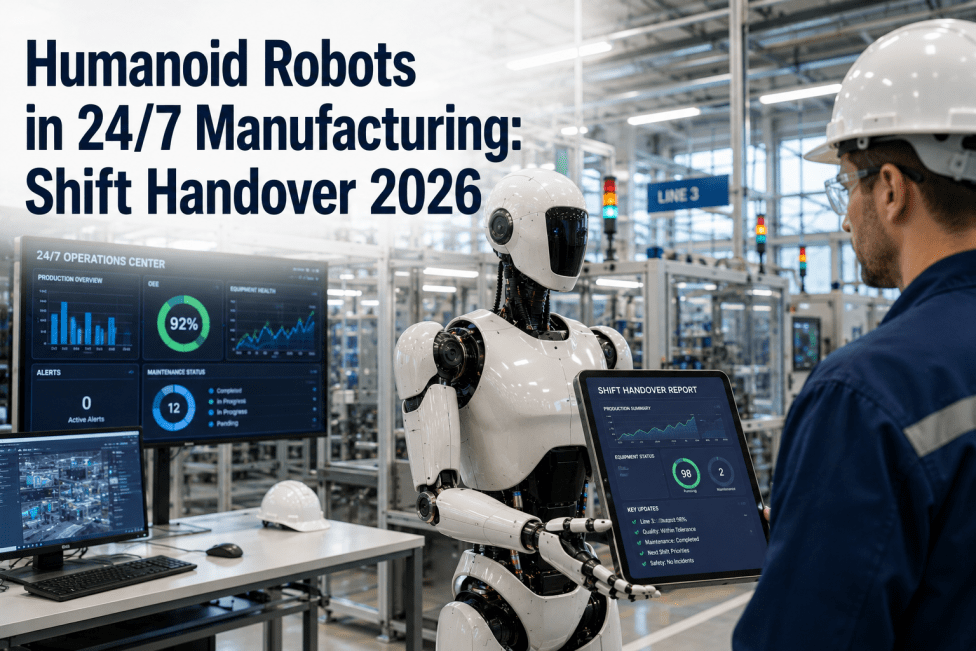
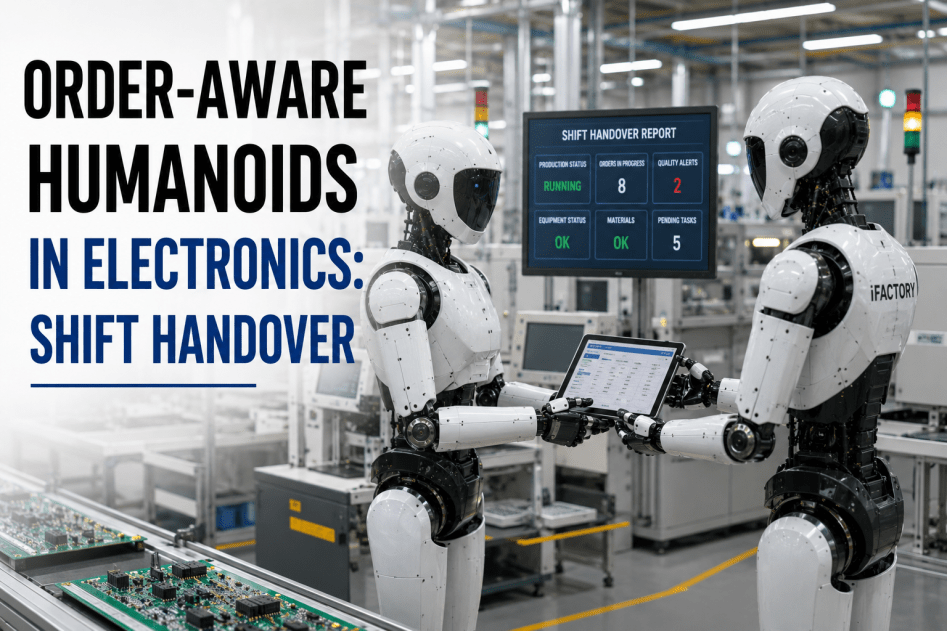
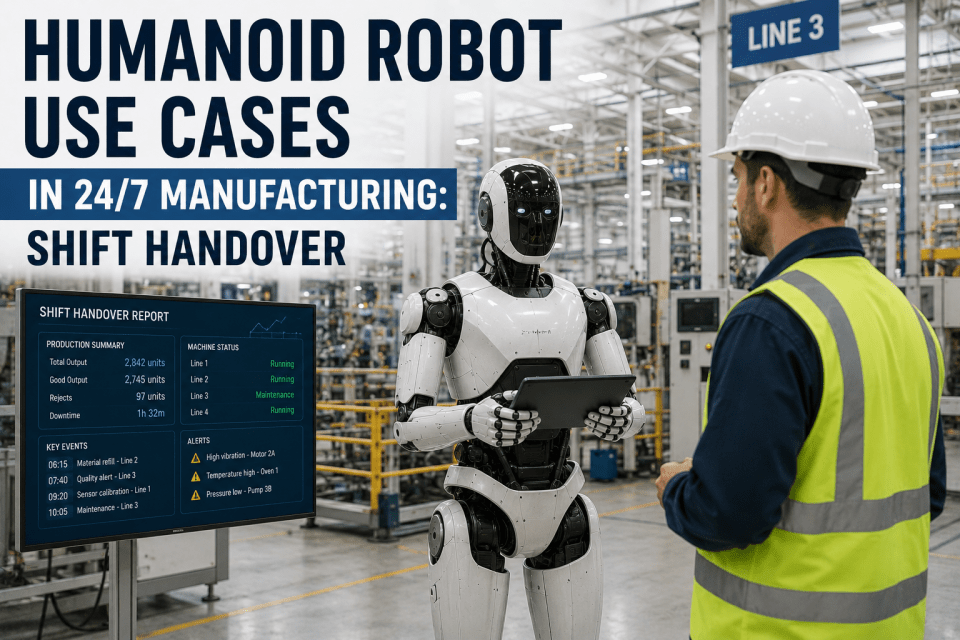
At shift end, the platform generates a digital handover report aggregating all patrol routes executed, sensor readings with timestamps, anomalies detected with severity scores, and corrective actions initiated. Reports are formatted for CMMS, MES, and shift logbook ingestion.
Multi-System Distribution
The handover report is automatically deposited into the plant CMMS, MES, digital shift log, and historian systems. The incoming shift supervisor receives a prioritized summary before stepping onto the production floor—eliminating the information gap between shifts.
Humanoid Robot Use Cases Across 24/7 Operations
The comparison below maps the most impactful humanoid robot use cases in 24/7 manufacturing against their traditional manual execution methods, showing the measurable difference across criteria that directly affect OEE, quality, and operational risk.
| Use Case | Traditional Method | Humanoid Robot |
|---|---|---|
| Shift Handover Reporting | Verbal briefing and paper log entry; 70-80% information loss between shifts | Digital report with all patrol data, sensor readings, and anomaly records auto-transferred to CMMS and MES |
| Night Shift Equipment Patrol | 2-3 manual walkthroughs per 12-hour shift; frequency drops after hour 6 due to operator fatigue | Continuous patrols every 30-90 minutes; AI detects thermal, vibration, and acoustic anomalies sub-second |
| Production Floor Safety Monitoring | Periodic safety supervisor rounds; near-miss events underreported by estimated 40% on night shifts | Continuous PPE compliance verification and near-miss detection with auto-generated safety records |
| Quality Verification Patrol | End-of-line inspection only; defects detected hours after process deviation begins | In-process visual and thermal inspection at every patrol cycle; anomalies flagged within minutes of onset |
| Asset Health Monitoring | Vibration and temperature data collected manually during scheduled rounds; trend analysis requires separate historian review | Continuous data acquisition at 1,200+ measurement points per hour with automated CMMS work order creation for anomalies |
Evaluating humanoid robot deployment for your 24/7 facility? Book a Demo to see how iFactory integrates with your existing MES, CMMS, and production systems.
Why Humanoid Robots Deliver Measurable Results in 24/7 Manufacturing
Digital Shift Handover Eliminates the Information Gap
Before humanoid deployment, the facility had no mechanism to capture the contextual observations that experienced operators accumulate during a shift—subtle equipment sounds, minor temperature drifts, intermittent vibration patterns that did not trigger alarms but signaled developing issues. The humanoid robot's structured patrol and reporting system captures every observation as quantitative data, time-stamped and geo-tagged, and transfers it to the incoming shift without interpretation loss. This single capability drove the majority of the 87% reduction in handover data loss.
Continuous Patrol Coverage Eliminates Fatigue-Driven Gaps
Night shift operators on twelve-hour schedules cannot maintain consistent patrol frequency or measurement accuracy through the full shift. Research across 24/7 manufacturing operations documents that manual patrol frequency drops by an average of 40% after the sixth hour of a night shift. The humanoid robot executes identical patrol routes every cycle without performance degradation, detecting anomalies that human operators consistently miss during early-morning hours—typically three to seven developing issues per night shift.
AI-Powered Anomaly Detection Surpasses Manual Inspection Accuracy
Traditional end-of-line inspection detects defects only after process deviation has already produced non-conforming product. The humanoid robot's AI vision and multi-modal sensor analysis identifies developing anomalies at the point of origin—a bearing temperature rising 2°C above baseline, a vibration signature shifting 0.8 μm, a coolant flow rate dropping 1 gpm—and flags them before they produce quality defects or equipment damage. This shifted anomaly detection from reactive (post-event) to proactive (pre-event), directly improving first-pass quality.
CMMS and MES Integration Converts Data into Action
The humanoid robot's patrol data is not delivered as a separate report for operators to interpret. The iFactory platform integrates directly with the facility's existing CMMS and MES, automatically creating work orders for detected anomalies, updating equipment status in the MES, and logging all observations to the plant historian. The day shift maintenance team arrives to find prioritized work orders with complete diagnostic data rather than a verbal description of a possible issue—compressing the time between anomaly detection and corrective action.
Integration with CMMS, MES, and ERP Platforms
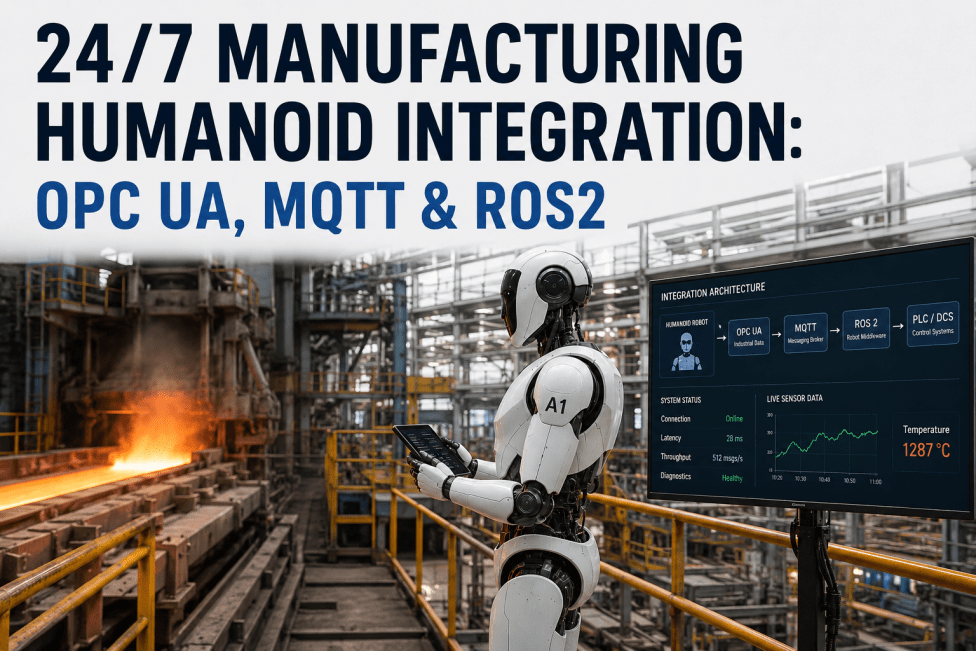
Humanoid robots deliver maximum value when their patrol data flows directly into a plant's existing operational systems rather than requiring operators to monitor a separate dashboard. iFactory's Humanoid Robot Integration Platform connects robot telemetry, inspection data, and maintenance workflows into a unified operational layer that integrates with CMMS, MES, SCADA, ERP, and industrial IoT platforms.
When a humanoid robot detects a developing equipment anomaly during a night shift patrol, the platform automatically creates a corresponding work order in the CMMS with severity classification, equipment tag, sensor evidence, and recommended corrective action. The equipment status is updated in the MES. The patrol data is logged to the plant historian with full timestamps. The incoming shift supervisor receives a prioritized handover report that summarizes overnight findings and highlights the most critical actions for the day ahead. This integration architecture ensures that humanoid robot deployment does not add administrative overhead but instead compresses the time between anomaly detection and corrective action across every shift.
Stop Losing Critical Information Between Shifts. Deploy Humanoid Robots for 24/7 Operations.
Your 24/7 manufacturing facility is losing an estimated 70-80% of operational context at every shift change. iFactory's Humanoid Robot Integration Platform automates shift handover reporting, continuous inspections, and real-time monitoring—integrated with your existing CMMS and MES. Deployed on-prem in 8-12 weeks.
Humanoid Robots as a Strategic Asset for 24/7 Manufacturing Operations
Humanoid robots are transforming shift handover in 24/7 manufacturing by replacing the verbal briefings and paper logs that have historically lost 70-80% of operational context between shifts with autonomous end-of-shift patrols, multi-sensor data acquisition, and structured digital reporting that transfers 100% of patrol data into the CMMS, MES, and shift logbook systems. By executing continuous inspection routes without fatigue degradation, detecting equipment anomalies at the point of origin through AI-powered sensor analysis, and integrating directly with existing plant systems to convert observations into actionable work orders, humanoid platforms enable manufacturers to achieve an 87% reduction in handover data loss, 45% faster anomaly detection, and measurable improvements in OEE and first-pass quality.
The technology is commercially available today, deployable within 8-12 weeks, and integrated with the CMMS and MES infrastructure already in place at most 24/7 manufacturing facilities. Manufacturing leaders evaluating autonomous operations solutions Book a Demo to see how iFactory's Humanoid Robot Integration Platform maps to their 24/7 production environment.