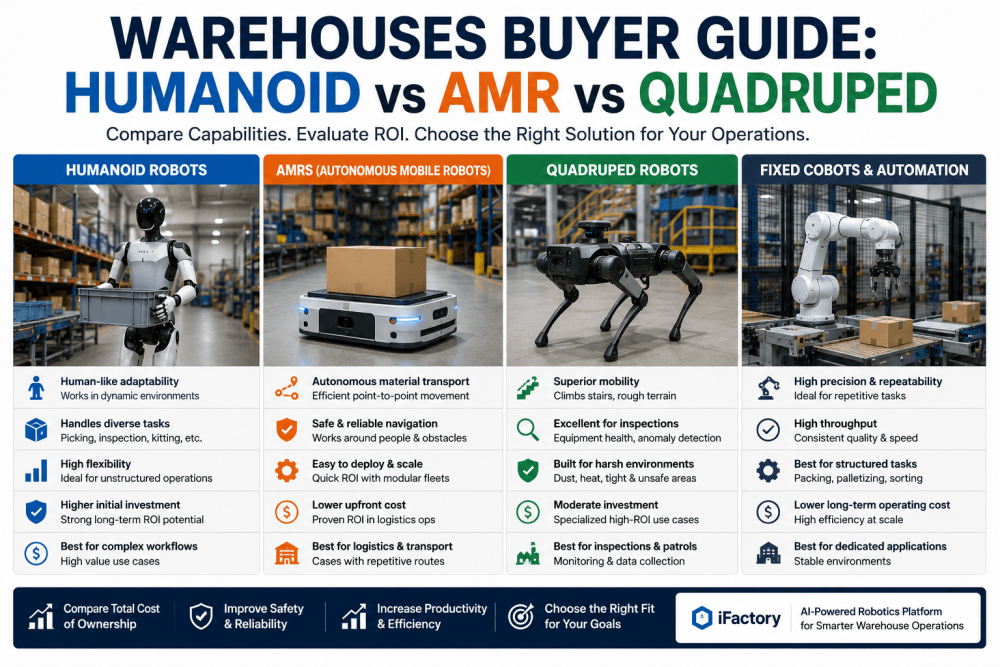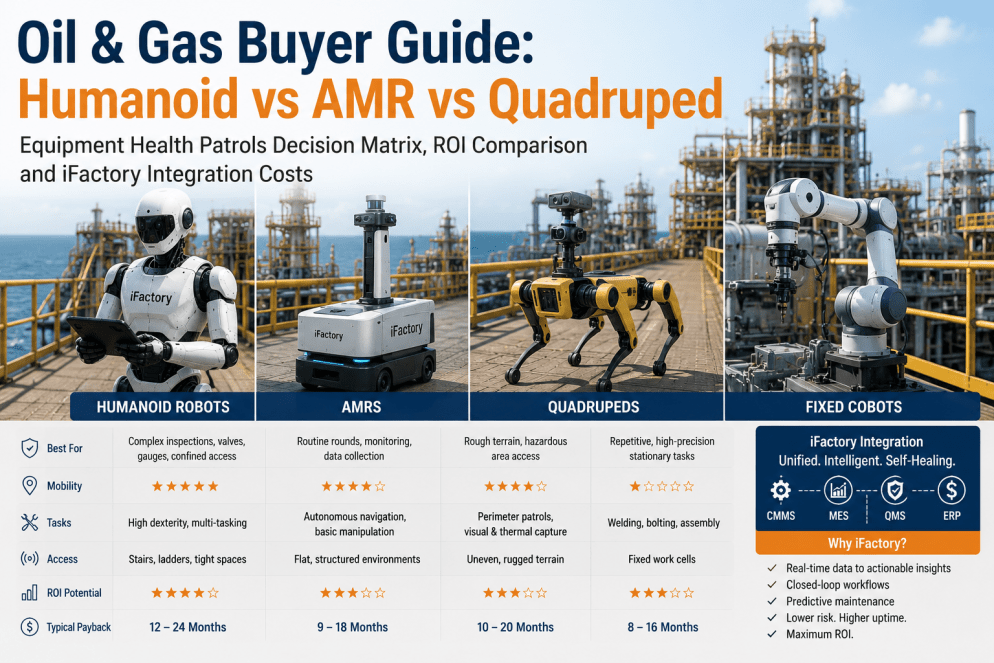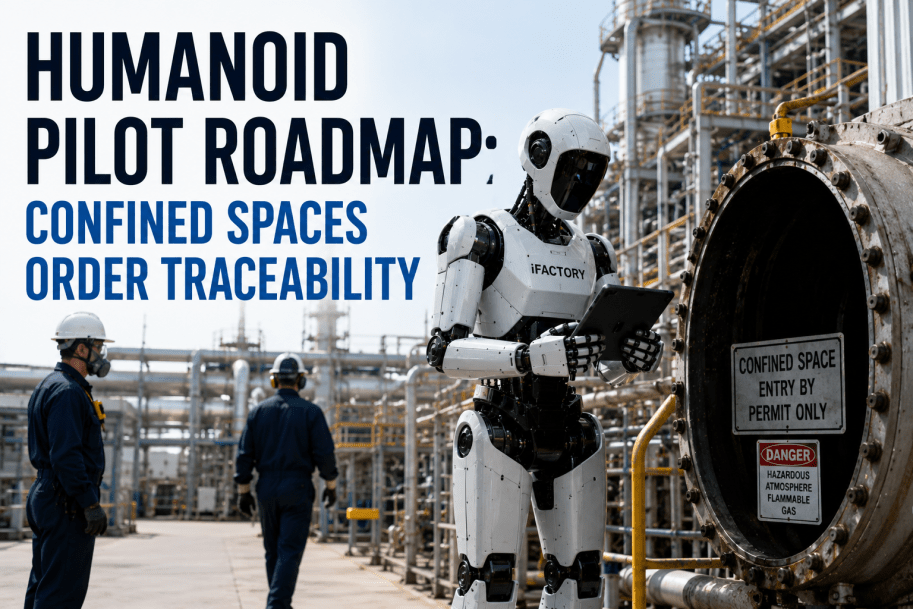
When a heavy machinery equipment manufacturer producing earthmovers and excavators evaluated its assembly-floor automation options for order verification and traceability, the plant engineering team faced four distinct platform choices — humanoid robots, autonomous mobile robots (AMRs), quadruped robots, and fixed cobots — each with different capabilities for inspection, data capture, and workflow execution. The selection would determine not only the traceability accuracy across 12,000 SKUs but also the integration timeline with the existing ERP, MES, and CMMS systems that track every component from receiving to final assembly. With a $2.4M automation budget on the line and a corporate mandate to achieve full lot-level traceability within two quarters, the team needed a structured comparison framework. Heavy machinery equipment manufacturers evaluating automation for order verification regularly Book a Demo to see how each platform integrates with iFactory's traceability and quality ecosystem.
The Automation Platform Decision for Heavy Machinery
Heavy machinery equipment manufacturers operate in an environment where one misidentified component can trigger a full assembly traceability investigation, delaying shipments and exposing the manufacturer to liability risk. The automation platform selected for order verification and traceability must handle varying component geometries, read data matrix codes on weathered surfaces, reconcile against ERP records in real time, and document every verification step for audit compliance. Each platform category — humanoid, AMR, quadruped, and cobot — addresses these requirements differently, and the choice depends on the specific mix of inspection tasks, floor layout, and integration architecture at each facility.
Integration Complexity
Connecting the automation platform to existing MES, ERP, and CMMS systems for real-time order verification requires API maturity and data model alignment. Platforms with embedded OPC UA and MQTT support integrate in days versus weeks for proprietary systems requiring custom middleware development.
Flexibility Limitations
Fixed cobots excel at repeatable inspection of identical components but cannot adjust when product mix changes or when traceability points move across the floor. Humanoid and AMR platforms offer re-deployable inspection paths that adapt to layout changes without reprogramming.
Traceability Gaps
Manual order verification achieves 94-96% accuracy under ideal conditions but drops below 90% during shift transitions and peak production periods. Automated platforms consistently achieve 99%+ accuracy, but the type of automation determines whether verification occurs at every station or only at choke points.
ROI Uncertainty
Platform costs range from $85K for a single cobot cell to $250K+ for a fully integrated humanoid deployment. The ROI timeline depends on whether the platform replaces manual labor, reduces error-related rework, or enables traceability that was previously impossible to achieve at the required cadence.
How Each Platform Compares for Order Verification & Traceability
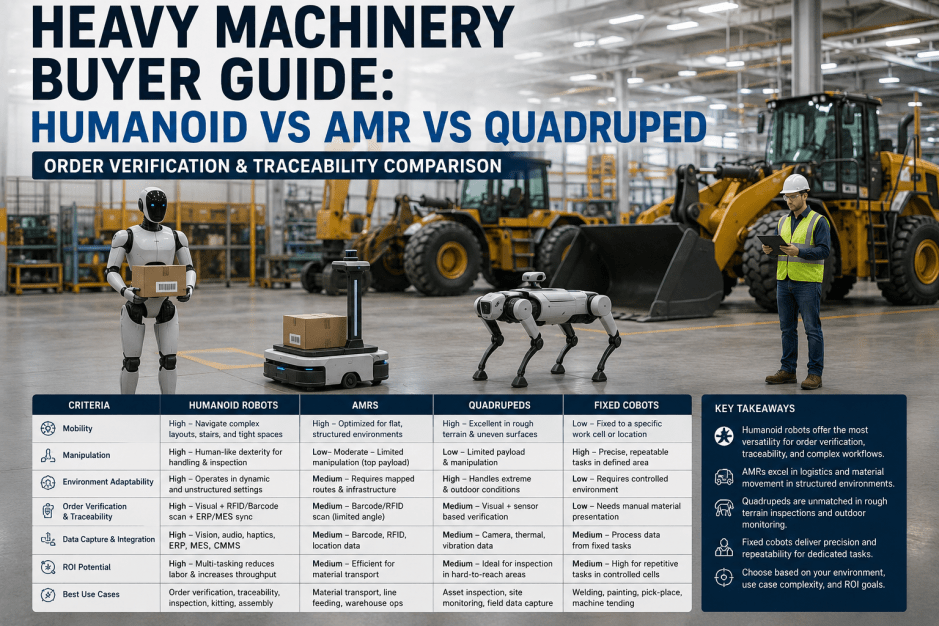
The table below provides a direct comparison of the four platform categories across the criteria most relevant to heavy machinery equipment manufacturers. Each platform is evaluated against the specific requirements of order verification, component traceability, and integration with plant systems. Engineering and operations teams evaluating these options regularly Book a Demo to discuss their specific use case mix and integration environment.
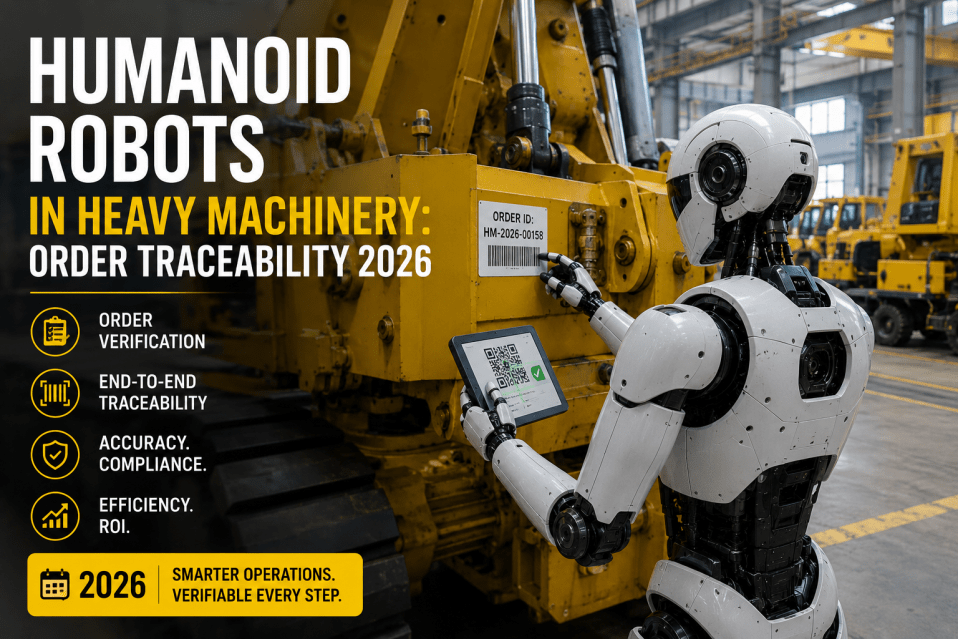
Full dexterity, mobile inspection, and direct system integration — Humanoid robots combine bipedal mobility with articulated manipulation, enabling them to navigate heavy machinery assembly lines, position cameras at any angle for data matrix code reading, and physically interact with components for verification. They integrate directly with MES and ERP systems via OPC UA and MQTT, writing verification records to the traceability database in real time. The iFactory integration stack enables humanoid robots to read serial numbers, verify component specifications against BOM records, and generate audit-compliant traceability documentation without human intervention. Humanoids are the only platform category that can perform both the physical inspection and the system-level data reconciliation in a single workflow.
Autonomous transport with fixed-point scanning capability — AMRs equipped with barcode scanners and vision cameras navigate pre-mapped routes, stopping at designated verification stations to read component identifiers and reconcile against order manifests. They excel at moving components between traceability checkpoints and can transport verified parts to the correct assembly station, reducing handling errors. However, AMRs cannot manipulate components for repositioning, and their scanning angles are limited by the fixed camera mount. They are best suited for linear verification workflows where components pass through defined checkpoints and the primary requirement is transport with verification rather than inspection at the point of assembly.
Terrain-capable inspection and high-speed repeatable verification — Quadruped robots (Boston Dynamics Spot-class) provide stair-climbing and uneven-terrain mobility for inspecting components in storage yards, mezzanine levels, and outdoor staging areas where wheeled platforms cannot operate. They carry payloads of up to 15 kg for LIDAR scanning and thermal inspection but lack manipulation capability. Cobots provide high-speed, repeatable verification of serial numbers and data matrix codes at fixed stations, achieving cycle times under 3 seconds per verification. They are the most cost-effective option for high-volume verification of identical components but require reconfiguration when product mix changes. Each platform serves a distinct niche within the traceability ecosystem.
Platform Comparison: Criteria, Capabilities, and Deployment Considerations
The decision framework below maps each platform against the criteria that heavy machinery equipment manufacturers consistently prioritize when selecting automation for order verification and traceability. The comparison draws from deployments across earthmoving equipment, agricultural machinery, and industrial vehicle manufacturing facilities.
| Criterion | Humanoid | AMR | Quadruped | Cobot |
|---|---|---|---|---|
| Mobility Type | Bipedal, full floor access | Wheeled, mapped routes | Legged, stairs & terrain | Fixed base, arm reach only |
| Manipulation | Full articulated arms | None or limited gripper | None (payload only) | Articulated arm |
| Code Reading | Multi-angle, repositionable | Fixed-mount camera | Fixed-mount camera | Fixed-mount camera |
| System Integration | OPC UA, MQTT, ROS2 | REST API, MQTT | REST API | PLC, fieldbus |
| Floor Re-deployment | Hours (new patrol route) | Days (map update) | Hours (path teaching) | Weeks (reprogram) |
| Traceability Audit Trail | Full (inspection + data) | Transport records only | Inspection images only | Inspection records |
| Deployment Timeline | 6-8 weeks | 4-6 weeks | 3-4 weeks | 2-3 weeks |
| Estimated ROI | 14 months | 22 months | 20 months | 26 months |
"Our team spent three months evaluating AMRs and cobots before we realized neither platform could handle the traceability scope we needed — reading data matrix codes on undercarriage components that were already installed on the assembly line. The AMR could drive past them but could not position the camera at the right angle. The cobot could not reach them at all. The humanoid walked up to each assembled unit, leaned in to read the codes at the correct angle, and transmitted every verification record to the MES before the unit moved to the next station. The platform selection became obvious once we matched capabilities to the actual inspection points on the floor rather than comparing spec sheets." — Automation Engineering Manager, Heavy Equipment Manufacturer
Matching Platform Capabilities to Traceability Requirements
The choice between humanoid, AMR, quadruped, and cobot platforms for heavy machinery order verification and traceability depends on three factors: the physical configuration of the components being verified, the integration maturity of the plant's existing systems, and the required level of audit documentation. Humanoid robots deliver the broadest capability coverage across all three factors, combining mobility, manipulation, and direct system integration in a single platform. AMRs provide the best value when transport and checkpoint verification are combined. Quadruped robots fill the niche for outdoor and multi-level inspection. Cobots deliver the lowest per-verification cost for fixed-station, high-volume applications.
iFactory provides the integration layer that connects all four platform types with existing MES, ERP, CMMS, and traceability systems, ensuring that regardless of which platform is selected, the verification data flows into the correct systems and generates audit-compliant documentation automatically. Heavy machinery equipment manufacturers developing their automation strategy are encouraged to Book a Demo to review platform options against their specific traceability requirements and integration environment.
Frequently Asked Questions
Cobot-based verification stations typically deploy fastest at 2-3 weeks because they operate at fixed locations with minimal integration requirements. However, this speed advantage applies only when the verification points are fixed and components pass through a known location. For mobile verification across multiple assembly stations or storage areas, humanoid platforms deploy in 6-8 weeks including route teaching, system integration, and validation testing. The total deployment timeline should account for the number of verification points covered — a single humanoid may replace four fixed cobot stations while covering more inspection points with a shorter total deployment timeline.
Yes — and this is often the optimal configuration for large heavy machinery facilities. A typical deployment uses cobots at high-speed receiving stations for incoming component verification, AMRs for in-process transport with checkpoint scanning, quadruped robots for outdoor storage yard and mezzanine inventory reconciliation, and humanoid robots for final assembly verification where complex component geometries require repositionable camera angles. The iFactory integration platform aggregates traceability data from all four platform types into a single audit trail, eliminating data silos and providing unified traceability reporting regardless of which platform captured each verification record.
Reading performance on weathered surfaces varies significantly by platform. Humanoid robots reposition the camera angle and distance to find the optimal reading orientation, achieving 99.7% first-pass read rates on components with surface wear, grease, or partial code damage. Fixed-mount AMR and cobot cameras read from a single angle and distance, achieving 92-96% first-pass read rates that require secondary verification passes. Quadruped platforms face similar limitations from fixed camera mounts. The humanoid advantage comes from its ability to approach each component at the optimal angle — the same way a human inspector would lean in to read a worn label — while maintaining the throughput of an automated system.
Fully deployed costs including hardware, integration, and iFactory platform licensing range as follows: cobot verification stations $85K-$160K per station depending on reach and payload; AMR platforms $120K-$200K including fleet management software and route mapping; quadruped robots $150K-$250K including payload sensors and inspection software; humanoid robots $200K-$350K fully integrated with iFactory CMMS, MES, and ERP connectivity. The per-verification-point cost favors humanoids in facilities with 8+ distributed inspection points because one humanoid covers all points versus requiring multiple cobot or AMR units. Total cost of ownership analysis should include re-deployment costs for product mix changes, which are significantly lower for humanoid and AMR platforms.
iFactory's integration architecture supports all four platform types through standardized interfaces. OPC UA and native SDK integration for humanoid platforms enables direct bidirectional communication with the iFactory CMMS and MES — the robot reads a code, iFactory reconciles it against the ERP order, and the verification record is written to the traceability database in under one second. AMR and quadruped platforms connect via REST API and MQTT, where iFactory acts as the message broker and data historian. Cobot platforms integrate through PLC fieldbus interfaces or OPC UA. All traceability data converges into a single iFactory audit trail regardless of which platform captured it, providing unified reporting and compliance documentation without manual data consolidation.